Spheres of Affection
Spheres of affection are influences flowing from what a person loves. See how they connect individuals and societies in Emanuel Swedenborg’s spiritual world.
In this article
Understanding the concept
A sphere of affection is an influence that extends from what a person loves and thinks. Emanuel Swedenborg uses it to explain how people in the spiritual world affect one another beyond the immediate place where they are. [1][2][3]
A whole society can have a sphere. These shared influences can help explain why people are drawn together or driven apart. They also have a place in Swedenborg’s account of the equilibrium between heaven and hell. [2][3][4]
Heaven and Its Wonders and Hell by Emanuel Swedenborg
Emanuel Swedenborg’s Heaven and Its Wonders and Hell describes societies communicating without all their members travelling into one another’s homes. In §49 their connection comes through the extension of a sphere of life, formed from the affections of love and faith. [1][2]
Swedenborg says that more inward affections reach more widely. The individual can share in the life of the society, and something of the individual can pass back into the whole. [2]
An angel can communicate some heavenly joy through a sphere of love. Swedenborg uses the example to describe how differently it can be received. What one person experiences as a little delight can overwhelm someone with a different capacity for it. [5]
In §591 the concept scales up. Spheres flow from individuals, societies and the whole of heaven or hell. Swedenborg attributes heavenly good to the Lord received by angels, while the infernal sphere expresses self-derived evil. These opposed influences participate in his explanation of equilibrium. [3][4]
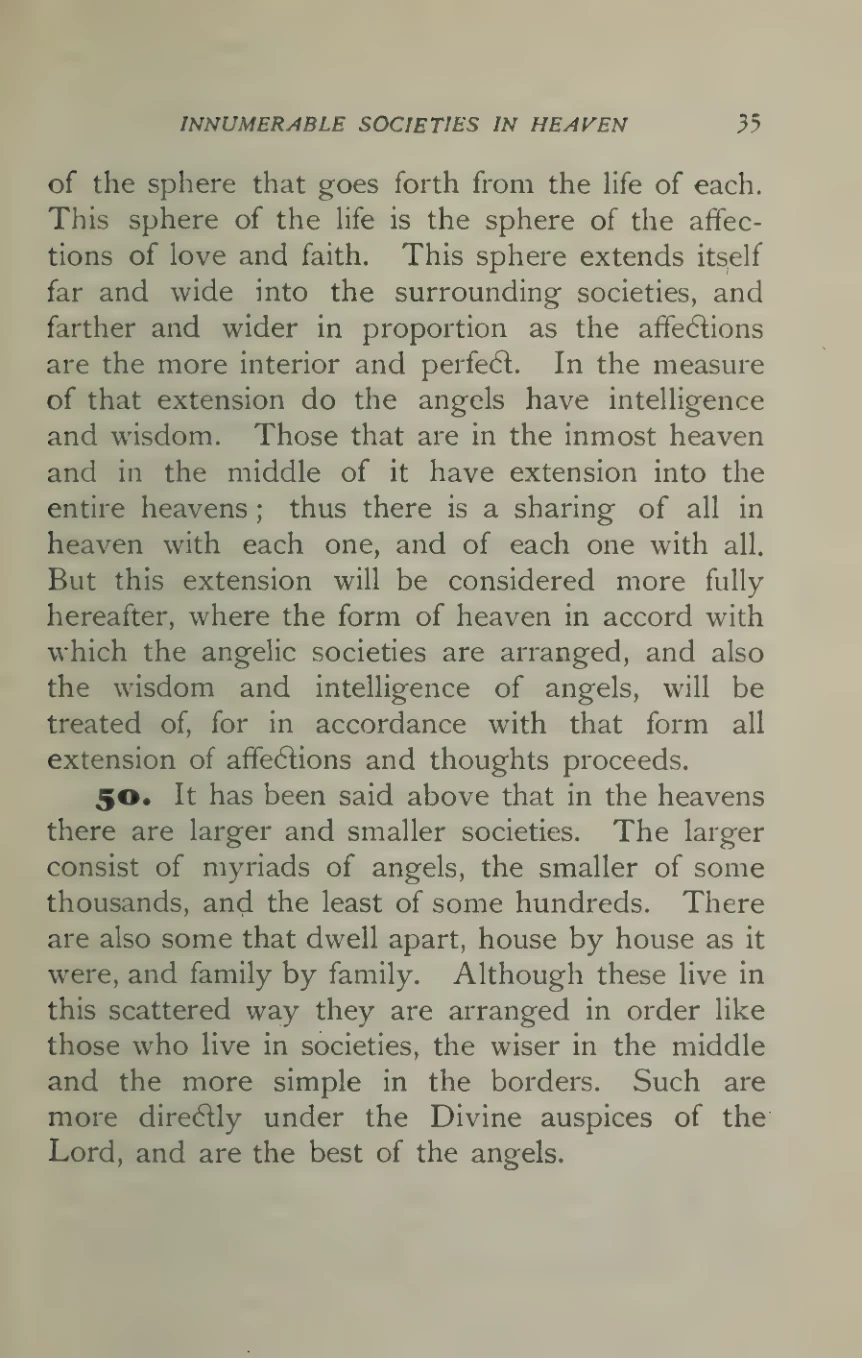
Heaven and Its Wonders and Hell (1916), printed p. 35, Library Reader page 42. Swedenborg describes what the individual and the society share through their spheres.
Emanuel Swedenborg, Heaven and Its Wonders and Hell, J. C. Ager translation, New York, 1916. Public-domain historical page from the checksum-verified Library PDF. · Image source ↗ · Public Domain
See references (5)
- Heaven and Its Wonders and Hell, printed p. 34, Reader page 41
- Heaven and Its Wonders and Hell, printed p. 35, Reader page 42
- Heaven and Its Wonders and Hell, printed p. 562, Reader page 569
- Heaven and Its Wonders and Hell, printed p. 563, Reader page 570
- Heaven and Its Wonders and Hell, printed p. 350, Reader page 357
The Astral Plane by C. W. Leadbeater
C. W. Leadbeater’s The Astral Plane describes an oval of luminous mist and distinguishes changing desire-colours from more slowly changing mental qualities and causal individuality. His aura gathers several manifestations of the person within a layered Theosophical account. [6][7]
A sphere of influence and a visible aura
Leadbeater gives the aura an outline and describes layers with different colours and rates of change. Swedenborg describes what can pass from one life into another, such as a shared delight. The aura has a shape to be seen in the first account, while a sphere of affection has a reach to be felt in the second. [2][5][3][6][7]
See references (5)
- Heaven and Its Wonders and Hell, printed p. 35, Reader page 42
- Heaven and Its Wonders and Hell, printed p. 562, Reader page 569
- Heaven and Its Wonders and Hell, printed p. 350, Reader page 357
- C. W. Leadbeater, The Astral Plane, the luminous oval (Library scan), Reader page 17
- C. W. Leadbeater, The Astral Plane, printed p. 21, Reader page 18
Read further in the library

Heaven and Its Wonders and Hell
Reading note
The separately titled account draws on exact passages in the consulted Library edition.
The Astral Plane
Reading note
Separately attributed comparison with exact previously researched Library passages.
Sources
See references (7)
- Heaven and Its Wonders and Hell, printed p. 34, Reader page 41Emanuel Swedenborg, Heaven and Its Wonders and Hell, From Things Heard and Seen, translated by J. C. Ager. American Swedenborg Printing and Publishing Society, New York, 1916. Latin original first published in 1758. Numbered sections and exact pages refer to this consulted edition. Claims of spiritual experience remain attributed.Read this page in Heaven and Its Wonders and Hell ↗Return to text ↑
- Heaven and Its Wonders and Hell, printed p. 35, Reader page 42Emanuel Swedenborg, Heaven and Its Wonders and Hell, From Things Heard and Seen, translated by J. C. Ager. American Swedenborg Printing and Publishing Society, New York, 1916. Latin original first published in 1758. Numbered sections and exact pages refer to this consulted edition. Claims of spiritual experience remain attributed.Read this page in Heaven and Its Wonders and Hell ↗Return to text ↑
- Heaven and Its Wonders and Hell, printed p. 562, Reader page 569Emanuel Swedenborg, Heaven and Its Wonders and Hell, From Things Heard and Seen, translated by J. C. Ager. American Swedenborg Printing and Publishing Society, New York, 1916. Latin original first published in 1758. Numbered sections and exact pages refer to this consulted edition. Claims of spiritual experience remain attributed.Read this page in Heaven and Its Wonders and Hell ↗Return to text ↑
- Heaven and Its Wonders and Hell, printed p. 563, Reader page 570Emanuel Swedenborg, Heaven and Its Wonders and Hell, From Things Heard and Seen, translated by J. C. Ager. American Swedenborg Printing and Publishing Society, New York, 1916. Latin original first published in 1758. Numbered sections and exact pages refer to this consulted edition. Claims of spiritual experience remain attributed.Read this page in Heaven and Its Wonders and Hell ↗Return to text ↑
- Heaven and Its Wonders and Hell, printed p. 350, Reader page 357Emanuel Swedenborg, Heaven and Its Wonders and Hell, From Things Heard and Seen, translated by J. C. Ager. American Swedenborg Printing and Publishing Society, New York, 1916. Latin original first published in 1758. Numbered sections and exact pages refer to this consulted edition. Claims of spiritual experience remain attributed.Read this page in Heaven and Its Wonders and Hell ↗Return to text ↑
- C. W. Leadbeater, The Astral Plane, the luminous oval (Library scan), Reader page 17Exact reference retained from the earlier attributed Aura book account.Read this page in The Astral Plane ↗Return to text ↑
- C. W. Leadbeater, The Astral Plane, printed p. 21, Reader page 18Exact reference retained from the earlier attributed Aura book account.Read this page in The Astral Plane ↗Return to text ↑