Spiritual Equilibrium
Spiritual equilibrium is the balance Swedenborg says makes free choice possible. Read how heaven, hell and the world of spirits fit into his account.
In this article
Understanding the concept
Spiritual equilibrium is a balance between opposing influences that, in Emanuel Swedenborg’s theology, gives a person room to choose. Good and evil remain active. The freedom comes from being able to respond to opposing influences and choose how to act. [1][2][3][4][5]
Swedenborg gives the Lord responsibility for maintaining the balance. Heaven and hell exert opposing influences within a single divine order. [6][7][8][9]
See references (9)
- Heaven and Its Wonders and Hell, printed p. 559, Reader page 566
- Heaven and Its Wonders and Hell, printed p. 560, Reader page 567
- Heaven and Its Wonders and Hell, printed p. 561, Reader page 568
- Heaven and Its Wonders and Hell, printed p. 568, Reader page 575
- Heaven and Its Wonders and Hell, printed p. 569, Reader page 576
- Heaven and Its Wonders and Hell, printed p. 562, Reader page 569
- Heaven and Its Wonders and Hell, printed p. 563, Reader page 570
- Heaven and Its Wonders and Hell, printed p. 564, Reader page 571
- Heaven and Its Wonders and Hell, printed p. 565, Reader page 572
Heaven and Its Wonders and Hell by Emanuel Swedenborg
Emanuel Swedenborg begins §589 of Heaven and Its Wonders and Hell with action and reaction. In his account of spiritual life, those terms help explain how a person experiences opposing influences as choices they can make. [1][2]
The intermediate world of spirits occupies this equilibrium. Newcomers remain in a freedom through which their character can be disclosed. Their visible paths towards heaven or hell express the affections and thoughts from which they travel. [3][6]
The balance has to be maintained as societies change. Swedenborg says no angel can see enough of the whole to do this alone. The Lord restrains some influences and changes how groups can act upon one another. [7][8][9]
Sections 597–600 connect this order with human reform. A person must recognise evil and cease to will it; something held only in thought does not yet become an enduring love. He distinguishes inward freedom from permission to act without moral or civil restraint, and explains earthly connection with heaven and hell through intermediary spirits. [4][5][10][11]
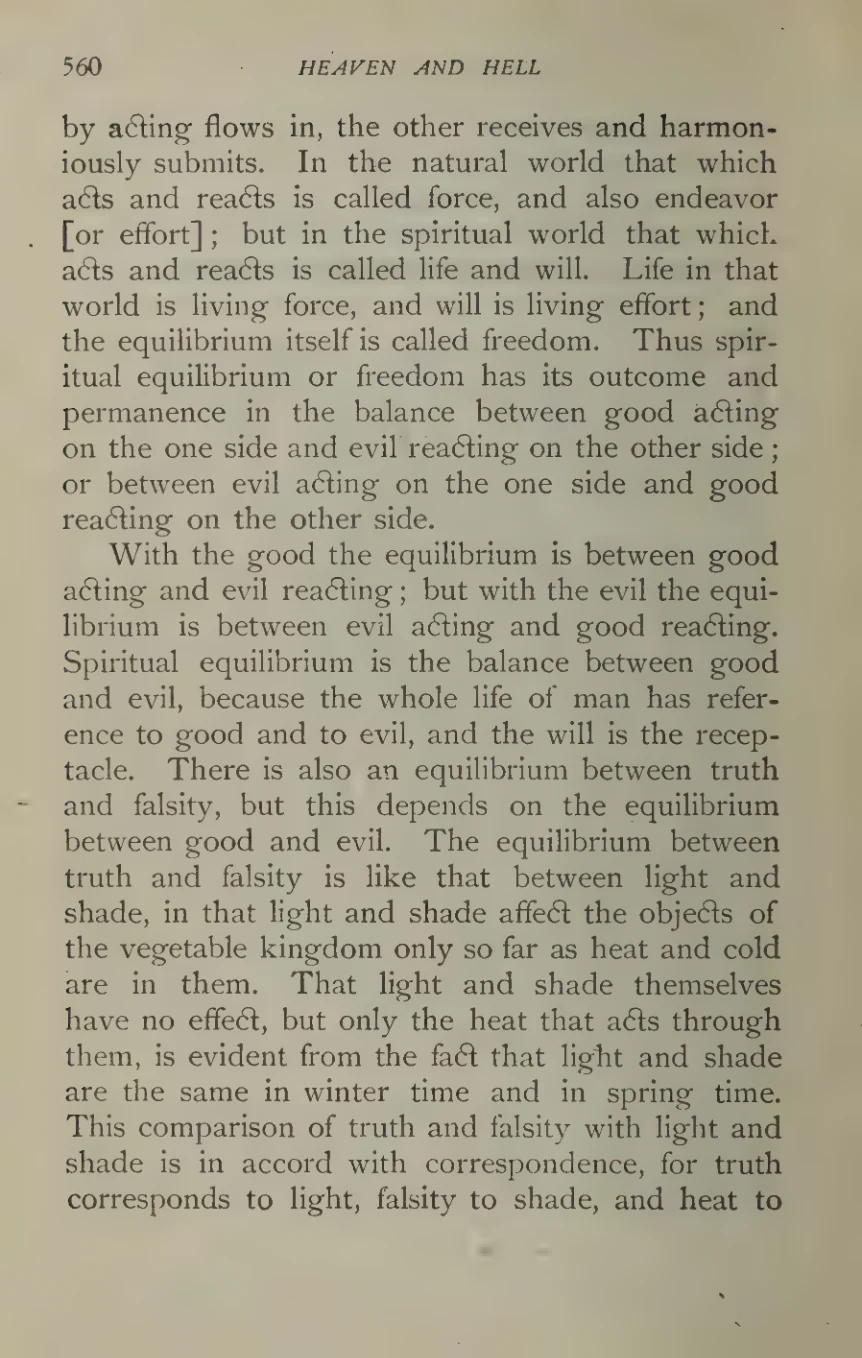
Heaven and Its Wonders and Hell (1916), printed p. 560, Library Reader page 567. Swedenborg connects the intermediate world of spirits with equilibrium.
Emanuel Swedenborg, Heaven and Its Wonders and Hell, J. C. Ager translation, New York, 1916. Public-domain historical page from the checksum-verified Library PDF. · Image source ↗ · Public Domain
See references (11)
- Heaven and Its Wonders and Hell, printed p. 559, Reader page 566
- Heaven and Its Wonders and Hell, printed p. 560, Reader page 567
- Heaven and Its Wonders and Hell, printed p. 561, Reader page 568
- Heaven and Its Wonders and Hell, printed p. 568, Reader page 575
- Heaven and Its Wonders and Hell, printed p. 569, Reader page 576
- Heaven and Its Wonders and Hell, printed p. 562, Reader page 569
- Heaven and Its Wonders and Hell, printed p. 563, Reader page 570
- Heaven and Its Wonders and Hell, printed p. 564, Reader page 571
- Heaven and Its Wonders and Hell, printed p. 565, Reader page 572
- Heaven and Its Wonders and Hell, printed p. 570, Reader page 577
- Heaven and Its Wonders and Hell, printed p. 571, Reader page 578
Evolution of Immortality by Rosicruciæ, catalogued as F. B. Dowd
Freeman Benjamin Dowd, publishing as Rosicruciæ, argues that two opposed principles require a third term through which they can act. He calls that factor energy and treats apparent division as differentiation within a common reality. The account extends this pattern into a soul mediating between tendencies. [12][13][14]
What the balance makes possible
Swedenborg uses freedom to explain how someone can recognise a harmful desire and turn away from it. A person can feel the conflict keenly and still have that freedom. The balance gives a choice its conditions and the person’s response gives it direction. [4][5][10][2]
Dowd asks how two tendencies can act together and names their common energy as a third factor. Swedenborg makes the Lord the keeper of a balance between heaven and hell. His question is how a person becomes free to take one influence up and resist the other. [12][13][14][1][2][7][4]
See references (9)
- Heaven and Its Wonders and Hell, printed p. 559, Reader page 566
- Heaven and Its Wonders and Hell, printed p. 560, Reader page 567
- Heaven and Its Wonders and Hell, printed p. 568, Reader page 575
- Heaven and Its Wonders and Hell, printed p. 569, Reader page 576
- Heaven and Its Wonders and Hell, printed p. 563, Reader page 570
- Heaven and Its Wonders and Hell, printed p. 570, Reader page 577
- Evolution of Immortality, printed p. 12, Reader page 9
- Evolution of Immortality, printed p. 13, Reader page 10
- Evolution of Immortality, printed p. 20, Reader page 17
Read further in the library

Heaven and Its Wonders and Hell
Reading note
The separately titled account draws on exact passages in the consulted Library edition.
Evolution of Immortality
Reading note
Separately attributed comparison with exact previously researched Library passages.
Sources
See references (14)
- Heaven and Its Wonders and Hell, printed p. 559, Reader page 566Emanuel Swedenborg, Heaven and Its Wonders and Hell, From Things Heard and Seen, translated by J. C. Ager. American Swedenborg Printing and Publishing Society, New York, 1916. Latin original first published in 1758. Numbered sections and exact pages refer to this consulted edition. Claims of spiritual experience remain attributed.Read this page in Heaven and Its Wonders and Hell ↗Return to text ↑
- Heaven and Its Wonders and Hell, printed p. 560, Reader page 567Emanuel Swedenborg, Heaven and Its Wonders and Hell, From Things Heard and Seen, translated by J. C. Ager. American Swedenborg Printing and Publishing Society, New York, 1916. Latin original first published in 1758. Numbered sections and exact pages refer to this consulted edition. Claims of spiritual experience remain attributed.Read this page in Heaven and Its Wonders and Hell ↗Return to text ↑
- Heaven and Its Wonders and Hell, printed p. 561, Reader page 568Emanuel Swedenborg, Heaven and Its Wonders and Hell, From Things Heard and Seen, translated by J. C. Ager. American Swedenborg Printing and Publishing Society, New York, 1916. Latin original first published in 1758. Numbered sections and exact pages refer to this consulted edition. Claims of spiritual experience remain attributed.Read this page in Heaven and Its Wonders and Hell ↗Return to text ↑
- Heaven and Its Wonders and Hell, printed p. 568, Reader page 575Emanuel Swedenborg, Heaven and Its Wonders and Hell, From Things Heard and Seen, translated by J. C. Ager. American Swedenborg Printing and Publishing Society, New York, 1916. Latin original first published in 1758. Numbered sections and exact pages refer to this consulted edition. Claims of spiritual experience remain attributed.Read this page in Heaven and Its Wonders and Hell ↗Return to text ↑
- Heaven and Its Wonders and Hell, printed p. 569, Reader page 576Emanuel Swedenborg, Heaven and Its Wonders and Hell, From Things Heard and Seen, translated by J. C. Ager. American Swedenborg Printing and Publishing Society, New York, 1916. Latin original first published in 1758. Numbered sections and exact pages refer to this consulted edition. Claims of spiritual experience remain attributed.Read this page in Heaven and Its Wonders and Hell ↗Return to text ↑
- Heaven and Its Wonders and Hell, printed p. 562, Reader page 569Emanuel Swedenborg, Heaven and Its Wonders and Hell, From Things Heard and Seen, translated by J. C. Ager. American Swedenborg Printing and Publishing Society, New York, 1916. Latin original first published in 1758. Numbered sections and exact pages refer to this consulted edition. Claims of spiritual experience remain attributed.Read this page in Heaven and Its Wonders and Hell ↗Return to text ↑
- Heaven and Its Wonders and Hell, printed p. 563, Reader page 570Emanuel Swedenborg, Heaven and Its Wonders and Hell, From Things Heard and Seen, translated by J. C. Ager. American Swedenborg Printing and Publishing Society, New York, 1916. Latin original first published in 1758. Numbered sections and exact pages refer to this consulted edition. Claims of spiritual experience remain attributed.Read this page in Heaven and Its Wonders and Hell ↗Return to text ↑
- Heaven and Its Wonders and Hell, printed p. 564, Reader page 571Emanuel Swedenborg, Heaven and Its Wonders and Hell, From Things Heard and Seen, translated by J. C. Ager. American Swedenborg Printing and Publishing Society, New York, 1916. Latin original first published in 1758. Numbered sections and exact pages refer to this consulted edition. Claims of spiritual experience remain attributed.Read this page in Heaven and Its Wonders and Hell ↗Return to text ↑
- Heaven and Its Wonders and Hell, printed p. 565, Reader page 572Emanuel Swedenborg, Heaven and Its Wonders and Hell, From Things Heard and Seen, translated by J. C. Ager. American Swedenborg Printing and Publishing Society, New York, 1916. Latin original first published in 1758. Numbered sections and exact pages refer to this consulted edition. Claims of spiritual experience remain attributed.Read this page in Heaven and Its Wonders and Hell ↗Return to text ↑
- Heaven and Its Wonders and Hell, printed p. 570, Reader page 577Emanuel Swedenborg, Heaven and Its Wonders and Hell, From Things Heard and Seen, translated by J. C. Ager. American Swedenborg Printing and Publishing Society, New York, 1916. Latin original first published in 1758. Numbered sections and exact pages refer to this consulted edition. Claims of spiritual experience remain attributed.Read this page in Heaven and Its Wonders and Hell ↗Return to text ↑
- Heaven and Its Wonders and Hell, printed p. 571, Reader page 578Emanuel Swedenborg, Heaven and Its Wonders and Hell, From Things Heard and Seen, translated by J. C. Ager. American Swedenborg Printing and Publishing Society, New York, 1916. Latin original first published in 1758. Numbered sections and exact pages refer to this consulted edition. Claims of spiritual experience remain attributed.Read this page in Heaven and Its Wonders and Hell ↗Return to text ↑
- Evolution of Immortality, printed p. 12, Reader page 9Rosicruciæ, catalogued as Freeman Benjamin Dowd, Evolution of Immortality. Eulian Publishing Company, Salem, Mass., copyright 1900; title page undated. The book’s metaphysical and scientific assertions remain attributed. The separately reproduced Higher Thought of Sex address has no speaker named in this edition.Read this page in Evolution of Immortality ↗Return to text ↑
- Evolution of Immortality, printed p. 13, Reader page 10Rosicruciæ, catalogued as Freeman Benjamin Dowd, Evolution of Immortality. Eulian Publishing Company, Salem, Mass., copyright 1900; title page undated. The book’s metaphysical and scientific assertions remain attributed. The separately reproduced Higher Thought of Sex address has no speaker named in this edition.Read this page in Evolution of Immortality ↗Return to text ↑
- Evolution of Immortality, printed p. 20, Reader page 17Rosicruciæ, catalogued as Freeman Benjamin Dowd, Evolution of Immortality. Eulian Publishing Company, Salem, Mass., copyright 1900; title page undated. The book’s metaphysical and scientific assertions remain attributed. The separately reproduced Higher Thought of Sex address has no speaker named in this edition.Read this page in Evolution of Immortality ↗Return to text ↑