Two-Petalled Lotus
Steiner’s two-petalled lotus lies near the eyes in his esoteric anatomy. It directs etheric currents and later connects the higher self with other beings.
In this article
Understanding the concept
The two-petalled lotus is a proposed organ near the eyes in Rudolf Steiner’s account of spiritual development. It helps direct etheric currents and later lets the higher self form a relation with other beings. [1][2][3][4]
The two roles come at different points in the book. The first concerns where currents can move. The second follows a learner coming to recognise what their own inward life has contributed to a perception. [2][5][6][7][3]
See references (7)
- Initiation and Its Results, printed p. 13, Reader page 13
- Initiation and Its Results, printed p. 45, Reader page 44
- Initiation and Its Results, printed p. 57, Reader page 56
- Initiation and Its Results, printed p. 58, Reader page 57
- Initiation and Its Results, printed p. 54, Reader page 53
- Initiation and Its Results, printed p. 55, Reader page 54
- Initiation and Its Results, printed p. 56, Reader page 55
Initiation and Its Results by Rudolf Steiner
In Initiation and Its Results, Rudolf Steiner places the organ between the eyes. In his account of etheric development, currents from the larynx reach the lotus and continue in waves along the hands. [1][2]
Later, the learner encounters what looks like a set of reflections of the lower personality. Steiner says the higher self first becomes recognisable among those images. The two-petalled lotus then gives it a way to reach beyond them towards other beings. [5][6][7][3]
Teacher-specific ideas are supposed to set the currents in motion and make their direction possible. Steiner compares their effect with light making things visible. The comparison explains a proposed enabling function without supplying an ordinary sensory mechanism. [3][4]
The surrounding account treats the higher ego’s birth as a real spiritual event, while making rational and moral formation conditions of its viability. The organ is therefore not presented as a substitute for judgement or as proof that every vivid image comes from another being. [6][7][4]
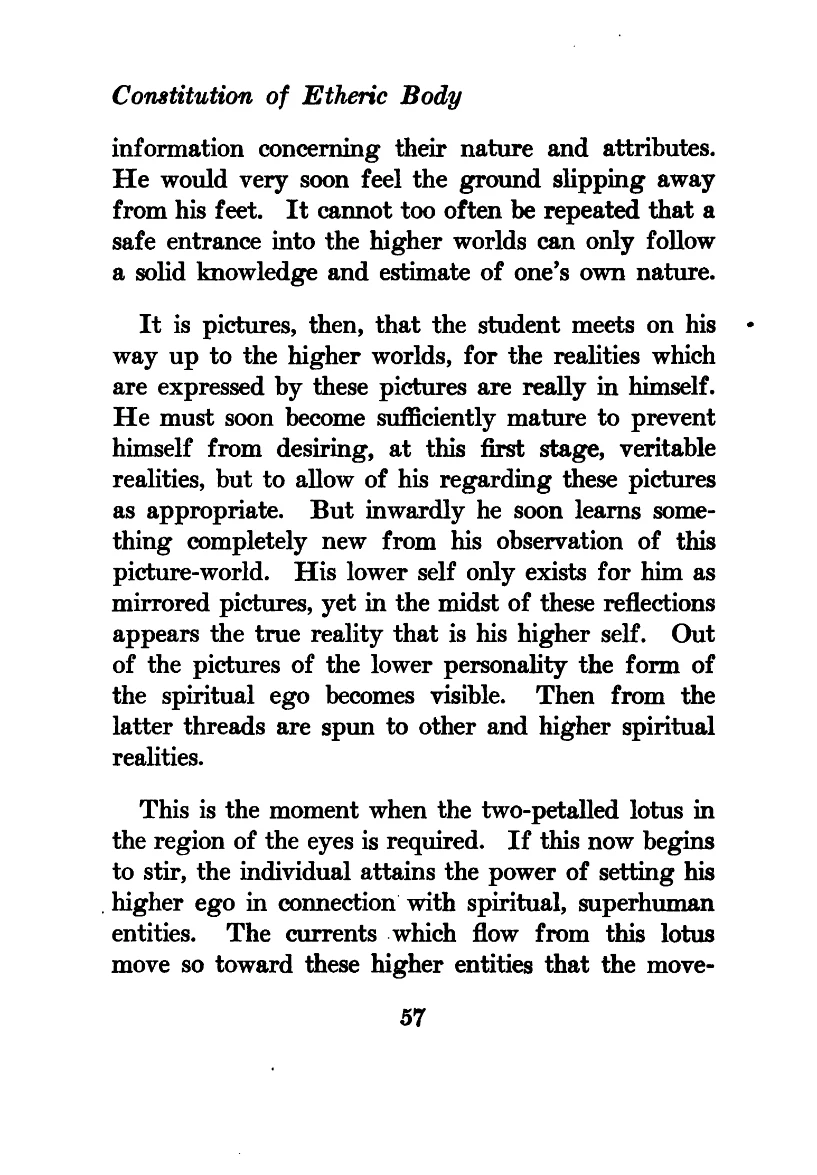
Initiation and Its Results (1909), printed p. 57, Library Reader page 56. Steiner connects the organ near the eyes with a relation beyond the pictures of the self.
Rudolf Steiner, Initiation and Its Results, Clifford Bax translation, First American Edition, 1909. Public-domain historical page from the checksum-verified Library PDF. · Image source ↗ · Public Domain
See references (7)
- Initiation and Its Results, printed p. 13, Reader page 13
- Initiation and Its Results, printed p. 45, Reader page 44
- Initiation and Its Results, printed p. 57, Reader page 56
- Initiation and Its Results, printed p. 58, Reader page 57
- Initiation and Its Results, printed p. 54, Reader page 53
- Initiation and Its Results, printed p. 55, Reader page 54
- Initiation and Its Results, printed p. 56, Reader page 55
An organ near the eyes and a centre that moves
The position near the eyes is only one part of Steiner’s description. The currents towards the hands and the later relation between spiritual beings give the organ two specific jobs in this book. [2][3][4]
The migrating etheric centre is an organising point that changes place during development. Steiner’s two-petalled organ remains near the eyes and receives currents sent through that wider arrangement. [8][2][9]
See references (5)
Read further in the library

Initiation and Its Results
Reading note
The separately titled account draws on exact passages in the consulted Library edition.
Sources
See references (9)
- Initiation and Its Results, printed p. 13, Reader page 13Rudolf Steiner, Initiation and Its Results: A Sequel to The Way of Initiation, translated by Clifford Bax. First American Edition, 1909. Macoy Publishing and Masonic Supply Co., New York; Max Gysi, London. Claims of clairvoyant perception and subtle organs remain attributed. References identify the exact consulted Library edition.Read this page in Initiation and Its Results ↗Return to text ↑
- Initiation and Its Results, printed p. 45, Reader page 44Rudolf Steiner, Initiation and Its Results: A Sequel to The Way of Initiation, translated by Clifford Bax. First American Edition, 1909. Macoy Publishing and Masonic Supply Co., New York; Max Gysi, London. Claims of clairvoyant perception and subtle organs remain attributed. References identify the exact consulted Library edition.Read this page in Initiation and Its Results ↗Return to text ↑
- Initiation and Its Results, printed p. 57, Reader page 56Rudolf Steiner, Initiation and Its Results: A Sequel to The Way of Initiation, translated by Clifford Bax. First American Edition, 1909. Macoy Publishing and Masonic Supply Co., New York; Max Gysi, London. Claims of clairvoyant perception and subtle organs remain attributed. References identify the exact consulted Library edition.Read this page in Initiation and Its Results ↗Return to text ↑
- Initiation and Its Results, printed p. 58, Reader page 57Rudolf Steiner, Initiation and Its Results: A Sequel to The Way of Initiation, translated by Clifford Bax. First American Edition, 1909. Macoy Publishing and Masonic Supply Co., New York; Max Gysi, London. Claims of clairvoyant perception and subtle organs remain attributed. References identify the exact consulted Library edition.Read this page in Initiation and Its Results ↗Return to text ↑
- Initiation and Its Results, printed p. 54, Reader page 53Rudolf Steiner, Initiation and Its Results: A Sequel to The Way of Initiation, translated by Clifford Bax. First American Edition, 1909. Macoy Publishing and Masonic Supply Co., New York; Max Gysi, London. Claims of clairvoyant perception and subtle organs remain attributed. References identify the exact consulted Library edition.Read this page in Initiation and Its Results ↗Return to text ↑
- Initiation and Its Results, printed p. 55, Reader page 54Rudolf Steiner, Initiation and Its Results: A Sequel to The Way of Initiation, translated by Clifford Bax. First American Edition, 1909. Macoy Publishing and Masonic Supply Co., New York; Max Gysi, London. Claims of clairvoyant perception and subtle organs remain attributed. References identify the exact consulted Library edition.Read this page in Initiation and Its Results ↗Return to text ↑
- Initiation and Its Results, printed p. 56, Reader page 55Rudolf Steiner, Initiation and Its Results: A Sequel to The Way of Initiation, translated by Clifford Bax. First American Edition, 1909. Macoy Publishing and Masonic Supply Co., New York; Max Gysi, London. Claims of clairvoyant perception and subtle organs remain attributed. References identify the exact consulted Library edition.Read this page in Initiation and Its Results ↗Return to text ↑
- Initiation and Its Results, printed p. 44, Reader page 43Rudolf Steiner, Initiation and Its Results: A Sequel to The Way of Initiation, translated by Clifford Bax. First American Edition, 1909. Macoy Publishing and Masonic Supply Co., New York; Max Gysi, London. Claims of clairvoyant perception and subtle organs remain attributed. References identify the exact consulted Library edition.Read this page in Initiation and Its Results ↗Return to text ↑
- Initiation and Its Results, printed p. 46, Reader page 45Rudolf Steiner, Initiation and Its Results: A Sequel to The Way of Initiation, translated by Clifford Bax. First American Edition, 1909. Macoy Publishing and Masonic Supply Co., New York; Max Gysi, London. Claims of clairvoyant perception and subtle organs remain attributed. References identify the exact consulted Library edition.Read this page in Initiation and Its Results ↗Return to text ↑