Twelve-Petalled Lotus
Steiner’s twelve-petalled heart lotus adds mental warmth or cold to the forms of thought. Read the six qualities he associates with its development.
In this article
Understanding the concept
The twelve-petalled lotus is a proposed organ near the heart in Rudolf Steiner’s account of spiritual perception. He says it adds the feeling of warmth or cold to a form already perceived through the throat organ. [1][2][3][4][5]
Steiner says six petals developed in an earlier stage of human life. The other six correspond to qualities a person can cultivate in how they think, act and respond. [1]
See references (5)
Initiation and Its Results by Rudolf Steiner
In Initiation and Its Results, Rudolf Steiner asks the reader to picture goodwill as a flower opening. The heart lotus makes the form feel mentally warm. He uses warmth again for growth and compares decay with cold. [1][2]
The heart lotus later has a close connection with the etheric centre. Rays move through it towards other lotuses, and an irregularity here would affect the wider arrangement. This later role extends its function beyond one isolated sense. [6][7]
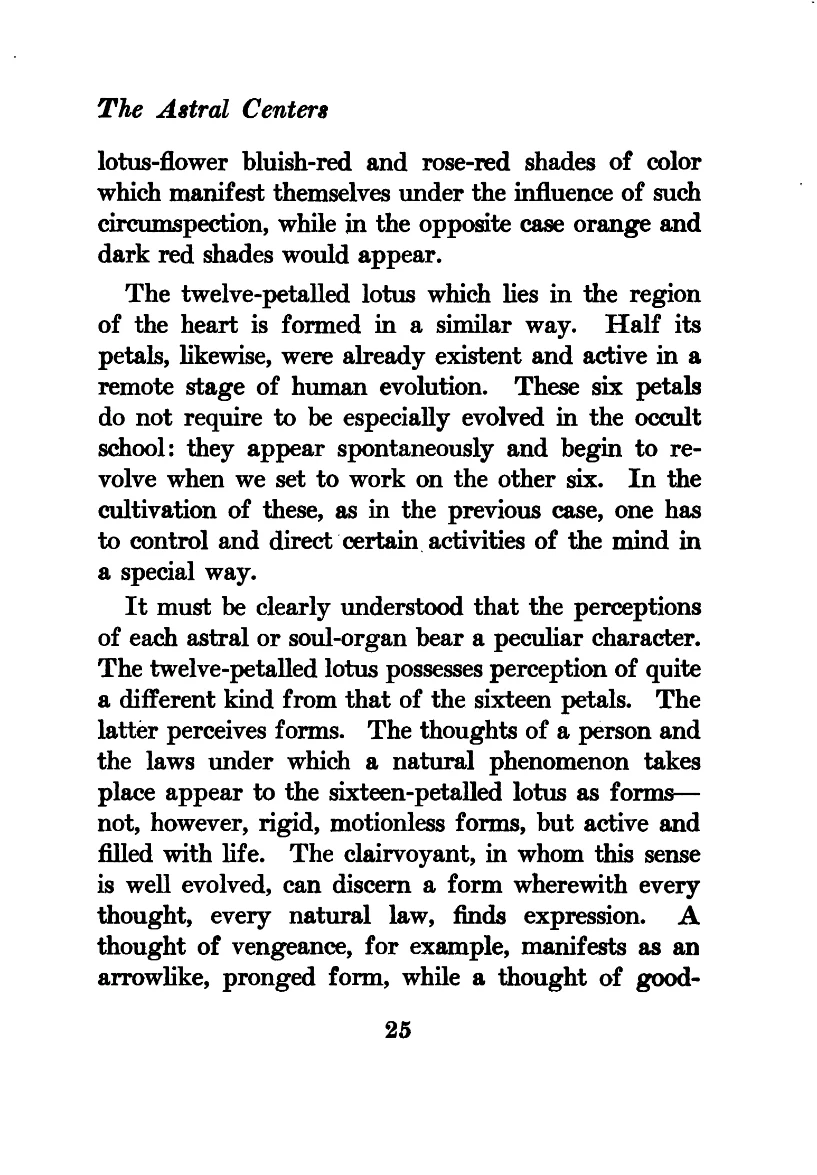
Initiation and Its Results (1909), printed p. 25, Library Reader page 25. Steiner introduces the six petals he says must be cultivated.
Rudolf Steiner, Initiation and Its Results, Clifford Bax translation, First American Edition, 1909. Public-domain historical page from the checksum-verified Library PDF. · Image source ↗ · Public Domain
The six qualities
- Coherent thought. Follow how one thought leads to another. [3]
- Consistent action. Make a later action fit what came before it. [3][4]
- Perseverance. Keep working towards a goal while there is good reason to pursue it. [4]
- Tolerance. Try to understand another person’s standpoint before settling on criticism. [4]
- Openness and trust. Be willing to test and rearrange an opinion when experience gives a reason to. [4][5]
- Equanimity. Keep joy and sorrow in proportion. [5]
The heart lotus and the etheric centre
Steiner describes a separate etheric centre near the heart. Rays pass from it into the twelve-petalled lotus and then towards other organs. The lotus has a perceptual role, and the etheric centre organises the currents. [8][9][6][7]
Warmth in the example of goodwill belongs to Steiner’s account of inner perception. He uses a familiar sensation to give the proposed faculty a quality the reader can imagine. [2][10]
See references (6)
- Initiation and Its Results, printed p. 26, Reader page 26
- Initiation and Its Results, printed p. 42, Reader page 41
- Initiation and Its Results, printed p. 43, Reader page 42
- Initiation and Its Results, printed p. 39, Reader page 38
- Initiation and Its Results, printed p. 41, Reader page 40
- Initiation and Its Results, printed p. 30, Reader page 30
Read further in the library

Initiation and Its Results
Reading note
The separately titled account draws on exact passages in the consulted Library edition.
Sources
See references (10)
- Initiation and Its Results, printed p. 25, Reader page 25Rudolf Steiner, Initiation and Its Results: A Sequel to The Way of Initiation, translated by Clifford Bax. First American Edition, 1909. Macoy Publishing and Masonic Supply Co., New York; Max Gysi, London. Claims of clairvoyant perception and subtle organs remain attributed. References identify the exact consulted Library edition.Read this page in Initiation and Its Results ↗Return to text ↑
- Initiation and Its Results, printed p. 26, Reader page 26Rudolf Steiner, Initiation and Its Results: A Sequel to The Way of Initiation, translated by Clifford Bax. First American Edition, 1909. Macoy Publishing and Masonic Supply Co., New York; Max Gysi, London. Claims of clairvoyant perception and subtle organs remain attributed. References identify the exact consulted Library edition.Read this page in Initiation and Its Results ↗Return to text ↑
- Initiation and Its Results, printed p. 27, Reader page 27Rudolf Steiner, Initiation and Its Results: A Sequel to The Way of Initiation, translated by Clifford Bax. First American Edition, 1909. Macoy Publishing and Masonic Supply Co., New York; Max Gysi, London. Claims of clairvoyant perception and subtle organs remain attributed. References identify the exact consulted Library edition.Read this page in Initiation and Its Results ↗Return to text ↑
- Initiation and Its Results, printed p. 28, Reader page 28Rudolf Steiner, Initiation and Its Results: A Sequel to The Way of Initiation, translated by Clifford Bax. First American Edition, 1909. Macoy Publishing and Masonic Supply Co., New York; Max Gysi, London. Claims of clairvoyant perception and subtle organs remain attributed. References identify the exact consulted Library edition.Read this page in Initiation and Its Results ↗Return to text ↑
- Initiation and Its Results, printed p. 29, Reader page 29Rudolf Steiner, Initiation and Its Results: A Sequel to The Way of Initiation, translated by Clifford Bax. First American Edition, 1909. Macoy Publishing and Masonic Supply Co., New York; Max Gysi, London. Claims of clairvoyant perception and subtle organs remain attributed. References identify the exact consulted Library edition.Read this page in Initiation and Its Results ↗Return to text ↑
- Initiation and Its Results, printed p. 42, Reader page 41Rudolf Steiner, Initiation and Its Results: A Sequel to The Way of Initiation, translated by Clifford Bax. First American Edition, 1909. Macoy Publishing and Masonic Supply Co., New York; Max Gysi, London. Claims of clairvoyant perception and subtle organs remain attributed. References identify the exact consulted Library edition.Read this page in Initiation and Its Results ↗Return to text ↑
- Initiation and Its Results, printed p. 43, Reader page 42Rudolf Steiner, Initiation and Its Results: A Sequel to The Way of Initiation, translated by Clifford Bax. First American Edition, 1909. Macoy Publishing and Masonic Supply Co., New York; Max Gysi, London. Claims of clairvoyant perception and subtle organs remain attributed. References identify the exact consulted Library edition.Read this page in Initiation and Its Results ↗Return to text ↑
- Initiation and Its Results, printed p. 39, Reader page 38Rudolf Steiner, Initiation and Its Results: A Sequel to The Way of Initiation, translated by Clifford Bax. First American Edition, 1909. Macoy Publishing and Masonic Supply Co., New York; Max Gysi, London. Claims of clairvoyant perception and subtle organs remain attributed. References identify the exact consulted Library edition.Read this page in Initiation and Its Results ↗Return to text ↑
- Initiation and Its Results, printed p. 41, Reader page 40Rudolf Steiner, Initiation and Its Results: A Sequel to The Way of Initiation, translated by Clifford Bax. First American Edition, 1909. Macoy Publishing and Masonic Supply Co., New York; Max Gysi, London. Claims of clairvoyant perception and subtle organs remain attributed. References identify the exact consulted Library edition.Read this page in Initiation and Its Results ↗Return to text ↑
- Initiation and Its Results, printed p. 30, Reader page 30Rudolf Steiner, Initiation and Its Results: A Sequel to The Way of Initiation, translated by Clifford Bax. First American Edition, 1909. Macoy Publishing and Masonic Supply Co., New York; Max Gysi, London. Claims of clairvoyant perception and subtle organs remain attributed. References identify the exact consulted Library edition.Read this page in Initiation and Its Results ↗Return to text ↑