Sixteen-Petalled Lotus
Steiner’s sixteen-petalled lotus is a proposed throat organ for perceiving thought as form. Read why eight petals are cultivated and how he relates the practice to Buddhism.
In this article
Understanding the concept
The sixteen-petalled lotus is a proposed organ near the throat in Rudolf Steiner’s account of spiritual perception. He calls its parts petals because of how he says the organ appears. Its function is to make thoughts and natural processes perceptible as forms. [1][2][3][4]
Steiner gives eight petals a long history and the other eight a role in conscious training. In his account, cultivating the second group also brings the earlier one back into activity. [3]
Initiation and Its Results by Rudolf Steiner
In Initiation and Its Results, Rudolf Steiner places this lotus at the larynx. The earlier eight petals have supposedly become inactive as ordinary consciousness brightened. The student works on the remaining eight, after which the older capacities return without being separately trained. [3]
Steiner starts with how a person receives ideas and comes to a decision. The student is meant to form a clear conception and act on a considered reason. He goes on to connect these and other habits with the Buddhist Eightfold Path. [5][6]
Steiner distinguishes giving the organ a form from bringing it into activity. In his account, someone can begin to see unfamiliar forms before learning to interpret them reliably. He gives conduct a place in training because he believes it shapes the capacity used to judge those forms. [6][7]
Steiner pictures vengeance as a pronged, arrow-like figure and goodwill as an opening flower. These thought-forms show what he means by perceiving thoughts as shapes. [4][8]
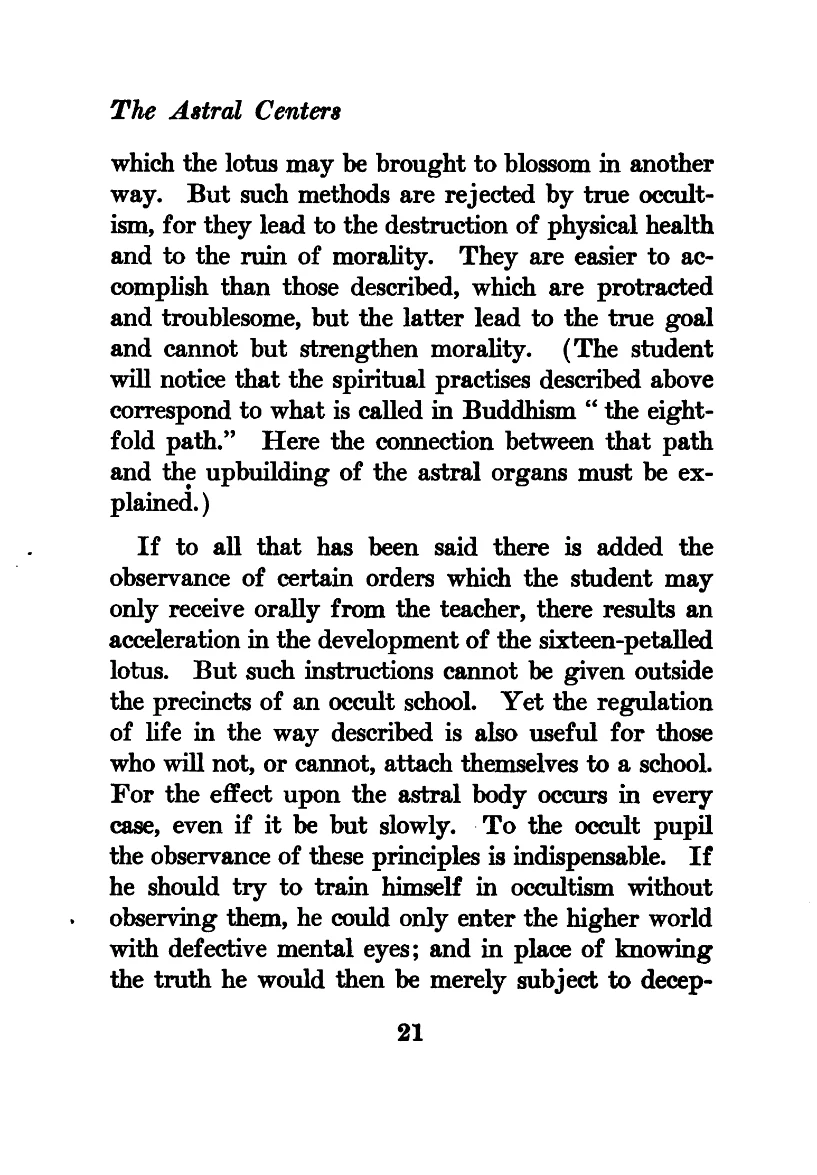
Initiation and Its Results (1909), printed p. 21, Library Reader page 21. Steiner compares his practices with the Buddhist Eightfold Path.
Rudolf Steiner, Initiation and Its Results, Clifford Bax translation, First American Edition, 1909. Public-domain historical page from the checksum-verified Library PDF. · Image source ↗ · Public Domain

An uncredited lotus ornament printed in the 1909 edition. The book uses the flower to describe the appearance of several of its proposed organs.
Initiation and Its Results, First American Edition, 1909. Artist uncredited. Historical printed image, Public Domain. · Image source ↗ · Public Domain
See references (6)
- Initiation and Its Results, printed p. 15, Reader page 15
- Initiation and Its Results, printed p. 25, Reader page 25
- Initiation and Its Results, printed p. 16, Reader page 16
- Initiation and Its Results, printed p. 21, Reader page 21
- Initiation and Its Results, printed p. 22, Reader page 22
- Initiation and Its Results, printed p. 26, Reader page 26
The Noble Eightfold Path in the Vibhaṅga Sutta
In SN 45.8, the Buddha explains the Noble Eightfold Path through understanding suffering, practising ethical conduct and cultivating the mind. Steiner reads his own disciplines alongside that path. His explanation of how the practices would shape a throat organ belongs to Initiation and Its Results. [10][6]
Seeing a form and reading it
The throat organ gives goodwill the outline of a flower. The twelve-petalled heart lotus adds what Steiner calls mental warmth. The two examples show different qualities he believes a person can perceive at the same time. [4][8]
The book asks the reader to distinguish what a form looks like from what it means. A well-formed capacity would, in Steiner’s account, help the student with both parts of the encounter. [3][5][6][7]
See references (6)
- Initiation and Its Results, printed p. 15, Reader page 15
- Initiation and Its Results, printed p. 25, Reader page 25
- Initiation and Its Results, printed p. 16, Reader page 16
- Initiation and Its Results, printed p. 21, Reader page 21
- Initiation and Its Results, printed p. 22, Reader page 22
- Initiation and Its Results, printed p. 26, Reader page 26
Read further in the library

Initiation and Its Results
Reading note
The separately titled account draws on exact passages in the consulted Library edition.
Sources
See references (10)
- Initiation and Its Results, printed p. 13, Reader page 13Rudolf Steiner, Initiation and Its Results: A Sequel to The Way of Initiation, translated by Clifford Bax. First American Edition, 1909. Macoy Publishing and Masonic Supply Co., New York; Max Gysi, London. Claims of clairvoyant perception and subtle organs remain attributed. References identify the exact consulted Library edition.Read this page in Initiation and Its Results ↗Return to text ↑
- Initiation and Its Results, printed p. 14, Reader page 14Rudolf Steiner, Initiation and Its Results: A Sequel to The Way of Initiation, translated by Clifford Bax. First American Edition, 1909. Macoy Publishing and Masonic Supply Co., New York; Max Gysi, London. Claims of clairvoyant perception and subtle organs remain attributed. References identify the exact consulted Library edition.Read this page in Initiation and Its Results ↗Return to text ↑
- Initiation and Its Results, printed p. 15, Reader page 15Rudolf Steiner, Initiation and Its Results: A Sequel to The Way of Initiation, translated by Clifford Bax. First American Edition, 1909. Macoy Publishing and Masonic Supply Co., New York; Max Gysi, London. Claims of clairvoyant perception and subtle organs remain attributed. References identify the exact consulted Library edition.Read this page in Initiation and Its Results ↗Return to text ↑
- Initiation and Its Results, printed p. 25, Reader page 25Rudolf Steiner, Initiation and Its Results: A Sequel to The Way of Initiation, translated by Clifford Bax. First American Edition, 1909. Macoy Publishing and Masonic Supply Co., New York; Max Gysi, London. Claims of clairvoyant perception and subtle organs remain attributed. References identify the exact consulted Library edition.Read this page in Initiation and Its Results ↗Return to text ↑
- Initiation and Its Results, printed p. 16, Reader page 16Rudolf Steiner, Initiation and Its Results: A Sequel to The Way of Initiation, translated by Clifford Bax. First American Edition, 1909. Macoy Publishing and Masonic Supply Co., New York; Max Gysi, London. Claims of clairvoyant perception and subtle organs remain attributed. References identify the exact consulted Library edition.Read this page in Initiation and Its Results ↗Return to text ↑
- Initiation and Its Results, printed p. 21, Reader page 21Rudolf Steiner, Initiation and Its Results: A Sequel to The Way of Initiation, translated by Clifford Bax. First American Edition, 1909. Macoy Publishing and Masonic Supply Co., New York; Max Gysi, London. Claims of clairvoyant perception and subtle organs remain attributed. References identify the exact consulted Library edition.Read this page in Initiation and Its Results ↗Return to text ↑
- Initiation and Its Results, printed p. 22, Reader page 22Rudolf Steiner, Initiation and Its Results: A Sequel to The Way of Initiation, translated by Clifford Bax. First American Edition, 1909. Macoy Publishing and Masonic Supply Co., New York; Max Gysi, London. Claims of clairvoyant perception and subtle organs remain attributed. References identify the exact consulted Library edition.Read this page in Initiation and Its Results ↗Return to text ↑
- Initiation and Its Results, printed p. 26, Reader page 26Rudolf Steiner, Initiation and Its Results: A Sequel to The Way of Initiation, translated by Clifford Bax. First American Edition, 1909. Macoy Publishing and Masonic Supply Co., New York; Max Gysi, London. Claims of clairvoyant perception and subtle organs remain attributed. References identify the exact consulted Library edition.Read this page in Initiation and Its Results ↗Return to text ↑
- Initiation and Its Results, Lotus blossom on water, Reader page 2Rudolf Steiner, Initiation and Its Results, Clifford Bax translation, First American Edition, 1909. Exact printed illustration from the consulted Library edition; original creator uncredited.Read this page in Initiation and Its Results ↗
- Vibhaṅga Sutta (SN 45.8), translated by Bhikkhu Sujato ↗Saṁyutta Nikāya 45.8, SuttaCentral, English translation by Bhikkhu Sujato.Return to text ↑