Life Review
A life review is an encounter with one’s past. Compare sudden recollection, inward judgment and scenes of earlier life in historical accounts.
In this article
What is a life review?
A life review is an encounter with the events and choices of one’s past. In accounts of dying or life after death, memories may return as vivid scenes. Some include intentions, things left undone and the effects a person’s actions had on others. [1][2]
The way the past comes back changes the story. It may arrive all at once, emerge in a detailed examination or become clear slowly as the person learns to recognise a fault. [1][2][9][10][13]
Seeing the past again
Lumen by Camille Flammarion
In Camille Flammarion’s Lumen, a traveller looks back at Earth from a distant world. He sees his parents before his own birth, then watches his mother help a child he recognises as himself. The past returns as an appearance he can see from elsewhere. [50][51][52]
Later scenes include schooling, public events, friendships, bereavements and the end of his earthly life. Quaerens objects that a succession lasting decades should take decades to watch. Lumen replies that he has been moving back towards Earth, encountering progressively newer light. In the narrative, the imagined speed of the soul’s return compresses the sequence into less than a day. [53][54][55][56][57]
The account does not finally promise an exhaustive replay. The Earth’s rotation poses a difficulty for the view of successive events. Lumen acknowledges the objection and says that he saw only some of the principal scenes, rather than every event. He cannot fully explain what drew him along the required line of sight. This qualification belongs beside the dramatic completeness suggested by the earlier narration. [57][58][59]
A later conversation gives the travelling record a moral purpose. Secret wrongdoing and secret kindness are both said to remain carried into space. Lumen imagines Napoleon bound to the departing appearance of Waterloo, confronting the ruin of his ambitions for a period calculated from lives supposedly cut short. The number and the sentence are the narrator’s moral arithmetic, rather than verified demography or an independently witnessed judgement. [60][61][62]
The book also distinguishes visible action from inward thought. After describing the preservation of deeds by light, Lumen proposes another kind of spiritual vibration that records secret thoughts. His explanation of individual judgement thus reaches beyond the optical account with which it begins. A visible past and a record of intention are related claims here, but they are not the same proposed mechanism. [62][63][64]
See references (15)
- Lumen, Reader page 50
- Lumen, Reader page 51
- Lumen, Reader page 52
- Lumen, Reader page 56
- Lumen, Reader page 58
- Lumen, Reader page 59
- Lumen, Reader page 60
- Lumen, Reader page 61
- Lumen, Reader page 62
- Lumen, Reader page 63
- Lumen, Reader page 126
- Lumen, Reader page 127
- Lumen, Reader page 128
- Lumen, Reader page 132
- Lumen, Reader page 133
Gone West by J. S. M. Ward
In J. S. M. Ward’s Gone West, H. J. L., one of Ward’s reported spirit contributors, describes his thoughts and deeds as having an existence of their own. An intended action can appear together with its room, furniture and circumstances. The returned scene includes the setting in which the thought once took shape. [1]
Ward asks whether thinking of an offence is therefore the same as committing it. His contributor answers by distinguishing the reasons an intention was abandoned. Resisting through a better impulse supplies a good thought that can later bring relief. Being stopped solely by an outside obstacle supplies no such response. The account follows the moral history of an intention. [1]
H. J. L.’s account of death places the review immediately after his first encounter with a guide. Thoughts and deeds crowd in on every side, moving and acting like tableaux. He says he perceives them with his whole being. At first, small and great events are present together, including things long forgotten. [3][2]
Prayer changes the arrangement. What was a chaotic multitude begins to take chronological order, pictured as a street extending beyond his sight. Forgotten acts of kindness and occasions of resisting temptation become visible among the painful scenes. Relief comes partly through recovering a fuller history of himself. [2]
The past continues to accompany him when he enters a school. His guide leads him through one of the visions, and the scenes recede into the background as another environment becomes available. Review becomes part of an ongoing education in which the person still has relationships and work ahead. [4]
The disturbing scenes can recur after H. J. L. has entered school. In a later account he says that a requiem service held on earth reaches him during such a period. The distressing visions give way to a church in which living and departed people pray. Within his account, relief includes discovering that others care about his progress. [5]
H. J. L. later explains judgment as something arising from the person’s own condition. No external judge has to assign a sentence: the spirit can enter only a state it has become able to bear. His explanation gives belief in God a decisive role, even imagining a charitable materialist initially excluded from realms of faith. This is the contributor’s particular theology of self-judgment. [6][7]
Within that theology, professed belief is also insufficient if conduct contradicts it. H. J. L. contrasts the person who struggles against temptation with someone who habitually cheats while claiming religious faith. The review concerns what a person has actually made of belief and action together. [6]
W. A.’s final chapter repeats the pattern from another life. After leaving the astral body, he finds his former thoughts and actions crowding around him in confusion. His guide tells him to pray; the visions then take a sequence from childhood to death, including both good and evil. H. J. L. interrupts to say that the rest resembles his own experience. The two contributors are made to support a shared explanation through distinct personal histories. [8]
See references (8)
- Gone West, printed p. 3, Reader page 16
- Gone West, printed p. 16, Reader page 29
- Gone West, printed p. 15, Reader page 28
- Gone West, printed p. 23, Reader page 36
- Gone West, printed p. 32, Reader page 45
- Gone West, printed p. 41, Reader page 54
- Gone West, printed p. 42, Reader page 55
- Gone West, printed p. 176, Reader page 189
A Subaltern in Spirit Land by J. S. M. Ward
In J. S. M. Ward’s A Subaltern in Spirit Land, Rex, Ward’s deceased brother, becomes preoccupied with memories of his past. His faults seem far clearer than his good actions, and some appear before his eyes. H. J. L., one of Ward’s reported spirit contributors, distinguishes this experience from the visible forms encountered in Gone West. Here he describes memory intensified within the astral condition. [9][10]
Ward asks whether someone must face a review again on entering the spirit plane. The guide says there may be a further experience, including the life just lived on the astral plane. Helping others after death can add a new history alongside the earlier one. The person being reviewed is still capable of change. [10][11]
As Rex recovers in a quiet region, the memories recur for shorter periods. Later he says they have taken an ordered sequence and that he can remember decent actions as well. The account connects relief with a more complete view of his life and with a resolve to act differently in the future. [12][13]
The distinction matters when the two Ward books are read together. Rex’s sharpened memory and H. J. L.’s earlier encounters with independent thought-forms belong to different proposed conditions. Both concern the continuing effect of a past life, while the sequel makes their differences explicit. [9][10][11][13][2][8]
See references (7)
- Gone West, printed p. 16, Reader page 29
- Gone West, printed p. 176, Reader page 189
- A Subaltern in Spirit Land, printed p. 16, Reader page 31
- A Subaltern in Spirit Land, printed p. 17, Reader page 32
- A Subaltern in Spirit Land, printed p. 18, Reader page 33
- A Subaltern in Spirit Land, printed p. 20, Reader page 35
- A Subaltern in Spirit Land, printed p. 24, Reader page 39
The Encyclopaedia of Death and Life in Spirit-World, Volume I
J. R. Francis’s The Encyclopaedia of Death and Life in Spirit-World, Volume I, includes a communication attributed to Judge Rufus W. Peckham and received through J. W. Edmonds. The speaker describes the sinking of the Ville du Havre as the setting for a sudden return of his past. Every action and every remembered friend becomes vividly present. The review accompanies a claimed reunion with his deceased parents: memory and recognition belong to the same transition. [14]
A different example appears in the unsigned visionary dialogue headed ‘Thrilling Narrative of a Magdalen’. Its speaker, Claude, recalls every incident of her life shortly before becoming unconscious and awakening among welcoming spirits. The surrounding story makes compassion central to this recollection. Her experience of exploitation and social condemnation becomes a reason to assist other women, rather than the end of her possibilities. [15][16]
The two accounts give the review different emphases. Peckham’s reported experience is panoramic and bound to familiar relationships; Claude’s belongs to a longer story about suffering, responsibility and a changed purpose. Neither passage describes the formal tribunal found in some religious accounts of judgment. Both are published Spiritualist narratives, not independently established records of what everyone experiences at death. [14][16]
The volume also preserves a counterexample. An unnamed New York Star writer describes losing consciousness after receiving an opiate and subsequently recovering. He specifically says that no instantaneous panorama of his life occurred. This is a different kind of report from the alleged communications of deceased people, and it prevents the anthology’s examples from being read as a uniform sequence. Its accounts describe varied recollections, including an explicit absence of the experience. [17][18]
See references (5)
- The Encyclopaedia of Death and Life in Spirit-World, Volume I, printed p. 29, Reader page 28
- The Encyclopaedia of Death and Life in Spirit-World, Volume I, printed p. 34, Reader page 33
- The Encyclopaedia of Death and Life in Spirit-World, Volume I, printed p. 40, Reader page 39
- The Encyclopaedia of Death and Life in Spirit-World, Volume I, printed p. 258, Reader page 257
- The Encyclopaedia of Death and Life in Spirit-World, Volume I, printed p. 260, Reader page 259
Judgment and change
A Wanderer in the Spirit Lands
Franchezzo’s A Wanderer in the Spirit Lands, transcribed by A. Farnese, makes self-recognition a continuing process. A person can see another spirit’s faults while remaining blind to their own. In the imperial court, nearly everyone still imagines their former attractive appearance; one penitent has begun to recognise his condition. Elsewhere, past actions play across a palace’s hangings and return in an inescapable panorama of memory. [19][20][21][22]
The most sustained review takes place during a voluntary journey through the Land of Remorse. Ahrinziman explains that this demanding method suits Franchezzo’s temperament. Other people need gentler, gradual instruction, and those whose mistakes are minor do not have to make the same journey. The book gives several ways of learning rather than one compulsory ordeal for every newly dead person. [23][24]
In the desert, forgotten unkind words and the tears he caused become visible scenes. He then recognises his harsh treatment of struggling artists in the rocks obstructing his path. Understanding changes what he does: he helps an exhausted traveller and resolves to encourage people whose early efforts he once dismissed. Review leads from remembering an injury to changing a habit and attempting repair. [25][26][27][28][29]
See references (11)
- A Wanderer in the Spirit Lands, Reader page 150
- A Wanderer in the Spirit Lands, Reader page 151
- A Wanderer in the Spirit Lands, Reader page 186
- A Wanderer in the Spirit Lands, Reader page 201
- A Wanderer in the Spirit Lands, Reader page 242
- A Wanderer in the Spirit Lands, Reader page 243
- A Wanderer in the Spirit Lands, Reader page 245
- A Wanderer in the Spirit Lands, Reader page 246
- A Wanderer in the Spirit Lands, Reader page 248
- A Wanderer in the Spirit Lands, Reader page 249
- A Wanderer in the Spirit Lands, Reader page 250
Judgment and self-examination
Dürer places the dead beneath Christ and the trumpeting angels in his woodcut of the Last Judgment. The print gives accountability the scale of a public event. Several books in this entry place it closer to the person, within memories or encounters with consequences. [30][23][24]

Albrecht Dürer, The Last Judgment, from The Small Passion, ca. 1510. Christian judgment imagery provides a comparison for the question of how a life is understood after death.
The Metropolitan Museum of Art. Gift of Junius Spencer Morgan, 1919. Accession 19.73.206. Public Domain (CC0). · Image source ↗ · CC0
Evolution of Immortality
Freeman Benjamin Dowd’s Evolution of Immortality, published as Rosicruciæ, offers an account of inward judgment that can be read beside the narrative life reviews in this entry. It does not describe a compulsory panorama shown to everyone after death. Instead, the person’s own earlier actions return to consciousness and demand recognition. [31][32]
Rosicruciæ calls this return a day of judgment for that individual. The soul itself becomes the great white throne, while the wrongs are compared with children returning to their parent. Recognition is meant to change the desire that produced them. The following passage links this process with self-forgiveness and an end to the inner conflict. [32][33]
The appendix adds that the record of what happened cannot be erased. A new record of conduct can nonetheless be made. Its emphasis falls on transformation through a continuing life, with the encounter between memory and responsibility taking place inwardly rather than in a single dated universal tribunal. [34]
Heaven and Its Wonders and Hell
Emanuel Swedenborg’s Heaven and Its Wonders and Hell describes a disclosure of life from the person’s own memory. Hidden thefts, dishonest judgments, slander and other acts are brought forth with their circumstances and intentions. Swedenborg reports cases in which places, faces, conversations and even written papers appeared in detail. The purpose is to reveal what the person actually willed and did, beyond the reputation maintained on earth. [36][37][38]
The searching angels look into the face and trace the person’s life through the body, beginning with the fingers. Swedenborg explains this through a distinction between external and internal memory. Everything thought, willed, spoken, done, heard or seen is said to be inscribed on the spiritual person. The biblical book of life thus becomes an image for the person’s own spiritual record. [38][39][40]
This does not mean that ordinary recollection remains continually open in the same way. The natural memory is retained but its material contents become quiescent, while the rational capacity cultivated through them remains available. The Lord can call forth particulars when required. Swedenborg therefore holds together complete retention and a changed use of memory after death. [35][41][42]
His examples include reviews continuing for hours. They need not be compressed into a single instantaneous panorama shown to every dying person. The account concerns the exposure of motives and acts during spiritual examination, and presents its complete-memory claim as part of Swedenborg’s visionary testimony. [37]
See references (8)
- Heaven and Its Wonders and Hell, printed p. 398, Reader page 405
- Heaven and Its Wonders and Hell, printed p. 401, Reader page 408
- Heaven and Its Wonders and Hell, printed p. 402, Reader page 409
- Heaven and Its Wonders and Hell, printed p. 403, Reader page 410
- Heaven and Its Wonders and Hell, printed p. 404, Reader page 411
- Heaven and Its Wonders and Hell, printed p. 405, Reader page 412
- Heaven and Its Wonders and Hell, printed p. 406, Reader page 413
- Heaven and Its Wonders and Hell, printed p. 409, Reader page 416
Life and Labor in the Spirit World: Shelhamer’s spirit-band
Life and Labor in the Spirit World, credited to the medium M. T. Shelhamer’s spirit-band, gives its most extended personal review in the contribution attributed to John Critchley Prince. As he dies, the narrator sees the events of his life as a panorama and experiences himself as others saw him. His regret includes opportunities left unused as well as things actively done. [43][44]
The familiar figures surrounding him initially seem like a mocking company. He later explains that this first experience consisted of the reflection of past recollections on his mind. The distinction is consequential: the narrative does not ultimately identify those first frightening appearances as a gathering of independent spirits. [43][44]
Later episodes turn memory into a task of self-examination. A guide distinguishes settings suited to different temperaments, while Prince’s later recollection becomes less exclusively a source of accusation. The past can help direct a changed life when it is joined to renewed purpose and assistance. [45][46][47][48][49]
See references (7)
- Life and Labor in the Spirit World, printed p. 351, Reader page 352
- Life and Labor in the Spirit World, printed p. 352, Reader page 353
- Life and Labor in the Spirit World, printed p. 361, Reader page 362
- Life and Labor in the Spirit World, printed p. 371, Reader page 372
- Life and Labor in the Spirit World, printed p. 372, Reader page 373
- Life and Labor in the Spirit World, printed p. 415, Reader page 416
- Life and Labor in the Spirit World, printed p. 416, Reader page 417
Memory, visible scenes and the absence of a panorama
In Gone West, past thoughts and acts take visible form. Ward’s sequel describes memory sharpened within an astral condition. Francis’s anthology places a rush of recollection beside a speaker who remembers no such panorama. [1][9][10][14][17][18]
Swedenborg describes an examination that can go on for hours. Dowd and Franchezzo make recognition of past harm part of a longer change in how someone lives. [37][31][32][34][25][26][27][28][29]
Swedenborg’s angels bring deeds and intentions into view from a person’s own memory. Prince says he sees himself as others saw him. One account has examiners, while the other follows an uneasy recognition from within. [36][37][38][39][40][35][41][42][43][44][45][48][49]
Flammarion begins with the visible past, Ward’s sequel with memory, and Swedenborg with a record of the person’s inward life. Their differences concern where the past is preserved and who or what brings it back. [36][37][38][39][40][9][10][1][50][51][52][57][58][59][62][63][64]
See references (36)
- Gone West, printed p. 3, Reader page 16
- A Subaltern in Spirit Land, printed p. 16, Reader page 31
- A Subaltern in Spirit Land, printed p. 17, Reader page 32
- The Encyclopaedia of Death and Life in Spirit-World, Volume I, printed p. 29, Reader page 28
- The Encyclopaedia of Death and Life in Spirit-World, Volume I, printed p. 258, Reader page 257
- The Encyclopaedia of Death and Life in Spirit-World, Volume I, printed p. 260, Reader page 259
- A Wanderer in the Spirit Lands, Reader page 245
- A Wanderer in the Spirit Lands, Reader page 246
- A Wanderer in the Spirit Lands, Reader page 248
- A Wanderer in the Spirit Lands, Reader page 249
- A Wanderer in the Spirit Lands, Reader page 250
- Evolution of Immortality, printed p. 75, Reader page 72
- Evolution of Immortality, printed p. 76, Reader page 73
- Evolution of Immortality, printed p. 133, Reader page 132
- Heaven and Its Wonders and Hell, printed p. 398, Reader page 405
- Heaven and Its Wonders and Hell, printed p. 401, Reader page 408
- Heaven and Its Wonders and Hell, printed p. 402, Reader page 409
- Heaven and Its Wonders and Hell, printed p. 403, Reader page 410
- Heaven and Its Wonders and Hell, printed p. 404, Reader page 411
- Heaven and Its Wonders and Hell, printed p. 405, Reader page 412
- Heaven and Its Wonders and Hell, printed p. 406, Reader page 413
- Heaven and Its Wonders and Hell, printed p. 409, Reader page 416
- Life and Labor in the Spirit World, printed p. 351, Reader page 352
- Life and Labor in the Spirit World, printed p. 352, Reader page 353
- Life and Labor in the Spirit World, printed p. 361, Reader page 362
- Life and Labor in the Spirit World, printed p. 415, Reader page 416
- Life and Labor in the Spirit World, printed p. 416, Reader page 417
- Lumen, Reader page 50
- Lumen, Reader page 51
- Lumen, Reader page 52
- Lumen, Reader page 61
- Lumen, Reader page 62
- Lumen, Reader page 63
- Lumen, Reader page 128
- Lumen, Reader page 132
- Lumen, Reader page 133
Read further in the library
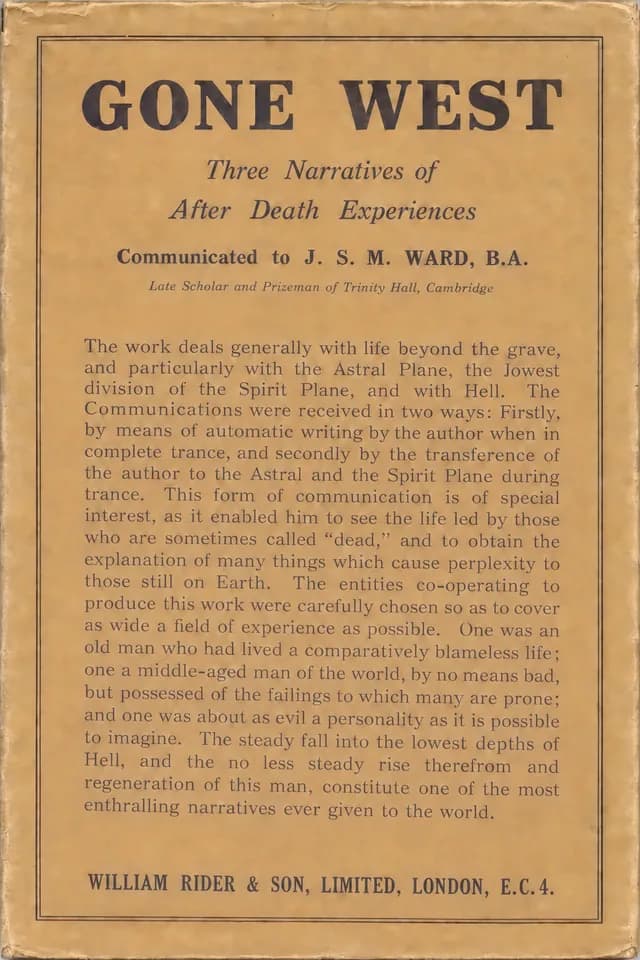
Gone West
Reading note
The book supplies the page-cited account and examples discussed in this entry.
A Subaltern in Spirit Land: A Sequel to Gone West
Reading note
Ward’s sequel adds the separately cited account of this subject.

The Encyclopaedia of Death and Life in the Spirit-World, Volume I
Reading note
Distinct accounts from the 1903 fourth edition, with each contributor and exact printed page identified.

A Wanderer in the Spirit Lands
Reading note
A voluntary journey through the Land of Remorse connects remembered harms with new acts of help.
Evolution of Immortality
Reading note
An inward return of past actions gives a different account of judgment from a narrated afterlife panorama.

Heaven and Its Wonders and Hell
Reading note
Hidden actions and motives are disclosed from a person’s own internal memory.
Life and Labour in the Spirit World
Reading note
The separately titled account draws on exact passages in the consulted Library edition.

Lumen
Reading note
The separately titled account draws on exact passages in the consulted Library edition.
Sources
See references (64)
- Gone West, printed p. 3, Reader page 16J. S. M. Ward, Gone West, 1920 third impression as reproduced in the 2009 Geoff Cutler digital transcription.Read this page in Gone West ↗Return to text ↑
- Gone West, printed p. 16, Reader page 29J. S. M. Ward, Gone West, 1920 third impression as reproduced in the 2009 Geoff Cutler digital transcription.Read this page in Gone West ↗Return to text ↑
- Gone West, printed p. 15, Reader page 28J. S. M. Ward, Gone West, 1920 third impression as reproduced in the 2009 Geoff Cutler digital transcription.Read this page in Gone West ↗Return to text ↑
- Gone West, printed p. 23, Reader page 36J. S. M. Ward, Gone West, 1920 third impression as reproduced in the 2009 Geoff Cutler digital transcription.Read this page in Gone West ↗Return to text ↑
- Gone West, printed p. 32, Reader page 45J. S. M. Ward, Gone West, 1920 third impression in the 2009 Geoff Cutler digital transcription.Read this page in Gone West ↗Return to text ↑
- Gone West, printed p. 41, Reader page 54J. S. M. Ward, Gone West, 1920 third impression in the 2009 Geoff Cutler digital transcription.Read this page in Gone West ↗Return to text ↑
- Gone West, printed p. 42, Reader page 55J. S. M. Ward, Gone West, 1920 third impression in the 2009 Geoff Cutler digital transcription.Read this page in Gone West ↗Return to text ↑
- Gone West, printed p. 176, Reader page 189J. S. M. Ward, Gone West, 1920 third impression in the 2009 Geoff Cutler digital transcription.Read this page in Gone West ↗Return to text ↑
- A Subaltern in Spirit Land, printed p. 16, Reader page 31J. S. M. Ward, A Subaltern in Spirit Land: A Sequel to Gone West, William Rider & Son, 1920.Read this page in A Subaltern in Spirit Land: A Sequel to Gone West ↗Return to text ↑
- A Subaltern in Spirit Land, printed p. 17, Reader page 32J. S. M. Ward, A Subaltern in Spirit Land: A Sequel to Gone West, William Rider & Son, 1920.Read this page in A Subaltern in Spirit Land: A Sequel to Gone West ↗Return to text ↑
- A Subaltern in Spirit Land, printed p. 18, Reader page 33J. S. M. Ward, A Subaltern in Spirit Land: A Sequel to Gone West, William Rider & Son, 1920.Read this page in A Subaltern in Spirit Land: A Sequel to Gone West ↗Return to text ↑
- A Subaltern in Spirit Land, printed p. 20, Reader page 35J. S. M. Ward, A Subaltern in Spirit Land: A Sequel to Gone West, William Rider & Son, 1920.Read this page in A Subaltern in Spirit Land: A Sequel to Gone West ↗Return to text ↑
- A Subaltern in Spirit Land, printed p. 24, Reader page 39J. S. M. Ward, A Subaltern in Spirit Land: A Sequel to Gone West, William Rider & Son, 1920.Read this page in A Subaltern in Spirit Land: A Sequel to Gone West ↗Return to text ↑
- The Encyclopaedia of Death and Life in Spirit-World, Volume I, printed p. 29, Reader page 28J. R. Francis (compiler), The Encyclopaedia of Death and Life in Spirit-World, Volume I, fourth edition, Progressive Thinker Publishing House, Chicago, 1903. Individual contributors identified in the text.Read this page in The Encyclopaedia of Death and Life in the Spirit-World, Volume I ↗Return to text ↑
- The Encyclopaedia of Death and Life in Spirit-World, Volume I, printed p. 34, Reader page 33J. R. Francis (compiler), The Encyclopaedia of Death and Life in Spirit-World, Volume I, fourth edition, Progressive Thinker Publishing House, Chicago, 1903. Individual contributors identified in the text.Read this page in The Encyclopaedia of Death and Life in the Spirit-World, Volume I ↗Return to text ↑
- The Encyclopaedia of Death and Life in Spirit-World, Volume I, printed p. 40, Reader page 39J. R. Francis (compiler), The Encyclopaedia of Death and Life in Spirit-World, Volume I, fourth edition, Progressive Thinker Publishing House, Chicago, 1903. Individual contributors identified in the text.Read this page in The Encyclopaedia of Death and Life in the Spirit-World, Volume I ↗Return to text ↑
- The Encyclopaedia of Death and Life in Spirit-World, Volume I, printed p. 258, Reader page 257Unnamed New York Star writer, reproduced in J. R. Francis (compiler), The Encyclopaedia of Death and Life in Spirit-World, Volume I, fourth edition, Chicago, 1903, printed pp. 258–260.Read this page in The Encyclopaedia of Death and Life in the Spirit-World, Volume I ↗Return to text ↑
- The Encyclopaedia of Death and Life in Spirit-World, Volume I, printed p. 260, Reader page 259Unnamed New York Star writer, reproduced in J. R. Francis (compiler), The Encyclopaedia of Death and Life in Spirit-World, Volume I, fourth edition, Chicago, 1903, printed pp. 258–260.Read this page in The Encyclopaedia of Death and Life in the Spirit-World, Volume I ↗Return to text ↑
- A Wanderer in the Spirit Lands, Reader page 150Franchezzo (source attribution), A Wanderer in the Spirit Lands, transcribed by A. Farnese. W. J. Sinkins, London, 1896. Date confirmed on the consulted title-page facsimile.Read this page in A Wanderer in the Spirit Lands ↗Return to text ↑
- A Wanderer in the Spirit Lands, Reader page 151Franchezzo (source attribution), A Wanderer in the Spirit Lands, transcribed by A. Farnese. W. J. Sinkins, London, 1896. Date confirmed on the consulted title-page facsimile.Read this page in A Wanderer in the Spirit Lands ↗Return to text ↑
- A Wanderer in the Spirit Lands, Reader page 186Franchezzo (source attribution), A Wanderer in the Spirit Lands, transcribed by A. Farnese. W. J. Sinkins, London, 1896. Date confirmed on the consulted title-page facsimile.Read this page in A Wanderer in the Spirit Lands ↗Return to text ↑
- A Wanderer in the Spirit Lands, Reader page 201Franchezzo (source attribution), A Wanderer in the Spirit Lands, transcribed by A. Farnese. W. J. Sinkins, London, 1896. Date confirmed on the consulted title-page facsimile.Read this page in A Wanderer in the Spirit Lands ↗Return to text ↑
- A Wanderer in the Spirit Lands, Reader page 242Franchezzo (source attribution), A Wanderer in the Spirit Lands, transcribed by A. Farnese. W. J. Sinkins, London, 1896. Date confirmed on the consulted title-page facsimile.Read this page in A Wanderer in the Spirit Lands ↗Return to text ↑
- A Wanderer in the Spirit Lands, Reader page 243Franchezzo (source attribution), A Wanderer in the Spirit Lands, transcribed by A. Farnese. W. J. Sinkins, London, 1896. Date confirmed on the consulted title-page facsimile.Read this page in A Wanderer in the Spirit Lands ↗Return to text ↑
- A Wanderer in the Spirit Lands, Reader page 245Franchezzo (source attribution), A Wanderer in the Spirit Lands, transcribed by A. Farnese. W. J. Sinkins, London, 1896. Date confirmed on the consulted title-page facsimile.Read this page in A Wanderer in the Spirit Lands ↗Return to text ↑
- A Wanderer in the Spirit Lands, Reader page 246Franchezzo (source attribution), A Wanderer in the Spirit Lands, transcribed by A. Farnese. W. J. Sinkins, London, 1896. Date confirmed on the consulted title-page facsimile.Read this page in A Wanderer in the Spirit Lands ↗Return to text ↑
- A Wanderer in the Spirit Lands, Reader page 248Franchezzo (source attribution), A Wanderer in the Spirit Lands, transcribed by A. Farnese. W. J. Sinkins, London, 1896. Date confirmed on the consulted title-page facsimile.Read this page in A Wanderer in the Spirit Lands ↗Return to text ↑
- A Wanderer in the Spirit Lands, Reader page 249Franchezzo (source attribution), A Wanderer in the Spirit Lands, transcribed by A. Farnese. W. J. Sinkins, London, 1896. Date confirmed on the consulted title-page facsimile.Read this page in A Wanderer in the Spirit Lands ↗Return to text ↑
- A Wanderer in the Spirit Lands, Reader page 250Franchezzo (source attribution), A Wanderer in the Spirit Lands, transcribed by A. Farnese. W. J. Sinkins, London, 1896. Date confirmed on the consulted title-page facsimile.Read this page in A Wanderer in the Spirit Lands ↗Return to text ↑
- The Last Judgment, from "The Small Passion" ↗The Metropolitan Museum of Art; object record 19.73.206Return to text ↑
- Evolution of Immortality, printed p. 75, Reader page 72Rosicruciæ (catalogued as Freeman Benjamin Dowd), Evolution of Immortality. Eulian Publishing Company, Salem, 1900.Read this page in Evolution of Immortality ↗Return to text ↑
- Evolution of Immortality, printed p. 76, Reader page 73Rosicruciæ (catalogued as Freeman Benjamin Dowd), Evolution of Immortality. Eulian Publishing Company, Salem, 1900.Read this page in Evolution of Immortality ↗Return to text ↑
- Evolution of Immortality, printed p. 77, Reader page 74Rosicruciæ (catalogued as Freeman Benjamin Dowd), Evolution of Immortality. Eulian Publishing Company, Salem, 1900.Read this page in Evolution of Immortality ↗Return to text ↑
- Evolution of Immortality, printed p. 133, Reader page 132Rosicruciæ (catalogued as Freeman Benjamin Dowd), Evolution of Immortality. Eulian Publishing Company, Salem, 1900.Read this page in Evolution of Immortality ↗Return to text ↑
- Heaven and Its Wonders and Hell, printed p. 398, Reader page 405Emanuel Swedenborg, Heaven and Its Wonders and Hell, translated by J. C. Ager. The American Swedenborg Printing and Publishing Society, New York, 1916. Original Latin work first published in 1758.Read this page in Heaven and Its Wonders and Hell ↗Return to text ↑
- Heaven and Its Wonders and Hell, printed p. 401, Reader page 408Emanuel Swedenborg, Heaven and Its Wonders and Hell, translated by J. C. Ager. The American Swedenborg Printing and Publishing Society, New York, 1916. Original Latin work first published in 1758.Read this page in Heaven and Its Wonders and Hell ↗Return to text ↑
- Heaven and Its Wonders and Hell, printed p. 402, Reader page 409Emanuel Swedenborg, Heaven and Its Wonders and Hell, translated by J. C. Ager. The American Swedenborg Printing and Publishing Society, New York, 1916. Original Latin work first published in 1758.Read this page in Heaven and Its Wonders and Hell ↗Return to text ↑
- Heaven and Its Wonders and Hell, printed p. 403, Reader page 410Emanuel Swedenborg, Heaven and Its Wonders and Hell, translated by J. C. Ager. The American Swedenborg Printing and Publishing Society, New York, 1916. Original Latin work first published in 1758.Read this page in Heaven and Its Wonders and Hell ↗Return to text ↑
- Heaven and Its Wonders and Hell, printed p. 404, Reader page 411Emanuel Swedenborg, Heaven and Its Wonders and Hell, translated by J. C. Ager. The American Swedenborg Printing and Publishing Society, New York, 1916. Original Latin work first published in 1758.Read this page in Heaven and Its Wonders and Hell ↗Return to text ↑
- Heaven and Its Wonders and Hell, printed p. 405, Reader page 412Emanuel Swedenborg, Heaven and Its Wonders and Hell, translated by J. C. Ager. The American Swedenborg Printing and Publishing Society, New York, 1916. Original Latin work first published in 1758.Read this page in Heaven and Its Wonders and Hell ↗Return to text ↑
- Heaven and Its Wonders and Hell, printed p. 406, Reader page 413Emanuel Swedenborg, Heaven and Its Wonders and Hell, translated by J. C. Ager. The American Swedenborg Printing and Publishing Society, New York, 1916. Original Latin work first published in 1758.Read this page in Heaven and Its Wonders and Hell ↗Return to text ↑
- Heaven and Its Wonders and Hell, printed p. 409, Reader page 416Emanuel Swedenborg, Heaven and Its Wonders and Hell, translated by J. C. Ager. The American Swedenborg Printing and Publishing Society, New York, 1916. Original Latin work first published in 1758.Read this page in Heaven and Its Wonders and Hell ↗Return to text ↑
- Life and Labor in the Spirit World, printed p. 351, Reader page 352Members of the Spirit-Band of Miss M. T. Shelhamer, Life and Labor in the Spirit World, Second Thousand, Boston: Colby & Rich, 1885. Exact Library edition IMJ-0202-E001. Parts I, II and III are respectively attributed to Spirit Violet, Spirit May and John Critchley Prince. Original metadata and retained Library PageRefs verified; consequential passages checked against actual Library facsimiles. Original Library PDF bytes remain unavailable.Read this page in Life and Labour in the Spirit World ↗Return to text ↑
- Life and Labor in the Spirit World, printed p. 352, Reader page 353Members of the Spirit-Band of Miss M. T. Shelhamer, Life and Labor in the Spirit World, Second Thousand, Boston: Colby & Rich, 1885. Exact Library edition IMJ-0202-E001. Parts I, II and III are respectively attributed to Spirit Violet, Spirit May and John Critchley Prince. Original metadata and retained Library PageRefs verified; consequential passages checked against actual Library facsimiles. Original Library PDF bytes remain unavailable.Read this page in Life and Labour in the Spirit World ↗Return to text ↑
- Life and Labor in the Spirit World, printed p. 361, Reader page 362Members of the Spirit-Band of Miss M. T. Shelhamer, Life and Labor in the Spirit World, Second Thousand, Boston: Colby & Rich, 1885. Exact Library edition IMJ-0202-E001. Parts I, II and III are respectively attributed to Spirit Violet, Spirit May and John Critchley Prince. Original metadata and retained Library PageRefs verified; consequential passages checked against actual Library facsimiles. Original Library PDF bytes remain unavailable.Read this page in Life and Labour in the Spirit World ↗Return to text ↑
- Life and Labor in the Spirit World, printed p. 371, Reader page 372Members of the Spirit-Band of Miss M. T. Shelhamer, Life and Labor in the Spirit World, Second Thousand, Boston: Colby & Rich, 1885. Exact Library edition IMJ-0202-E001. Parts I, II and III are respectively attributed to Spirit Violet, Spirit May and John Critchley Prince. Original metadata and retained Library PageRefs verified; consequential passages checked against actual Library facsimiles. Original Library PDF bytes remain unavailable.Read this page in Life and Labour in the Spirit World ↗Return to text ↑
- Life and Labor in the Spirit World, printed p. 372, Reader page 373Members of the Spirit-Band of Miss M. T. Shelhamer, Life and Labor in the Spirit World, Second Thousand, Boston: Colby & Rich, 1885. Exact Library edition IMJ-0202-E001. Parts I, II and III are respectively attributed to Spirit Violet, Spirit May and John Critchley Prince. Original metadata and retained Library PageRefs verified; consequential passages checked against actual Library facsimiles. Original Library PDF bytes remain unavailable.Read this page in Life and Labour in the Spirit World ↗Return to text ↑
- Life and Labor in the Spirit World, printed p. 415, Reader page 416Members of the Spirit-Band of Miss M. T. Shelhamer, Life and Labor in the Spirit World, Second Thousand, Boston: Colby & Rich, 1885. Exact Library edition IMJ-0202-E001. Parts I, II and III are respectively attributed to Spirit Violet, Spirit May and John Critchley Prince. Original metadata and retained Library PageRefs verified; consequential passages checked against actual Library facsimiles. Original Library PDF bytes remain unavailable.Read this page in Life and Labour in the Spirit World ↗Return to text ↑
- Life and Labor in the Spirit World, printed p. 416, Reader page 417Members of the Spirit-Band of Miss M. T. Shelhamer, Life and Labor in the Spirit World, Second Thousand, Boston: Colby & Rich, 1885. Exact Library edition IMJ-0202-E001. Parts I, II and III are respectively attributed to Spirit Violet, Spirit May and John Critchley Prince. Original metadata and retained Library PageRefs verified; consequential passages checked against actual Library facsimiles. Original Library PDF bytes remain unavailable.Read this page in Life and Labour in the Spirit World ↗Return to text ↑
- Lumen, Reader page 50Camille Flammarion, Lumen, authorised English translation by A. A. M. and R. M., Dodd, Mead and Company, New York, 1897. Exact selected Library edition IMJ-0398-E001. Lumen and Quaerens are speakers in the dialogue; claims made by the narrator are attributed to this text. Original PageIDs and current Reader positions are verified separately from printed pagination.Read this page in Lumen ↗Return to text ↑
- Lumen, Reader page 51Camille Flammarion, Lumen, authorised English translation by A. A. M. and R. M., Dodd, Mead and Company, New York, 1897. Exact selected Library edition IMJ-0398-E001. Lumen and Quaerens are speakers in the dialogue; claims made by the narrator are attributed to this text. Original PageIDs and current Reader positions are verified separately from printed pagination.Read this page in Lumen ↗Return to text ↑
- Lumen, Reader page 52Camille Flammarion, Lumen, authorised English translation by A. A. M. and R. M., Dodd, Mead and Company, New York, 1897. Exact selected Library edition IMJ-0398-E001. Lumen and Quaerens are speakers in the dialogue; claims made by the narrator are attributed to this text. Original PageIDs and current Reader positions are verified separately from printed pagination.Read this page in Lumen ↗Return to text ↑
- Lumen, Reader page 56Camille Flammarion, Lumen, authorised English translation by A. A. M. and R. M., Dodd, Mead and Company, New York, 1897. Exact selected Library edition IMJ-0398-E001. Lumen and Quaerens are speakers in the dialogue; claims made by the narrator are attributed to this text. Original PageIDs and current Reader positions are verified separately from printed pagination.Read this page in Lumen ↗Return to text ↑
- Lumen, Reader page 58Camille Flammarion, Lumen, authorised English translation by A. A. M. and R. M., Dodd, Mead and Company, New York, 1897. Exact selected Library edition IMJ-0398-E001. Lumen and Quaerens are speakers in the dialogue; claims made by the narrator are attributed to this text. Original PageIDs and current Reader positions are verified separately from printed pagination.Read this page in Lumen ↗Return to text ↑
- Lumen, Reader page 59Camille Flammarion, Lumen, authorised English translation by A. A. M. and R. M., Dodd, Mead and Company, New York, 1897. Exact selected Library edition IMJ-0398-E001. Lumen and Quaerens are speakers in the dialogue; claims made by the narrator are attributed to this text. Original PageIDs and current Reader positions are verified separately from printed pagination.Read this page in Lumen ↗Return to text ↑
- Lumen, Reader page 60Camille Flammarion, Lumen, authorised English translation by A. A. M. and R. M., Dodd, Mead and Company, New York, 1897. Exact selected Library edition IMJ-0398-E001. Lumen and Quaerens are speakers in the dialogue; claims made by the narrator are attributed to this text. Original PageIDs and current Reader positions are verified separately from printed pagination.Read this page in Lumen ↗Return to text ↑
- Lumen, Reader page 61Camille Flammarion, Lumen, authorised English translation by A. A. M. and R. M., Dodd, Mead and Company, New York, 1897. Exact selected Library edition IMJ-0398-E001. Lumen and Quaerens are speakers in the dialogue; claims made by the narrator are attributed to this text. Original PageIDs and current Reader positions are verified separately from printed pagination.Read this page in Lumen ↗Return to text ↑
- Lumen, Reader page 62Camille Flammarion, Lumen, authorised English translation by A. A. M. and R. M., Dodd, Mead and Company, New York, 1897. Exact selected Library edition IMJ-0398-E001. Lumen and Quaerens are speakers in the dialogue; claims made by the narrator are attributed to this text. Original PageIDs and current Reader positions are verified separately from printed pagination.Read this page in Lumen ↗Return to text ↑
- Lumen, Reader page 63Camille Flammarion, Lumen, authorised English translation by A. A. M. and R. M., Dodd, Mead and Company, New York, 1897. Exact selected Library edition IMJ-0398-E001. Lumen and Quaerens are speakers in the dialogue; claims made by the narrator are attributed to this text. Original PageIDs and current Reader positions are verified separately from printed pagination.Read this page in Lumen ↗Return to text ↑
- Lumen, Reader page 126Camille Flammarion, Lumen, authorised English translation by A. A. M. and R. M., Dodd, Mead and Company, New York, 1897. Exact selected Library edition IMJ-0398-E001. Lumen and Quaerens are speakers in the dialogue; claims made by the narrator are attributed to this text. Original PageIDs and current Reader positions are verified separately from printed pagination.Read this page in Lumen ↗Return to text ↑
- Lumen, Reader page 127Camille Flammarion, Lumen, authorised English translation by A. A. M. and R. M., Dodd, Mead and Company, New York, 1897. Exact selected Library edition IMJ-0398-E001. Lumen and Quaerens are speakers in the dialogue; claims made by the narrator are attributed to this text. Original PageIDs and current Reader positions are verified separately from printed pagination.Read this page in Lumen ↗Return to text ↑
- Lumen, Reader page 128Camille Flammarion, Lumen, authorised English translation by A. A. M. and R. M., Dodd, Mead and Company, New York, 1897. Exact selected Library edition IMJ-0398-E001. Lumen and Quaerens are speakers in the dialogue; claims made by the narrator are attributed to this text. Original PageIDs and current Reader positions are verified separately from printed pagination.Read this page in Lumen ↗Return to text ↑
- Lumen, Reader page 132Camille Flammarion, Lumen, authorised English translation by A. A. M. and R. M., Dodd, Mead and Company, New York, 1897. Exact selected Library edition IMJ-0398-E001. Lumen and Quaerens are speakers in the dialogue; claims made by the narrator are attributed to this text. Original PageIDs and current Reader positions are verified separately from printed pagination.Read this page in Lumen ↗Return to text ↑
- Lumen, Reader page 133Camille Flammarion, Lumen, authorised English translation by A. A. M. and R. M., Dodd, Mead and Company, New York, 1897. Exact selected Library edition IMJ-0398-E001. Lumen and Quaerens are speakers in the dialogue; claims made by the narrator are attributed to this text. Original PageIDs and current Reader positions are verified separately from printed pagination.Read this page in Lumen ↗Return to text ↑