Prayer for the Dead
Prayer for the dead asks for help or peace for those who have died. Explore Catholic intercession and accounts in Dante and Spiritualist books.
In this article
What is prayer for the dead?
Prayer for the dead is prayer offered for someone who has died. A mourner may ask for peace, mercy or help for the departed. Catholic teaching commends prayer and the Eucharist for the dead and relates them to purification. [1][2][45]
A prayer can be described from the side of the person offering it or, in a story, from the side of the person receiving help. Dante and the Spiritualist authors give that second point of view different forms. [1][2][8][9]
Requiem and intercession
The Science of the Sacraments by Charles W. Leadbeater
In The Science of the Sacraments, Charles W. Leadbeater describes a priest celebrating the Eucharist with a person in mind. An angel carries what Leadbeater imagines as help: strength or comfort suited to the recipient, including someone who has died. [35][36][37][38][39]
At the burial service, the prayer asks for the departed person’s peace and continued service and for the consolation of those who loved them. Leadbeater premises this on his belief that death is a transition into another form of life. He gives the mourners a role in the service through their attention and prayer. [40][41][42][43][44]
See references (10)
- The Science of the Sacraments, Reader page 173
- The Science of the Sacraments, Reader page 174
- The Science of the Sacraments, Reader page 175
- The Science of the Sacraments, Reader page 176
- The Science of the Sacraments, Reader page 177
- The Science of the Sacraments, Reader page 532
- The Science of the Sacraments, Reader page 533
- The Science of the Sacraments, Reader page 545
- The Science of the Sacraments, Reader page 546
- The Science of the Sacraments, Reader page 547
The Other World, edited by Frederick George Lee
Frederick George Lee’s The Other World links some appearances of the dead with requests for help. In a Paris hotel narrative, a traveller is said to witness a disturbing scene followed by a request for an Ave Maria. The account later connects the scene with a recent death in the room. Its religious meaning is supplied through that request and a subsequent clerical interpretation; the woman’s experience and the explanation given to it are separate parts of the story. [30][31][32]
Lee also reproduces prayers for souls understood to be suffering in particular places. The locality gives the petition a focus: assistance is sought for people whose condition is imagined as connected with where they lived or sinned. The passage does not require every apparition to have the same need or every troubled place to have the same explanation. [33][34]
Alongside these prayers, Lee quotes the Marquis de Marsay on souls resisting their assigned purification. Marsay describes some as seeking help through their own will instead of submitting to divine order. The tension is important. In this account, asking others for relief is not automatically the same thing as accepting the change that purification requires. [33][34]
The book therefore offers more than a simple exchange in which the living perform an act and a ghost is released. Prayer, the soul’s disposition and the authority under which help is sought can all matter to the author being quoted. Those qualifications belong with the narratives of assistance, rather than being smoothed away to make one rule for every departed person. [30][31][32][33][34]
Gone West by J. S. M. Ward
In J. S. M. Ward’s Gone West, H. J. L., one of Ward’s reported spirit contributors, describes being troubled again by visions of his past. A religious service then appears around him, replacing those distressing scenes. He recognises Ward’s father conducting a requiem and becomes aware of both living and departed people praying for him. [1]
His attention moves towards the altar, where a light appears. He reports relief and a sense of being strengthened. The episode gives prayer a personal effect: he discovers that others remain concerned for him while he struggles with his own memories. This is H. J. L.’s reported experience within Ward’s communicated narrative. [1]
Prayer also sustains a house of refuge in hell. Its chapel serves the helpers working there, with one celebration of Holy Communion following another. Their continuous intercession is said to generate a light that shines through a window and guides wanderers towards shelter. The light makes the activity of prayer part of the landscape. [3][2]
H. J. L. describes this particular house in the Christian form familiar to him. He says other houses use other forms of intercession and that helpers can direct a rescued person to the community best able to receive them. This is the book’s own attempt to imagine cooperation across religious differences. [2]
The two settings connect prayer with company. A man suffering alone discovers a congregation that cares for him; workers in the lower regions maintain a shared practice while others search outside. Neither episode removes the book’s emphasis on further learning and personal change. Prayer accompanies that work. [1][2]
The Officer’s later narrative makes the prayers specific to a person on the way towards a refuge. His guide says that the people inside are praying and thinking about them, and that this directs the beacon towards their path. The guide also says he has continued to pray for the Officer during years when the latter kept him at a distance. Intercession appears as sustained concern before it is recognised by its recipient. [5][6]
Intercession in art
Juan Francisco de Aguilera sets the Virgin and Child above souls looking up from flames. The small copper painting was made for individual devotion around 1720. A worshipper looking at it could see intercession given a place and direction. [4]
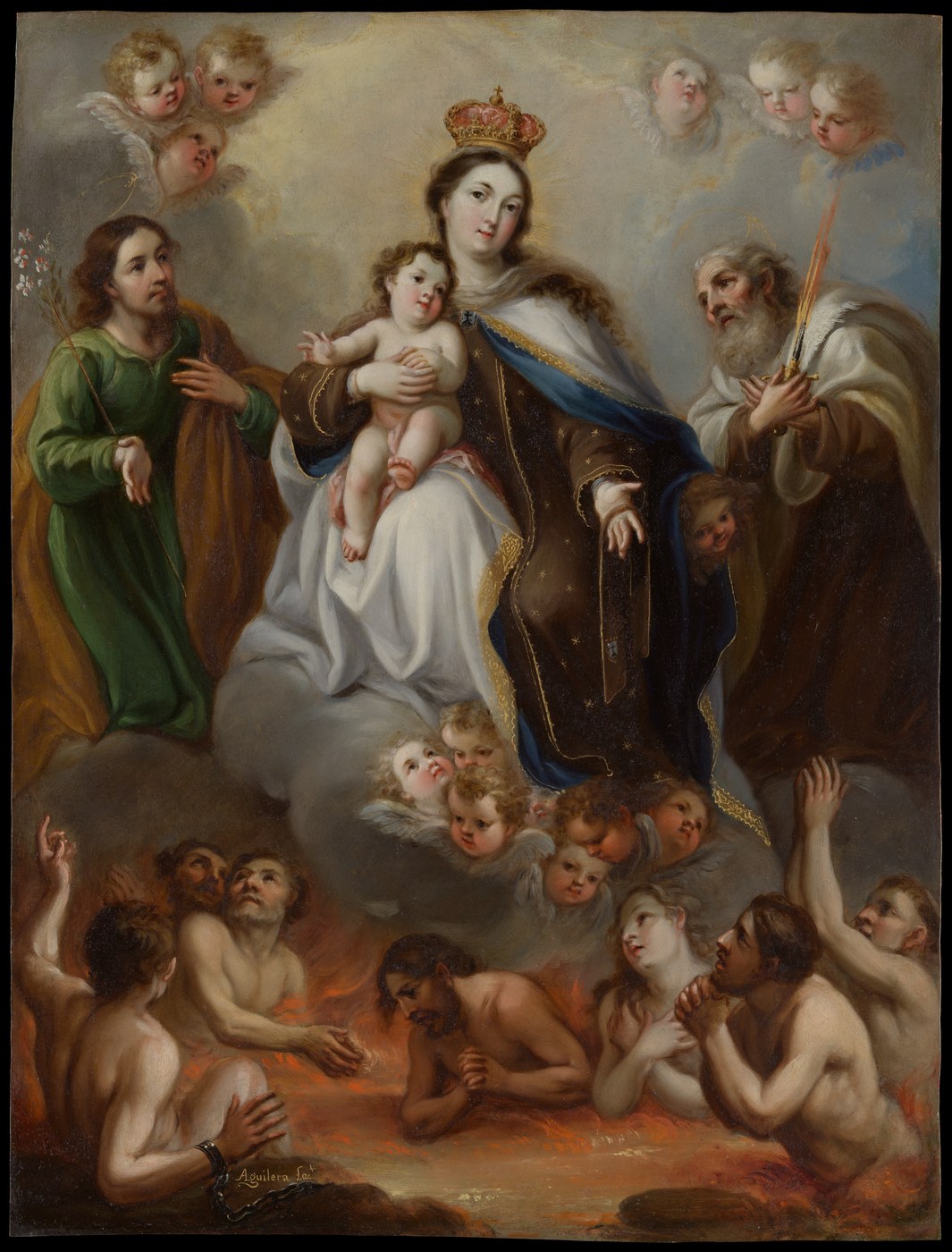
Juan Francisco de Aguilera, The Virgin of Carmen and the Souls of Purgatory with St. Joseph and the Prophet Elijah, ca. 1720. Oil and gold on copper. This devotional painting depicts the Virgin interceding for the departed. Its Catholic setting gives a historical image of heavenly aid.
The Metropolitan Museum of Art. Purchase, Nancy Dunn Revocable Trust Gift, 2017. Accession 2017.234. Public Domain (CC0). · Image source ↗ · CC0
A Subaltern in Spirit Land by J. S. M. Ward
In J. S. M. Ward’s A Subaltern in Spirit Land, Rex, Ward’s deceased brother, says he becomes aware of the requiem held for him after his death. A beam of light widens until he can see into St Mary’s, where his father places his sword behind the altar cross. He sees both the living congregation and departed participants gathered around the service. [7][8]
Rex describes the service as soothing and says it gives him hope while the surrounding world feels confused and hostile. When he later recalls the occasion, he calls the gathering a Communion of Saints. Prayer connects a mourning family on earth with a person the narrative imagines still learning what has happened to him. [8][9]
H. J. L., one of Ward’s reported spirit contributors, adds a condition to this account. In his view, a service reaches beyond its earthly setting through the mental effort of worshippers united in a common purpose. A brief prayer can reach further than the rest of a ceremony. This is the contributor’s explanation of how intercession works. [9][10]
Ward then describes another requiem, seen as light rising towards a French soldier. The earthly service has only a priest and a few older people present, yet many luminous spirits are said to join it. Within the story, the size of the visible congregation gives little indication of the company imagined around it. [10]
The Christmas chapter also reverses the direction of attention. Rex and his companions attend Midnight Mass in the astral counterpart of Ypres Cathedral and describe joining their prayers with worshippers on earth. They explain their temporary use of earthly time through this wish to pray together. H. J. L. calls the connection a communion of souls, while emphasising that its participants are still imperfect. The passage belongs to Ward’s Spiritualist interpretation of Christian worship. [11][12]
The sequel gives a quieter example alongside Rex’s vivid experience of the Requiem. During Ward’s mother’s hospital recovery, the service is said to send up a shaft of light and make her smile, while she remains asleep. The narrative distinguishes a comforting response from an immediate awakening or complete recovery. [26][27]
Read beside Rex’s encounter, the scene shows different recipients responding differently. The common image of light does not make every service produce an identical result. This remains Ward’s reported account of intercession rather than a universal rule about the effects of a Mass. [28][29][26]
The contrast belongs with H. J. L.’s view that common intention matters more than the visible size or length of a ceremony. The spirit contributor’s explanation should remain distinct from the church’s own account of its liturgy. [28][29][26]
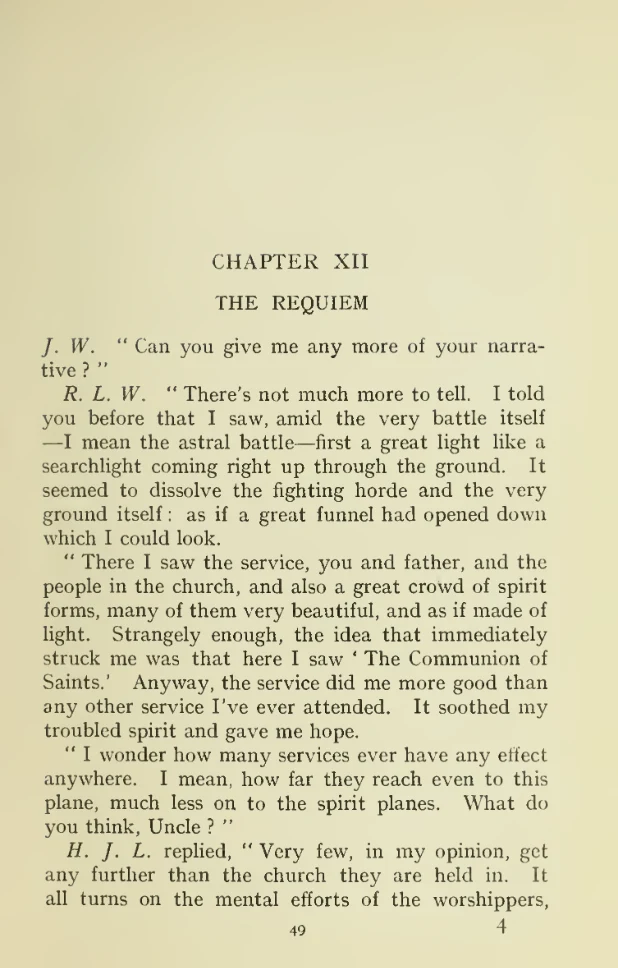
Source facsimile: A Subaltern in Spirit Land (1920), printed p. 49, Reader page 64.
J. S. M. Ward, A Subaltern in Spirit Land. William Rider & Son, 1920. Public-domain historical text and page image, extracted from the checksum-verified retained Library scan. · Image source ↗ · Public Domain
See references (10)
- A Subaltern in Spirit Land, printed p. 1, Reader page 16
- A Subaltern in Spirit Land, printed p. 2, Reader page 17
- A Subaltern in Spirit Land, printed p. 49, Reader page 64
- A Subaltern in Spirit Land, printed p. 50, Reader page 65
- A Subaltern in Spirit Land, printed p. 253, Reader page 268
- A Subaltern in Spirit Land, printed p. 254, Reader page 269
- A Subaltern in Spirit Land, printed p. 128, Reader page 143
- A Subaltern in Spirit Land, printed p. 129, Reader page 144
- A Subaltern in Spirit Land, printed p. 49, Reader page 64
- A Subaltern in Spirit Land, printed p. 50, Reader page 65
The Divine Comedy by Dante Alighieri
Dante Alighieri’s Divine Comedy repeatedly connects the mountain’s souls with people who can pray for them. Belacqua explains that his delayed repentance requires a corresponding wait before ascent, unless prayer from a heart living in grace helps him sooner. Giacopo del Cassero asks Dante to seek prayers in Fano. Remembering a name can become an act of assistance, rather than a memorial alone. [13][14]
The requests raise a question for the pilgrim: how can another person’s prayer change a sentence established by divine judgment? In Purgatory VI, Virgil answers that love can fulfil quickly what the penitent otherwise has to satisfy. He distinguishes this assistance from overturning the judgment, then refers Dante to Beatrice for fuller assurance. The explanation also marks the limits of the classical guide’s authority. [15]
Forese gives the practice a personal face. He attributes his rapid progress to his wife Nella’s prayers, grief and faithful love. The poem presents a continuing relation between her earthly life and his purification. Her prayer assists someone already directed towards blessedness; it is not an account of buying a release or making an unwilling soul good by force. [16][17]
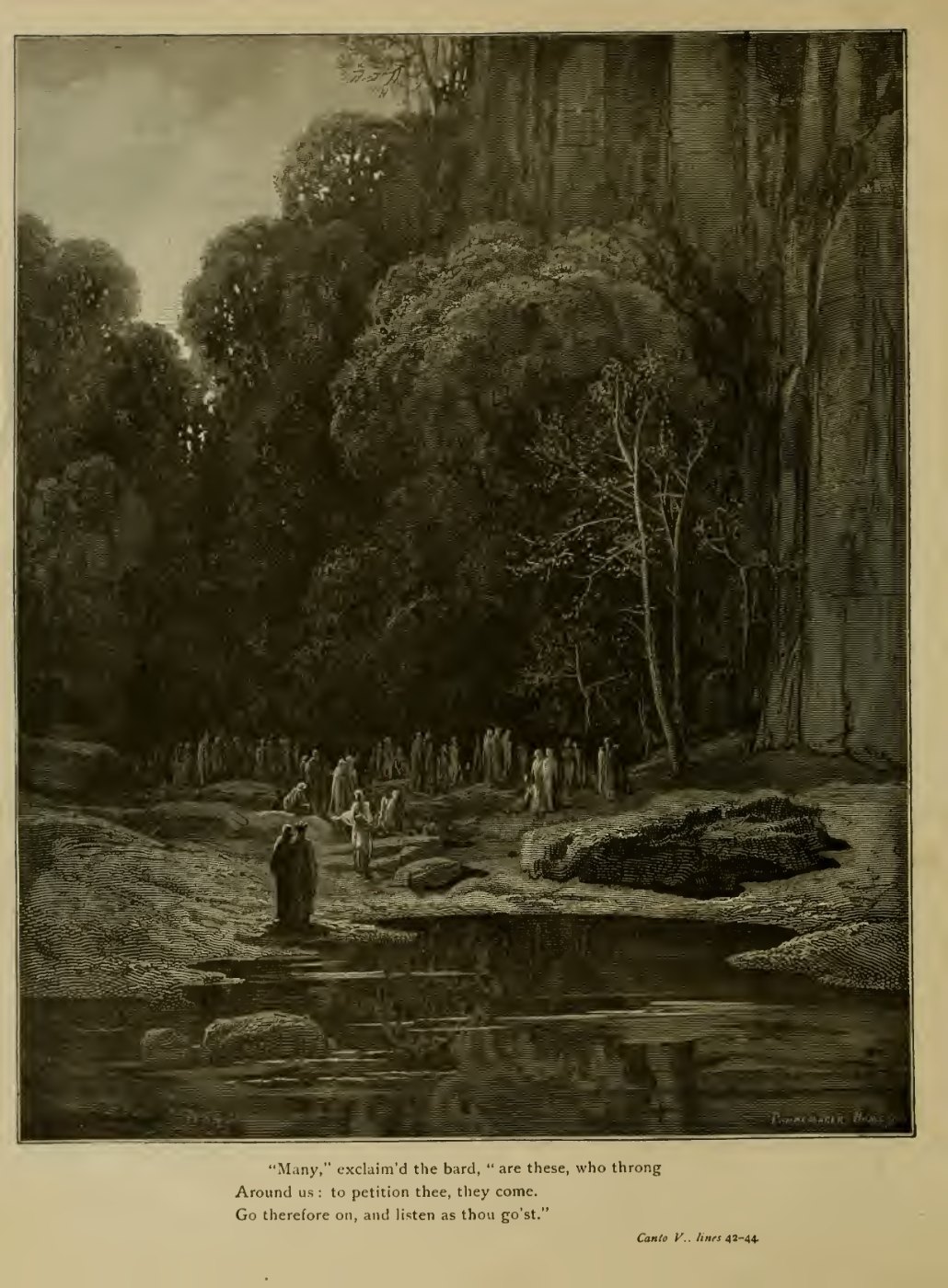
Souls gather to petition Dante in Purgatory V, Doré’s design. The encounter leads to requests that the living remember and pray for them. Their gathering is part of the poem’s account of continuing concern across death.
Design by Gustave Doré. Purgatory and Paradise, Henry Francis Cary translation, Thompson & Thomas, Chicago, 1901. Public Domain. · Image source ↗ · Public Domain
See references (5)
A Wanderer in the Spirit Lands
In A Wanderer in the Spirit Lands, attributed to Franchezzo and transcribed by A. Farnese, prayer can draw help towards someone unable to perceive the person praying. A wife in a brighter sphere continues to care for her husband, whose desire for vengeance keeps him elsewhere. Franchezzo is sent to carry the assurance that she still loves him and hopes for their reunion. [19][20][21]
The message does not instantly place husband and wife together. He first becomes willing to leave his revenge, is led to helpers and begins further development. Prayer works through a chain of personal care in this story: the wife, the messenger, the receiving friends and the man’s own change of direction all have a role. [21][22]
The concluding appeal asks the living to offer sympathy and prayer even for people whose deaths or lives seemed to place them beyond hope. It explicitly includes those who died by suicide. This is the author’s account of continuing mercy and solidarity, rather than evidence that a prayer has a measurable effect or that mourners must secure another person’s progress. [23][24][25]
See references (7)
- A Wanderer in the Spirit Lands, Reader page 165
- A Wanderer in the Spirit Lands, Reader page 166
- A Wanderer in the Spirit Lands, Reader page 167
- A Wanderer in the Spirit Lands, Reader page 168
- A Wanderer in the Spirit Lands, Reader page 230
- A Wanderer in the Spirit Lands, Reader page 231
- A Wanderer in the Spirit Lands, Reader page 315
Assistance, participation and responsibility
Ward’s contributors become aware of services held for them. Franchezzo brings a message to someone who cannot perceive the person praying for him. Dante gives petitions a part in the ascent of a penitent already bound for blessedness. [1][7][8][11][12][19][20][21][16][17]
The stories give the recipient a role as well as the mourner. Some are ready to receive help, while others have to recognise where it comes from or decide what to do next. [5][6][16][17][23][24][25]
Ward links strength with recognising a requiem. Dante’s Virgil explains help through love meeting an obligation. Marsay’s account in Lee’s collection asks what help would mean for someone still resisting purification. [1][15][33][34]
Dante’s Belacqua hopes a prayer may shorten his wait. Leadbeater describes help fitted to a person’s condition and gives funeral prayers a place in comforting those still alive. [13][14][38][39][43][44]
See references (24)
- Gone West, printed p. 32, Reader page 45
- Gone West, printed p. 151, Reader page 164
- Gone West, printed p. 152, Reader page 165
- A Subaltern in Spirit Land, printed p. 1, Reader page 16
- A Subaltern in Spirit Land, printed p. 2, Reader page 17
- A Subaltern in Spirit Land, printed p. 253, Reader page 268
- A Subaltern in Spirit Land, printed p. 254, Reader page 269
- Purgatory and Paradise, Purgatory IV, printed p. 18, Reader page 28
- Purgatory and Paradise, Purgatory V, Reader page 33
- Purgatory and Paradise, Purgatory VI, printed p. 24, Reader page 36
- Purgatory and Paradise, Purgatory XXIII, Reader page 138
- Purgatory and Paradise, Purgatory XXIII, Reader page 139
- A Wanderer in the Spirit Lands, Reader page 165
- A Wanderer in the Spirit Lands, Reader page 166
- A Wanderer in the Spirit Lands, Reader page 167
- A Wanderer in the Spirit Lands, Reader page 230
- A Wanderer in the Spirit Lands, Reader page 231
- A Wanderer in the Spirit Lands, Reader page 315
- The Other World, Reader page 388
- The Other World, Reader page 389
- The Science of the Sacraments, Reader page 176
- The Science of the Sacraments, Reader page 177
- The Science of the Sacraments, Reader page 546
- The Science of the Sacraments, Reader page 547
Read further in the library

Gone West
Reading note
The account below follows the exact pages of the verified Library edition.

A Subaltern in Spirit Land: A Sequel to Gone West
Reading note
Ward’s sequel adds the separately cited account of this subject.
Purgatory and Paradise: The Vision of Dante
Reading note
Dante’s distinct literary account, linked to exact leaves of the consulted Cary translation.

A Wanderer in the Spirit Lands
Reading note
A wife’s prayers reach her husband through a messenger, with further progress still needed before their reunion.

The Other World
Reading note
The separately titled account draws on exact passages in the consulted Library edition.

The Science of the Sacraments
Reading note
The separately titled account draws on exact passages in the consulted Library edition.
Sources
See references (45)
- Gone West, printed p. 32, Reader page 45J. S. M. Ward, Gone West, 1920 third impression in the 2009 Geoff Cutler digital transcription.Read this page in Gone West ↗Return to text ↑
- Gone West, printed p. 45, Reader page 58J. S. M. Ward, Gone West, 1920 third impression in the 2009 Geoff Cutler digital transcription.Read this page in Gone West ↗Return to text ↑
- Gone West, printed p. 44, Reader page 57J. S. M. Ward, Gone West, 1920 third impression in the 2009 Geoff Cutler digital transcription.Read this page in Gone West ↗Return to text ↑
- The Virgin of Carmen and the Souls of Purgatory with St. Joseph and the Prophet Elijah ↗The Metropolitan Museum of Art; object record 2017.234Return to text ↑
- Gone West, printed p. 151, Reader page 164J. S. M. Ward, Gone West, 1920 third impression in the 2009 Geoff Cutler digital transcription.Read this page in Gone West ↗Return to text ↑
- Gone West, printed p. 152, Reader page 165J. S. M. Ward, Gone West, 1920 third impression in the 2009 Geoff Cutler digital transcription.Read this page in Gone West ↗Return to text ↑
- A Subaltern in Spirit Land, printed p. 1, Reader page 16J. S. M. Ward, A Subaltern in Spirit Land: A Sequel to Gone West, William Rider & Son, 1920.Read this page in A Subaltern in Spirit Land: A Sequel to Gone West ↗Return to text ↑
- A Subaltern in Spirit Land, printed p. 2, Reader page 17J. S. M. Ward, A Subaltern in Spirit Land: A Sequel to Gone West, William Rider & Son, 1920.Read this page in A Subaltern in Spirit Land: A Sequel to Gone West ↗Return to text ↑
- A Subaltern in Spirit Land, printed p. 49, Reader page 64J. S. M. Ward, A Subaltern in Spirit Land: A Sequel to Gone West, William Rider & Son, 1920.Read this page in A Subaltern in Spirit Land: A Sequel to Gone West ↗Return to text ↑
- A Subaltern in Spirit Land, printed p. 50, Reader page 65J. S. M. Ward, A Subaltern in Spirit Land: A Sequel to Gone West, William Rider & Son, 1920.Read this page in A Subaltern in Spirit Land: A Sequel to Gone West ↗Return to text ↑
- A Subaltern in Spirit Land, printed p. 253, Reader page 268J. S. M. Ward, A Subaltern in Spirit Land: A Sequel to Gone West, William Rider & Son, 1920.Read this page in A Subaltern in Spirit Land: A Sequel to Gone West ↗Return to text ↑
- A Subaltern in Spirit Land, printed p. 254, Reader page 269J. S. M. Ward, A Subaltern in Spirit Land: A Sequel to Gone West, William Rider & Son, 1920.Read this page in A Subaltern in Spirit Land: A Sequel to Gone West ↗Return to text ↑
- Purgatory and Paradise, Purgatory IV, printed p. 18, Reader page 28Dante Alighieri, The Divine Comedy, translated by Henry Francis Cary, designs by Gustave Doré. Inferno: Thompson & Thomas, Chicago, undated New Edition; Purgatory and Paradise: Thompson & Thomas, Chicago, 1901.Read this page in Purgatory and Paradise: The Vision of Dante ↗Return to text ↑
- Purgatory and Paradise, Purgatory V, Reader page 33Dante Alighieri, The Divine Comedy, translated by Henry Francis Cary, designs by Gustave Doré. Inferno: Thompson & Thomas, Chicago, undated New Edition; Purgatory and Paradise: Thompson & Thomas, Chicago, 1901.Read this page in Purgatory and Paradise: The Vision of Dante ↗Return to text ↑
- Purgatory and Paradise, Purgatory VI, printed p. 24, Reader page 36Dante Alighieri, The Divine Comedy, translated by Henry Francis Cary, designs by Gustave Doré. Inferno: Thompson & Thomas, Chicago, undated New Edition; Purgatory and Paradise: Thompson & Thomas, Chicago, 1901.Read this page in Purgatory and Paradise: The Vision of Dante ↗Return to text ↑
- Purgatory and Paradise, Purgatory XXIII, Reader page 138Dante Alighieri, The Divine Comedy, translated by Henry Francis Cary, designs by Gustave Doré. Inferno: Thompson & Thomas, Chicago, undated New Edition; Purgatory and Paradise: Thompson & Thomas, Chicago, 1901.Read this page in Purgatory and Paradise: The Vision of Dante ↗Return to text ↑
- Purgatory and Paradise, Purgatory XXIII, Reader page 139Dante Alighieri, The Divine Comedy, translated by Henry Francis Cary, designs by Gustave Doré. Inferno: Thompson & Thomas, Chicago, undated New Edition; Purgatory and Paradise: Thompson & Thomas, Chicago, 1901.Read this page in Purgatory and Paradise: The Vision of Dante ↗Return to text ↑
- Purgatory and Paradise, Purgatory V, Reader page 32Dante Alighieri, The Divine Comedy, translated by Henry Francis Cary. Inferno: undated New Edition, Thompson & Thomas, Chicago. Purgatory and Paradise: New Edition, Thompson & Thomas, Chicago, 1901. Designs by Gustave Doré.Read this page in Purgatory and Paradise: The Vision of Dante ↗
- A Wanderer in the Spirit Lands, Reader page 165Franchezzo (source attribution), A Wanderer in the Spirit Lands, transcribed by A. Farnese. W. J. Sinkins, London, 1896. Date confirmed on the consulted title-page facsimile.Read this page in A Wanderer in the Spirit Lands ↗Return to text ↑
- A Wanderer in the Spirit Lands, Reader page 166Franchezzo (source attribution), A Wanderer in the Spirit Lands, transcribed by A. Farnese. W. J. Sinkins, London, 1896. Date confirmed on the consulted title-page facsimile.Read this page in A Wanderer in the Spirit Lands ↗Return to text ↑
- A Wanderer in the Spirit Lands, Reader page 167Franchezzo (source attribution), A Wanderer in the Spirit Lands, transcribed by A. Farnese. W. J. Sinkins, London, 1896. Date confirmed on the consulted title-page facsimile.Read this page in A Wanderer in the Spirit Lands ↗Return to text ↑
- A Wanderer in the Spirit Lands, Reader page 168Franchezzo (source attribution), A Wanderer in the Spirit Lands, transcribed by A. Farnese. W. J. Sinkins, London, 1896. Date confirmed on the consulted title-page facsimile.Read this page in A Wanderer in the Spirit Lands ↗Return to text ↑
- A Wanderer in the Spirit Lands, Reader page 230Franchezzo (source attribution), A Wanderer in the Spirit Lands, transcribed by A. Farnese. W. J. Sinkins, London, 1896. Date confirmed on the consulted title-page facsimile.Read this page in A Wanderer in the Spirit Lands ↗Return to text ↑
- A Wanderer in the Spirit Lands, Reader page 231Franchezzo (source attribution), A Wanderer in the Spirit Lands, transcribed by A. Farnese. W. J. Sinkins, London, 1896. Date confirmed on the consulted title-page facsimile.Read this page in A Wanderer in the Spirit Lands ↗Return to text ↑
- A Wanderer in the Spirit Lands, Reader page 315Franchezzo (source attribution), A Wanderer in the Spirit Lands, transcribed by A. Farnese. W. J. Sinkins, London, 1896. Date confirmed on the consulted title-page facsimile.Read this page in A Wanderer in the Spirit Lands ↗Return to text ↑
- A Subaltern in Spirit Land, printed p. 128, Reader page 143J. S. M. Ward, A Subaltern in Spirit Land: A Sequel to Gone West. William Rider & Son, London, 1920. Narrated experiences and explanations are attributed to Ward and his reported spirit contributors, especially his brother Rex (R. L. W.) and H. J. L.Read this page in A Subaltern in Spirit Land: A Sequel to Gone West ↗Return to text ↑
- A Subaltern in Spirit Land, printed p. 129, Reader page 144J. S. M. Ward, A Subaltern in Spirit Land: A Sequel to Gone West. William Rider & Son, London, 1920. Narrated experiences and explanations are attributed to Ward and his reported spirit contributors, especially his brother Rex (R. L. W.) and H. J. L.Read this page in A Subaltern in Spirit Land: A Sequel to Gone West ↗Return to text ↑
- A Subaltern in Spirit Land, printed p. 49, Reader page 64J. S. M. Ward, A Subaltern in Spirit Land: A Sequel to Gone West. William Rider & Son, London, 1920. Narrated experiences and explanations are attributed to Ward and his reported spirit contributors, especially his brother Rex (R. L. W.) and H. J. L.Read this page in A Subaltern in Spirit Land: A Sequel to Gone West ↗Return to text ↑
- A Subaltern in Spirit Land, printed p. 50, Reader page 65J. S. M. Ward, A Subaltern in Spirit Land: A Sequel to Gone West. William Rider & Son, London, 1920. Narrated experiences and explanations are attributed to Ward and his reported spirit contributors, especially his brother Rex (R. L. W.) and H. J. L.Read this page in A Subaltern in Spirit Land: A Sequel to Gone West ↗Return to text ↑
- The Other World, Reader page 376Frederick George Lee, editor, The Other World; or, Glimpses of the Supernatural, two volumes, Henry S. King and Co., London, 1875. Exact consulted Library edition IMJ-0657-E001. Narratives and embedded quotations are attributed to this compilation; an original author is not represented as independently consulted merely because Lee quotes them. Reader positions are verified separately from printed pagination.Read this page in The Other World ↗Return to text ↑
- The Other World, Reader page 377Frederick George Lee, editor, The Other World; or, Glimpses of the Supernatural, two volumes, Henry S. King and Co., London, 1875. Exact consulted Library edition IMJ-0657-E001. Narratives and embedded quotations are attributed to this compilation; an original author is not represented as independently consulted merely because Lee quotes them. Reader positions are verified separately from printed pagination.Read this page in The Other World ↗Return to text ↑
- The Other World, Reader page 378Frederick George Lee, editor, The Other World; or, Glimpses of the Supernatural, two volumes, Henry S. King and Co., London, 1875. Exact consulted Library edition IMJ-0657-E001. Narratives and embedded quotations are attributed to this compilation; an original author is not represented as independently consulted merely because Lee quotes them. Reader positions are verified separately from printed pagination.Read this page in The Other World ↗Return to text ↑
- The Other World, Reader page 388Frederick George Lee, editor, The Other World; or, Glimpses of the Supernatural, two volumes, Henry S. King and Co., London, 1875. Exact consulted Library edition IMJ-0657-E001. Narratives and embedded quotations are attributed to this compilation; an original author is not represented as independently consulted merely because Lee quotes them. Reader positions are verified separately from printed pagination.Read this page in The Other World ↗Return to text ↑
- The Other World, Reader page 389Frederick George Lee, editor, The Other World; or, Glimpses of the Supernatural, two volumes, Henry S. King and Co., London, 1875. Exact consulted Library edition IMJ-0657-E001. Narratives and embedded quotations are attributed to this compilation; an original author is not represented as independently consulted merely because Lee quotes them. Reader positions are verified separately from printed pagination.Read this page in The Other World ↗Return to text ↑
- The Science of the Sacraments, Reader page 173Charles W. Leadbeater, The Science of the Sacraments, The St. Alban Press, 1920. Exact Library edition IMJ-0615-E001.Read this page in The Science of the Sacraments ↗Return to text ↑
- The Science of the Sacraments, Reader page 174Charles W. Leadbeater, The Science of the Sacraments, The St. Alban Press, 1920. Exact Library edition IMJ-0615-E001.Read this page in The Science of the Sacraments ↗Return to text ↑
- The Science of the Sacraments, Reader page 175Charles W. Leadbeater, The Science of the Sacraments, The St. Alban Press, 1920. Exact Library edition IMJ-0615-E001.Read this page in The Science of the Sacraments ↗Return to text ↑
- The Science of the Sacraments, Reader page 176Charles W. Leadbeater, The Science of the Sacraments, The St. Alban Press, 1920. Exact Library edition IMJ-0615-E001.Read this page in The Science of the Sacraments ↗Return to text ↑
- The Science of the Sacraments, Reader page 177Charles W. Leadbeater, The Science of the Sacraments, The St. Alban Press, 1920. Exact Library edition IMJ-0615-E001.Read this page in The Science of the Sacraments ↗Return to text ↑
- The Science of the Sacraments, Reader page 532Charles W. Leadbeater, The Science of the Sacraments, The St. Alban Press, 1920. Exact Library edition IMJ-0615-E001.Read this page in The Science of the Sacraments ↗Return to text ↑
- The Science of the Sacraments, Reader page 533Charles W. Leadbeater, The Science of the Sacraments, The St. Alban Press, 1920. Exact Library edition IMJ-0615-E001.Read this page in The Science of the Sacraments ↗Return to text ↑
- The Science of the Sacraments, Reader page 545Charles W. Leadbeater, The Science of the Sacraments, The St. Alban Press, 1920. Exact Library edition IMJ-0615-E001.Read this page in The Science of the Sacraments ↗Return to text ↑
- The Science of the Sacraments, Reader page 546Charles W. Leadbeater, The Science of the Sacraments, The St. Alban Press, 1920. Exact Library edition IMJ-0615-E001.Read this page in The Science of the Sacraments ↗Return to text ↑
- The Science of the Sacraments, Reader page 547Charles W. Leadbeater, The Science of the Sacraments, The St. Alban Press, 1920. Exact Library edition IMJ-0615-E001.Read this page in The Science of the Sacraments ↗Return to text ↑
- Catechism of the Catholic Church, §1032 ↗Catechism of the Catholic Church, §1032, The Final Purification, or Purgatory.Return to text ↑