Divine love
Divine love can mean God’s love, devotion to God or a power in existence. Compare scripture with the accounts of Swedenborg, Dowd and Walter Russell.
In this article
What is divine love?
Divine love can mean love that God gives, love that a person directs towards God or love understood as a power present in all things. The meanings can meet. A person may understand care for others as a response to being loved by God. A writer who calls love the organising power of the world is making a further claim. [1][2][3][4]
1 John: love expressed towards others
In 1 John 4:7–12, God acts first by sending the Son. Those who receive that love are called to love one another, and God’s love comes to its fulfilment among them. Verses 16–19 connect mature love with freedom from fear. [1]
Bhagavad Gita: devotion to Krishna
Bhagavad Gita 12.20 describes faithful devotees who take Krishna as their supreme goal and follow the teaching just given. They are dear to him. In Swami Mukundananda’s explanation, this belongs to the path of loving devotion, or bhakti. Divine love is expressed through a relationship of dedication and response. This verse gives one particular account within a much wider range of Hindu devotional traditions. [2]
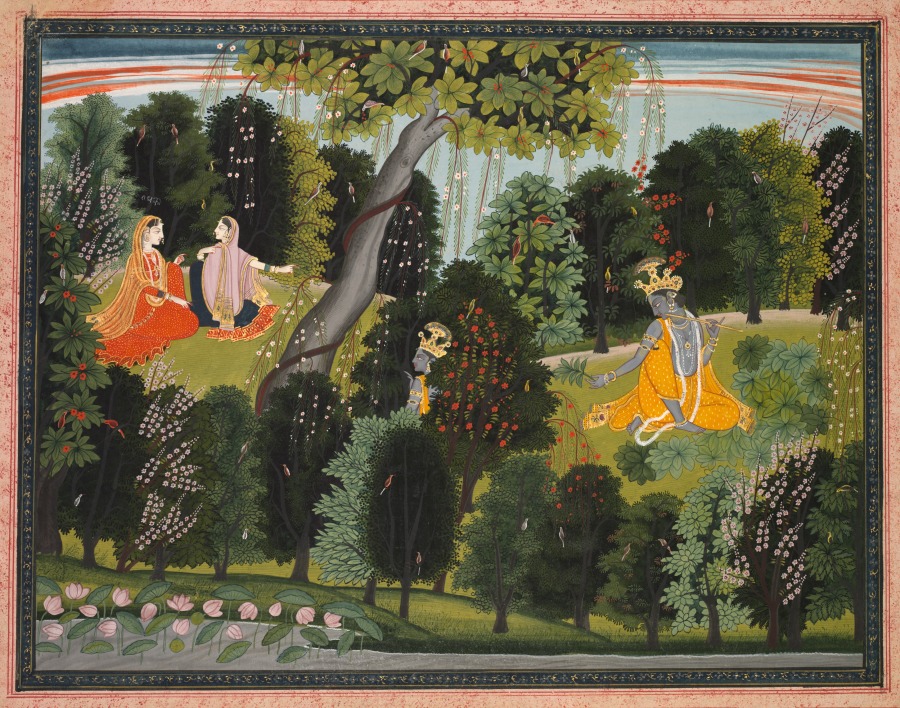
Sakhi persuades Radha to meet Krishna, attributed to Purkhu, about 1820–25. The painting illustrates Jayadeva’s Gita Govinda, a devotional poem centred on Radha and Krishna.
The Cleveland Museum of Art, Bequest of Mrs. Severance A. Millikin. 1989.334. CC0. · Image source ↗ · CC0
Quran: love and committed faith
Quran 5:54 describes a people whom God loves and who love God. The verse expresses that relationship through conduct: gentleness towards believers, firmness towards those who disbelieve and commitment in God’s cause. [3]
Heaven and Its Wonders and Hell
Emanuel Swedenborg’s Heaven and Its Wonders and Hell describes Divine love as willing the salvation and happiness of all. Its character is sharing: those who receive it find joy in the good of others. Angels’ wisdom and happiness are understood through this reception, rather than as possessions originating independently in themselves. [15][16][17][18][25][26][27]
The sun of heaven makes this love perceptible within Swedenborg’s cosmology. Its warmth corresponds to good and its light to truth. Different communities receive that influence in different ways. He compares an obstructed reception with clouds blocking sunlight: the sun continues to shine even when the observer cannot receive its brightness. [19][20][21][22][23][24][36][37]
This continuity also shapes his account of judgment. The Lord does not become angry, turn away or cease to offer good. A person may nevertheless turn towards a love incompatible with heavenly life. Swedenborg explains the separation through what is received and rejected, while maintaining the Divine will to save. [32][33][34][35]
Continuing love does not imply that every spirit eventually reaches heaven in this book. Swedenborg holds that a ruling love made one’s own on earth remains after death. His account must therefore be read with both claims present: Divine goodness is unceasing, and the recipient’s settled orientation can exclude the heavenly happiness it offers. [28][29][30][31][38]
See references (24)
- Heaven and Its Wonders and Hell, printed p. 9, Reader page 16
- Heaven and Its Wonders and Hell, printed p. 10, Reader page 17
- Heaven and Its Wonders and Hell, printed p. 11, Reader page 18
- Heaven and Its Wonders and Hell, printed p. 12, Reader page 19
- Heaven and Its Wonders and Hell, printed p. 13, Reader page 20
- Heaven and Its Wonders and Hell, printed p. 85, Reader page 92
- Heaven and Its Wonders and Hell, printed p. 86, Reader page 93
- Heaven and Its Wonders and Hell, printed p. 87, Reader page 94
- Heaven and Its Wonders and Hell, printed p. 93, Reader page 100
- Heaven and Its Wonders and Hell, printed p. 94, Reader page 101
- Heaven and Its Wonders and Hell, printed p. 337, Reader page 344
- Heaven and Its Wonders and Hell, printed p. 338, Reader page 345
- Heaven and Its Wonders and Hell, printed p. 339, Reader page 346
- Heaven and Its Wonders and Hell, printed p. 426, Reader page 433
- Heaven and Its Wonders and Hell, printed p. 427, Reader page 434
- Heaven and Its Wonders and Hell, printed p. 485, Reader page 492
- Heaven and Its Wonders and Hell, printed p. 486, Reader page 493
- Heaven and Its Wonders and Hell, printed p. 509, Reader page 516
- Heaven and Its Wonders and Hell, printed p. 510, Reader page 517
- Heaven and Its Wonders and Hell, printed p. 511, Reader page 518
- Heaven and Its Wonders and Hell, printed p. 512, Reader page 519
- Heaven and Its Wonders and Hell, printed p. 513, Reader page 520
- Heaven and Its Wonders and Hell, printed p. 514, Reader page 521
- Heaven and Its Wonders and Hell, printed p. 566, Reader page 573
Evolution of Immortality
Freeman Benjamin Dowd, publishing as Rosicruciæ in Evolution of Immortality, gives love a creative and organising role. The family provides an early image: a centre from which life, care and social activity radiate. Within the person, love supplies warmth while intelligence supplies light. The book asks for their cooperation in a developed soul. [5][6][7]
Rosicruciæ later calls love the creative power of the universe while distinguishing this Love God from the great Infinite Energy. He interprets worship through a person’s own love and the truth of the soul. In this account, love requires truth to become stable and ordered. It is more than an intensity of feeling, since desire can also produce confusion or discord. [4][8][9]
The appendix gives that inward work an ethical purpose. Love should prevent harm, replace vengeance with practical help and contribute to the uplift of all souls. Private happiness remains incomplete while other people remain oppressed. These are the social hopes of the author’s spiritual programme, joined to his further claims that loving vibrations can act through unseen spaces. [10][11]
The same book also uses love for a particular spiritual partnership and insists on monogamy within its fraternity. Its universal fellowship and its account of a singular intimate bond are related but different uses of the word. Keeping them distinct makes the book’s teaching easier to follow without turning its historical model of partnership into a universal rule about love. [12][13]
See references (10)
- Evolution of Immortality, printed p. 83, Reader page 80
- Evolution of Immortality, printed p. 14, Reader page 11
- Evolution of Immortality, printed p. 15, Reader page 12
- Evolution of Immortality, printed p. 16, Reader page 13
- Evolution of Immortality, printed p. 84, Reader page 81
- Evolution of Immortality, printed p. 85, Reader page 82
- Evolution of Immortality, printed p. 132, Reader page 131
- Evolution of Immortality, printed p. 139, Reader page 138
- Evolution of Immortality, printed p. 141, Reader page 140
- Evolution of Immortality, printed p. 142, Reader page 141
The Universal One by Walter Russell
Walter Russell calls the mutual dependence of everything the law of love. He connects it to the fact that all visible forms are expressions of a single substance. Because no form exists in isolation, he understands cosmic oneness as having consequences for how a person thinks and relates to others. [40][41][42]
The preface signed Lao Russell presents love as rhythmic, balanced interchange. It gives the theme a practical emphasis by connecting knowledge of balance with conduct. The preface is separately attributed, and its note identifies a 1974 printing. [43][44][45]
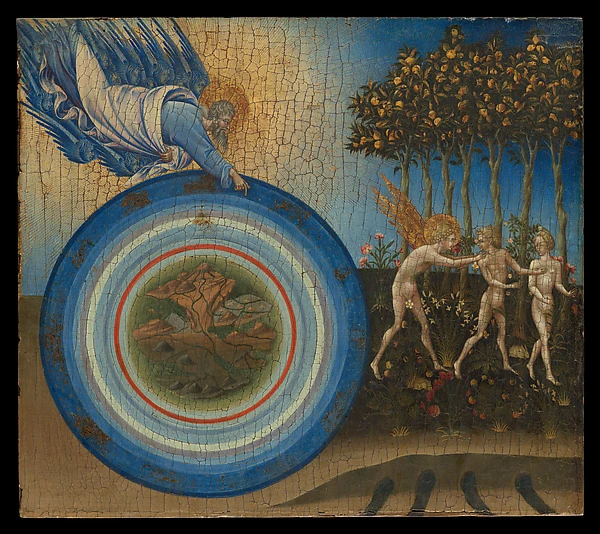
Giovanni di Paolo depicts creation using concentric circles. This Christian image of a single ordered cosmos has its own account of God’s relation to the world.
Giovanni di Paolo, The Creation of the World and the Expulsion from Paradise. The Metropolitan Museum of Art. Robert Lehman Collection, 1975. · Image source ↗ · CC0
Intention, action and the unity of things
Swedenborg begins with what divine love wants for others: that they share in happiness. Dowd gives love a creative role within the person and a social role in preventing harm and helping others. Russell begins with the dependence of every form on a common substance. Across these accounts, love can name an intention, an activity or a relation between all things. [5][6][7][12][13][15][16][17][18][25][26][27][28][29][30][31][38][40][41]
See references (19)
- Evolution of Immortality, printed p. 14, Reader page 11
- Evolution of Immortality, printed p. 15, Reader page 12
- Evolution of Immortality, printed p. 16, Reader page 13
- Evolution of Immortality, printed p. 141, Reader page 140
- Evolution of Immortality, printed p. 142, Reader page 141
- Heaven and Its Wonders and Hell, printed p. 9, Reader page 16
- Heaven and Its Wonders and Hell, printed p. 10, Reader page 17
- Heaven and Its Wonders and Hell, printed p. 11, Reader page 18
- Heaven and Its Wonders and Hell, printed p. 12, Reader page 19
- Heaven and Its Wonders and Hell, printed p. 337, Reader page 344
- Heaven and Its Wonders and Hell, printed p. 338, Reader page 345
- Heaven and Its Wonders and Hell, printed p. 339, Reader page 346
- Heaven and Its Wonders and Hell, printed p. 426, Reader page 433
- Heaven and Its Wonders and Hell, printed p. 427, Reader page 434
- Heaven and Its Wonders and Hell, printed p. 485, Reader page 492
- Heaven and Its Wonders and Hell, printed p. 486, Reader page 493
- Heaven and Its Wonders and Hell, printed p. 566, Reader page 573
- The Universal One, Reader page 66
- The Universal One, Reader page 69
Read further in the library
Evolution of Immortality
Reading note
Creative love, truth, practical fellowship and spiritual partnership each receive a distinct role.

Heaven and Its Wonders and Hell
Reading note
Divine love continually offers good, while reception explains the different lives that follow.
The Universal One
Reading note
The separately titled account draws on exact passages in the consulted Library edition.
Sources
See references (45)
- 1 John 4:7–12, 16–19 ↗1 John, New American Bible, Revised Edition; United States Conference of Catholic Bishops.Return to text ↑
- Bhagavad Gita 12.20 ↗Bhagavad Gita 12.20, translation and commentary by Swami Mukundananda, published by the teacher’s Bhagavad Gita site.Return to text ↑
- Quran 5:54, Arabic text ↗Quran 5:54, Arabic text presented by Quran.com. The account here paraphrases its reciprocal love language without attributing an unverified English translation.Return to text ↑
- Evolution of Immortality, printed p. 83, Reader page 80Rosicruciæ (catalogued as Freeman Benjamin Dowd), Evolution of Immortality. Eulian Publishing Company, Salem, 1900.Read this page in Evolution of Immortality ↗Return to text ↑
- Evolution of Immortality, printed p. 14, Reader page 11Rosicruciæ (catalogued as Freeman Benjamin Dowd), Evolution of Immortality. Eulian Publishing Company, Salem, 1900.Read this page in Evolution of Immortality ↗Return to text ↑
- Evolution of Immortality, printed p. 15, Reader page 12Rosicruciæ (catalogued as Freeman Benjamin Dowd), Evolution of Immortality. Eulian Publishing Company, Salem, 1900.Read this page in Evolution of Immortality ↗Return to text ↑
- Evolution of Immortality, printed p. 16, Reader page 13Rosicruciæ (catalogued as Freeman Benjamin Dowd), Evolution of Immortality. Eulian Publishing Company, Salem, 1900.Read this page in Evolution of Immortality ↗Return to text ↑
- Evolution of Immortality, printed p. 84, Reader page 81Rosicruciæ (catalogued as Freeman Benjamin Dowd), Evolution of Immortality. Eulian Publishing Company, Salem, 1900.Read this page in Evolution of Immortality ↗Return to text ↑
- Evolution of Immortality, printed p. 85, Reader page 82Rosicruciæ (catalogued as Freeman Benjamin Dowd), Evolution of Immortality. Eulian Publishing Company, Salem, 1900.Read this page in Evolution of Immortality ↗Return to text ↑
- Evolution of Immortality, printed p. 132, Reader page 131Rosicruciæ (catalogued as Freeman Benjamin Dowd), Evolution of Immortality. Eulian Publishing Company, Salem, 1900.Read this page in Evolution of Immortality ↗Return to text ↑
- Evolution of Immortality, printed p. 139, Reader page 138Rosicruciæ (catalogued as Freeman Benjamin Dowd), Evolution of Immortality. Eulian Publishing Company, Salem, 1900.Read this page in Evolution of Immortality ↗Return to text ↑
- Evolution of Immortality, printed p. 141, Reader page 140Rosicruciæ (catalogued as Freeman Benjamin Dowd), Evolution of Immortality. Eulian Publishing Company, Salem, 1900.Read this page in Evolution of Immortality ↗Return to text ↑
- Evolution of Immortality, printed p. 142, Reader page 141Rosicruciæ (catalogued as Freeman Benjamin Dowd), Evolution of Immortality. Eulian Publishing Company, Salem, 1900.Read this page in Evolution of Immortality ↗Return to text ↑
- Sakhi persuades Radha to meet Krishna, from a Gita Govinda (Song of the Cowherd) of Jayadeva, c. 1820–25 ↗Sakhi persuades Radha to meet Krishna, from a Gita Govinda (Song of the Cowherd) of Jayadeva, c. 1820–25. Attributed to Purkhu (Indian, 1750–1860). Gum tempera and gold on paper; overall: 24.1 x 32.1 cm (9 1/2 x 12 5/8 in.); with borders: 25.4 x 30.3 cm (10 x 11 15/16 in.). The Cleveland Museum of Art, Bequest of Mrs. Severance A. Millikin, 1989.334. CC0 open-access image.
- Heaven and Its Wonders and Hell, printed p. 9, Reader page 16Emanuel Swedenborg, Heaven and Its Wonders and Hell, translated by J. C. Ager. The American Swedenborg Printing and Publishing Society, New York, 1916. Original Latin work first published in 1758.Read this page in Heaven and Its Wonders and Hell ↗Return to text ↑
- Heaven and Its Wonders and Hell, printed p. 10, Reader page 17Emanuel Swedenborg, Heaven and Its Wonders and Hell, translated by J. C. Ager. The American Swedenborg Printing and Publishing Society, New York, 1916. Original Latin work first published in 1758.Read this page in Heaven and Its Wonders and Hell ↗Return to text ↑
- Heaven and Its Wonders and Hell, printed p. 11, Reader page 18Emanuel Swedenborg, Heaven and Its Wonders and Hell, translated by J. C. Ager. The American Swedenborg Printing and Publishing Society, New York, 1916. Original Latin work first published in 1758.Read this page in Heaven and Its Wonders and Hell ↗Return to text ↑
- Heaven and Its Wonders and Hell, printed p. 12, Reader page 19Emanuel Swedenborg, Heaven and Its Wonders and Hell, translated by J. C. Ager. The American Swedenborg Printing and Publishing Society, New York, 1916. Original Latin work first published in 1758.Read this page in Heaven and Its Wonders and Hell ↗Return to text ↑
- Heaven and Its Wonders and Hell, printed p. 13, Reader page 20Emanuel Swedenborg, Heaven and Its Wonders and Hell, translated by J. C. Ager. The American Swedenborg Printing and Publishing Society, New York, 1916. Original Latin work first published in 1758.Read this page in Heaven and Its Wonders and Hell ↗Return to text ↑
- Heaven and Its Wonders and Hell, printed p. 85, Reader page 92Emanuel Swedenborg, Heaven and Its Wonders and Hell, translated by J. C. Ager. The American Swedenborg Printing and Publishing Society, New York, 1916. Original Latin work first published in 1758.Read this page in Heaven and Its Wonders and Hell ↗Return to text ↑
- Heaven and Its Wonders and Hell, printed p. 86, Reader page 93Emanuel Swedenborg, Heaven and Its Wonders and Hell, translated by J. C. Ager. The American Swedenborg Printing and Publishing Society, New York, 1916. Original Latin work first published in 1758.Read this page in Heaven and Its Wonders and Hell ↗Return to text ↑
- Heaven and Its Wonders and Hell, printed p. 87, Reader page 94Emanuel Swedenborg, Heaven and Its Wonders and Hell, translated by J. C. Ager. The American Swedenborg Printing and Publishing Society, New York, 1916. Original Latin work first published in 1758.Read this page in Heaven and Its Wonders and Hell ↗Return to text ↑
- Heaven and Its Wonders and Hell, printed p. 93, Reader page 100Emanuel Swedenborg, Heaven and Its Wonders and Hell, translated by J. C. Ager. The American Swedenborg Printing and Publishing Society, New York, 1916. Original Latin work first published in 1758.Read this page in Heaven and Its Wonders and Hell ↗Return to text ↑
- Heaven and Its Wonders and Hell, printed p. 94, Reader page 101Emanuel Swedenborg, Heaven and Its Wonders and Hell, translated by J. C. Ager. The American Swedenborg Printing and Publishing Society, New York, 1916. Original Latin work first published in 1758.Read this page in Heaven and Its Wonders and Hell ↗Return to text ↑
- Heaven and Its Wonders and Hell, printed p. 337, Reader page 344Emanuel Swedenborg, Heaven and Its Wonders and Hell, translated by J. C. Ager. The American Swedenborg Printing and Publishing Society, New York, 1916. Original Latin work first published in 1758.Read this page in Heaven and Its Wonders and Hell ↗Return to text ↑
- Heaven and Its Wonders and Hell, printed p. 338, Reader page 345Emanuel Swedenborg, Heaven and Its Wonders and Hell, translated by J. C. Ager. The American Swedenborg Printing and Publishing Society, New York, 1916. Original Latin work first published in 1758.Read this page in Heaven and Its Wonders and Hell ↗Return to text ↑
- Heaven and Its Wonders and Hell, printed p. 339, Reader page 346Emanuel Swedenborg, Heaven and Its Wonders and Hell, translated by J. C. Ager. The American Swedenborg Printing and Publishing Society, New York, 1916. Original Latin work first published in 1758.Read this page in Heaven and Its Wonders and Hell ↗Return to text ↑
- Heaven and Its Wonders and Hell, printed p. 426, Reader page 433Emanuel Swedenborg, Heaven and Its Wonders and Hell, translated by J. C. Ager. The American Swedenborg Printing and Publishing Society, New York, 1916. Original Latin work first published in 1758.Read this page in Heaven and Its Wonders and Hell ↗Return to text ↑
- Heaven and Its Wonders and Hell, printed p. 427, Reader page 434Emanuel Swedenborg, Heaven and Its Wonders and Hell, translated by J. C. Ager. The American Swedenborg Printing and Publishing Society, New York, 1916. Original Latin work first published in 1758.Read this page in Heaven and Its Wonders and Hell ↗Return to text ↑
- Heaven and Its Wonders and Hell, printed p. 485, Reader page 492Emanuel Swedenborg, Heaven and Its Wonders and Hell, translated by J. C. Ager. The American Swedenborg Printing and Publishing Society, New York, 1916. Original Latin work first published in 1758.Read this page in Heaven and Its Wonders and Hell ↗Return to text ↑
- Heaven and Its Wonders and Hell, printed p. 486, Reader page 493Emanuel Swedenborg, Heaven and Its Wonders and Hell, translated by J. C. Ager. The American Swedenborg Printing and Publishing Society, New York, 1916. Original Latin work first published in 1758.Read this page in Heaven and Its Wonders and Hell ↗Return to text ↑
- Heaven and Its Wonders and Hell, printed p. 509, Reader page 516Emanuel Swedenborg, Heaven and Its Wonders and Hell, translated by J. C. Ager. The American Swedenborg Printing and Publishing Society, New York, 1916. Original Latin work first published in 1758.Read this page in Heaven and Its Wonders and Hell ↗Return to text ↑
- Heaven and Its Wonders and Hell, printed p. 510, Reader page 517Emanuel Swedenborg, Heaven and Its Wonders and Hell, translated by J. C. Ager. The American Swedenborg Printing and Publishing Society, New York, 1916. Original Latin work first published in 1758.Read this page in Heaven and Its Wonders and Hell ↗Return to text ↑
- Heaven and Its Wonders and Hell, printed p. 511, Reader page 518Emanuel Swedenborg, Heaven and Its Wonders and Hell, translated by J. C. Ager. The American Swedenborg Printing and Publishing Society, New York, 1916. Original Latin work first published in 1758.Read this page in Heaven and Its Wonders and Hell ↗Return to text ↑
- Heaven and Its Wonders and Hell, printed p. 512, Reader page 519Emanuel Swedenborg, Heaven and Its Wonders and Hell, translated by J. C. Ager. The American Swedenborg Printing and Publishing Society, New York, 1916. Original Latin work first published in 1758.Read this page in Heaven and Its Wonders and Hell ↗Return to text ↑
- Heaven and Its Wonders and Hell, printed p. 513, Reader page 520Emanuel Swedenborg, Heaven and Its Wonders and Hell, translated by J. C. Ager. The American Swedenborg Printing and Publishing Society, New York, 1916. Original Latin work first published in 1758.Read this page in Heaven and Its Wonders and Hell ↗Return to text ↑
- Heaven and Its Wonders and Hell, printed p. 514, Reader page 521Emanuel Swedenborg, Heaven and Its Wonders and Hell, translated by J. C. Ager. The American Swedenborg Printing and Publishing Society, New York, 1916. Original Latin work first published in 1758.Read this page in Heaven and Its Wonders and Hell ↗Return to text ↑
- Heaven and Its Wonders and Hell, printed p. 566, Reader page 573Emanuel Swedenborg, Heaven and Its Wonders and Hell, translated by J. C. Ager. The American Swedenborg Printing and Publishing Society, New York, 1916. Original Latin work first published in 1758.Read this page in Heaven and Its Wonders and Hell ↗Return to text ↑
- Giovanni di Paolo, The Creation of the World and the Expulsion from Paradise ↗Giovanni di Paolo, The Creation of the World and the Expulsion from Paradise. The Metropolitan Museum of Art. Robert Lehman Collection, 1975.
- The Universal One, Reader page 66Walter Russell, The Universal One, edited by Louise Russell, University of Science and Philosophy, Limited Edition De Luxe. Lumitheca Library edition IMJ-0605-E001.Read this page in The Universal One ↗Return to text ↑
- The Universal One, Reader page 69Walter Russell, The Universal One, edited by Louise Russell, University of Science and Philosophy, Limited Edition De Luxe. Lumitheca Library edition IMJ-0605-E001.Read this page in The Universal One ↗Return to text ↑
- The Universal One, Reader page 70Walter Russell, The Universal One, edited by Louise Russell, University of Science and Philosophy, Limited Edition De Luxe. Lumitheca Library edition IMJ-0605-E001.Read this page in The Universal One ↗Return to text ↑
- The Universal One, Reader page 4Walter Russell, The Universal One, edited by Louise Russell, University of Science and Philosophy, Limited Edition De Luxe. Lumitheca Library edition IMJ-0605-E001.Read this page in The Universal One ↗Return to text ↑
- The Universal One, Reader page 5Walter Russell, The Universal One, edited by Louise Russell, University of Science and Philosophy, Limited Edition De Luxe. Lumitheca Library edition IMJ-0605-E001.Read this page in The Universal One ↗Return to text ↑
- The Universal One, Reader page 6Walter Russell, The Universal One, edited by Louise Russell, University of Science and Philosophy, Limited Edition De Luxe. Lumitheca Library edition IMJ-0605-E001.Read this page in The Universal One ↗Return to text ↑