Divine immanence
Divine immanence is the presence of the divine within the world. Compare Paul’s speech in Acts with Spinoza, Freeman Benjamin Dowd and Walter Russell.
In this article
What is divine immanence?
Divine immanence means that the divine is present or active within the world. A writer may mean that living beings depend continuously on God, that God works within nature, or that everything exists within divine reality. Each claim gives a different relation between the world and its source. [1][2][3][4]
Acts of the Apostles: a God who is near
In Acts 17:24–31, Paul tells his Athenian listeners that God made the world and gives life to its inhabitants. God is near to each person, and human life depends on that presence. The speech moves from that dependence to seeking God, repentance and judgment. [1]
Spinoza’s Ethics: an indwelling cause
In Ethics I, proposition 18, Baruch Spinoza calls God the indwelling cause of all things. He reasons that everything is in God and that no substance exists outside God. On this view, the things God causes exist within the reality on which they depend. [2]
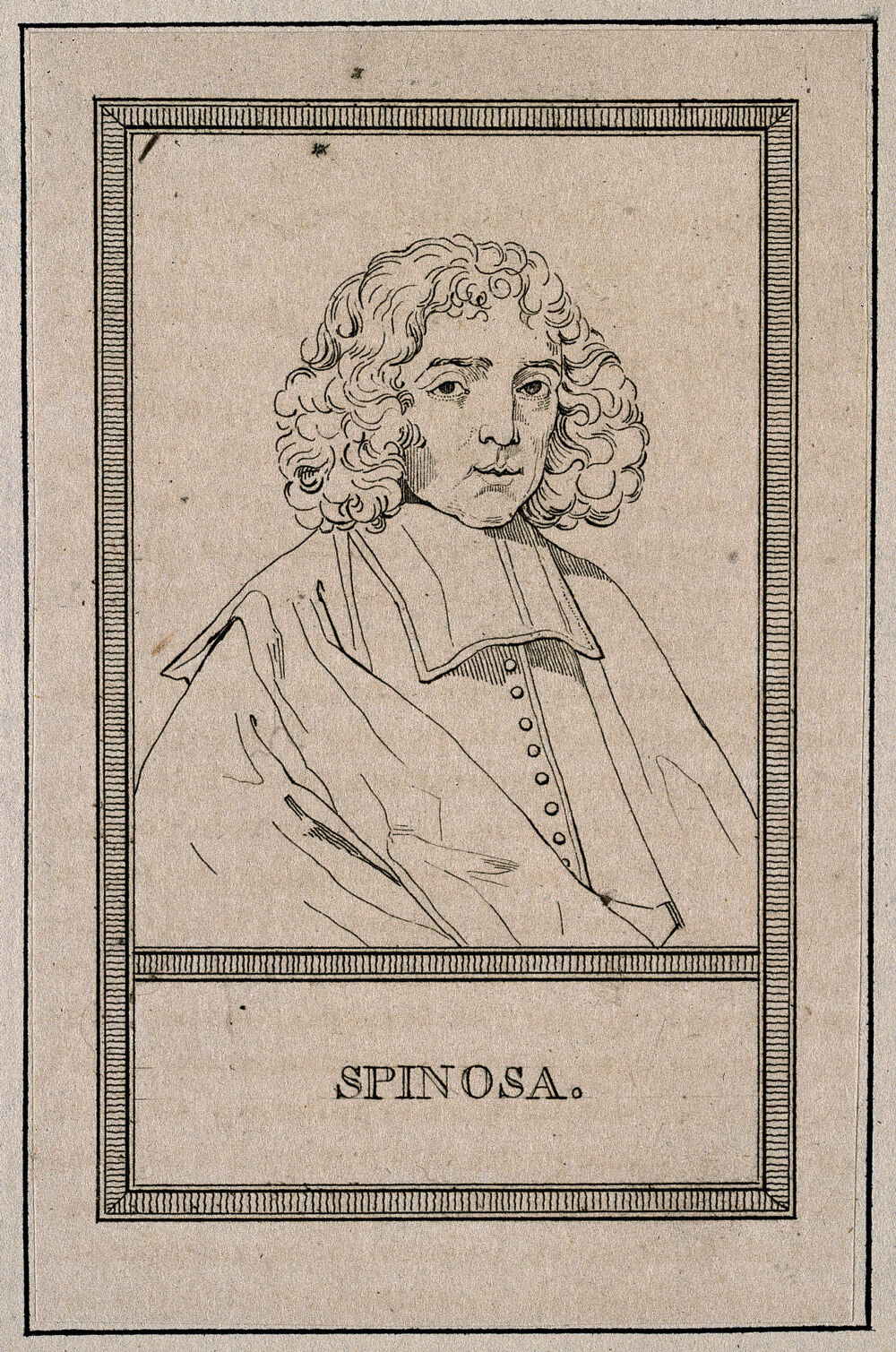
Engraved portrait of Baruch Spinoza, held by Wellcome Collection.
Wellcome Collection, 8923i. Public Domain Mark. Engraver and date not established in the catalogue record. · Image source ↗ · Public Domain
Evolution of Immortality
Freeman Benjamin Dowd, writing as Rosicruciæ in Evolution of Immortality, identifies God with an eternal energy pervading nature. Breathing and thinking express that common reality. He argues that there can have been no period of absolute inactivity or nothingness. [3][4][12][13][16]
Dowd compares distinct forms to waves within water. Waves take different shapes while remaining part of the same water. The soul is a centre through which universal forces take on individual qualities. [5][6][7][8][14][15]
Later in the book, Dowd distinguishes Infinite Energy from the creative God of Love. He gives these powers different roles in his account of Genesis and the teaching of Jesus. [9][10]
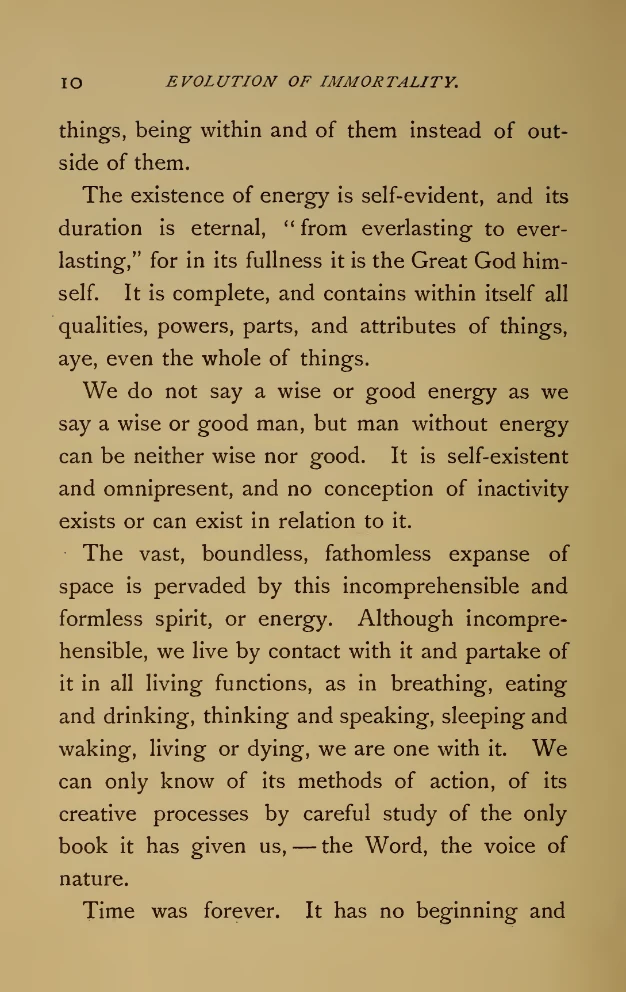
Source facsimile: Evolution of Immortality (1900), printed p. 10, Reader page 7.
Rosicruciæ (catalogued as Freeman Benjamin Dowd), Evolution of Immortality, copyright 1900. Public-domain historical page from the checksum-verified Library PDF. · Image source ↗ · Public Domain
See references (13)
- Evolution of Immortality, printed p. 9, Reader page 6
- Evolution of Immortality, printed p. 10, Reader page 7
- Evolution of Immortality, printed p. 12, Reader page 9
- Evolution of Immortality, printed p. 13, Reader page 10
- Evolution of Immortality, printed p. 14, Reader page 11
- Evolution of Immortality, printed p. 16, Reader page 13
- Evolution of Immortality, printed p. 83, Reader page 80
- Evolution of Immortality, printed p. 84, Reader page 81
- Evolution of Immortality, printed p. 10, Reader page 7
- Evolution of Immortality, printed p. 11, Reader page 8
- Evolution of Immortality, printed p. 12, Reader page 9
- Evolution of Immortality, printed p. 13, Reader page 10
- Evolution of Immortality, printed p. 9, Reader page 6
God as universal energy: distinctions
The opening identification should be read beside the later distinction between Infinite Energy and the creative God of Love. The book differentiates powers within its own account. A single slogan about universal energy would conceal that complication. [12][17][18]
The Universal One by Walter Russell
Walter Russell’s chapter on omnipresence asks how God can be present everywhere while remaining apart from nature. He treats human beings and nature as expressions of the same Mind. His examples in the chapter on oneness range from a tree and a stream to stars. [20][21][22][23]
For Russell, creation adds nothing to divine substance. His account draws a distinction between the underlying substance, which persists, and the appearance of a particular thing, which changes. God is present both in the formation of things and in their dissolution. [20][24][25][23]
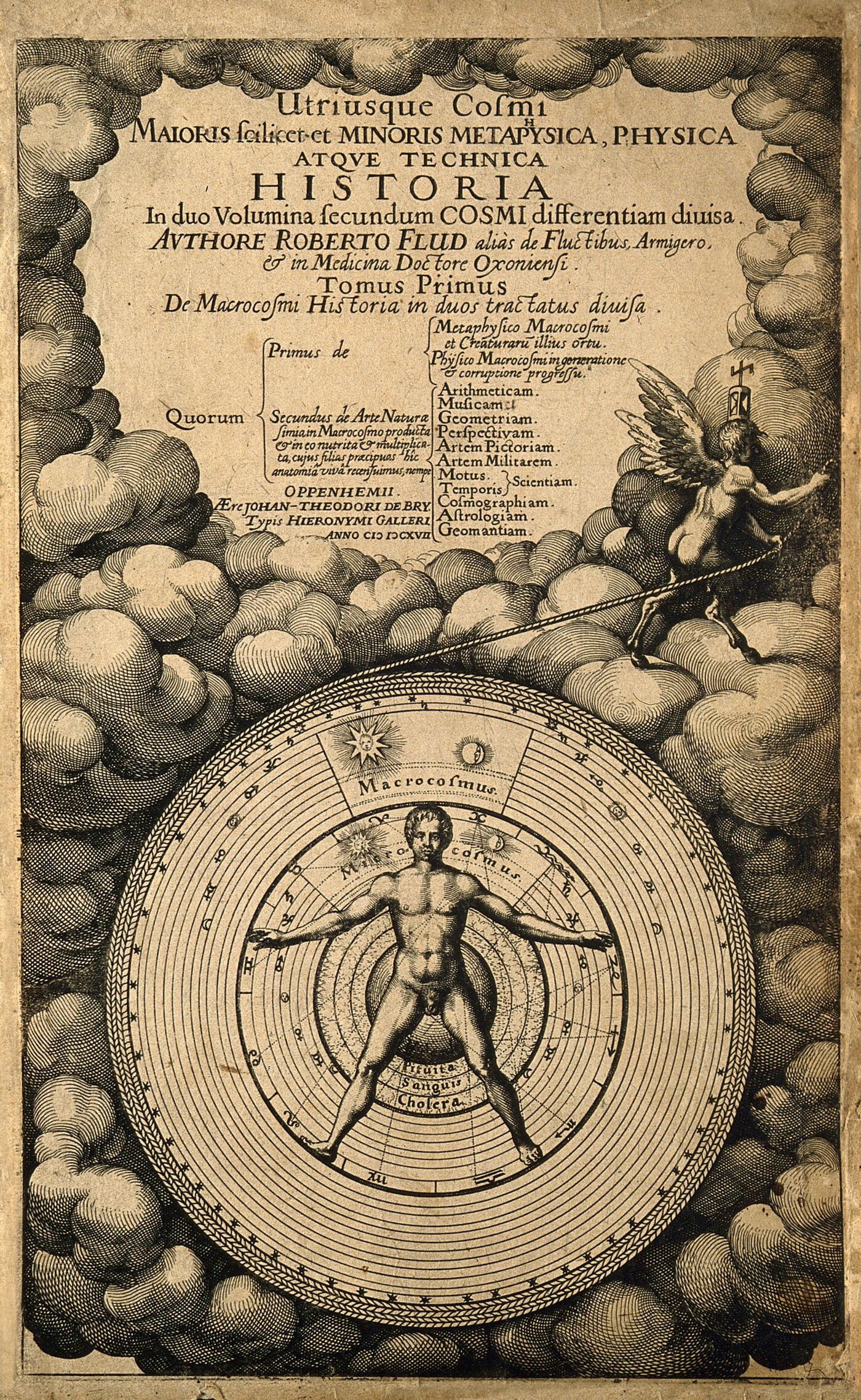
Robert Fludd’s engraved frontispiece maps a human figure within the cosmos. It offers an earlier image of connected human and cosmic life.
Wellcome Collection, 2989i. T. de Bry, 1617, associated with Robert Fludd. Public Domain Mark. · Image source ↗ · Public Domain
Nearness, causation and unity
Paul speaks of a creator who gives and sustains life. Spinoza argues that things exist within their divine cause. Dowd and Russell both describe a common ground for changing forms. Dowd differentiates divine powers, while Russell makes Mind the substance of nature. [1][2][5][6][9][10][20][21][23]
See references (9)
- Acts of the Apostles 17:24–29
- Spinoza, Ethics, I, proposition 18 and proof
- Evolution of Immortality, printed p. 12, Reader page 9
- Evolution of Immortality, printed p. 13, Reader page 10
- Evolution of Immortality, printed p. 83, Reader page 80
- Evolution of Immortality, printed p. 84, Reader page 81
- The Universal One, Reader page 17
- The Universal One, Reader page 19
- The Universal One, Reader page 71
Read further in the library
Evolution of Immortality
Reading note
Divine energy within nature, the differentiation of forms and an inward account of spiritual presence.

The Universal One
Reading note
The separately titled account draws on exact passages in the consulted Library edition.
Sources
See references (25)
- Acts of the Apostles 17:24–29 ↗Acts of the Apostles, New American Bible, Revised Edition; United States Conference of Catholic Bishops.Return to text ↑
- Spinoza, Ethics, I, proposition 18 and proof ↗Benedict de Spinoza, Ethics, translated by R. H. M. Elwes; Project Gutenberg.Return to text ↑
- Evolution of Immortality, printed p. 9, Reader page 6Rosicruciæ (catalogued as Freeman Benjamin Dowd), Evolution of Immortality. Eulian Publishing Company, Salem, 1900.Read this page in Evolution of Immortality ↗Return to text ↑
- Evolution of Immortality, printed p. 10, Reader page 7Rosicruciæ (catalogued as Freeman Benjamin Dowd), Evolution of Immortality. Eulian Publishing Company, Salem, 1900.Read this page in Evolution of Immortality ↗Return to text ↑
- Evolution of Immortality, printed p. 12, Reader page 9Rosicruciæ (catalogued as Freeman Benjamin Dowd), Evolution of Immortality. Eulian Publishing Company, Salem, 1900.Read this page in Evolution of Immortality ↗Return to text ↑
- Evolution of Immortality, printed p. 13, Reader page 10Rosicruciæ (catalogued as Freeman Benjamin Dowd), Evolution of Immortality. Eulian Publishing Company, Salem, 1900.Read this page in Evolution of Immortality ↗Return to text ↑
- Evolution of Immortality, printed p. 14, Reader page 11Rosicruciæ (catalogued as Freeman Benjamin Dowd), Evolution of Immortality. Eulian Publishing Company, Salem, 1900.Read this page in Evolution of Immortality ↗Return to text ↑
- Evolution of Immortality, printed p. 16, Reader page 13Rosicruciæ (catalogued as Freeman Benjamin Dowd), Evolution of Immortality. Eulian Publishing Company, Salem, 1900.Read this page in Evolution of Immortality ↗Return to text ↑
- Evolution of Immortality, printed p. 83, Reader page 80Rosicruciæ (catalogued as Freeman Benjamin Dowd), Evolution of Immortality. Eulian Publishing Company, Salem, 1900.Read this page in Evolution of Immortality ↗Return to text ↑
- Evolution of Immortality, printed p. 84, Reader page 81Rosicruciæ (catalogued as Freeman Benjamin Dowd), Evolution of Immortality. Eulian Publishing Company, Salem, 1900.Read this page in Evolution of Immortality ↗Return to text ↑
- Benedictus (Baruch) Spinoza: line engraving, Wellcome 8923i ↗Wellcome Collection, 8923i. Public Domain Mark. Engraver and date not established in the catalogue record.
- Evolution of Immortality, printed p. 10, Reader page 7Rosicruciæ, catalogued as Freeman Benjamin Dowd, Evolution of Immortality. Eulian Publishing Company, Salem, Mass., copyright 1900; title page undated. The book’s metaphysical and scientific assertions remain attributed. The separately reproduced Higher Thought of Sex address has no speaker named in this edition.Read this page in Evolution of Immortality ↗Return to text ↑
- Evolution of Immortality, printed p. 11, Reader page 8Rosicruciæ, catalogued as Freeman Benjamin Dowd, Evolution of Immortality. Eulian Publishing Company, Salem, Mass., copyright 1900; title page undated. The book’s metaphysical and scientific assertions remain attributed. The separately reproduced Higher Thought of Sex address has no speaker named in this edition.Read this page in Evolution of Immortality ↗Return to text ↑
- Evolution of Immortality, printed p. 12, Reader page 9Rosicruciæ, catalogued as Freeman Benjamin Dowd, Evolution of Immortality. Eulian Publishing Company, Salem, Mass., copyright 1900; title page undated. The book’s metaphysical and scientific assertions remain attributed. The separately reproduced Higher Thought of Sex address has no speaker named in this edition.Read this page in Evolution of Immortality ↗Return to text ↑
- Evolution of Immortality, printed p. 13, Reader page 10Rosicruciæ, catalogued as Freeman Benjamin Dowd, Evolution of Immortality. Eulian Publishing Company, Salem, Mass., copyright 1900; title page undated. The book’s metaphysical and scientific assertions remain attributed. The separately reproduced Higher Thought of Sex address has no speaker named in this edition.Read this page in Evolution of Immortality ↗Return to text ↑
- Evolution of Immortality, printed p. 9, Reader page 6Rosicruciæ, catalogued as Freeman Benjamin Dowd, Evolution of Immortality. Eulian Publishing Company, Salem, Mass., copyright 1900; title page undated. The book’s metaphysical and scientific assertions remain attributed. The separately reproduced Higher Thought of Sex address has no speaker named in this edition.Read this page in Evolution of Immortality ↗Return to text ↑
- Evolution of Immortality, printed p. 83, Reader page 80Rosicruciæ, catalogued as Freeman Benjamin Dowd, Evolution of Immortality. Eulian Publishing Company, Salem, Mass., copyright 1900; title page undated. The book’s metaphysical and scientific assertions remain attributed. The separately reproduced Higher Thought of Sex address has no speaker named in this edition.Read this page in Evolution of Immortality ↗Return to text ↑
- Evolution of Immortality, printed p. 84, Reader page 81Rosicruciæ, catalogued as Freeman Benjamin Dowd, Evolution of Immortality. Eulian Publishing Company, Salem, Mass., copyright 1900; title page undated. The book’s metaphysical and scientific assertions remain attributed. The separately reproduced Higher Thought of Sex address has no speaker named in this edition.Read this page in Evolution of Immortality ↗Return to text ↑
- Robert Fludd’s microcosm and macrocosm title page, engraving associated with T. de Bry, 1617 ↗Wellcome Collection, 2989i. T. de Bry, 1617, associated with Robert Fludd. Public Domain Mark.
- The Universal One, Reader page 17Walter Russell, The Universal One, edited by Louise Russell, University of Science and Philosophy, Limited Edition De Luxe. Lumitheca Library edition IMJ-0605-E001.Read this page in The Universal One ↗Return to text ↑
- The Universal One, Reader page 19Walter Russell, The Universal One, edited by Louise Russell, University of Science and Philosophy, Limited Edition De Luxe. Lumitheca Library edition IMJ-0605-E001.Read this page in The Universal One ↗Return to text ↑
- The Universal One, Reader page 66Walter Russell, The Universal One, edited by Louise Russell, University of Science and Philosophy, Limited Edition De Luxe. Lumitheca Library edition IMJ-0605-E001.Read this page in The Universal One ↗Return to text ↑
- The Universal One, Reader page 71Walter Russell, The Universal One, edited by Louise Russell, University of Science and Philosophy, Limited Edition De Luxe. Lumitheca Library edition IMJ-0605-E001.Read this page in The Universal One ↗Return to text ↑
- The Universal One, Reader page 18Walter Russell, The Universal One, edited by Louise Russell, University of Science and Philosophy, Limited Edition De Luxe. Lumitheca Library edition IMJ-0605-E001.Read this page in The Universal One ↗Return to text ↑
- The Universal One, Reader page 26Walter Russell, The Universal One, edited by Louise Russell, University of Science and Philosophy, Limited Edition De Luxe. Lumitheca Library edition IMJ-0605-E001.Read this page in The Universal One ↗Return to text ↑