Soul
What is the soul? Compare Aristotle and Plato, the Buddhist teaching of not-self, and esoteric accounts of life, consciousness and personal survival.
In this article
What does soul mean?
Soul can mean what makes a body alive, the inward self or the part of a person believed to survive death. Aristotle asks what makes a body capable of living. Plato’s Phaedo asks what happens when soul and body separate. Later esoteric writers give the word further meanings, from an organising centre of life to a record of experience. [1][2][3]
Those meanings answer different questions. A theory of how a plant grows or a person thinks can use the word soul without making a claim about what survives bodily death. [1][4]
Aristotle: the life of an organised body
In On the Soul II.1, Aristotle calls soul the form or first actuality of a natural body capable of life. His example is an eye. If an eye were an animal, sight would be its soul because seeing is what makes it a functioning eye. The same account includes plants, whose living activities include nourishment and growth. [1]
Plato: soul and separation
In the Phaedo, Socrates describes death as the separation of soul and body. Philosophical discipline involves a related withdrawal from bodily distraction in the pursuit of understanding. The dialogue connects this way of life with a hope that knowledge will become clearer after death. Its dramatic setting makes the question urgent: Socrates is facing his own execution. This is an argument about how to live and what may follow death, rather than an observed account of a soul departing. [2]
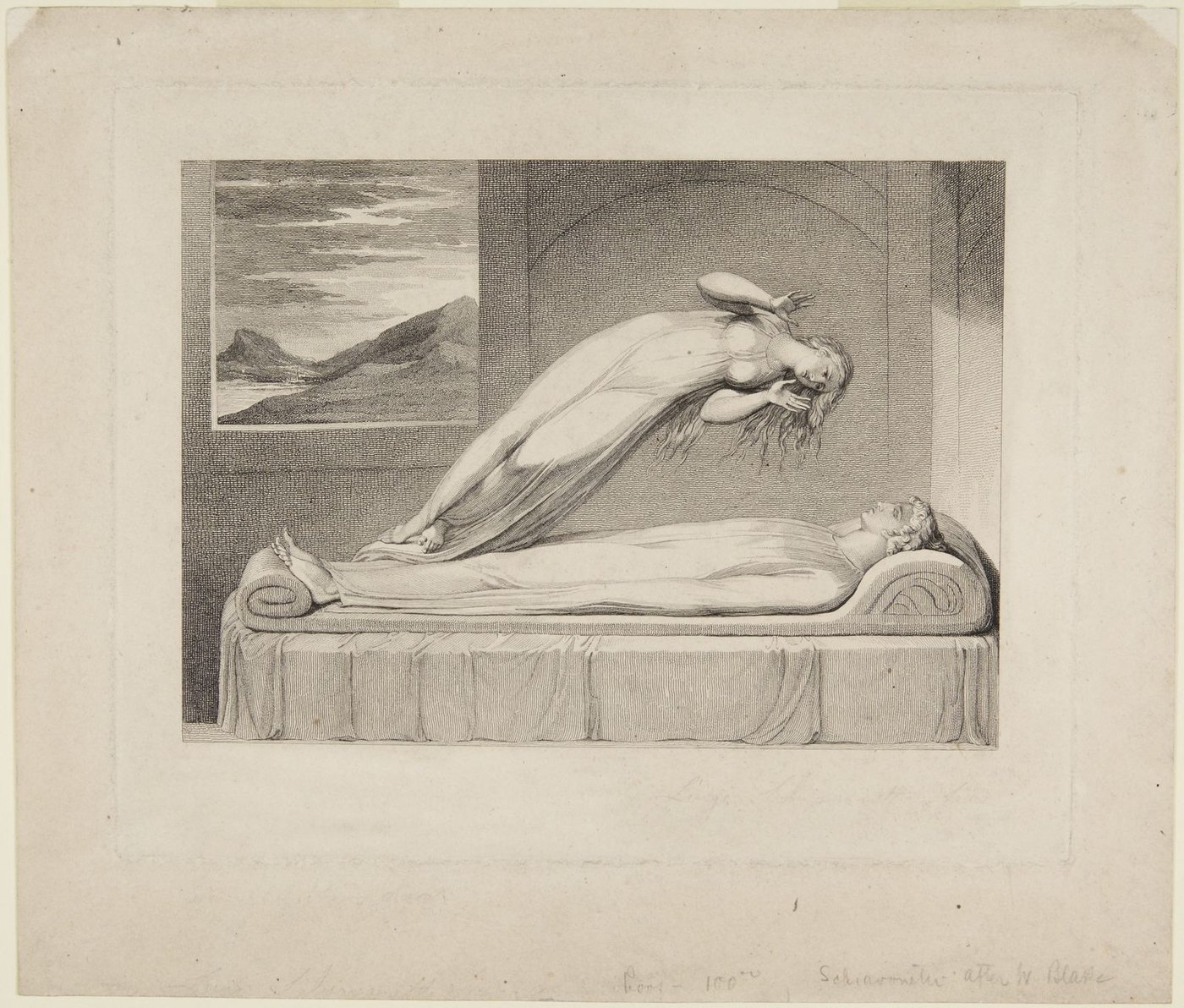
Luigi Schiavonetti after William Blake, The Soul Hovering over the Body Reluctantly Parting with Life, 1805–08. Made for Robert Blair’s poem The Grave, this image visualises a departing soul. It illustrates a poetic account of separation, rather than Aristotle’s definition of life.
Princeton University Art Museum. Gift of Frank Jewett Mather Jr., x1947-85. Public Domain. · Image source ↗ · Public Domain
SN 22:59: the not-self characteristic
The Pali discourse SN 22:59 considers five aspects of experience: form, feeling, perception, fabrications and consciousness. They change and are beyond complete control. The teaching asks the practitioner to stop treating them as self or as possessions, a discernment the discourse connects to dispassion and release. [29]
In Ghostly Japan by Lafcadio Hearn
Lafcadio Hearn includes a Japanese saying that even a tiny worm possesses a little soul. He immediately qualifies it: the use of tamashii reflects popular belief rather than Buddhist philosophy. He explains its point as mercy towards a living creature, however small. The saying is ethical language as well as a claim-shaped image of interior life. [30][31]
This distinction changes how the proverb should be read. It gives evidence that soul-language could occur in ordinary Japanese speech; it does not establish an orthodox Buddhist theory of a miniature, enduring object inside an animal. Hearn’s own note asks the reader to separate those levels. [30][31]
Suggestion supplies a second caution. The unnamed visitor’s proposals about sex and rebirth are expressly tentative, and Hearn questions how they fit accepted doctrine. A theory recounted in conversation cannot stand in for the teaching of every Buddhist community, any more than a compassionate proverb can settle a philosophical dispute about self. [32][33][34][35][36]
What does not-self mean here?
Do Buddhists believe in a soul? A useful answer begins by identifying which claim “soul” makes. Hearn’s worm proverb calls for compassion. Plato’s Phaedo develops an argument about the separation of soul and body. SN 22:59 examines the changing constituents of experience and their fitness to be identified as self. Shared English vocabulary does not make those the same account. [30][31][2][29]
The not-self passage also differs from a denial that suffering or ethical care matters. Its analysis leads towards release from attachment; Hearn’s proverb urges mercy towards small creatures. The practical concerns can be read together while their explanations of personhood remain distinct. Neither passage licenses reducing Buddhist rebirth to an unchanged soul moving between bodies. [31][29]
Lumen by Camille Flammarion
Camille Flammarion’s Lumen distinguishes three principles in a human being: body, vital energy and soul. The body is the changing material organism. Vital energy organises and maintains it, while the soul thinks, judges and remains conscious of an individual identity. The explanation depends on keeping these roles distinct, even though the dialogue describes them as united during embodied life. [18][19][20][21]
Lumen calls vital energy finite and unconscious: it arises through generation, grows, declines and ends. The soul, by contrast, is said to retain its identity through changes in bodily matter. The feeling of being the same person becomes part of the argument for a thinker whose continuity is not exhausted by the succession of bodily constituents. [20][21][22]
Moral judgement, mathematical understanding, affection and contemplation are offered as activities of a different order from physical motion. Lumen treats this difference as a reason to reject the production of thought by cerebral mechanisms alone. The dialogue calls its explanation scientific, but that description is part of its case. Its account of rapidly replaced tissues and immutable atoms belongs to the historical argument, rather than providing an adequate contemporary account of physiology. [18][19][21][22][23]
The word acquires a wider organising meaning later in the book. Asked whether earthly plants have souls, Lumen answers that their forms require an inherent organising principle. The oak and peach are his examples. He expressly denies self-consciousness to an ordinary plant soul, while describing a hierarchy of subordinate centres governed by the human soul. An organising soul and a self-aware person are therefore not identical categories in this text. [24][25][26]
This wider usage also prevents the opening argument from becoming a simple promise that every centre of life has the same personal future. In the second conversation, Lumen makes conscious spiritual life a condition of personal immortality. The continuing individual, the life-maintaining force and the subordinate organising centres need to be read together without erasing those differences. [27][28][24][25][26]
See references (11)
Evolution of Immortality
Freeman Benjamin Dowd, publishing as Rosicruciæ in Evolution of Immortality, gives soul the role of a centre that organises forces. He applies the word beyond an individual person. A family, a government or a factory can have a soul in this sense: a concentration of energy through which a larger activity is coordinated. The executive of a factory illustrates an intelligence directing many outward movements. [5][6][7]
Within the person, the soul mediates between intelligence and impulse. The author reads the firmament in Genesis as an image of this division and places the kingdom of heaven within it. Soul is associated especially with feeling and emotion, while mind is described through thought and stored knowledge. Their cooperation matters more than the isolated enlargement of either faculty. [8][5][3][9]
The centre also has a spiritual destiny. Love gives it warmth, intelligence gives it light, and their development is supposed to prepare a more complete form of life. Near the end of the book, the author insists that divine spirit cannot die. His definitions of soul, mind, spirit and perfected embodiment therefore need to be followed through their relationships, rather than treated as interchangeable names for a single invisible object. [7][9][4][10]
Rosicruciæ, catalogued as Freeman Benjamin Dowd, gives the soul’s centre an ethical as well as an organising role in Evolution of Immortality. Being self-poised does not mean standing above every need for other people. The author connects it with equality, sympathy and the refusal to dominate. [12][13]
One becomes free, he argues, by seeking the good of others and bringing it into shared life. The same influence can be received differently according to each person’s condition. A stable centre does not therefore erase individuality or make everyone respond alike. [13]
The image returns when the ego holds a balance between opposing forces. Peace is located within the person here and now rather than only in a remote heaven. The appendix adds that self-poise is not achieved by ignoring selfhood or leaving the functions of body and mind unused. [14][15][16]
The centre is consequently an active point of relation. It distinguishes, directs and participates. The book’s ideal is a coordinated life, not an empty isolation in which nothing can affect the self. [12][13][15][16]
The unmoving point described early in the book and the later call for rhythmic activity belong together. Stability concerns the relation of forces, while the person’s outward conduct can remain responsive and useful. [17][12][13][16]
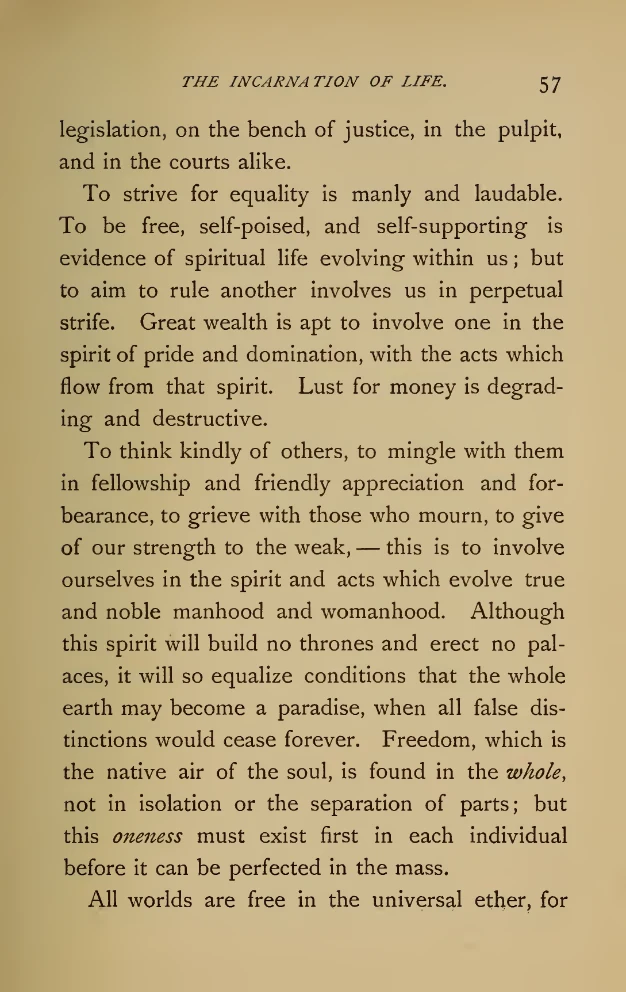
Source facsimile: Evolution of Immortality (1900), printed p. 57, Reader page 54.
Rosicruciæ (catalogued as Freeman Benjamin Dowd), Evolution of Immortality, copyright 1900. Public-domain historical page from the checksum-verified Library PDF. · Image source ↗ · Public Domain
See references (14)
- Evolution of Immortality, printed p. 17, Reader page 14
- Evolution of Immortality, printed p. 129, Reader page 128
- Evolution of Immortality, printed p. 14, Reader page 11
- Evolution of Immortality, printed p. 15, Reader page 12
- Evolution of Immortality, printed p. 16, Reader page 13
- Evolution of Immortality, printed p. 13, Reader page 10
- Evolution of Immortality, printed p. 20, Reader page 17
- Evolution of Immortality, printed p. 137, Reader page 136
- Evolution of Immortality, printed p. 57, Reader page 54
- Evolution of Immortality, printed p. 58, Reader page 55
- Evolution of Immortality, printed p. 103, Reader page 100
- Evolution of Immortality, printed p. 104, Reader page 101
- Evolution of Immortality, printed p. 142, Reader page 141
- Evolution of Immortality, printed p. 16, Reader page 13
The Universal One by Walter Russell
Walter Russell describes the soul as the record of a person’s evolving idea. He says it retains the history of thinking and serves as the matrix from which a body can take form again. The record remains when the visible form disappears, as he also says it does during sleep. [38][39][40]
Russell applies the record to more than a human soul. In his account of the seed, an idea is already present before it appears in developed form. The concluding discussion returns to a person’s responsibility for what thought records and uses his speculative language of electric and chemical processes to describe it. [41][42][43][44]
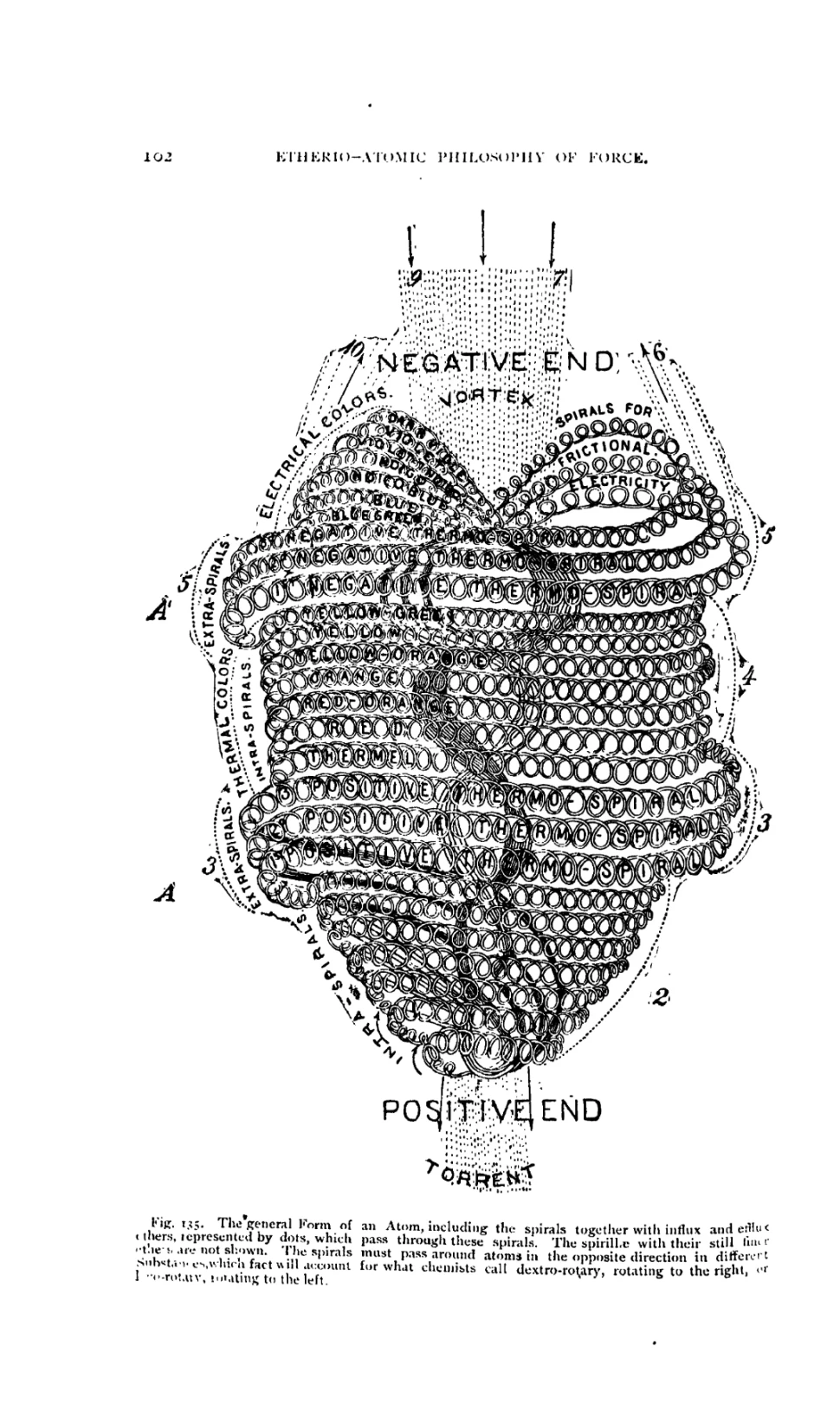
Edwin D. Babbitt diagrams a proposed atom with spirals and paired ends. Russell similarly uses the vocabulary of physical processes to write about spirit. The diagram belongs to Babbitt’s own system.
Edwin D. Babbitt, The Principles of Light and Color, second edition, 1896. Lumitheca Library facsimile. · Image source ↗ · Public Domain
Organising life and carrying it forward
Dowd’s Evolution of Immortality also gives soul an organising role, extending the image to a family or factory directed from a centre. Flammarion applies organising soul to plants and subordinate centres, yet initially distinguishes the conscious human soul from unconscious vital energy. The comparison reveals an overlap in function, not a shared map of the person: what one writer calls soul cannot automatically replace the other’s vital force or guarantee the same account of personal survival. [5][6][7][3][9][20][21][24][25][26]
Flammarion’s Lumen distinguishes the conscious soul from the body and the vital energy that organizes it. Russell foregrounds what a person’s thinking leaves behind and how the record can give rise to another body. The record, in his account, explains continuity even when a particular form has disappeared. [38][39][41][18][19][20][21]
See references (15)
- Evolution of Immortality, printed p. 17, Reader page 14
- Evolution of Immortality, printed p. 14, Reader page 11
- Evolution of Immortality, printed p. 15, Reader page 12
- Evolution of Immortality, printed p. 16, Reader page 13
- Evolution of Immortality, printed p. 20, Reader page 17
- Lumen, Reader page 11
- Lumen, Reader page 12
- Lumen, Reader page 13
- Lumen, Reader page 14
- Lumen, Reader page 200
- Lumen, printed p. 195, Reader page 201
- Lumen, Reader page 202
- The Universal One, Reader page 78
- The Universal One, Reader page 79
- The Universal One, Reader page 105
Read further in the library
Evolution of Immortality
Reading note
Soul as an organising centre, a seat of feeling and a participant in the book’s proposed spiritual transformation.
Lumen
Reading note
The separately titled account draws on exact passages in the consulted Library edition.

In Ghostly Japan
Reading note
The separately titled account draws on exact passages in the consulted Library edition.

The Principles of Light and Color
Reading note
Separately attributed primary Library account, cited on exact verified Reader leaves.

The Universal One
Reading note
The separately titled account draws on exact passages in the consulted Library edition.
Sources
See references (44)
- Aristotle, On the Soul, II.1 ↗Aristotle, On the Soul, Book II, part 1. Translated by J. A. Smith; Internet Classics Archive.Return to text ↑
- Plato, Phaedo, 64c–67d ↗Plato, Phaedo, translated by Benjamin Jowett; Internet Classics Archive.Return to text ↑
- Evolution of Immortality, printed p. 17, Reader page 14Rosicruciæ (catalogued as Freeman Benjamin Dowd), Evolution of Immortality. Eulian Publishing Company, Salem, 1900.Read this page in Evolution of Immortality ↗Return to text ↑
- Evolution of Immortality, printed p. 129, Reader page 128Rosicruciæ (catalogued as Freeman Benjamin Dowd), Evolution of Immortality. Eulian Publishing Company, Salem, 1900.Read this page in Evolution of Immortality ↗Return to text ↑
- Evolution of Immortality, printed p. 14, Reader page 11Rosicruciæ (catalogued as Freeman Benjamin Dowd), Evolution of Immortality. Eulian Publishing Company, Salem, 1900.Read this page in Evolution of Immortality ↗Return to text ↑
- Evolution of Immortality, printed p. 15, Reader page 12Rosicruciæ (catalogued as Freeman Benjamin Dowd), Evolution of Immortality. Eulian Publishing Company, Salem, 1900.Read this page in Evolution of Immortality ↗Return to text ↑
- Evolution of Immortality, printed p. 16, Reader page 13Rosicruciæ (catalogued as Freeman Benjamin Dowd), Evolution of Immortality. Eulian Publishing Company, Salem, 1900.Read this page in Evolution of Immortality ↗Return to text ↑
- Evolution of Immortality, printed p. 13, Reader page 10Rosicruciæ (catalogued as Freeman Benjamin Dowd), Evolution of Immortality. Eulian Publishing Company, Salem, 1900.Read this page in Evolution of Immortality ↗Return to text ↑
- Evolution of Immortality, printed p. 20, Reader page 17Rosicruciæ (catalogued as Freeman Benjamin Dowd), Evolution of Immortality. Eulian Publishing Company, Salem, 1900.Read this page in Evolution of Immortality ↗Return to text ↑
- Evolution of Immortality, printed p. 137, Reader page 136Rosicruciæ (catalogued as Freeman Benjamin Dowd), Evolution of Immortality. Eulian Publishing Company, Salem, 1900.Read this page in Evolution of Immortality ↗Return to text ↑
- Luigi Schiavonetti after William Blake, The Soul Hovering over the Body Reluctantly Parting with Life, 1805–08. ↗Princeton University Art Museum. Gift of Frank Jewett Mather Jr., x1947-85. Public Domain.
- Evolution of Immortality, printed p. 57, Reader page 54Rosicruciæ, catalogued as Freeman Benjamin Dowd, Evolution of Immortality. Eulian Publishing Company, Salem, Mass., copyright 1900; title page undated. The book’s metaphysical and scientific assertions remain attributed. The separately reproduced Higher Thought of Sex address has no speaker named in this edition.Read this page in Evolution of Immortality ↗Return to text ↑
- Evolution of Immortality, printed p. 58, Reader page 55Rosicruciæ, catalogued as Freeman Benjamin Dowd, Evolution of Immortality. Eulian Publishing Company, Salem, Mass., copyright 1900; title page undated. The book’s metaphysical and scientific assertions remain attributed. The separately reproduced Higher Thought of Sex address has no speaker named in this edition.Read this page in Evolution of Immortality ↗Return to text ↑
- Evolution of Immortality, printed p. 103, Reader page 100Rosicruciæ, catalogued as Freeman Benjamin Dowd, Evolution of Immortality. Eulian Publishing Company, Salem, Mass., copyright 1900; title page undated. The book’s metaphysical and scientific assertions remain attributed. The separately reproduced Higher Thought of Sex address has no speaker named in this edition.Read this page in Evolution of Immortality ↗Return to text ↑
- Evolution of Immortality, printed p. 104, Reader page 101Rosicruciæ, catalogued as Freeman Benjamin Dowd, Evolution of Immortality. Eulian Publishing Company, Salem, Mass., copyright 1900; title page undated. The book’s metaphysical and scientific assertions remain attributed. The separately reproduced Higher Thought of Sex address has no speaker named in this edition.Read this page in Evolution of Immortality ↗Return to text ↑
- Evolution of Immortality, printed p. 142, Reader page 141Rosicruciæ, catalogued as Freeman Benjamin Dowd, Evolution of Immortality. Eulian Publishing Company, Salem, Mass., copyright 1900; title page undated. The book’s metaphysical and scientific assertions remain attributed. The separately reproduced Higher Thought of Sex address has no speaker named in this edition.Read this page in Evolution of Immortality ↗Return to text ↑
- Evolution of Immortality, printed p. 16, Reader page 13Rosicruciæ, catalogued as Freeman Benjamin Dowd, Evolution of Immortality. Eulian Publishing Company, Salem, Mass., copyright 1900; title page undated. The book’s metaphysical and scientific assertions remain attributed. The separately reproduced Higher Thought of Sex address has no speaker named in this edition.Read this page in Evolution of Immortality ↗Return to text ↑
- Lumen, Reader page 11Camille Flammarion, Lumen, authorised English translation by A. A. M. and R. M., Dodd, Mead and Company, New York, 1897. Exact selected Library edition IMJ-0398-E001. Lumen and Quaerens are speakers in the dialogue; claims made by the narrator are attributed to this text. Original PageIDs and current Reader positions are verified separately from printed pagination.Read this page in Lumen ↗Return to text ↑
- Lumen, Reader page 12Camille Flammarion, Lumen, authorised English translation by A. A. M. and R. M., Dodd, Mead and Company, New York, 1897. Exact selected Library edition IMJ-0398-E001. Lumen and Quaerens are speakers in the dialogue; claims made by the narrator are attributed to this text. Original PageIDs and current Reader positions are verified separately from printed pagination.Read this page in Lumen ↗Return to text ↑
- Lumen, Reader page 13Camille Flammarion, Lumen, authorised English translation by A. A. M. and R. M., Dodd, Mead and Company, New York, 1897. Exact selected Library edition IMJ-0398-E001. Lumen and Quaerens are speakers in the dialogue; claims made by the narrator are attributed to this text. Original PageIDs and current Reader positions are verified separately from printed pagination.Read this page in Lumen ↗Return to text ↑
- Lumen, Reader page 14Camille Flammarion, Lumen, authorised English translation by A. A. M. and R. M., Dodd, Mead and Company, New York, 1897. Exact selected Library edition IMJ-0398-E001. Lumen and Quaerens are speakers in the dialogue; claims made by the narrator are attributed to this text. Original PageIDs and current Reader positions are verified separately from printed pagination.Read this page in Lumen ↗Return to text ↑
- Lumen, Reader page 15Camille Flammarion, Lumen, authorised English translation by A. A. M. and R. M., Dodd, Mead and Company, New York, 1897. Exact selected Library edition IMJ-0398-E001. Lumen and Quaerens are speakers in the dialogue; claims made by the narrator are attributed to this text. Original PageIDs and current Reader positions are verified separately from printed pagination.Read this page in Lumen ↗Return to text ↑
- Lumen, Reader page 16Camille Flammarion, Lumen, authorised English translation by A. A. M. and R. M., Dodd, Mead and Company, New York, 1897. Exact selected Library edition IMJ-0398-E001. Lumen and Quaerens are speakers in the dialogue; claims made by the narrator are attributed to this text. Original PageIDs and current Reader positions are verified separately from printed pagination.Read this page in Lumen ↗Return to text ↑
- Lumen, Reader page 200Camille Flammarion, Lumen, authorised English translation by A. A. M. and R. M., Dodd, Mead and Company, New York, 1897. Exact selected Library edition IMJ-0398-E001. Lumen and Quaerens are speakers in the dialogue; claims made by the narrator are attributed to this text. Original PageIDs and current Reader positions are verified separately from printed pagination.Read this page in Lumen ↗Return to text ↑
- Lumen, printed p. 195, Reader page 201Camille Flammarion, Lumen, authorised English translation by A. A. M. and R. M., Dodd, Mead and Company, New York, 1897. Exact selected Library edition IMJ-0398-E001. Lumen and Quaerens are speakers in the dialogue; claims made by the narrator are attributed to this text. Original PageIDs and current Reader positions are verified separately from printed pagination.Read this page in Lumen ↗Return to text ↑
- Lumen, Reader page 202Camille Flammarion, Lumen, authorised English translation by A. A. M. and R. M., Dodd, Mead and Company, New York, 1897. Exact selected Library edition IMJ-0398-E001. Lumen and Quaerens are speakers in the dialogue; claims made by the narrator are attributed to this text. Original PageIDs and current Reader positions are verified separately from printed pagination.Read this page in Lumen ↗Return to text ↑
- Lumen, printed p. 103, Reader page 109Camille Flammarion, Lumen, authorised English translation by A. A. M. and R. M., Dodd, Mead and Company, New York, 1897. Exact selected Library edition IMJ-0398-E001. Lumen and Quaerens are speakers in the dialogue; claims made by the narrator are attributed to this text. Original PageIDs and current Reader positions are verified separately from printed pagination.Read this page in Lumen ↗Return to text ↑
- Lumen, printed p. 104, Reader page 110Camille Flammarion, Lumen, authorised English translation by A. A. M. and R. M., Dodd, Mead and Company, New York, 1897. Exact selected Library edition IMJ-0398-E001. Lumen and Quaerens are speakers in the dialogue; claims made by the narrator are attributed to this text. Original PageIDs and current Reader positions are verified separately from printed pagination.Read this page in Lumen ↗Return to text ↑
- SN 22:59, the discourse on the not-self characteristic ↗Primary Pali discourse in Thanissaro Bhikkhu’s English translation, directly consulted. The passage examines form, feeling, perception, fabrications and consciousness, their instability and their fitness to be regarded as self.Return to text ↑
- In Ghostly Japan, Reader page 169Lafcadio Hearn, In Ghostly Japan, Little, Brown, and Company, Boston, 1899. Exact consulted Library edition IMJ-0654-E001, with title page visually checked. Persistent PageIDs and current Reader positions are verified from the supplied edition. Embedded stories, translations and quotations are attributed to Hearn’s presentation unless an original source has separately been consulted.Read this page in In Ghostly Japan ↗Return to text ↑
- In Ghostly Japan, Reader page 170Lafcadio Hearn, In Ghostly Japan, Little, Brown, and Company, Boston, 1899. Exact consulted Library edition IMJ-0654-E001, with title page visually checked. Persistent PageIDs and current Reader positions are verified from the supplied edition. Embedded stories, translations and quotations are attributed to Hearn’s presentation unless an original source has separately been consulted.Read this page in In Ghostly Japan ↗Return to text ↑
- In Ghostly Japan, Reader page 190Lafcadio Hearn, In Ghostly Japan, Little, Brown, and Company, Boston, 1899. Exact consulted Library edition IMJ-0654-E001, with title page visually checked. Persistent PageIDs and current Reader positions are verified from the supplied edition. Embedded stories, translations and quotations are attributed to Hearn’s presentation unless an original source has separately been consulted.Read this page in In Ghostly Japan ↗Return to text ↑
- In Ghostly Japan, Reader page 191Lafcadio Hearn, In Ghostly Japan, Little, Brown, and Company, Boston, 1899. Exact consulted Library edition IMJ-0654-E001, with title page visually checked. Persistent PageIDs and current Reader positions are verified from the supplied edition. Embedded stories, translations and quotations are attributed to Hearn’s presentation unless an original source has separately been consulted.Read this page in In Ghostly Japan ↗Return to text ↑
- In Ghostly Japan, Reader page 192Lafcadio Hearn, In Ghostly Japan, Little, Brown, and Company, Boston, 1899. Exact consulted Library edition IMJ-0654-E001, with title page visually checked. Persistent PageIDs and current Reader positions are verified from the supplied edition. Embedded stories, translations and quotations are attributed to Hearn’s presentation unless an original source has separately been consulted.Read this page in In Ghostly Japan ↗Return to text ↑
- In Ghostly Japan, Reader page 193Lafcadio Hearn, In Ghostly Japan, Little, Brown, and Company, Boston, 1899. Exact consulted Library edition IMJ-0654-E001, with title page visually checked. Persistent PageIDs and current Reader positions are verified from the supplied edition. Embedded stories, translations and quotations are attributed to Hearn’s presentation unless an original source has separately been consulted.Read this page in In Ghostly Japan ↗Return to text ↑
- In Ghostly Japan, Reader page 194Lafcadio Hearn, In Ghostly Japan, Little, Brown, and Company, Boston, 1899. Exact consulted Library edition IMJ-0654-E001, with title page visually checked. Persistent PageIDs and current Reader positions are verified from the supplied edition. Embedded stories, translations and quotations are attributed to Hearn’s presentation unless an original source has separately been consulted.Read this page in In Ghostly Japan ↗Return to text ↑
- Figure 135, Babbitt’s spiral atom, Reader page 109Edwin D. Babbitt, The Principles of Light and Color, second edition, 1896. Lumitheca Library facsimile.Read this page in The Principles of Light and Color ↗
- The Universal One, Reader page 78Walter Russell, The Universal One, edited by Louise Russell, University of Science and Philosophy, Limited Edition De Luxe. Lumitheca Library edition IMJ-0605-E001.Read this page in The Universal One ↗Return to text ↑
- The Universal One, Reader page 79Walter Russell, The Universal One, edited by Louise Russell, University of Science and Philosophy, Limited Edition De Luxe. Lumitheca Library edition IMJ-0605-E001.Read this page in The Universal One ↗Return to text ↑
- The Universal One, Reader page 80Walter Russell, The Universal One, edited by Louise Russell, University of Science and Philosophy, Limited Edition De Luxe. Lumitheca Library edition IMJ-0605-E001.Read this page in The Universal One ↗Return to text ↑
- The Universal One, Reader page 105Walter Russell, The Universal One, edited by Louise Russell, University of Science and Philosophy, Limited Edition De Luxe. Lumitheca Library edition IMJ-0605-E001.Read this page in The Universal One ↗Return to text ↑
- The Universal One, Reader page 303Walter Russell, The Universal One, edited by Louise Russell, University of Science and Philosophy, Limited Edition De Luxe. Lumitheca Library edition IMJ-0605-E001.Read this page in The Universal One ↗Return to text ↑
- The Universal One, Reader page 304Walter Russell, The Universal One, edited by Louise Russell, University of Science and Philosophy, Limited Edition De Luxe. Lumitheca Library edition IMJ-0605-E001.Read this page in The Universal One ↗Return to text ↑
- The Universal One, Reader page 305Walter Russell, The Universal One, edited by Louise Russell, University of Science and Philosophy, Limited Edition De Luxe. Lumitheca Library edition IMJ-0605-E001.Read this page in The Universal One ↗Return to text ↑