Dante’s Nine Heavens
Dante’s nine heavens extend from the Moon to the Primum Mobile. Follow the spheres in order and see why the Empyrean lies beyond the moving heavens.
In this article
Understanding the nine heavens of dante
Dante’s nine heavens are the moving spheres the pilgrim passes through in Paradise before he enters the Empyrean. Seven carry the celestial bodies of the medieval planetary scheme. The heaven of the fixed stars and the Primum Mobile bring the moving total to nine. [1][2][3][4][5][6][7][8][9][10]
In Paradise IV, Beatrice says that the souls appear in particular spheres to make differences in blessedness intelligible to Dante. Their appearances help a living traveller see something of how people receive Heaven. [11][12]
See references (12)
- Purgatory and Paradise, Reader page 212
- Purgatory and Paradise, Reader page 225
- Purgatory and Paradise, Reader page 239
- Purgatory and Paradise, Reader page 249
- Purgatory and Paradise, Reader page 268
- Purgatory and Paradise, Reader page 290
- Purgatory and Paradise, Reader page 305
- Purgatory and Paradise, Reader page 312
- Purgatory and Paradise, Reader page 339
- Purgatory and Paradise, Reader page 340
- Purgatory and Paradise, Reader page 221
- Purgatory and Paradise, Reader page 222
The Divine Comedy by Dante Alighieri
In the Divine Comedy, Dante Alighieri gives each heaven a distinctive encounter, shape or subject. The journey begins with the Moon and ends its passage through the moving spheres at the Primum Mobile. [1][13][11][12]
The nine heavens in order
- 1. Moon. Piccarda’s appearance introduces the question of vows and why blessed souls appear in different spheres. [1][13][11][12]
- 2. Mercury. Justinian recounts the history of Roman imperial action. [2][14]
- 3. Venus. The encounters turn to love and differences of disposition. [3][33]
- 4. Sun. Learned and holy speakers form circles of lights. [4][34]
- 5. Mars. The lights form a cross and introduce lives associated with faith and conflict. [5][15]
- 6. Jupiter. The lights form the eagle that speaks about justice. [6][16][17]
- 7. Saturn. A ladder rises before Dante, and he meets contemplative souls. [7][35]
- 8. Fixed Stars. Dante enters at Gemini, looks down on the seven planetary spheres and is examined in faith, hope and charity. [8][18][19][20][21]
- 9. Primum Mobile. The swiftest moving sphere measures the motions below it. Here Beatrice explains the circles of angels. [9][10][22][23][24][36]
See references (28)
- Purgatory and Paradise, Reader page 212
- Purgatory and Paradise, Reader page 225
- Purgatory and Paradise, Reader page 239
- Purgatory and Paradise, Reader page 249
- Purgatory and Paradise, Reader page 268
- Purgatory and Paradise, Reader page 290
- Purgatory and Paradise, Reader page 305
- Purgatory and Paradise, Reader page 312
- Purgatory and Paradise, Reader page 339
- Purgatory and Paradise, Reader page 340
- Purgatory and Paradise, Reader page 221
- Purgatory and Paradise, Reader page 222
- Purgatory and Paradise, Reader page 217
- Purgatory and Paradise, Reader page 229
- Purgatory and Paradise, Reader page 270
- Purgatory and Paradise, Reader page 295
- Purgatory and Paradise, Reader page 296
- Purgatory and Paradise, Reader page 313
- Purgatory and Paradise, Reader page 320
- Purgatory and Paradise, Reader page 325
- Purgatory and Paradise, Reader page 330
- Purgatory and Paradise, Reader page 341
- Purgatory and Paradise, Reader page 343
- Purgatory and Paradise, Reader page 344
- Paradise, Canto VIII, Reader page 240
- Paradise, Canto X, Reader page 250
- Paradise, Canto XXI, Reader page 306
- Paradise, Canto XXVIII, Reader page 342
Heaven and Its Wonders and Hell by Emanuel Swedenborg
Emanuel Swedenborg distinguishes two heavenly kingdoms and three heavens according to different receptions of divine good and the opening of angelic interiors. These are different classifications within his own account of heavenly life. [28][29][30][31]
Moving spheres, angelic rings and the Empyrean
The Sun and Moon count among the seven planetary spheres in the poem. Beyond all nine moving heavens Dante enters the Empyrean, described as unbodied light. The two counts distinguish motion within the cosmos from what comes after it. [8][18][9][26]
The rings of angels appear to reverse the scale of the moving spheres. The smallest, nearest the point of light, corresponds to the largest physical sphere. Beatrice explains the correspondence by comparing their power. [27][23][24]
Swedenborg groups heavenly life by how angelic beings receive divine good. Dante uses a sequence of moving spheres to teach a traveller what he sees. The numbers come from different accounts of how a heavenly order becomes intelligible. [28][29][30][31][12][9][10][26]
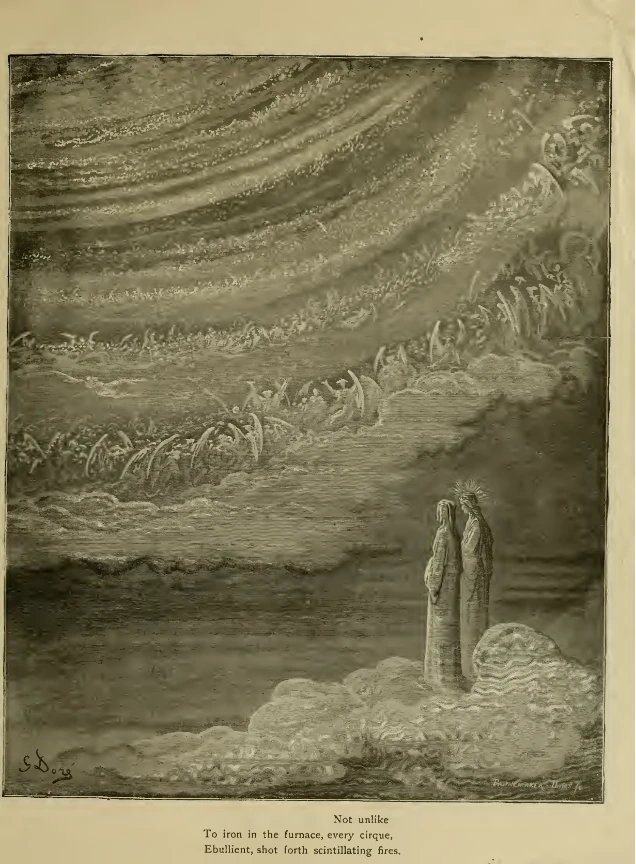
Gustave Doré, Paradise XXVIII. The angelic circles provide a second way to see the order Beatrice describes.
Purgatory and Paradise, 1901. Dante Alighieri, translated by Henry Francis Cary, designs by Gustave Doré. Thompson & Thomas, Chicago. Historical text and original designs Public Domain. · Image source ↗ · Public Domain
See references (13)
- Purgatory and Paradise, Reader page 312
- Purgatory and Paradise, Reader page 339
- Purgatory and Paradise, Reader page 340
- Purgatory and Paradise, Reader page 222
- Purgatory and Paradise, Reader page 313
- Purgatory and Paradise, Reader page 343
- Purgatory and Paradise, Reader page 344
- Purgatory and Paradise, Reader page 351
- Purgatory and Paradise, Reader page 342
- Heaven and Its Wonders and Hell, printed p. 9, Reader page 16
- Heaven and Its Wonders and Hell, printed p. 19, Reader page 26
- Heaven and Its Wonders and Hell, printed p. 23, Reader page 30
- Heaven and Its Wonders and Hell, printed p. 24, Reader page 31
Read further in the library
Purgatory and Paradise: The Vision of Dante
Reading note
Exact consulted edition and PageRefs in a separately titled book account.

Heaven and Its Wonders and Hell
Reading note
Exact consulted edition and PageRefs in a separately titled book account.
Sources
See references (36)
- Purgatory and Paradise, Reader page 212Dante Alighieri, The Divine Comedy, translated by Henry Francis Cary, designs by Gustave Doré. Inferno: undated New Edition, Thompson & Thomas, Chicago. Purgatory and Paradise: New Edition, Thompson & Thomas, Chicago, 1901. Canto arguments are editorial matter and are distinguished from the poem.Read this page in Purgatory and Paradise: The Vision of Dante ↗Return to text ↑
- Purgatory and Paradise, Reader page 225Dante Alighieri, The Divine Comedy, translated by Henry Francis Cary, designs by Gustave Doré. Inferno: undated New Edition, Thompson & Thomas, Chicago. Purgatory and Paradise: New Edition, Thompson & Thomas, Chicago, 1901. Canto arguments are editorial matter and are distinguished from the poem.Read this page in Purgatory and Paradise: The Vision of Dante ↗Return to text ↑
- Purgatory and Paradise, Reader page 239Dante Alighieri, The Divine Comedy, translated by Henry Francis Cary, designs by Gustave Doré. Inferno: undated New Edition, Thompson & Thomas, Chicago. Purgatory and Paradise: New Edition, Thompson & Thomas, Chicago, 1901. Canto arguments are editorial matter and are distinguished from the poem.Read this page in Purgatory and Paradise: The Vision of Dante ↗Return to text ↑
- Purgatory and Paradise, Reader page 249Dante Alighieri, The Divine Comedy, translated by Henry Francis Cary, designs by Gustave Doré. Inferno: undated New Edition, Thompson & Thomas, Chicago. Purgatory and Paradise: New Edition, Thompson & Thomas, Chicago, 1901. Canto arguments are editorial matter and are distinguished from the poem.Read this page in Purgatory and Paradise: The Vision of Dante ↗Return to text ↑
- Purgatory and Paradise, Reader page 268Dante Alighieri, The Divine Comedy, translated by Henry Francis Cary, designs by Gustave Doré. Inferno: undated New Edition, Thompson & Thomas, Chicago. Purgatory and Paradise: New Edition, Thompson & Thomas, Chicago, 1901. Canto arguments are editorial matter and are distinguished from the poem.Read this page in Purgatory and Paradise: The Vision of Dante ↗Return to text ↑
- Purgatory and Paradise, Reader page 290Dante Alighieri, The Divine Comedy, translated by Henry Francis Cary, designs by Gustave Doré. Inferno: undated New Edition, Thompson & Thomas, Chicago. Purgatory and Paradise: New Edition, Thompson & Thomas, Chicago, 1901. Canto arguments are editorial matter and are distinguished from the poem.Read this page in Purgatory and Paradise: The Vision of Dante ↗Return to text ↑
- Purgatory and Paradise, Reader page 305Dante Alighieri, The Divine Comedy, translated by Henry Francis Cary, designs by Gustave Doré. Inferno: undated New Edition, Thompson & Thomas, Chicago. Purgatory and Paradise: New Edition, Thompson & Thomas, Chicago, 1901. Canto arguments are editorial matter and are distinguished from the poem.Read this page in Purgatory and Paradise: The Vision of Dante ↗Return to text ↑
- Purgatory and Paradise, Reader page 312Dante Alighieri, The Divine Comedy, translated by Henry Francis Cary, designs by Gustave Doré. Inferno: undated New Edition, Thompson & Thomas, Chicago. Purgatory and Paradise: New Edition, Thompson & Thomas, Chicago, 1901. Canto arguments are editorial matter and are distinguished from the poem.Read this page in Purgatory and Paradise: The Vision of Dante ↗Return to text ↑
- Purgatory and Paradise, Reader page 339Dante Alighieri, The Divine Comedy, translated by Henry Francis Cary, designs by Gustave Doré. Inferno: undated New Edition, Thompson & Thomas, Chicago. Purgatory and Paradise: New Edition, Thompson & Thomas, Chicago, 1901. Canto arguments are editorial matter and are distinguished from the poem.Read this page in Purgatory and Paradise: The Vision of Dante ↗Return to text ↑
- Purgatory and Paradise, Reader page 340Dante Alighieri, The Divine Comedy, translated by Henry Francis Cary, designs by Gustave Doré. Inferno: undated New Edition, Thompson & Thomas, Chicago. Purgatory and Paradise: New Edition, Thompson & Thomas, Chicago, 1901. Canto arguments are editorial matter and are distinguished from the poem.Read this page in Purgatory and Paradise: The Vision of Dante ↗Return to text ↑
- Purgatory and Paradise, Reader page 221Dante Alighieri, The Divine Comedy, translated by Henry Francis Cary, designs by Gustave Doré. Inferno: undated New Edition, Thompson & Thomas, Chicago. Purgatory and Paradise: New Edition, Thompson & Thomas, Chicago, 1901. Canto arguments are editorial matter and are distinguished from the poem.Read this page in Purgatory and Paradise: The Vision of Dante ↗Return to text ↑
- Purgatory and Paradise, Reader page 222Dante Alighieri, The Divine Comedy, translated by Henry Francis Cary, designs by Gustave Doré. Inferno: undated New Edition, Thompson & Thomas, Chicago. Purgatory and Paradise: New Edition, Thompson & Thomas, Chicago, 1901. Canto arguments are editorial matter and are distinguished from the poem.Read this page in Purgatory and Paradise: The Vision of Dante ↗Return to text ↑
- Purgatory and Paradise, Reader page 217Dante Alighieri, The Divine Comedy, translated by Henry Francis Cary, designs by Gustave Doré. Inferno: undated New Edition, Thompson & Thomas, Chicago. Purgatory and Paradise: New Edition, Thompson & Thomas, Chicago, 1901. Canto arguments are editorial matter and are distinguished from the poem.Read this page in Purgatory and Paradise: The Vision of Dante ↗Return to text ↑
- Purgatory and Paradise, Reader page 229Dante Alighieri, The Divine Comedy, translated by Henry Francis Cary, designs by Gustave Doré. Inferno: undated New Edition, Thompson & Thomas, Chicago. Purgatory and Paradise: New Edition, Thompson & Thomas, Chicago, 1901. Canto arguments are editorial matter and are distinguished from the poem.Read this page in Purgatory and Paradise: The Vision of Dante ↗Return to text ↑
- Purgatory and Paradise, Reader page 270Dante Alighieri, The Divine Comedy, translated by Henry Francis Cary, designs by Gustave Doré. Inferno: undated New Edition, Thompson & Thomas, Chicago. Purgatory and Paradise: New Edition, Thompson & Thomas, Chicago, 1901. Canto arguments are editorial matter and are distinguished from the poem.Read this page in Purgatory and Paradise: The Vision of Dante ↗Return to text ↑
- Purgatory and Paradise, Reader page 295Dante Alighieri, The Divine Comedy, translated by Henry Francis Cary, designs by Gustave Doré. Inferno: undated New Edition, Thompson & Thomas, Chicago. Purgatory and Paradise: New Edition, Thompson & Thomas, Chicago, 1901. Canto arguments are editorial matter and are distinguished from the poem.Read this page in Purgatory and Paradise: The Vision of Dante ↗Return to text ↑
- Purgatory and Paradise, Reader page 296Dante Alighieri, The Divine Comedy, translated by Henry Francis Cary, designs by Gustave Doré. Inferno: undated New Edition, Thompson & Thomas, Chicago. Purgatory and Paradise: New Edition, Thompson & Thomas, Chicago, 1901. Canto arguments are editorial matter and are distinguished from the poem.Read this page in Purgatory and Paradise: The Vision of Dante ↗Return to text ↑
- Purgatory and Paradise, Reader page 313Dante Alighieri, The Divine Comedy, translated by Henry Francis Cary, designs by Gustave Doré. Inferno: undated New Edition, Thompson & Thomas, Chicago. Purgatory and Paradise: New Edition, Thompson & Thomas, Chicago, 1901. Canto arguments are editorial matter and are distinguished from the poem.Read this page in Purgatory and Paradise: The Vision of Dante ↗Return to text ↑
- Purgatory and Paradise, Reader page 320Dante Alighieri, The Divine Comedy, translated by Henry Francis Cary, designs by Gustave Doré. Inferno: undated New Edition, Thompson & Thomas, Chicago. Purgatory and Paradise: New Edition, Thompson & Thomas, Chicago, 1901. Canto arguments are editorial matter and are distinguished from the poem.Read this page in Purgatory and Paradise: The Vision of Dante ↗Return to text ↑
- Purgatory and Paradise, Reader page 325Dante Alighieri, The Divine Comedy, translated by Henry Francis Cary, designs by Gustave Doré. Inferno: undated New Edition, Thompson & Thomas, Chicago. Purgatory and Paradise: New Edition, Thompson & Thomas, Chicago, 1901. Canto arguments are editorial matter and are distinguished from the poem.Read this page in Purgatory and Paradise: The Vision of Dante ↗Return to text ↑
- Purgatory and Paradise, Reader page 330Dante Alighieri, The Divine Comedy, translated by Henry Francis Cary, designs by Gustave Doré. Inferno: undated New Edition, Thompson & Thomas, Chicago. Purgatory and Paradise: New Edition, Thompson & Thomas, Chicago, 1901. Canto arguments are editorial matter and are distinguished from the poem.Read this page in Purgatory and Paradise: The Vision of Dante ↗Return to text ↑
- Purgatory and Paradise, Reader page 341Dante Alighieri, The Divine Comedy, translated by Henry Francis Cary, designs by Gustave Doré. Inferno: undated New Edition, Thompson & Thomas, Chicago. Purgatory and Paradise: New Edition, Thompson & Thomas, Chicago, 1901. Canto arguments are editorial matter and are distinguished from the poem.Read this page in Purgatory and Paradise: The Vision of Dante ↗Return to text ↑
- Purgatory and Paradise, Reader page 343Dante Alighieri, The Divine Comedy, translated by Henry Francis Cary, designs by Gustave Doré. Inferno: undated New Edition, Thompson & Thomas, Chicago. Purgatory and Paradise: New Edition, Thompson & Thomas, Chicago, 1901. Canto arguments are editorial matter and are distinguished from the poem.Read this page in Purgatory and Paradise: The Vision of Dante ↗Return to text ↑
- Purgatory and Paradise, Reader page 344Dante Alighieri, The Divine Comedy, translated by Henry Francis Cary, designs by Gustave Doré. Inferno: undated New Edition, Thompson & Thomas, Chicago. Purgatory and Paradise: New Edition, Thompson & Thomas, Chicago, 1901. Canto arguments are editorial matter and are distinguished from the poem.Read this page in Purgatory and Paradise: The Vision of Dante ↗Return to text ↑
- Purgatory and Paradise, Reader page 350Dante Alighieri, The Divine Comedy, translated by Henry Francis Cary, designs by Gustave Doré. Inferno: undated New Edition, Thompson & Thomas, Chicago. Purgatory and Paradise: New Edition, Thompson & Thomas, Chicago, 1901. Canto arguments are editorial matter and are distinguished from the poem.Read this page in Purgatory and Paradise: The Vision of Dante ↗
- Purgatory and Paradise, Reader page 351Dante Alighieri, The Divine Comedy, translated by Henry Francis Cary, designs by Gustave Doré. Inferno: undated New Edition, Thompson & Thomas, Chicago. Purgatory and Paradise: New Edition, Thompson & Thomas, Chicago, 1901. Canto arguments are editorial matter and are distinguished from the poem.Read this page in Purgatory and Paradise: The Vision of Dante ↗Return to text ↑
- Purgatory and Paradise, Reader page 342Dante Alighieri, The Divine Comedy, translated by Henry Francis Cary, designs by Gustave Doré. Inferno: undated New Edition, Thompson & Thomas, Chicago. Purgatory and Paradise: New Edition, Thompson & Thomas, Chicago, 1901. Canto arguments are editorial matter and are distinguished from the poem.Read this page in Purgatory and Paradise: The Vision of Dante ↗Return to text ↑
- Heaven and Its Wonders and Hell, printed p. 9, Reader page 16Emanuel Swedenborg, Heaven and Its Wonders and Hell, translated by J. C. Ager. The American Swedenborg Printing and Publishing Society, New York, 1916. Original Latin work first published in 1758.Read this page in Heaven and Its Wonders and Hell ↗Return to text ↑
- Heaven and Its Wonders and Hell, printed p. 19, Reader page 26Emanuel Swedenborg, Heaven and Its Wonders and Hell, translated by J. C. Ager. The American Swedenborg Printing and Publishing Society, New York, 1916. Original Latin work first published in 1758.Read this page in Heaven and Its Wonders and Hell ↗Return to text ↑
- Heaven and Its Wonders and Hell, printed p. 23, Reader page 30Emanuel Swedenborg, Heaven and Its Wonders and Hell, translated by J. C. Ager. The American Swedenborg Printing and Publishing Society, New York, 1916. Original Latin work first published in 1758.Read this page in Heaven and Its Wonders and Hell ↗Return to text ↑
- Heaven and Its Wonders and Hell, printed p. 24, Reader page 31Emanuel Swedenborg, Heaven and Its Wonders and Hell, translated by J. C. Ager. The American Swedenborg Printing and Publishing Society, New York, 1916. Original Latin work first published in 1758.Read this page in Heaven and Its Wonders and Hell ↗Return to text ↑
- Purgatory and Paradise, Reader page 143Dante Alighieri, The Divine Comedy, translated by Henry Francis Cary, designs by Gustave Doré. Inferno: undated New Edition, Thompson & Thomas, Chicago. Purgatory and Paradise: New Edition, Thompson & Thomas, Chicago, 1901. Canto arguments are editorial matter and are distinguished from the poem.Read this page in Purgatory and Paradise: The Vision of Dante ↗
- Paradise, Canto VIII, Reader page 240Dante Alighieri, translated by Henry Francis Cary.Read this page in Purgatory and Paradise: The Vision of Dante ↗Return to text ↑
- Paradise, Canto X, Reader page 250Dante Alighieri, translated by Henry Francis Cary.Read this page in Purgatory and Paradise: The Vision of Dante ↗Return to text ↑
- Paradise, Canto XXI, Reader page 306Dante Alighieri, translated by Henry Francis Cary.Read this page in Purgatory and Paradise: The Vision of Dante ↗Return to text ↑
- Paradise, Canto XXVIII, Reader page 342Dante Alighieri, translated by Henry Francis Cary.Read this page in Purgatory and Paradise: The Vision of Dante ↗Return to text ↑