The Empyrean in Dante
The Empyrean is Dante’s highest, immaterial heaven. Follow his passage from the moving heavens into intellectual light and the celestial rose.
In this article
What is the Empyrean?
The Empyrean is the highest heaven in Dante’s Divine Comedy. It lies beyond the bodily spheres, whose motions give the journey through the heavens its order. Beatrice describes its light in terms of understanding and love. [4][5]
The change becomes apparent in what Dante can see. A traveller who has been moving from sphere to sphere now enters a realm in which height and distance no longer limit the view. [3][5][7]
The Divine Comedy by Dante Alighieri
In Paradise XXII, Benedict tells Dante that he will see him without his covering in the last sphere, where desire finds fulfilment. In Paradise XXVII, Beatrice traces the swiftest bodily heaven back to the divine mind. The two passages prepare for a realm whose order cannot be explained through physical motion. [2][3]
In Paradise XXX, Beatrice announces that they have left the last bodily sphere for intellectual light, love and joy. The light overwhelms Dante. When his sight returns, it can bear more. Entering the Empyrean changes the traveller’s power of seeing. [4][5]
The first thing he can make out is a river of light, with sparks among flowers. Beatrice explains that the scene is suited to what he can see now. As his sight is refined, the river becomes round and the shapes give way to the two heavenly companies. [6]
The blessed appear as a vast rose, with angels moving between its ranks and the source of light. Dante can see across its whole extent. The assembly gives a visible form to Beatrice’s earlier explanation that the blessed he met in different spheres share one heaven. [1][7][8]
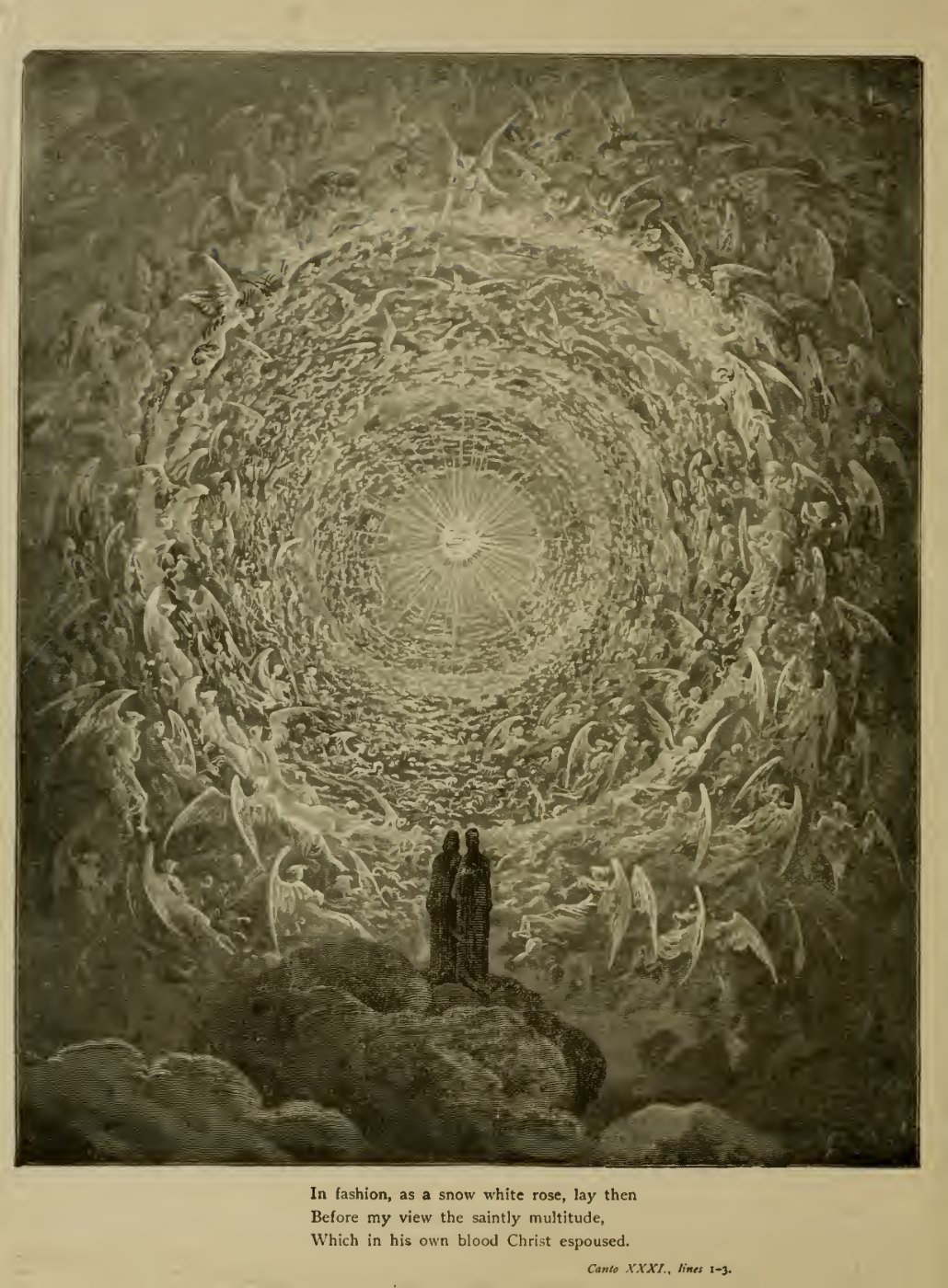
The celestial rose in Doré’s design for Paradise XXXI, an image of the blessed assembly in the Empyrean. This plate appears earlier among the bound volume’s illustrations; its original caption identifies the scene.
Design by Gustave Doré. Purgatory and Paradise, Henry Francis Cary translation, Thompson & Thomas, Chicago, 1901. Public Domain. · Image source ↗ · Public Domain
See references (8)
- Purgatory and Paradise, Paradise IV, Reader page 222
- Purgatory and Paradise, Paradise XXII, Reader page 311
- Purgatory and Paradise, Paradise XXVII, Reader page 340
- Purgatory and Paradise, Paradise XXX, Reader page 350
- Purgatory and Paradise, Paradise XXX, Reader page 351
- Purgatory and Paradise, Paradise XXX, Reader page 352
- Purgatory and Paradise, Paradise XXX, Reader page 353
- Purgatory and Paradise, Paradise XXXI, Reader page 355
Read further in the library
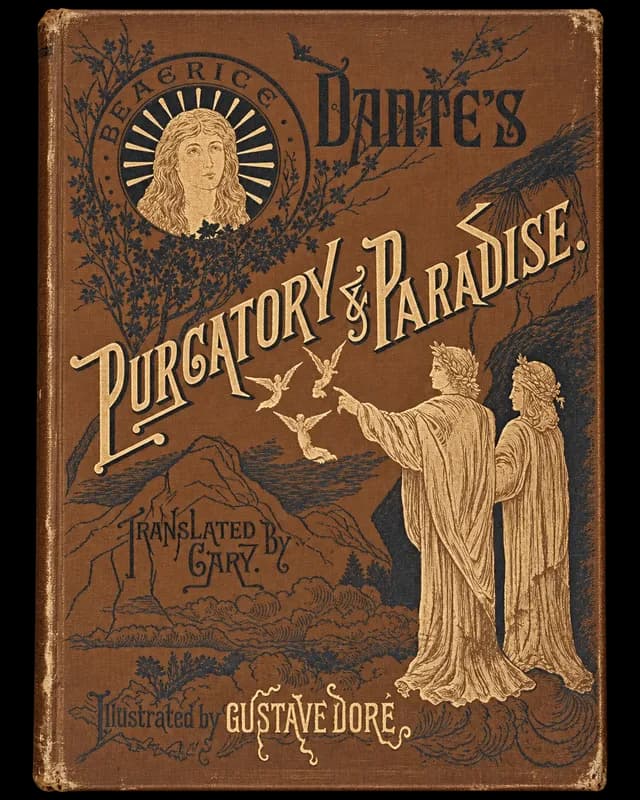
Purgatory and Paradise: The Vision of Dante
Reading note
A separately attributed account in the consulted Cary translation, with exact current Library Reader leaves.
Sources
See references (9)
- Purgatory and Paradise, Paradise IV, Reader page 222Dante Alighieri, The Divine Comedy, translated by Henry Francis Cary. Inferno: undated New Edition, Thompson & Thomas, Chicago. Purgatory and Paradise: New Edition, Thompson & Thomas, Chicago, 1901. Designs by Gustave Doré.Read this page in Purgatory and Paradise: The Vision of Dante ↗Return to text ↑
- Purgatory and Paradise, Paradise XXII, Reader page 311Dante Alighieri, The Divine Comedy, translated by Henry Francis Cary. Inferno: undated New Edition, Thompson & Thomas, Chicago. Purgatory and Paradise: New Edition, Thompson & Thomas, Chicago, 1901. Designs by Gustave Doré.Read this page in Purgatory and Paradise: The Vision of Dante ↗Return to text ↑
- Purgatory and Paradise, Paradise XXVII, Reader page 340Dante Alighieri, The Divine Comedy, translated by Henry Francis Cary. Inferno: undated New Edition, Thompson & Thomas, Chicago. Purgatory and Paradise: New Edition, Thompson & Thomas, Chicago, 1901. Designs by Gustave Doré.Read this page in Purgatory and Paradise: The Vision of Dante ↗Return to text ↑
- Purgatory and Paradise, Paradise XXX, Reader page 350Dante Alighieri, The Divine Comedy, translated by Henry Francis Cary. Inferno: undated New Edition, Thompson & Thomas, Chicago. Purgatory and Paradise: New Edition, Thompson & Thomas, Chicago, 1901. Designs by Gustave Doré.Read this page in Purgatory and Paradise: The Vision of Dante ↗Return to text ↑
- Purgatory and Paradise, Paradise XXX, Reader page 351Dante Alighieri, The Divine Comedy, translated by Henry Francis Cary. Inferno: undated New Edition, Thompson & Thomas, Chicago. Purgatory and Paradise: New Edition, Thompson & Thomas, Chicago, 1901. Designs by Gustave Doré.Read this page in Purgatory and Paradise: The Vision of Dante ↗Return to text ↑
- Purgatory and Paradise, Paradise XXX, Reader page 352Dante Alighieri, The Divine Comedy, translated by Henry Francis Cary. Inferno: undated New Edition, Thompson & Thomas, Chicago. Purgatory and Paradise: New Edition, Thompson & Thomas, Chicago, 1901. Designs by Gustave Doré.Read this page in Purgatory and Paradise: The Vision of Dante ↗Return to text ↑
- Purgatory and Paradise, Paradise XXX, Reader page 353Dante Alighieri, The Divine Comedy, translated by Henry Francis Cary. Inferno: undated New Edition, Thompson & Thomas, Chicago. Purgatory and Paradise: New Edition, Thompson & Thomas, Chicago, 1901. Designs by Gustave Doré.Read this page in Purgatory and Paradise: The Vision of Dante ↗Return to text ↑
- Purgatory and Paradise, Paradise XXXI, Reader page 355Dante Alighieri, The Divine Comedy, translated by Henry Francis Cary. Inferno: undated New Edition, Thompson & Thomas, Chicago. Purgatory and Paradise: New Edition, Thompson & Thomas, Chicago, 1901. Designs by Gustave Doré.Read this page in Purgatory and Paradise: The Vision of Dante ↗Return to text ↑
- Purgatory and Paradise, Paradise XXXI, Reader page 144Dante Alighieri, The Divine Comedy, translated by Henry Francis Cary. Inferno: undated New Edition, Thompson & Thomas, Chicago. Purgatory and Paradise: New Edition, Thompson & Thomas, Chicago, 1901. Designs by Gustave Doré.Read this page in Purgatory and Paradise: The Vision of Dante ↗