The Primum Mobile in Dante
The Primum Mobile is Dante’s outermost moving heaven. See how it orders cosmic motion and why the angelic circles appear to reverse it.
In this article
Understanding the primum mobile in dante
The Primum Mobile is the outermost moving sphere in Dante’s Paradise. Its motion gives measure to the heavens below it. Beatrice locates it in the divine mind, beyond any surrounding physical sphere. [1][2]
It is the ninth of the moving heavens. The Empyrean comes after it and is described as unbodied light. The difference matters because this sphere orders motions that the next heaven is no longer described as sharing. [2][3][4]
The Divine Comedy by Dante Alighieri
In Paradise XXVII, Dante Alighieri describes leaving the constellation of Gemini and entering the swiftest heaven. Its uniformity prevents the narrator from identifying a particular entrance point. Beatrice then explains its relation to the rest of the cosmic order. [1][2]
Beatrice pictures time as a plant with roots here and leaves in the lower heavens. Each lower movement receives a measure from the source above it. The image gives Dante a way to relate the order of the spheres to the time they make perceptible. [2]
In Paradise XXVIII, Dante sees nine fiery rings around a bright point. The nearest and smallest ring moves fastest. This looks reversed after a journey in which the swiftest physical sphere is the largest. [5][6]
Beatrice tells him to compare what the circles can do. The ring nearest the point expresses the greatest power and corresponds to the highest moving sphere. Visible diameter differs because the angelic image and the physical arrangement express the order in different ways. [6][7][8]
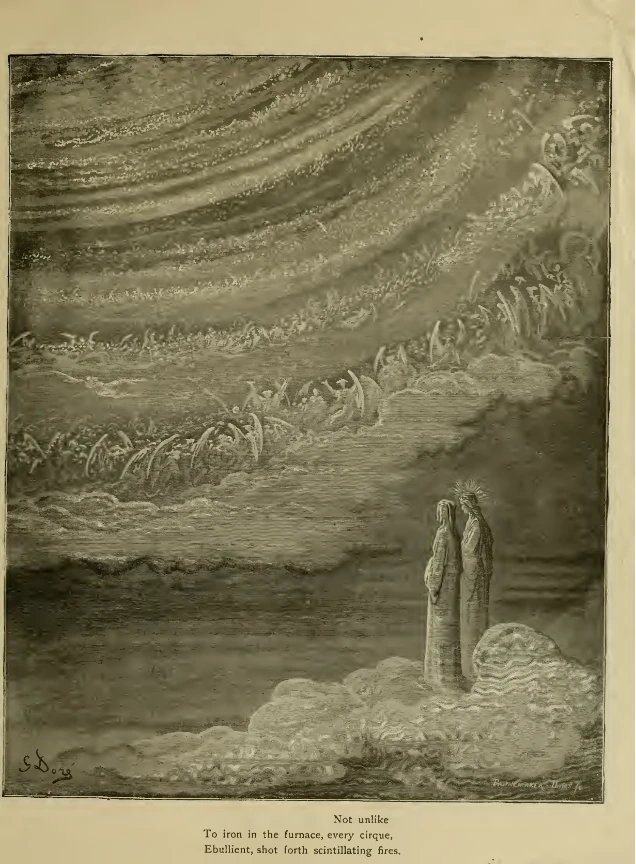
Gustave Doré, Paradise XXVIII. Nine fiery circles surround the point of light, with the nearest ring moving fastest.
Purgatory and Paradise, 1901. Dante Alighieri, translated by Henry Francis Cary, designs by Gustave Doré. Thompson & Thomas, Chicago. Historical text and original designs Public Domain. · Image source ↗ · Public Domain
Why the angelic circles look reversed
The largest moving heaven and the smallest angelic ring belong together in Beatrice’s explanation. Each has the greatest power in the order Dante is seeing. The apparent reversal teaches him which feature to compare. [6][7]
The next transition changes the terms again. Paradise XXX calls the destination unbodied light. Treating the Empyrean as simply a further revolving shell would miss the distinction the poem announces. [3][4]
Read further in the library
Purgatory and Paradise: The Vision of Dante
Reading note
Exact consulted edition and PageRefs in a separately titled book account.
Sources
See references (9)
- Purgatory and Paradise, Reader page 339Dante Alighieri, The Divine Comedy, translated by Henry Francis Cary, designs by Gustave Doré. Inferno: undated New Edition, Thompson & Thomas, Chicago. Purgatory and Paradise: New Edition, Thompson & Thomas, Chicago, 1901. Canto arguments are editorial matter and are distinguished from the poem.Read this page in Purgatory and Paradise: The Vision of Dante ↗Return to text ↑
- Purgatory and Paradise, Reader page 340Dante Alighieri, The Divine Comedy, translated by Henry Francis Cary, designs by Gustave Doré. Inferno: undated New Edition, Thompson & Thomas, Chicago. Purgatory and Paradise: New Edition, Thompson & Thomas, Chicago, 1901. Canto arguments are editorial matter and are distinguished from the poem.Read this page in Purgatory and Paradise: The Vision of Dante ↗Return to text ↑
- Purgatory and Paradise, Reader page 350Dante Alighieri, The Divine Comedy, translated by Henry Francis Cary, designs by Gustave Doré. Inferno: undated New Edition, Thompson & Thomas, Chicago. Purgatory and Paradise: New Edition, Thompson & Thomas, Chicago, 1901. Canto arguments are editorial matter and are distinguished from the poem.Read this page in Purgatory and Paradise: The Vision of Dante ↗Return to text ↑
- Purgatory and Paradise, Reader page 351Dante Alighieri, The Divine Comedy, translated by Henry Francis Cary, designs by Gustave Doré. Inferno: undated New Edition, Thompson & Thomas, Chicago. Purgatory and Paradise: New Edition, Thompson & Thomas, Chicago, 1901. Canto arguments are editorial matter and are distinguished from the poem.Read this page in Purgatory and Paradise: The Vision of Dante ↗Return to text ↑
- Purgatory and Paradise, Reader page 341Dante Alighieri, The Divine Comedy, translated by Henry Francis Cary, designs by Gustave Doré. Inferno: undated New Edition, Thompson & Thomas, Chicago. Purgatory and Paradise: New Edition, Thompson & Thomas, Chicago, 1901. Canto arguments are editorial matter and are distinguished from the poem.Read this page in Purgatory and Paradise: The Vision of Dante ↗Return to text ↑
- Purgatory and Paradise, Reader page 342Dante Alighieri, The Divine Comedy, translated by Henry Francis Cary, designs by Gustave Doré. Inferno: undated New Edition, Thompson & Thomas, Chicago. Purgatory and Paradise: New Edition, Thompson & Thomas, Chicago, 1901. Canto arguments are editorial matter and are distinguished from the poem.Read this page in Purgatory and Paradise: The Vision of Dante ↗Return to text ↑
- Purgatory and Paradise, Reader page 343Dante Alighieri, The Divine Comedy, translated by Henry Francis Cary, designs by Gustave Doré. Inferno: undated New Edition, Thompson & Thomas, Chicago. Purgatory and Paradise: New Edition, Thompson & Thomas, Chicago, 1901. Canto arguments are editorial matter and are distinguished from the poem.Read this page in Purgatory and Paradise: The Vision of Dante ↗Return to text ↑
- Purgatory and Paradise, Reader page 344Dante Alighieri, The Divine Comedy, translated by Henry Francis Cary, designs by Gustave Doré. Inferno: undated New Edition, Thompson & Thomas, Chicago. Purgatory and Paradise: New Edition, Thompson & Thomas, Chicago, 1901. Canto arguments are editorial matter and are distinguished from the poem.Read this page in Purgatory and Paradise: The Vision of Dante ↗Return to text ↑
- Purgatory and Paradise, Reader page 143Dante Alighieri, The Divine Comedy, translated by Henry Francis Cary, designs by Gustave Doré. Inferno: undated New Edition, Thompson & Thomas, Chicago. Purgatory and Paradise: New Edition, Thompson & Thomas, Chicago, 1901. Canto arguments are editorial matter and are distinguished from the poem.Read this page in Purgatory and Paradise: The Vision of Dante ↗