Abraham
Explore Abraham’s covenant and family stories, Jewish interpretations, Christian readings of faith and the Quran’s account of Ibrahim.
In this article
Who is Abraham?
Abraham is a foundational ancestor in Judaism and a major figure in Christianity and Islam, where he is known as Ibrahim. Stories of departure, covenant, children and testing give his life its religious significance. Each tradition approaches those stories through its own scriptures and interpretations. [8][13][9]
Story, covenant and household
What can historical evidence establish?
Genesis presents Abraham within an ancestral world of households, journeys and promises. Christine Hayes’s Yale lecture distinguishes the religious and literary force of these narratives from the problem of reconstructing an individual lifetime. An exact birth date is not established by the evidence discussed here. [1]
Hayes surveys disagreements over whether the stories preserve early memories or largely reflect later composition. Customs resembling those in ancient Near Eastern documents do not, by themselves, settle their date: similar practices could persist across centuries. A plausible social setting is different from independent confirmation of every narrated event. [1]
Her reading also follows the story’s suspense. Promises of descendants, blessing and land recur while the household’s prospects seem repeatedly endangered. Sarah’s difficulty bearing a child makes the future uncertain to the characters, even when a reader already knows how the narrative will develop. [1]
Departure, new names and covenant
Genesis 12 calls Abram to leave his homeland for a promised future. Genesis 17 renames him Abraham and Sarai Sarah, associates the covenant with circumcision, and promises a son through Sarah. [2][3]
Abraham asks that Ishmael might live under God’s favour. The reply in Genesis 17 distinguishes a blessing for Ishmael and his descendants from the covenant to be continued through Isaac. The text’s family relationships contain both connection and differentiation. [3]
Hayes contrasts Genesis 15, where God alone passes between divided sacrificial animals to ratify the promise, with Genesis 17, where circumcision marks an obligation for Abraham’s household. Her comparison shows why the covenant cannot be reduced to a single abstract statement: its different presentations join promise, ritual and responsibility. [1]
Hospitality and an argument about justice
Genesis 18 joins hospitality with intercession. Abraham feeds three visitors; Sarah hears that she will bear a son. Later, Abraham questions whether Sodom’s innocent inhabitants should perish with the guilty, asking about progressively smaller numbers of righteous people. [4]
The visitors in a Renaissance landscape
Josse Lieferinxe’s Abraham and the Three Angels places three winged visitors in matching pale robes before a kneeling Abraham. Sarah watches from the doorway of a rustic building. The landscape, clothing and carefully balanced figures bring the biblical encounter into a European painter’s visual world. [15]
The Kress catalogue identifies the scene with the announcement of Sarah’s future child. The painting offers a close way to notice how hospitality becomes a revelation: an apparently ordinary visit carries news that changes the household’s future. Dated about 1495–1500, it is a later interpretation of Genesis, with its own artistic choices. [15]
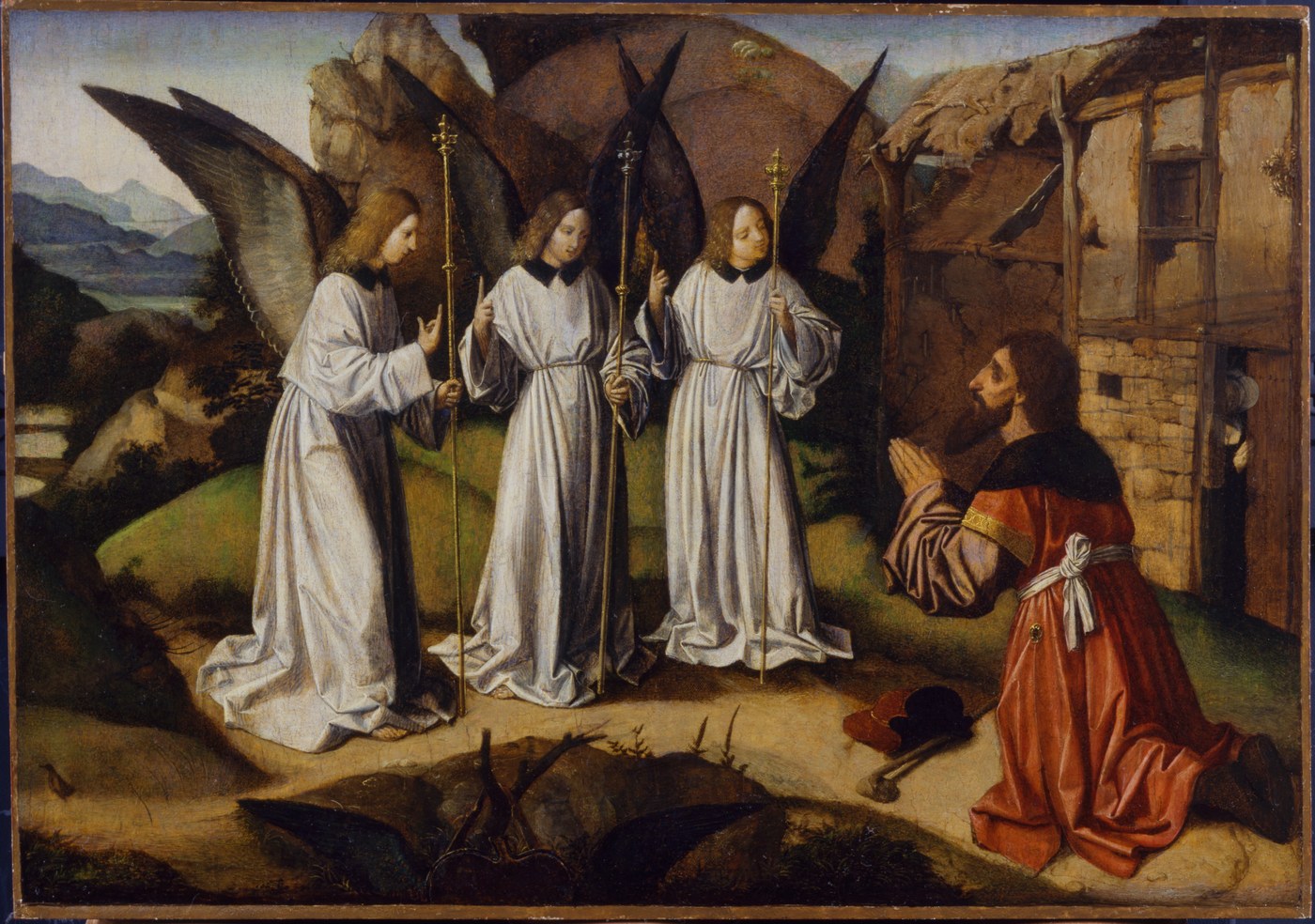
Josse Lieferinxe, Abraham and the Three Angels, about 1495–1500. Denver Art Museum, Kress Collection.
Denver Art Museum, gift of the Samuel H. Kress Foundation; image from the Samuel H. Kress Foundation. Accession 1961.158; K367. Public Domain. · Museum record ↗ · Public Domain
Hagar, Ishmael and the binding of Isaac
Genesis 21 includes painful exclusion: Sarah demands Hagar and Ishmael’s departure, distressing Abraham. In the wilderness, divine aid reaches mother and child. The narrative preserves a future for Ishmael alongside the promise attached to Isaac. [5]
In Genesis 22, Abraham prepares to sacrifice Isaac. A divine messenger stops him, and a ram replaces the child. The episode makes testing inseparable from the danger to a beloved son. [6]
Genesis 25 later brings Isaac and Ishmael together to bury their father. [7]
Jewish and Christian interpretations
Why Jewish interpreters speak of ten tests
Menachem Posner’s Chabad discussion begins with a useful distinction: the Mishnah speaks of Abraham enduring ten tests without specifying the entire list. Later interpreters identify the trials differently. A familiar summary of the ten therefore already represents an interpretive choice. [8]
Posner contrasts the lists attributed to Maimonides and Rabbi Ovadiah of Bertinoro. The first draws its events from scripture; the second includes Abraham’s ordeal in a fiery furnace, a story transmitted through midrashic tradition. Recognizing that difference helps readers locate a well-known episode in its actual literary setting. [8]
This Orthodox Jewish account reads the trials as expressions of Abraham’s devotion. It also shows how commentary extends a biblical life: the inherited figure becomes a subject of continuing discussion about faithfulness under pressure. [8]
Rembrandt’s moment of restraint
In Rembrandt’s Abraham’s Sacrifice, the angel presses close to Abraham and restrains his arms. Isaac bends across the foreground, his face covered by his father’s hand. The ram appears at the right. The composition concentrates attention on touch, arrested movement and the vulnerability of the child. [16]
This 1655 etching and drypoint is a small print, rather than a monumental painting. Its dense lines gather the three figures into an intimate encounter. Seen beside the Genesis account, it gives particular visual weight to the instant when the killing is prevented, showing how an artist can direct a reader’s attention within a familiar story. [16]
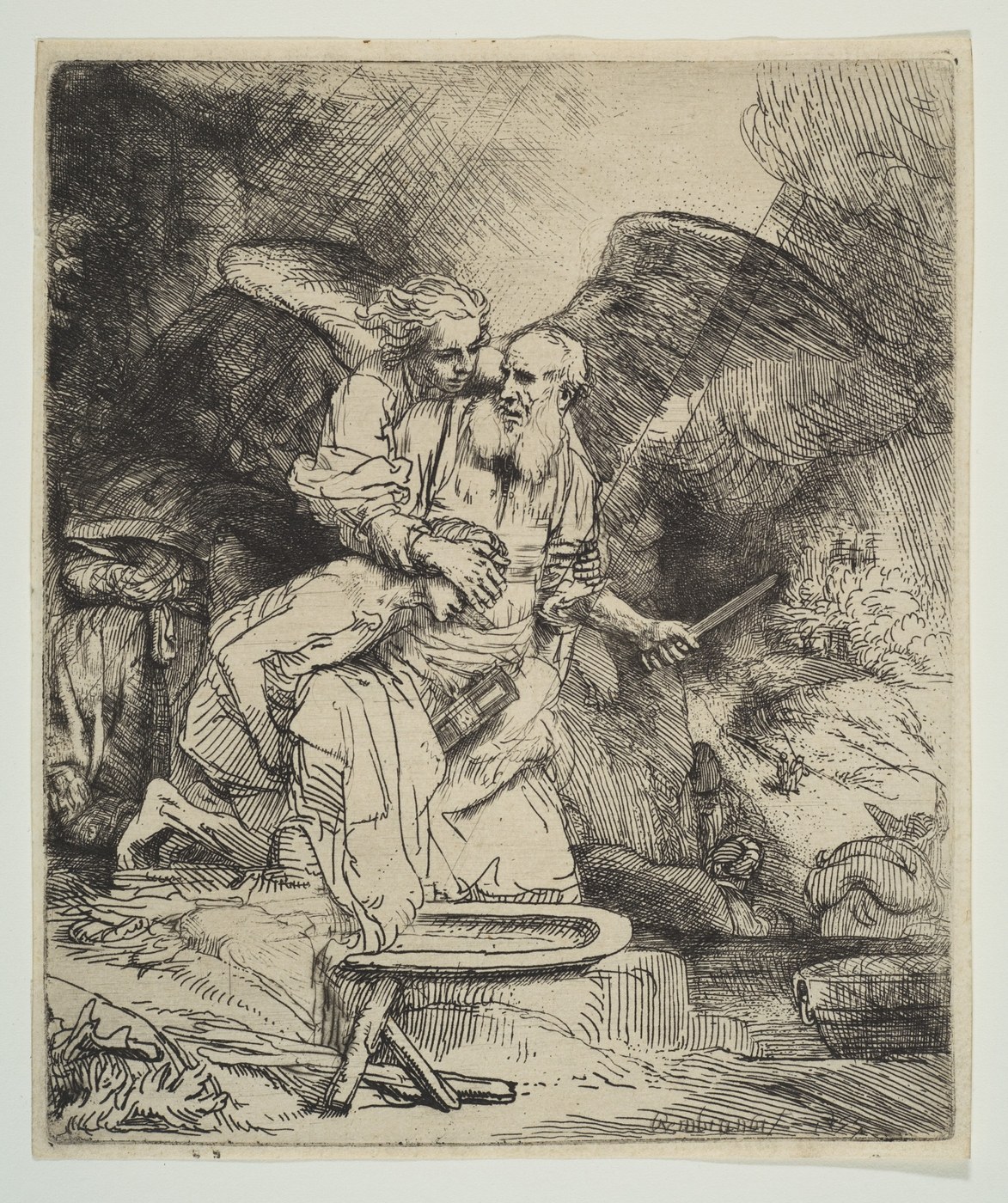
Rembrandt, Abraham’s Sacrifice, 1655. Etching and drypoint.
Bequest of Ida Kammerer, in memory of her husband, Frederic Kammerer, M.D., 1933. Accession 33.79.13. Public Domain. · Museum record ↗ · CC0
Faith, action and promise in Christian texts
Romans 4 appeals to Abraham’s trust before circumcision to explain how he can be an ancestor of believers beyond the circumcised community. Paul connects that argument with faith in the God who raised Jesus. [9]
James 2 emphasizes Abraham’s action in offering Isaac, presenting faith as completed through works. Its wider discussion challenges faith that leaves a poorly clothed, hungry neighbour unaided. [10]
Hebrews 11 portrays Abraham as a traveller seeking a divinely prepared homeland. It interprets the offering of Isaac through confidence that God could raise the dead. These passages develop distinct Christian arguments from the ancestral story. [11]
The question each passage asks matters. Romans addresses the reach of the promise and righteousness before circumcision. James challenges a profession of faith that produces no action. Reading both in context preserves their different emphases without treating either as a complete account of Jewish covenantal life. [9][10]
Ibrahim in Islamic scripture and sacred geography
Ibrahim and the House of worship
Quran 2:124–129 presents Abraham as tested and entrusted with leadership, while excluding wrongdoers from the covenant’s assurance. Abraham and Ishmael raise the foundations of the House and pray for acceptance, guidance in worship and a faithful community. Their work is joined with prayer. [12]
Quran 3:65–68 challenges competing claims to Abraham by presenting him as an upright worshipper submitted to God, preceding the revelation of Torah and Gospel. This is the Quran’s theological account of his identity; it should be read in its own setting alongside Jewish and Christian interpretations. [13]
The sacrifice narrative and the unnamed son
In Quran 37:99–113, Abraham tells his son about a dream of sacrifice. The son responds with willingness and endurance. The account describes their submission, the divine interruption and a great sacrifice given in ransom. [14]
The sacrifice episode does not name the son. Verses 112–113 then announce Isaac and bless him with Abraham. A later identification should be distinguished from the passage’s wording. [14]
Abraham’s sacred geography in a pilgrimage book
The Futuh al-Haramayn describes the holy cities of Mecca and Medina for pilgrims. Muhi al-Din Lari composed its text in the early sixteenth century; the Met dates this copy to that century and identifies Bukhara as its probable place of production. The copyist and illustrator are not named here. [17]
Its diagram of the sanctuary arranges the Kaaba, surrounding structures and minarets in a richly coloured enclosure. It can be read alongside the Quran’s association of Abraham and Ishmael with the House. The image belongs to a later culture of pilgrimage and sacred places, rather than documenting the appearance of a site in Abraham’s lifetime. [17]
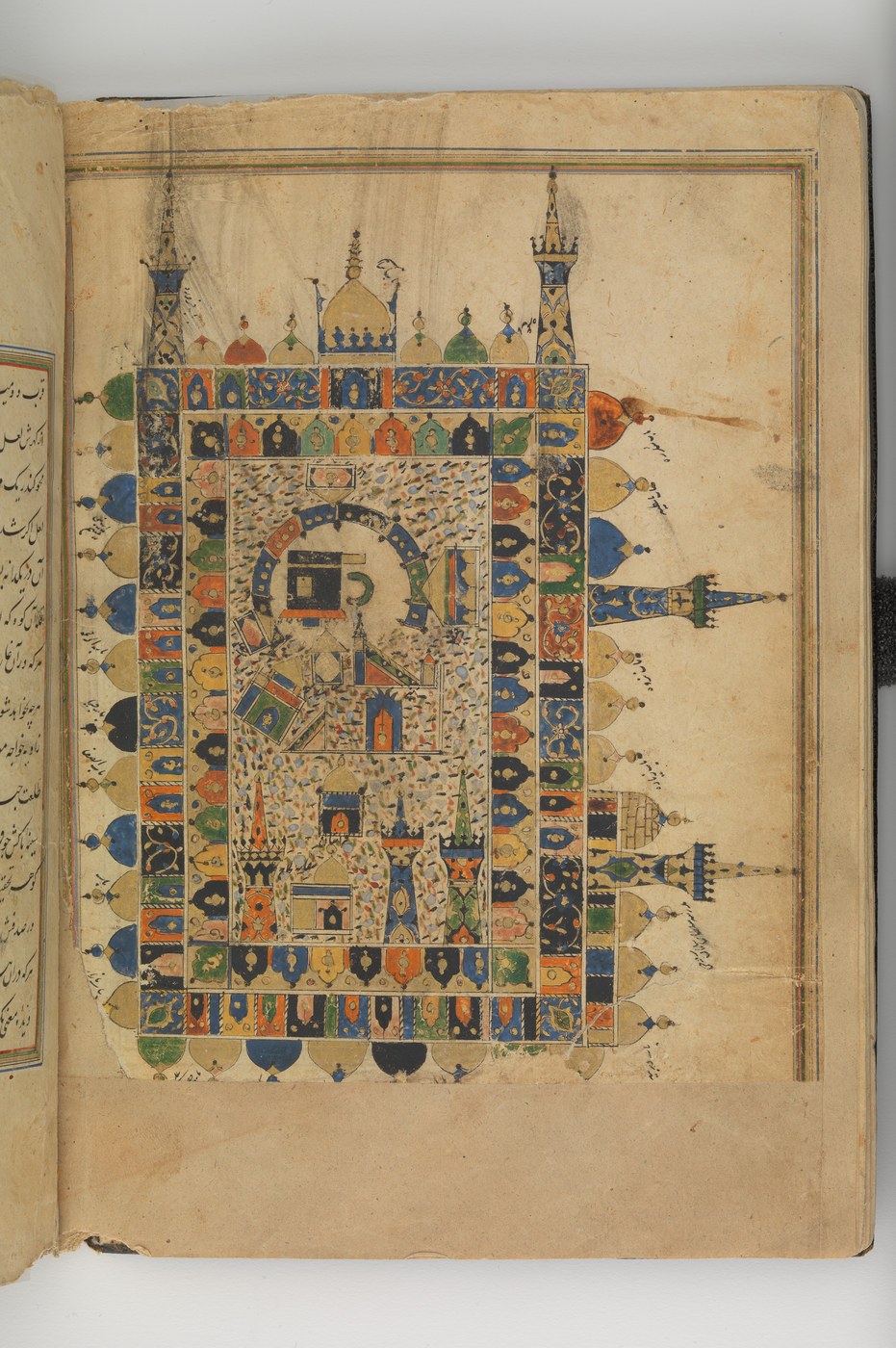
Futuh al-Haramayn, sixteenth-century copy, probably Bukhara. Text by Muhi al-Din Lari; copyist and illustrator unidentified.
The Metropolitan Museum of Art. Purchase, Patti Cadby Birch Gift, 2009. Accession 2009.343. Public Domain (CC0). · Museum record ↗ · CC0
Read further in the library
The Bible Gallery
Reading note
Gustave Doré’s biblical illustrations and Talbot W. Chambers’s narratives offer a nineteenth-century visual retelling of selected scriptural scenes.
Sources
- Biblical Narrative: The Stories of the Patriarchs, RLST145 Lecture6 ↗Christine Hayes, Open Yale Courses; chapters1–3 inspectedReturn to text ↑
- Genesis 12 ↗The JPS TANAKH: Gender-Sensitive Edition, Jewish Publication Society; Sefaria; selected verses inspectedReturn to text ↑
- Genesis 17 ↗The JPS TANAKH: Gender-Sensitive Edition, Jewish Publication Society; Sefaria; selected verses inspectedReturn to text ↑
- Genesis 18 ↗The JPS TANAKH: Gender-Sensitive Edition, Jewish Publication Society; Sefaria; selected verses inspectedReturn to text ↑
- Genesis 21 ↗The JPS TANAKH: Gender-Sensitive Edition, Jewish Publication Society; Sefaria; selected verses inspectedReturn to text ↑
- Genesis 22 ↗The JPS TANAKH: Gender-Sensitive Edition, Jewish Publication Society; Sefaria; selected verses inspectedReturn to text ↑
- Genesis 25 ↗The JPS TANAKH: Gender-Sensitive Edition, Jewish Publication Society; Sefaria; selected verses inspectedReturn to text ↑
- What Were Abraham’s 10 Tests? ↗Menachem Posner, Chabad.orgReturn to text ↑
- Romans 4:1–25 ↗New Revised Standard Version Updated Edition, National Council of Churches; Bible GatewayReturn to text ↑
- James 2:14–26 ↗New Revised Standard Version Updated Edition, National Council of Churches; Bible GatewayReturn to text ↑
- Hebrews 11:8–19 ↗New Revised Standard Version Updated Edition, National Council of Churches; Bible GatewayReturn to text ↑
- Quran 2:124–129 ↗The Clear Quran, Mustafa Khattab; Quran.com; verses124–129 inspected across their individual pages and contextReturn to text ↑
- Quran 3:65–68 ↗The Clear Quran, Mustafa Khattab; Quran.comReturn to text ↑
- Quran 37:99–113 ↗The Clear Quran, Mustafa Khattab; Quran.comReturn to text ↑
- Abraham and the Three Angels, K367 ↗Samuel H. Kress Foundation; Denver Art Museum, accession1961.158Return to text ↑
- Abraham’s Sacrifice ↗The Metropolitan Museum of Art; accession33.79.13Return to text ↑
- Futuh al-Haramayn (Description of the Holy Cities) ↗The Metropolitan Museum of Art; accession2009.343Return to text ↑
About this article & its sources
A comparative biographical reference separating Genesis, Jewish interpretation, Christian texts and Quranic accounts. No exact historical lifetime is asserted. Later art and sacred-site diagrams retain their own dates and settings.
Passage attributions
Who is Abraham?
Passage 1: Menachem Posner, Chabad.org.
What can historical evidence establish?
Passage 1: Christine Hayes, Open Yale Courses; chapters1–3 inspected.
Passage 2: Christine Hayes, Open Yale Courses; chapters1–3 inspected.
Passage 3: Christine Hayes, Open Yale Courses; chapters1–3 inspected.
Departure, new names and covenant
Passage 1: The JPS TANAKH: Gender-Sensitive Edition, Jewish Publication Society; Sefaria; selected verses inspected.
Passage 2: The JPS TANAKH: Gender-Sensitive Edition, Genesis17:18–21.
Passage 3: Christine Hayes, Yale lecture6, chapter3.
Hospitality and an argument about justice
Passage 1: The JPS TANAKH: Gender-Sensitive Edition, Jewish Publication Society; Sefaria; selected verses inspected.
The visitors in a Renaissance landscape
Passage 1: Samuel H. Kress Foundation; Denver Art Museum, accession1961.158.
Passage 2: Samuel H. Kress Foundation; Denver Art Museum, accession1961.158.
Hagar, Ishmael and the binding of Isaac
Passage 1: The JPS TANAKH: Gender-Sensitive Edition, Jewish Publication Society; Sefaria; selected verses inspected.
Passage 2: The JPS TANAKH: Gender-Sensitive Edition, Jewish Publication Society; Sefaria; selected verses inspected.
Passage 3: The JPS TANAKH: Gender-Sensitive Edition, Jewish Publication Society; Sefaria; selected verses inspected.
Why Jewish interpreters speak of ten tests
Passage 1: Menachem Posner, Chabad.org.
Passage 2: Menachem Posner, Chabad.org.
Passage 3: Menachem Posner, Chabad.org.
Rembrandt’s moment of restraint
Passage 1: The Metropolitan Museum of Art; accession33.79.13.
Passage 2: The Metropolitan Museum of Art; accession33.79.13.
Faith, action and promise in Christian texts
Passage 1: New Revised Standard Version Updated Edition, National Council of Churches; Bible Gateway.
Passage 2: New Revised Standard Version Updated Edition, National Council of Churches; Bible Gateway.
Passage 3: New Revised Standard Version Updated Edition, National Council of Churches; Bible Gateway.
Passage 4: Romans4 and James2:14–26, NRSVUE; comparative reading.
Ibrahim and the House of worship
Passage 1: The Clear Quran, Mustafa Khattab; Quran.com; verses124–129 inspected across their individual pages and context.
Passage 2: The Clear Quran, Mustafa Khattab; Quran.com; verses124–129 inspected across their individual pages and context.