Yama
Explore Yama through Vedic ancestors, the dialogue with Nachiketas, Savitri’s appeal, Buddhist moral judgment and different forms of sacred art.
In this article
Who is Yama?
Yama is a lord of the dead in Hindu and Buddhist traditions. His role changes across texts: the ancient path of the ancestors, an encounter with Death as teacher, and moral judgment each give the figure a different emphasis. Rig Veda 10.14 addresses him as a king who gathers people and has found a dwelling for the departed. [1]
The hymn’s setting is funerary. The deceased is directed towards paths already travelled by the ancestors, with Yama among those who receive the dead. This is a useful starting point because the imagery concerns arrival, community and a place of rest. A later picture of punishment should not supply every detail of this earlier setting. [1]
Ancestors and Hindu narratives
The ancestors and the guarded path
The hymn also names Yama’s two dogs as watchers of the path. It asks that the deceased be entrusted to their protection. Gifts and offerings connect the living with Yama and the ancestors. The passage holds the fear of death together with a hope of welcome among those who have gone before. [1]
Nachiketas asks Death a question
The Katha Upanishad makes Yama an interlocutor. Nachiketas has waited in his house for three nights without food, and Death offers three boons in response. The first concerns reconciliation with the boy’s father; the second concerns the fire sacrifice leading to heaven. [2]
The third asks what happens when a person dies. Yama acknowledges the difficulty of the question and offers alternatives: wealth, descendants, long life and pleasures. Nachiketas refuses to exchange the question for things that pass away. Even a long life remains brief in the presence of Death. [2]
The encounter gives inquiry a dramatic setting. The teacher is Death itself, and the pupil must decide what is worth asking. The refusal of substitutes prepares the teaching that follows. This opening dialogue is therefore more than a catalogue of rewards: it examines whether comfort and duration can answer the question mortality raises. [2]
Savitri and the force of a promise
In the Mahabharata’s Savitri episode, Yama comes to take Satyavan’s life. Savitri follows him and speaks about righteous conduct, friendship and compassion. Pleased with her words, he offers successive boons while repeatedly excluding her husband’s life. [3]
Her requests eventually include sons born to herself and Satyavan. She then points out that the promise requires her husband’s restoration. Yama releases him. The story makes Death responsive to moral speech and to the implications of a granted word. [3]
The episode’s force lies in the dialogue as well as its miraculous ending. Savitri addresses Yama as a dispenser of equal law and appeals to the conduct expected of the righteous. It is an epic religious narrative of devotion and reasoning, with its own account of what a promise requires. [3]
Buddhist judgment and protection
A Buddhist account of responsibility
In MN 130, Yama questions a wrongdoer about warnings visible in human life, including birth, aging, illness and death. The failure was heedlessness. Yama stresses that the person’s harmful action was their own, and its result must be experienced by that person. This is the discourse’s moral setting for his judgment. [4]
Yama as a protector in Tibetan Buddhist art
A different setting appears in the Rubin Museum’s discussion of Yama Dharmaraja. A nineteenth-century Mongolian painting presents a fierce protector associated especially with the Geluk tradition. Its imagery includes a skull club, a noose and a buffalo, with another form of Yama below. [5]
The museum explains wrathful appearance through the removal of obstacles and the protection of Buddhist teaching. In this setting, a frightening form can serve a protective role. That role should be kept distinct from the questioning king in the Pali discourse and from the teacher of the Katha Upanishad. The shared name connects a history of religious forms without making their purposes identical. [5]
A Sri Lankan guardian of the south
The Met’s ninth-century Sri Lankan bronze presents Yama as regent of the south, accompanied by a buffalo and holding the remains of a staff. The museum places him among directional guardians associated with the protection of Buddhist teaching and community. It leaves the sculpture’s precise ritual function open. [6]
The surviving object is smaller and quieter than many later wrathful paintings. Comparing the two settings helps separate a figure’s direction, attributes and protective role from an assumption that every image must depict the same narrative moment. [6]
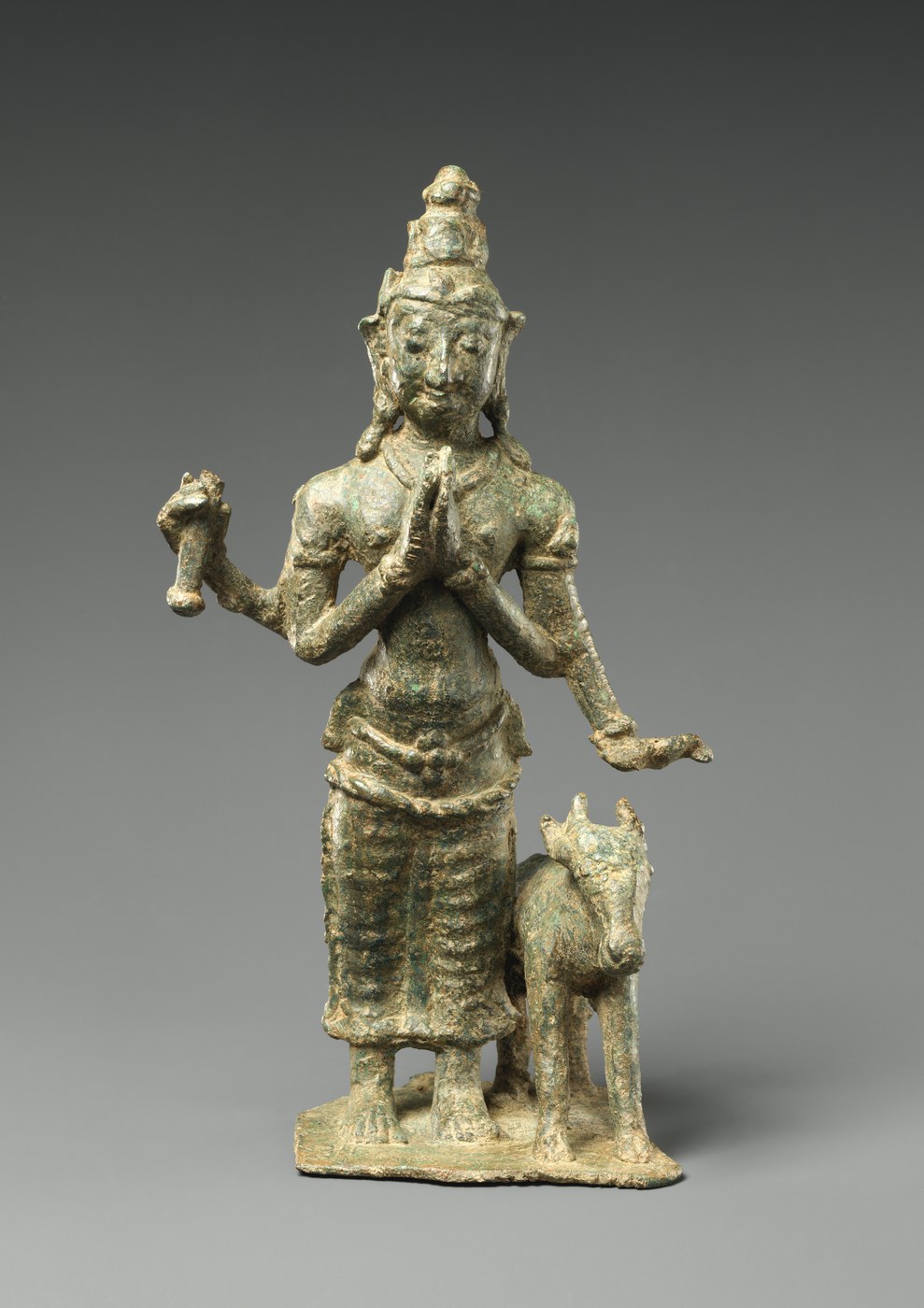
Yama, Lord of Death: Regent of the South, Sri Lanka, ninth century. Bronze. A directional guardian accompanied by a buffalo.
The Metropolitan Museum of Art. Gift of Guardian of the Flame Collection, 2005. Accession 2005.468.1. Public Domain (CC0). · Museum record ↗ · CC0
The historical Library accounts
The Library’s Nachiketas retelling
The Library retelling preserves Yama’s three boons to Nachiketas. [7]
The Library’s Savitri retelling
Its Savitri episode ends with Yama restoring Satyavan’s life. [8]
Read further in the library
Myths of the Hindus and Buddhists
Reading note
Compare the collection’s historical Nachiketas and Savitri retellings with the primary texts and the distinct Buddhist settings discussed here. Both original Reader citations are retained.
Sources
- Rig Veda 10.14: Yama ↗Ralph T. H. Griffith’s historical translation; funeral hymnReturn to text ↑
- Katha Upanishad I.1 ↗F. Max Müller, The Upanishads, Part II; primary text distinguished from translator’s notesReturn to text ↑
- Mahabharata, Vana Parva, section 295 ↗Kisari Mohan Ganguli’s historical translation; Savitri’s dialogue with YamaReturn to text ↑
- MN 130: The Deva Messengers ↗Pali discourse translated by Thanissaro Bhikkhu; personal action and its consequencesReturn to text ↑
- Flaming, Fanged, and Fierce: Wrathful Deities in the Tibetan Buddhist Shrine Room ↗Christina Watson, Rubin Museum, 27 March 2026; Yama Dharmaraja in a Geluk settingReturn to text ↑
- Yama, Lord of Death: Regent of the South ↗The Metropolitan Museum of Art; Sri Lanka, ninth century, accession 2005.468.1Return to text ↑
- Myths of the Hindus & Buddhists: printed page 333Sister Nivedita and Ananda K. Coomaraswamy, 1914; historical retellingReturn to text ↑
Examine the original Library page
Exact inherited citation retained. Original page image inspected again. The historical author’s account remains distinct from the primary, museum and scholarly sources used in the expanded entry.
ask of me three boons in return
Open the original page in Myths of the Hindus and Buddhists ↗Scan leaf 407 · Sister Nivedita and Ananda K. Coomaraswamy
- Myths of the Hindus & Buddhists: printed page 351Sister Nivedita and Ananda K. Coomaraswamy, 1914; historical retellingReturn to text ↑
Examine the original Library page
Exact inherited citation retained. Original page image inspected again. The historical author’s account remains distinct from the primary, museum and scholarly sources used in the expanded entry.
Then Yama yielded and gave back Satyavan
Open the original page in Myths of the Hindus and Buddhists ↗Scan leaf 427 · Sister Nivedita and Ananda K. Coomaraswamy
About this article & its sources
Selected Vedic, Upanishadic, epic and Buddhist accounts, with separate historical art examples. Different roles are explained through their texts rather than combined into one universal biography.
Passage attributions
Who is Yama?
Passage 1: Ralph T. H. Griffith’s historical translation; funeral hymn.
Passage 2: Ralph T. H. Griffith’s historical translation; funeral hymn.
The ancestors and the guarded path
Passage 1: Ralph T. H. Griffith’s historical translation; funeral hymn.
Nachiketas asks Death a question
Passage 1: F. Max Müller, The Upanishads, Part II; primary text distinguished from translator’s notes.
Passage 2: F. Max Müller, The Upanishads, Part II; primary text distinguished from translator’s notes.
Passage 3: F. Max Müller, The Upanishads, Part II; primary text distinguished from translator’s notes.
Savitri and the force of a promise
Passage 1: Kisari Mohan Ganguli’s historical translation; Savitri’s dialogue with Yama.
Passage 2: Kisari Mohan Ganguli’s historical translation; Savitri’s dialogue with Yama.
Passage 3: Kisari Mohan Ganguli’s historical translation; Savitri’s dialogue with Yama.
A Buddhist account of responsibility
Passage 1: Pali discourse translated by Thanissaro Bhikkhu; personal action and its consequences.
Yama as a protector in Tibetan Buddhist art
Passage 1: Christina Watson, Rubin Museum, 27 March 2026; Yama Dharmaraja in a Geluk setting.
Passage 2: Christina Watson, Rubin Museum, 27 March 2026; Yama Dharmaraja in a Geluk setting.
A Sri Lankan guardian of the south
Passage 1: The Metropolitan Museum of Art; Sri Lanka, ninth century, accession 2005.468.1.
Passage 2: The Metropolitan Museum of Art; Sri Lanka, ninth century, accession 2005.468.1.
The Library’s Nachiketas retelling
Passage 1: Sister Nivedita and Ananda K. Coomaraswamy, 1914; historical retelling.
The Library’s Savitri retelling
Passage 1: Sister Nivedita and Ananda K. Coomaraswamy, 1914; historical retelling.