The Wall of Fire in Gone West
The Wall of Fire is a boundary in J. S. M. Ward’s Gone West. Read what changes at the threshold and why his guides decline to describe what lies beyond.
In this article
Understanding the wall of fire in gone west
The Wall of Fire is a boundary in J. S. M. Ward’s Gone West. Spirits who pass through it are said to change form while remaining themselves. The book tells more about the approach and the people crossing it than about the condition on the other side. [1][2]
The limit matters in the classroom and in conversations with guides. A teacher can say the students will leave their present form, but the answer stops at a point beyond the teacher’s own experience. [1][2][3]
Gone West by J. S. M. Ward
J. S. M. Ward’s introduction recounts the monk Ambrose passing through the Wall of Fire after long service helping other spirits. His dog and a woman he loved are said to accompany him. The event combines completed service, continuing companionship and a further stage of spiritual life. [1]
Some of Ward’s contributors call passing the wall a second death. The book also uses that expression for moving from an astral to a spiritual condition. The name points to leaving an accustomed form, and the surrounding passage tells us which transition it means. [1]
The guardian says he passed the wall and later came back to work. On the spirit plane he needs a form, so he gives himself one. His demonstration of flame and cloud makes the contrast visible: the form changes while the person who assumes it continues. [1][2]
Ward then considers whether passing beyond the wall entails reincarnation. He allows that possibility for some spirits but thinks others continue to higher planes. He explicitly presents this as an inference at the edge of his information, rather than a settled description of what every spirit undergoes. [2]
In H. J. L.’s classroom, a teacher makes the limit equally clear. The pupils ask whether they will ultimately leave their present form. He says they will, but cannot explain what follows: his own knowledge does not extend through the wall. The uncertainty is built into the lesson. [3]
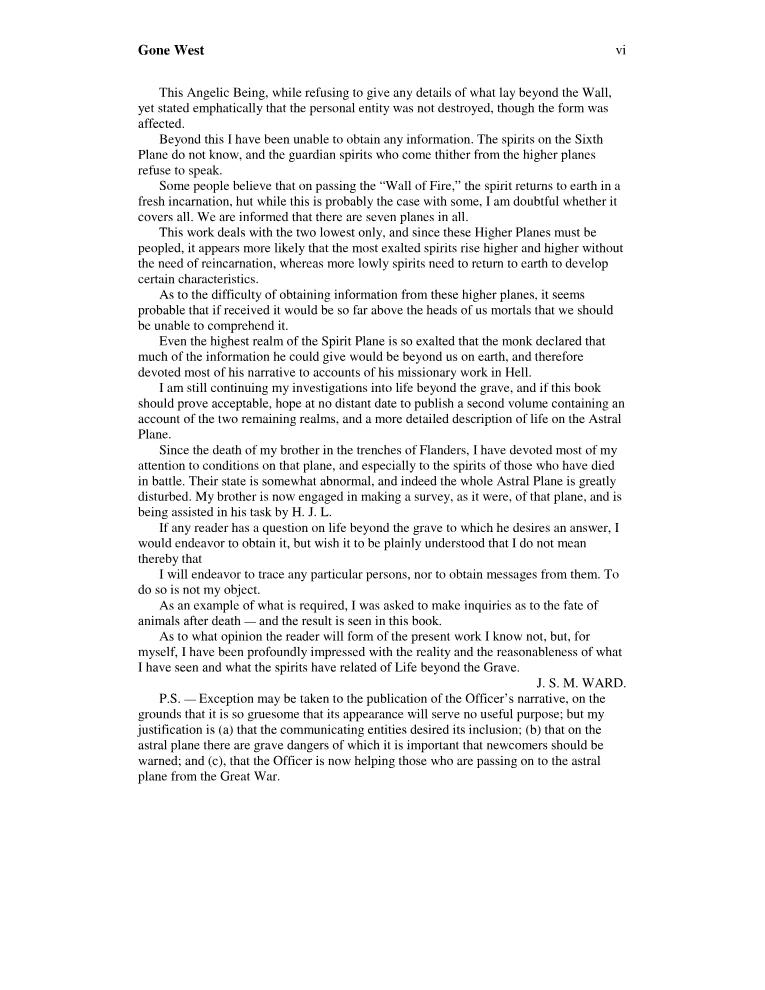
Source page: Gone West, Reader page 10. Ward’s 1920 text is shown in Geoff Cutler’s 2009 digital transcription, rather than an original printed facsimile.
J. S. M. Ward, Gone West, historical text in the public domain. Geoff Cutler’s 2009 transcription expressly permits reuse for any purpose on source leaf2. This image shows the digital transcription, not an original printed facsimile. · Image source ↗ · Public Domain
The Angels’ Diary and Celestion Study of Man
Celestion Study of Man, published under the names of Effie M. Shirey and Charles Samson, names a further stage Argaon. Passing through successive centres is said to refine the spiritual form while preserving the distinctive individual. Argaon is identified with a higher atmosphere rather than described through a detailed landscape. [6][7]
What changes at a boundary?
The wall of darkness marks another transition in Ward’s narrative, where the Officer approaches from Hell towards a brighter condition. It belongs to a different episode and is described in terms of faith, darkness and the limits of what the Officer can perceive. [4][5]
Ward affirms that a person can remain the same through a change of appearance. Celestion Study of Man explains increasing refinement through Argaon, a higher atmosphere or force. The difference lies in where each stops explaining: Ward marks a boundary beyond his guides’ knowledge, while Celestion describes the quality assigned to its further stage. [1][2][6][7][3]
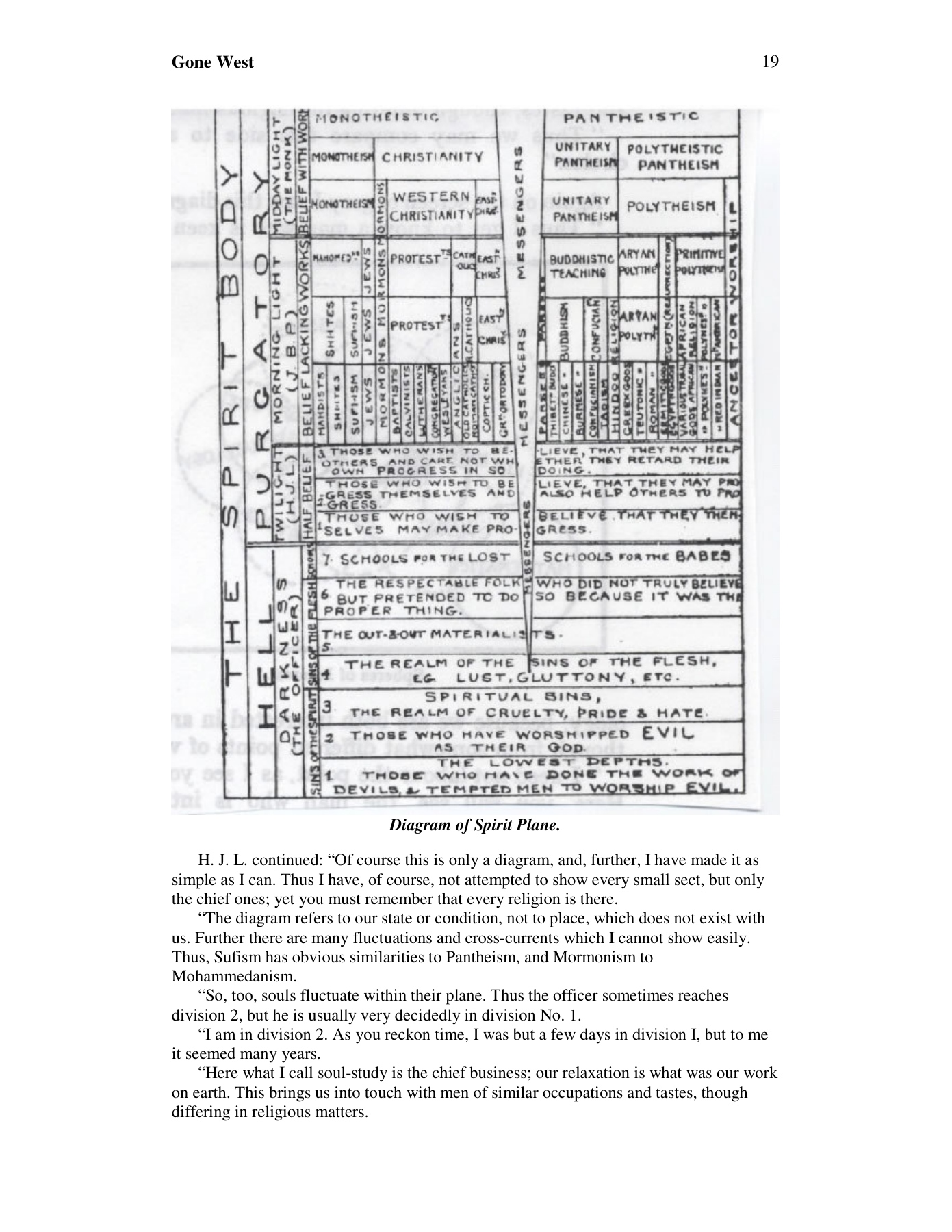
Diagram of the Spirit Plane in Gone West, printed p. 19, Library Reader page 32. The chart describes conditions within the spirit plane. The introduction discusses the Wall of Fire separately.
J. S. M. Ward, Gone West. Historical diagram in the public domain. Digital transcription by Geoff Cutler, whose notice on source leaf 2 permits reuse for any purpose. · Image source ↗ · Public Domain
See references (7)
- Gone West, printed p. v, Reader page 9
- Gone West, printed p. vi, Reader page 10
- Gone West, printed p. 25, Reader page 38
- Gone West, printed p. 36, Reader page 49
- Gone West, printed p. 37, Reader page 50
- The Angels’ Diary and Celestion Study of Man, Reader page 152
- The Angels’ Diary and Celestion Study of Man, Reader page 153
Read further in the library

Gone West
Reading note
The separately titled account draws on exact passages in the consulted Library edition.
The Angels’ Diary and Celestion Study of Man
Reading note
Separately attributed comparison with exact previously researched Library passages.
Sources
See references (8)
- Gone West, printed p. v, Reader page 9J. S. M. Ward, Gone West: Three Narratives of After-Death Experiences, third impression, William Rider & Son, London, 1920, as reproduced in Geoff Cutler’s December 2009 digital transcription. Ward’s introduction is distinct from the supplied 1974 foreword.Read this page in Gone West ↗Return to text ↑
- Gone West, printed p. vi, Reader page 10J. S. M. Ward, Gone West: Three Narratives of After-Death Experiences, third impression, William Rider & Son, London, 1920, as reproduced in Geoff Cutler’s December 2009 digital transcription. Ward’s introduction is distinct from the supplied 1974 foreword.Read this page in Gone West ↗Return to text ↑
- Gone West, printed p. 25, Reader page 38J. S. M. Ward, Gone West: Three Narratives of After-Death Experiences, third impression, William Rider & Son, London, 1920, as reproduced in Geoff Cutler’s December 2009 digital transcription. Ward’s introduction is distinct from the supplied 1974 foreword.Read this page in Gone West ↗Return to text ↑
- Gone West, printed p. 36, Reader page 49J. S. M. Ward, Gone West: Three Narratives of After-Death Experiences, third impression, William Rider & Son, London, 1920, as reproduced in Geoff Cutler’s December 2009 digital transcription. Ward’s introduction is distinct from the supplied 1974 foreword.Read this page in Gone West ↗Return to text ↑
- Gone West, printed p. 37, Reader page 50J. S. M. Ward, Gone West: Three Narratives of After-Death Experiences, third impression, William Rider & Son, London, 1920, as reproduced in Geoff Cutler’s December 2009 digital transcription. Ward’s introduction is distinct from the supplied 1974 foreword.Read this page in Gone West ↗Return to text ↑
- The Angels’ Diary and Celestion Study of Man, Reader page 152Effie M. Shirey and Charles Samson, The Angels’ Diary and Celestion Study of Man (1903), communicated through Elizabeth Maud Weatherhead according to the volume’s acknowledgment. Accounts below refer to the exact retained Library edition IMJ-0055-E001.Read this page in The Angels’ Diary and Celestion Study of Man ↗Return to text ↑
- The Angels’ Diary and Celestion Study of Man, Reader page 153Effie M. Shirey and Charles Samson, The Angels’ Diary and Celestion Study of Man (1903), communicated through Elizabeth Maud Weatherhead according to the volume’s acknowledgment. Accounts below refer to the exact retained Library edition IMJ-0055-E001.Read this page in The Angels’ Diary and Celestion Study of Man ↗Return to text ↑
- Gone West, printed p. 19, Reader page 32J. S. M. Ward, Gone West, 1920 third impression as reproduced in the 2009 Geoff Cutler digital transcription.Read this page in Gone West ↗