Reincarnation
Reincarnation is the idea of another embodied life after death. Hindu, Buddhist and Spiritualist texts give different answers about what carries over.
In this article
Rebirth in Hindu and Buddhist texts
What is reincarnation?
Reincarnation is the idea that life after death can include another embodied life. The questions of what continues, how the new life is related to the former one and whether rebirth is necessary receive different answers. A belief in an immortal individual soul is one possible account of continuity. The Buddhist discourse considered below challenges a particular claim that the same consciousness travels unchanged. [1][2]
Returning to birth is also a different claim from communicating with the dead or changing a spiritual body while remaining in an afterlife. A Wanderer in the Spirit Lands distinguishes these possibilities and allows different paths of development. Its discussion should be read as a particular Spiritualist account, alongside the distinct Indian texts. [4][7][8]
Changing bodies in the Bhagavad Gita
Bhagavad Gita 2.22 compares the embodied soul’s departure from one body and entry into another to changing worn clothing. In Swami Mukundananda’s translation and commentary, the image emphasises the soul’s continuity through the change of body. This verse gives a compact model of rebirth through an enduring soul; it does not by itself supply every Hindu account of the subject. [1]
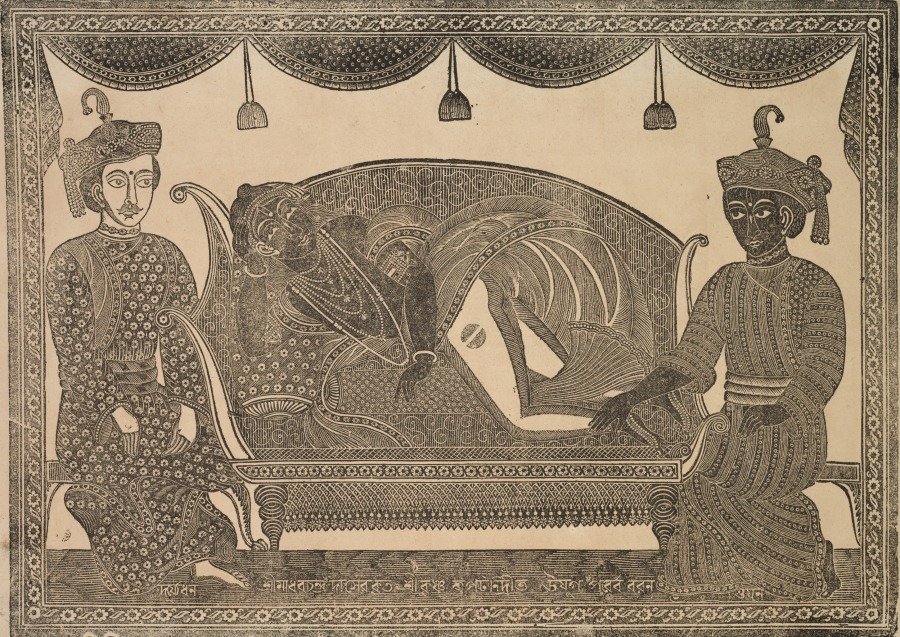
A Kalighat painting shows Krishna with Arjuna and Duryodhana in a separate Mahabharata episode. Krishna’s teaching to Arjuna in the Bhagavad Gita provides one of the accounts of rebirth in this article.
Cleveland Museum of Art, Gift of William E. Ward in memory of Evelyn Svec Ward, 2003.139. Shri Gobinda Chandra Roy, about 1890. CC0; resized and converted to JPEG. · Image source ↗ · CC0
A Buddhist challenge to an unchanged traveller
In Majjhima Nikaya 38, Sāti claims that the same consciousness moves through successive lives. The Buddha rejects his formulation and explains consciousness through the conditions on which it arises. Bhikkhu Sujato’s translation uses examples such as consciousness dependent on sight or hearing. This dispute shows why Buddhist rebirth should not simply be restated as an unchanged soul moving from body to body. [2]
Rebirth in Buddhist art
A Tibetan painting of Amitabha in the Western Pure Land gives rebirth a particular religious setting. The museum identifies the lower pools and lotus flowers as places where the purified are being reborn. This artwork belongs to the imagery of Sukhavati; it should not be treated as a depiction of Sāti’s argument in the earlier Buddhist discourse or of Franchezzo’s spirit spheres. [11]
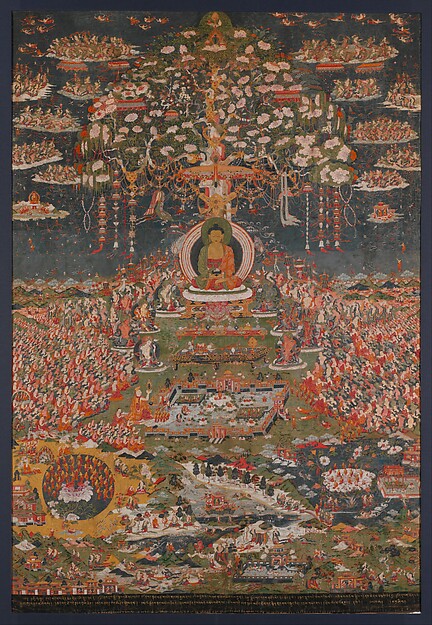
Amitabha, the Buddha of the Western Pure Land, Central Tibet, ca. 1700. Pools and lotus flowers at the bottom contain figures being reborn. The painting presents a specifically Buddhist setting, distinct from the other accounts on this page.
The Metropolitan Museum of Art, Purchase, Barbara and William Karatz Gift and funds from various donors, 2004 · Image source ↗ · CC0
Spiritualist accounts of return
Gone West by J. S. M. Ward
J. S. M. Ward’s introduction to Gone West considers reincarnation as one possible explanation for passing beyond the Wall of Fire. He doubts that it explains every case. Because the system includes higher planes, he reasons that advanced spirits may continue upwards while others return to earth to develop particular characteristics. [32]
This is Ward’s qualified interpretation at the limit of the information he says he has obtained. He does not present a fully described process, a rule covering every spirit or an independently established previous-life case. The uncertainty belongs to the account and should remain visible. [33][32]
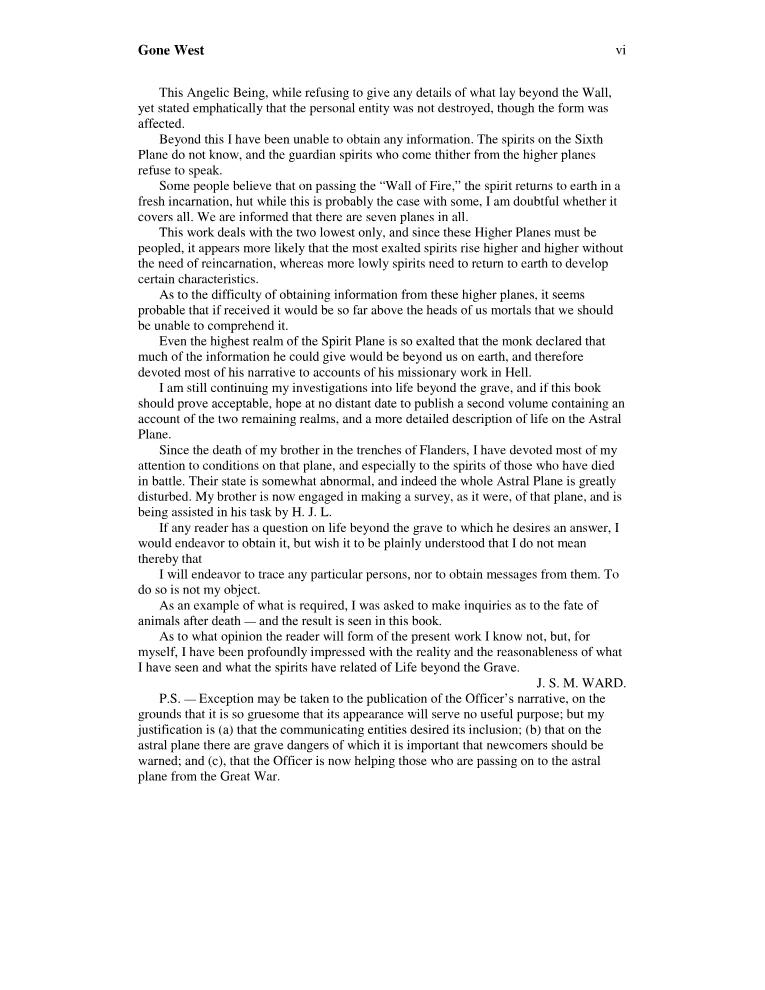
Source page: Gone West, Reader page 10. Ward’s 1920 text is shown in Geoff Cutler’s 2009 digital transcription, rather than an original printed facsimile.
J. S. M. Ward, Gone West, historical text in the public domain. Geoff Cutler’s 2009 transcription expressly permits reuse for any purpose on source leaf2. This image shows the digital transcription, not an original printed facsimile. · Image source ↗ · Public Domain
Who returns to earth in Ward’s account?
Ward sees a return to earth as one way for a spirit to develop. He also leaves room for another path, in which advanced spirits continue to higher planes. [32]
A Wanderer in the Spirit Lands
In A Wanderer in the Spirit Lands, attributed to Franchezzo and transcribed by A. Farnese, the narrator first declines to judge reincarnation because he knows it only by hearsay. A later conversation supplies a more developed position through Faithful Friend. The guide accepts repeated earthly lives for some spirits while expressly rejecting an absolute requirement applying to every soul. [3][7]
He describes different schools of guardianship. One returns its learners to earth for experiences or reparation; another uses education and renewed encounters with the past within the spirit spheres. The purpose is development, but the methods vary. He cautions against turning the practice of one community into a general rule for all spirits. [7][8][9]
Hassein, the narrator’s guide, adds a separate qualification later: he rejects animal-to-human and human-to-animal transmigration while affirming further development for each kind of soul. The book can therefore accept some reincarnation, animal immortality and continuing education in the afterlife without making them a single undifferentiated doctrine. [5][6][10]
See references (7)
- A Wanderer in the Spirit Lands, Reader page 75
- A Wanderer in the Spirit Lands, Reader page 116
- A Wanderer in the Spirit Lands, Reader page 117
- A Wanderer in the Spirit Lands, Reader page 144
- A Wanderer in the Spirit Lands, Reader page 145
- A Wanderer in the Spirit Lands, Reader page 146
- A Wanderer in the Spirit Lands, Reader page 268
Evolution of Immortality
In Evolution of Immortality, Freeman Benjamin Dowd writes as Rosicruciæ about both progress and retrogression. A person’s habitual desires are said to prepare a corresponding future form. He explicitly allows a human life to pass into animal embodiment, describing this as an attraction towards a congenial mode of life rather than an externally imposed penalty. This differs from the exclusion of human-to-animal transmigration in A Wanderer in the Spirit Lands. [12][13][14][15][16]
The book also states a limit to its own case: reincarnation cannot be demonstrated by material facts or testimony. It argues that the loss of earlier memories does not disprove the possibility, comparing it with forgotten infancy. That analogy supplies part of the author’s reasoning; it does not establish a remembered or independently verified previous life. [15]
Later passages connect birth with earlier actions, dispositions and the attraction of an incarnating soul to its parents. The appendix presents release from repeated embodiment as a form of salvation. Its claims about chosen birth and inherited illness belong to this historical moral cosmology, and provide no evidence that a person’s illness or difficult circumstances are deserved. [17][18][19][20][21]
See references (10)
- Evolution of Immortality, printed p. 40, Reader page 37
- Evolution of Immortality, printed p. 41, Reader page 38
- Evolution of Immortality, printed p. 42, Reader page 39
- Evolution of Immortality, printed p. 43, Reader page 40
- Evolution of Immortality, printed p. 44, Reader page 41
- Evolution of Immortality, printed p. 53, Reader page 50
- Evolution of Immortality, printed p. 54, Reader page 51
- Evolution of Immortality, printed p. 55, Reader page 52
- Evolution of Immortality, printed p. 56, Reader page 53
- Evolution of Immortality, printed p. 132, Reader page 131
Lumen by Camille Flammarion
Camille Flammarion’s Lumen presents reincarnation as a succession of lives across different worlds. From a position near Capella, the narrator recognises himself and former companions in light arriving from a world associated with Gamma in Virgo. He rejects the suggestion that he is presently in two places. In the dialogue’s explanation, he is observing an earlier embodiment through its delayed appearance. [46][47][48][49]
The book distinguishes that supposed observation from recollection. Lumen says he remembers having lived as a woman on Venus, but denies directly seeing that remote life from his present standpoint: the light reaching him does not belong to the required period. His next account concerns a life among reasoning plants in Cygnus. These episodes expand the imagined forms of embodiment while preserving a difference between memory and optical revisiting. [50][51]
Why would previous lives be forgotten? Lumen answers that full remembrance belongs to the intervals between incarnations. Embodied life restricts that recollection for a particular task. He also argues that foreknowledge could hinder freedom and diminish the significance of striving. Forgetting consequently serves a purpose within his explanation, rather than counting as an interruption of the soul’s identity. [52][53][54]
The caterpillar, chrysalis and butterfly provide an analogy for continuity through changes of form and awareness. The speaker also invokes somnambulism and other gaps in recollection. These examples illustrate his reply to the objection from forgetting; they do not independently establish the planetary lives he narrates. [53][54]
Innate differences between children become another argument for an earlier life. Lumen rejects intellectual heredity and treats differences of disposition as evidence for pre-existence. That conclusion belongs to the book’s metaphysics. Its dismissal of heredity should remain visible as a historical premise, rather than being carried forward as an account of contemporary genetics or proof of a particular former identity. [54][55][56][57]
Esoteric accounts of continuity
A Primer of Higher Space by Claude Bragdon
Claude Bragdon imagines a small cube crossing the plane many times. Each passage yields a complete series of sections, which he compares to one embodied life. Contact begins the particular personality, and the last contact ends its visible career. The underlying individual remains the same cube across different passages. [101][102][103][104][105]
In the sermon at the end of the parable, each passage leaves its experiences available to the larger consciousness. Christos says a person who attains cube consciousness could recover those experiences. The claim about memory belongs to the sermon’s account of what the larger identity retains. [105][106][107]
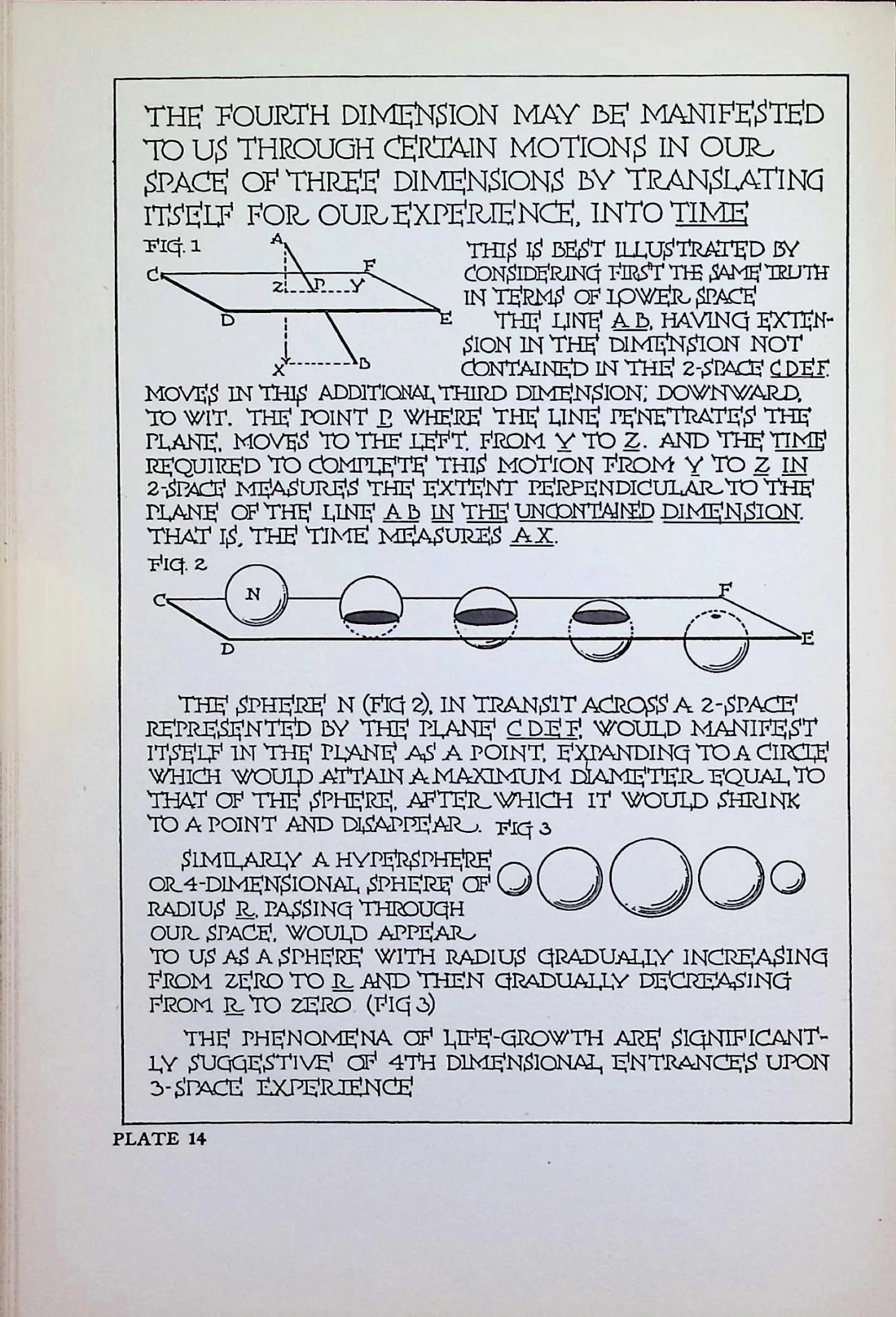
Plate 14, Reader page 43. Bragdon’s earlier diagrams show a solid passing through a plane. Man the Square uses that relation to imagine a succession of embodied lives.
Claude Bragdon, A Primer of Higher Space, The Manas Press, 1913. Stickley Museum scan via Internet Archive. · Image source ↗ · Public Domain
Reincarnation as repeated cross-sections: distinctions
In Aleister Crowley’s Moonchild, Simon Iff also makes successive lives intelligible through cuts across a solid, in that case a cone. Bragdon distinguishes the series of sections that makes up an entire passage from the series of different passages. That lets him use the same geometry for change within a life and for the succession of lives. [102][103][105][107][84][85][86]
The Universal One by Walter Russell
Walter Russell compares death to a sleep long enough for total bodily regeneration. Ordinary sleep, he says, restores the body in part. The longer interval ends with a new bodily form. In both cases he makes the continuing record of the person’s idea the reason a life can resume. [96][97][98]
He returns to this in the conclusion, where growth and decline operate together and each has its period of predominance. At the turning point, the visible form dissolves but the process continues. He treats reappearance as part of the same rhythm he assigns to creation as a whole. [97][98][99]
Watchers of the Seven Spheres by H. K. Challoner
H. K. Challoner’s Builder of Form describes a birth in which earlier actions help shape the new conditions. The builder draws matter from the parents and particles from other kingdoms while the child’s egoic form is said to watch and assist. The poem gives continuity a part in the work of forming a body. [92]
In The Cosmic Messengers, actions and thoughts are said to build spiritual atoms that lie latent after death and can be taken up in another life. The poem connects their assembly with the person’s relation to the larger cosmos. It later treats understanding karma as a way of taking responsibility for that relation. [93][94]
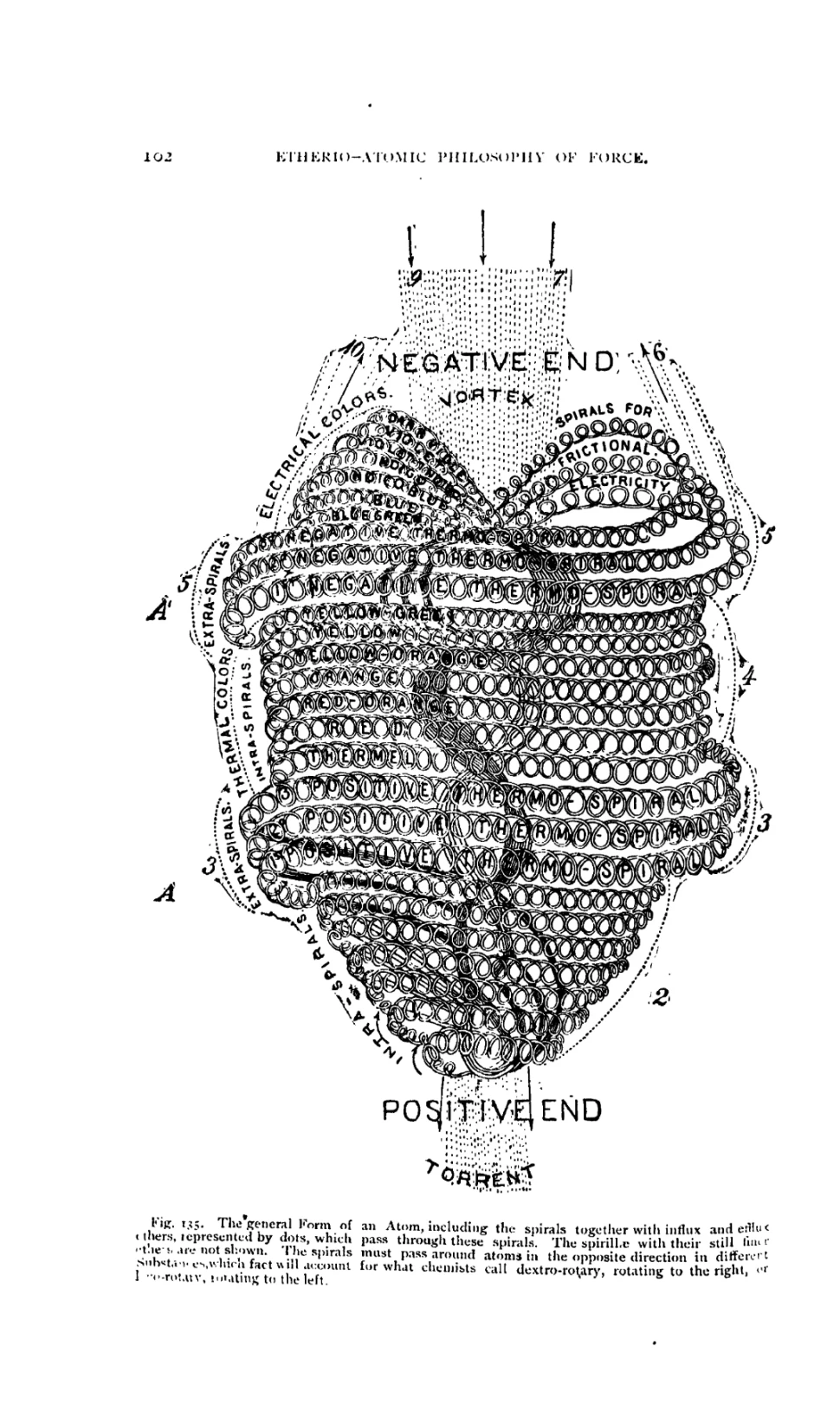
Edwin D. Babbitt’s spiral atom is an earlier speculative illustration of subtle matter. Challoner’s spiritual atoms belong to a poetic account of continuity between lives.
Edwin D. Babbitt, The Principles of Light and Color, second edition, 1896. Lumitheca Library facsimile. · Image source ↗ · Public Domain
Challoner and the other accounts
Steiner’s Initiation and Its Results gives continuity to a higher identity that outlasts the ordinary personality. Challoner adds an image of latent particles gathered again through a person’s relation to the wider world. The two accounts assign continuity to a level beyond ordinary memory, but use different images to describe what is carried forward. [92][93][94][34][35][36]
See references (6)
- Initiation and Its Results, printed p. 60, Reader page 59
- Initiation and Its Results, printed p. 61, Reader page 60
- Initiation and Its Results, printed p. 62, Reader page 61
- Watchers of the Seven Spheres, Reader page 39
- Watchers of the Seven Spheres, Reader page 82
- Watchers of the Seven Spheres, Reader page 84
Initiation and Its Results by Rudolf Steiner
Rudolf Steiner’s Initiation and Its Results presents the lower personality as one form assumed by a higher nature that outlasts it. The student is said to discover the relation between the present life, spiritual connections and karma. Repeated embodiment is thus explained through a continuing higher identity in this account. [34][35][36]
The Lesser Guardian’s narrative speech makes earlier conduct visible as the person’s character and destiny. It says the powers of karma shaped a new birth in relation to what remained imperfect. The student’s own past is therefore given a role in explaining why another earthly life was required. [37][38][39][40]
The later chapter stresses the value of earthly experience. Faculties necessary for further spiritual work must be developed in the visible world; access to an invisible world does not make that preparation dispensable. Return is presented as a developmental necessity within this explanation. [41][42][43][44]
The book also places reincarnation within a hierarchy of supposedly higher national and racial forms. That is a racial evolutionary claim in this historical text. It should remain identifiable as such, rather than becoming an unqualified account of humanity or a way to rank living peoples. [45]
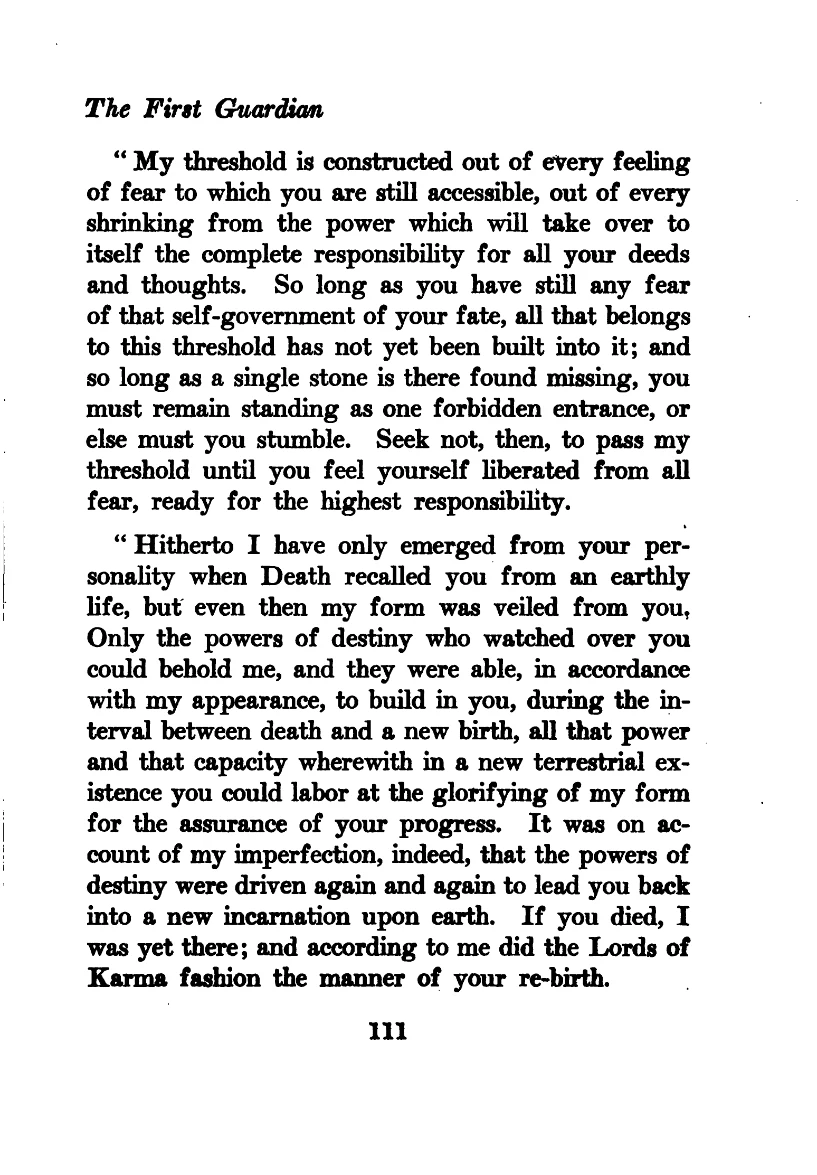
Source facsimile: Initiation and Its Results (1909), printed p. 111, Reader page 108.
Rudolf Steiner, Initiation and Its Results, Clifford Bax translation, First American Edition, 1909. Public-domain historical page from the checksum-verified Library PDF. · Image source ↗ · Public Domain
See references (12)
- Initiation and Its Results, printed p. 60, Reader page 59
- Initiation and Its Results, printed p. 61, Reader page 60
- Initiation and Its Results, printed p. 62, Reader page 61
- Initiation and Its Results, printed p. 108, Reader page 105
- Initiation and Its Results, printed p. 109, Reader page 106
- Initiation and Its Results, printed p. 111, Reader page 108
- Initiation and Its Results, printed p. 112, Reader page 109
- Initiation and Its Results, printed p. 121, Reader page 117
- Initiation and Its Results, printed p. 122, Reader page 118
- Initiation and Its Results, printed p. 123, Reader page 119
- Initiation and Its Results, printed p. 124, Reader page 120
- Initiation and Its Results, printed p. 128, Reader page 124
Reincarnation: distinctions
Steiner’s narrative also explains suffering and differences of character through deeds in earlier lives. That is the book’s karmic interpretation, not independently established evidence about the cause of a particular person’s suffering. [37][38][41][42]
The continuing higher identity in this explanation should be kept attached to Steiner’s account. It does not settle the distinct questions of self, consciousness and rebirth raised by other traditions represented in this entry. [34][35][36]
A Wanderer in the Spirit Lands, attributed to Franchezzo and transcribed by A. Farnese, expressly allows different methods of spiritual education. Some guardians return learners to earthly lives; others provide experiences and reparation within spirit spheres. Steiner’s account here makes repeated earthly embodiment part of a more comprehensive developmental explanation. The difference over necessity should remain visible rather than being absorbed into a single supposed Spiritualist consensus. [7][8][9][39][40][41][42][43]
See references (13)
- A Wanderer in the Spirit Lands, Reader page 144
- A Wanderer in the Spirit Lands, Reader page 145
- A Wanderer in the Spirit Lands, Reader page 146
- Initiation and Its Results, printed p. 60, Reader page 59
- Initiation and Its Results, printed p. 61, Reader page 60
- Initiation and Its Results, printed p. 62, Reader page 61
- Initiation and Its Results, printed p. 108, Reader page 105
- Initiation and Its Results, printed p. 109, Reader page 106
- Initiation and Its Results, printed p. 111, Reader page 108
- Initiation and Its Results, printed p. 112, Reader page 109
- Initiation and Its Results, printed p. 121, Reader page 117
- Initiation and Its Results, printed p. 122, Reader page 118
- Initiation and Its Results, printed p. 123, Reader page 119
Magick Without Tears by Aleister Crowley
Aleister Crowley asks what, in his account of reincarnation, could continue from one life to another. He names a higher triad that clothes Hadit, his term here for the original point of view. He includes whatever part of the ordinary mind and personality has become bound to that triad. This leaves room for considerable change between lives. He calls terrestrial reincarnation comparatively rare and treats parts of the surrounding scheme as speculation. [77][78][79][80]
In discussing evidence he draws a distinction between what seems to him to be personal recollection and what his correspondent learns by hearing him tell it. He describes memories he connects with earlier deaths, with much less to say about intervals between lives. He also points back to Liber Thisharb as an earlier account of the work he calls Magical Memory. [81][82][77][83][78][79]
Liber Thisharb by Aleister Crowley
Aleister Crowley proposes writing down details such as the appearance of a city that a person claims to remember from a former life. He uses Cracow as an example of a description that could later be checked. Fixing the description in writing makes it possible to see how much was specified before the comparison. [76]
Human Animals by Frank Hamel
Frank Hamel’s Human Animals treats departed humans in animal form separately from living shape-changers. Its examples include traditions in which a dead relative or chief is associated with an animal. The connection can be understood through ancestry or a continuing soul, depending on the report. [22][23][24]
Birds, butterflies and other creatures become possible forms of the human dead in the chapter. These are claims about a human identity after death. They do not by themselves answer whether an individual animal survives its own death, a question taken up elsewhere in the book. [24][25][26]
Hamel also quotes Prentice Mulford in a discussion of spiritual development from animal to human life. This supplies an evolutionary metaphysical model rather than simply a collection of family or ancestor stories. Its direction and theory of progress should remain attributed to that strand of the book. [27][28][29]
The distinction between rebirth and apparition is important. A departed person appearing in an animal shape has not necessarily begun another ordinary animal lifetime. Hamel’s later phantasm material introduces projected forms, which can reproduce an animal appearance without implying birth at all. [22][23][30][31]
See references (10)
- Human Animals, printed p. 23, Reader page 32
- Human Animals, printed p. 24, Reader page 33
- Human Animals, printed p. 25, Reader page 34
- Human Animals, printed p. 26, Reader page 35
- Human Animals, printed p. 27, Reader page 36
- Human Animals, printed p. 39, Reader page 48
- Human Animals, printed p. 40, Reader page 49
- Human Animals, printed p. 41, Reader page 50
- Human Animals, printed p. 265, Reader page 274
- Human Animals, printed p. 266, Reader page 275
Another embodiment or another appearance?
The Buddhist, Spiritualist and Rosicrucian material already gathered here offers different understandings of rebirth, identity and development. Hamel’s human souls in animal form add a further distinction: an appearance interpreted as an ancestor need not describe a new birth. His Mulford passages propose a developmental sequence, but that sequence should not be imported into every religious account of rebirth. [22][23][27][28][29][2][3][7][12][13]
See references (10)
- Majjhima Nikaya 38, §§ 2–8: consciousness and conditions
- A Wanderer in the Spirit Lands, Reader page 75
- A Wanderer in the Spirit Lands, Reader page 144
- Evolution of Immortality, printed p. 40, Reader page 37
- Evolution of Immortality, printed p. 41, Reader page 38
- Human Animals, printed p. 23, Reader page 32
- Human Animals, printed p. 24, Reader page 33
- Human Animals, printed p. 39, Reader page 48
- Human Animals, printed p. 40, Reader page 49
- Human Animals, printed p. 41, Reader page 50
Reincarnation in novels and folklore
Moonchild by Aleister Crowley
In Aleister Crowley’s Moonchild, Simon Iff asks Lisa to imagine a cone intersected at different angles. A body and mind are to a soul what a single section is to the cone. Successive lives could therefore belong to the same soul while sharing no ordinary memories. Iff suggests that they might still resemble one another, as a poet’s style can recur across very different poems. [84][85][86]
The book also gives incarnation a dramatic form. Iliel sees possible entrants gathered around a boundary. The narrator distinguishes experienced human souls willing to return from beings it calls partial souls. Malkah’s attempt to enter earthly life becomes an act of renunciation in the vision. The story attaches this event to its invented cosmology and to Iliel’s particular experience. [87][88][89][90]
Ambrosius and reincarnation in The Goat-Foot God
Dion Fortune gives Hugh two distinct starting points. He supposes that the dead Ambrosius might speak through him, while Mona suggests that Hugh’s own soul once lived as the monk. In her account the emerging memories and dispositions belong to Hugh, though they have not been available in his ordinary consciousness. Jelkes has already considered another possibility, a divided personality with qualities that are absent from Hugh’s usual conduct. [68][69][70]
In the cellar episode’s aftermath, Hugh experiences the monk’s ordeal as something in his own past. He asks whether its effects could have survived the transition to a new life, leaving a fear whose cause the present person has forgotten. This gives the novel one account of why knowing the past might matter. Later, when Jelkes asks how he knows Ambrosius was him, Hugh describes an inner conviction and admits he cannot establish the identification. [71][72][73][74][75]
In Ghostly Japan by Lafcadio Hearn
Lafcadio Hearn opens In Ghostly Japan with a pilgrim climbing a mountain beside a bodhisattva. What first seems to be broken rock proves to be human bone. At the climax the guide tells him that every skull once held his own dreams, delusions and desires. Repeated birth becomes something almost physically overwhelming: the apparent stranger beneath his feet was once himself. [58][59][60][61][62]
The force of the episode lies in its reversal. Fear of an alien landscape becomes recognition of an immense history of desire. Hearn presents it as a short literary fragment, not as the discovery of a geographical mountain or a documented memory of particular former lives. The scene also does not explain the philosophical mechanism connecting one birth with another. [58][61][62]
A later piece, Suggestion, records a conversation about whether desire might produce alternating male and female births, or eventually a being combining the capacities of both. Hearn questions its agreement with accepted doctrine. His unnamed companion explicitly calls it a theory, and Hearn says he wrote the conversation down afterwards from memory. Its speculative status is part of the account. [63][64][65][66][67]
See references (10)
- In Ghostly Japan, Reader page 10
- In Ghostly Japan, Reader page 11
- In Ghostly Japan, Reader page 12
- In Ghostly Japan, Reader page 13
- In Ghostly Japan, Reader page 14
- In Ghostly Japan, Reader page 190
- In Ghostly Japan, Reader page 191
- In Ghostly Japan, Reader page 192
- In Ghostly Japan, Reader page 193
- In Ghostly Japan, Reader page 194
In Ancient Tales and Folk-lore of Japan
Richard Gordon Smith’s Kinoto legend begins with two monkeys listening to a priest read Buddhist teaching. They bring him food while he copies the sacred text. The priest completes five volumes. When he discovers that both monkeys have died, he buries them and prays for them. [108][109][110]
Decades later the governor, called Kinomi-ta-ka Ason in the book, asks for the unfinished manuscript. He identifies himself as the elder monkey reborn as a human and resumes the copying. The manuscript gives him something he can find and finish, so remembered identity has a practical consequence in the plot. Smith leaves the Buddhist text unidentified. [111]
How the accounts compare
Lafcadio Hearn’s skull-mound story makes the many lives of a single person visible as a landscape. Smith’s governor recalls a single earlier life and takes up work that it left unfinished. These are two ways a narrative can give past lives a consequence in the present. [108][109][110][111][58][59][60]
See references (7)
- In Ghostly Japan, Reader page 10
- In Ghostly Japan, Reader page 11
- In Ghostly Japan, Reader page 12
- Ancient Tales and Folklore of Japan, Reader page 194
- Ancient Tales and Folklore of Japan, Reader page 197
- Ancient Tales and Folklore of Japan, Reader page 198
- Ancient Tales and Folklore of Japan, Reader page 199
In The Chinese Fairy Book
In Richard Wilhelm’s The Chinese Fairy Book, translated by Frederick H. Martens, Ma sees a water carrier who died years earlier enter the house of the Li family. A child is born there at about the same moment. Ma takes the two events together as a sign that the carrier has returned to earthly life. Years later the child accidentally causes a fall that echoes the water carrier’s death. The retelling makes the pattern visible to a witness who can compare its two halves. [113][114][115]
In The Golden Canister, a woman recalls having been a physician in a previous life. She says she was held responsible for a child’s death and sent back to earth in servitude. After preventing a conflict and averting loss of life, she regards what she has done as answering that earlier wrong. Here the person who returns is also the one who interprets her former life. [116]
Two ways a story makes rebirth visible
In Hearn’s story, the guide explains why the mountain is made of the traveller’s own skulls. In Wilhelm’s “Retribution,” someone watching a child sees an event that echoes a former life. In “The Golden Canister,” the person who returned is also the one who remembers. Each story gives the reader a different witness. [113][114][115][116][61][62]
A Song scroll of the Ten Kings pictures one Chinese Buddhist way of imagining judgment before rebirth. The two Wilhelm tales keep any such court outside the scene. Retribution lets events correspond across lives, while The Golden Canister lets a character say how responsibility carried over. [112][115][116]
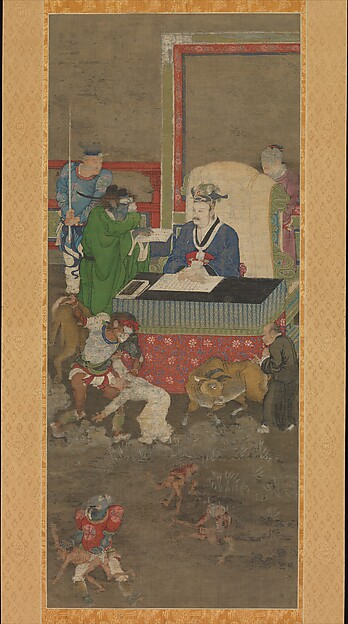
A Song scroll depicts one of the Ten Kings and his court, a way of representing judgment before rebirth.
Jin Chushi. Ten Kings of Hell. before 1195. The Metropolitan Museum of Art. Rogers Fund, 1930. Public Domain. · Image source ↗ · Public Domain
Where the accounts differ
Who returns, and in what form?
The guides in A Wanderer in the Spirit Lands allow some spirits to return to earth, but rule out a passage between human and animal lives. Freeman Benjamin Dowd allows human beings to be born as animals. In Evolution of Immortality he ties some kinds of desire to the form a person can take next. [3][7][5][6][10][12][13][14][15][16][17][18][19][20][21]
Ward’s Gone West treats a return to earth as one possible route of further development and doubts that it explains every departure beyond the Wall of Fire. Lumen instead ranges across remembered planetary embodiments, with full memory assigned to the disembodied interval. Dowd and Flammarion both answer the objection from forgetting by pointing to continuity without continuous recollection, but their analogies do not demonstrate a former life. The differences concern where return occurs, whom it involves and what counts as knowing that it happened. [32][15][46][47][48][49][52][53][54]
J. S. M. Ward’s introduction to Gone West considers reincarnation as one route a spirit might take to develop particular qualities. Fortune uses the idea to explain the qualities and fears a living character may already carry. Where Ward weighs reincarnation against progress through higher planes, Fortune weighs it alongside mediumship and accounts of divided or unnoticed mental life. [32][68][69][72]
The Bhagavad Gita compares taking a new body to putting on a new garment. Its image highlights the continuity of the one who wears it. Russell compares dying with sleeping and makes the regeneration of bodily form part of a universal process. His explanation rests on a record that persists through the loss of form. [96][97][98][1]
See references (30)
- Bhagavad Gita 2.22, the image of changing garments
- A Wanderer in the Spirit Lands, Reader page 75
- A Wanderer in the Spirit Lands, Reader page 116
- A Wanderer in the Spirit Lands, Reader page 117
- A Wanderer in the Spirit Lands, Reader page 144
- A Wanderer in the Spirit Lands, Reader page 268
- Evolution of Immortality, printed p. 40, Reader page 37
- Evolution of Immortality, printed p. 41, Reader page 38
- Evolution of Immortality, printed p. 42, Reader page 39
- Evolution of Immortality, printed p. 43, Reader page 40
- Evolution of Immortality, printed p. 44, Reader page 41
- Evolution of Immortality, printed p. 53, Reader page 50
- Evolution of Immortality, printed p. 54, Reader page 51
- Evolution of Immortality, printed p. 55, Reader page 52
- Evolution of Immortality, printed p. 56, Reader page 53
- Evolution of Immortality, printed p. 132, Reader page 131
- Gone West, printed p. vi, Reader page 10
- Lumen, Reader page 148
- Lumen, Reader page 149
- Lumen, Reader page 150
- Lumen, Reader page 151
- Lumen, printed p. 153, Reader page 159
- Lumen, Reader page 160
- Lumen, Reader page 161
- The Goat-Foot God, Reader page 201
- The Goat-Foot God, Reader page 243
- The Goat-Foot God, Reader page 281
- The Universal One, Reader page 78
- The Universal One, Reader page 79
- The Universal One, Reader page 80
What could someone remember?
The Bhagavad Gita compares taking a new body to putting on another garment. Hearn’s pilgrim instead sees the sheer number of his past lives as a mountain of skulls. The verse gives the soul continuity across the change. The story lets the pilgrim recognise his past without explaining what in him has persisted. [1][62]
The warning in Majjhima Nikaya 38 is therefore useful beside the story: Sati’s claim that the same consciousness travels through lives is rejected in favour of consciousness arising with conditions. Hearn’s memorable use of “your own” skulls should not silently replace that distinction with a permanent, unchanged inner traveller. His later conversation supplies a speculative proposal, not a ruling on Buddhist rebirth. [2][62][65][67]
The Bhagavad Gita compares taking a new body to putting on new clothes. Crowley’s letters ask a different set of questions about which elements of personality could continue and what would make a recollection persuasive to someone else. Liber Thisharb proposes checking details recorded in advance against an independently accessible place. Such a check can test a particular description while leaving the explanation for any match open. [1][76][82][77][78][79]
Camille Flammarion’s Lumen gives forgetting a purpose within each embodiment. Full recollection is said to return between lives. Moonchild uses the cross-section analogy to explain why one embodied identity would have no ready access to another. Both writers make room for continuity through forgetting, but the dialogue proposes a change in access while the novel proposes a relation between distinct lives and a larger self. [84][86][52][53][54]
See references (15)
- Bhagavad Gita 2.22, the image of changing garments
- Majjhima Nikaya 38, §§ 2–8: consciousness and conditions
- Lumen, printed p. 153, Reader page 159
- Lumen, Reader page 160
- Lumen, Reader page 161
- In Ghostly Japan, Reader page 14
- In Ghostly Japan, Reader page 192
- In Ghostly Japan, Reader page 194
- Liber Thisharb, passage on checking a claimed recollection of Cracow
- Magick Without Tears, Reader page 159
- Magick Without Tears, Reader page 197
- Magick Without Tears, Reader page 198
- Magick Without Tears, Reader page 158
- Moonchild, Reader page 125
- Moonchild, Reader page 128
Read further in the library

A Wanderer in the Spirit Lands
Reading note
Different schools of guardianship are said to use earthly rebirth or education within the spirit spheres.
Evolution of Immortality
Reading note
An argument for repeated embodiment that explicitly permits human-to-animal transmigration and acknowledges limits to its evidence.

Human Animals
Reading note
Frank Hamel collects the particular stories and interpretations discussed here; the account identifies exact printed and Library Reader pages.

Gone West
Reading note
The separately titled account draws on exact passages in the consulted Library edition.

Initiation and Its Results
Reading note
The separately titled account draws on exact passages in the consulted Library edition.
Lumen
Reading note
The separately titled account draws on exact passages in the consulted Library edition.

In Ghostly Japan
Reading note
The separately titled account draws on exact passages in the consulted Library edition.
The Goat-Foot God
Reading note
The separately titled account draws on exact passages in the consulted Library edition.
Magick Without Tears
Reading note
The separately titled account draws on exact passages in the consulted Library edition.

Moonchild
Reading note
The separately titled account draws on exact passages in the consulted Library edition.

The Principles of Light and Color
Reading note
Separately attributed primary Library account, cited on exact verified Reader leaves.
Watchers of the Seven Spheres
Reading note
The separately titled account draws on exact passages in the consulted Library edition.

The Universal One
Reading note
The separately titled account draws on exact passages in the consulted Library edition.
A Primer of Higher Space
Reading note
The separately titled account draws on exact passages in the consulted Library edition.
Ancient Tales and Folk-lore of Japan
Reading note
Read Richard Gordon Smith’s separately attributed tale in its Library edition.

The Chinese Fairy Book
Reading note
Read “Retribution” and “The Golden Canister” for two stories in which events or remembered deeds connect one life to another.
Sources
See references (116)
- Bhagavad Gita 2.22, the image of changing garments ↗Bhagavad Gita, chapter2 verse 22, translation and commentary by Swami Mukundananda.Return to text ↑
- Majjhima Nikaya 38, §§ 2–8: consciousness and conditions ↗Bhikkhu Sujato’s translation on SuttaCentral. Exact segments 2–8 checked in SuttaCentral’s official published Bilara source.Return to text ↑
- A Wanderer in the Spirit Lands, Reader page 75Franchezzo (source attribution), A Wanderer in the Spirit Lands, transcribed by A. Farnese. W. J. Sinkins, London, 1896. Consulted printing confirmed on its title-page facsimile.Read this page in A Wanderer in the Spirit Lands ↗Return to text ↑
- A Wanderer in the Spirit Lands, Reader page 90Franchezzo (source attribution), A Wanderer in the Spirit Lands, transcribed by A. Farnese. W. J. Sinkins, London, 1896. Consulted printing confirmed on its title-page facsimile.Read this page in A Wanderer in the Spirit Lands ↗Return to text ↑
- A Wanderer in the Spirit Lands, Reader page 116Franchezzo (source attribution), A Wanderer in the Spirit Lands, transcribed by A. Farnese. W. J. Sinkins, London, 1896. Consulted printing confirmed on its title-page facsimile.Read this page in A Wanderer in the Spirit Lands ↗Return to text ↑
- A Wanderer in the Spirit Lands, Reader page 117Franchezzo (source attribution), A Wanderer in the Spirit Lands, transcribed by A. Farnese. W. J. Sinkins, London, 1896. Consulted printing confirmed on its title-page facsimile.Read this page in A Wanderer in the Spirit Lands ↗Return to text ↑
- A Wanderer in the Spirit Lands, Reader page 144Franchezzo (source attribution), A Wanderer in the Spirit Lands, transcribed by A. Farnese. W. J. Sinkins, London, 1896. Consulted printing confirmed on its title-page facsimile.Read this page in A Wanderer in the Spirit Lands ↗Return to text ↑
- A Wanderer in the Spirit Lands, Reader page 145Franchezzo (source attribution), A Wanderer in the Spirit Lands, transcribed by A. Farnese. W. J. Sinkins, London, 1896. Consulted printing confirmed on its title-page facsimile.Read this page in A Wanderer in the Spirit Lands ↗Return to text ↑
- A Wanderer in the Spirit Lands, Reader page 146Franchezzo (source attribution), A Wanderer in the Spirit Lands, transcribed by A. Farnese. W. J. Sinkins, London, 1896. Consulted printing confirmed on its title-page facsimile.Read this page in A Wanderer in the Spirit Lands ↗Return to text ↑
- A Wanderer in the Spirit Lands, Reader page 268Franchezzo (source attribution), A Wanderer in the Spirit Lands, transcribed by A. Farnese. W. J. Sinkins, London, 1896. Consulted printing confirmed on its title-page facsimile.Read this page in A Wanderer in the Spirit Lands ↗Return to text ↑
- Amitabha, the Buddha of the Western Pure Land (Sukhavati), ca. 1700 ↗The Metropolitan Museum of Art, accession 2004.139; CC0 imageReturn to text ↑
- Evolution of Immortality, printed p. 40, Reader page 37Rosicruciæ (catalogued as Freeman Benjamin Dowd), Evolution of Immortality. Eulian Publishing Company, Salem, 1900.Read this page in Evolution of Immortality ↗Return to text ↑
- Evolution of Immortality, printed p. 41, Reader page 38Rosicruciæ (catalogued as Freeman Benjamin Dowd), Evolution of Immortality. Eulian Publishing Company, Salem, 1900.Read this page in Evolution of Immortality ↗Return to text ↑
- Evolution of Immortality, printed p. 42, Reader page 39Rosicruciæ (catalogued as Freeman Benjamin Dowd), Evolution of Immortality. Eulian Publishing Company, Salem, 1900.Read this page in Evolution of Immortality ↗Return to text ↑
- Evolution of Immortality, printed p. 43, Reader page 40Rosicruciæ (catalogued as Freeman Benjamin Dowd), Evolution of Immortality. Eulian Publishing Company, Salem, 1900.Read this page in Evolution of Immortality ↗Return to text ↑
- Evolution of Immortality, printed p. 44, Reader page 41Rosicruciæ (catalogued as Freeman Benjamin Dowd), Evolution of Immortality. Eulian Publishing Company, Salem, 1900.Read this page in Evolution of Immortality ↗Return to text ↑
- Evolution of Immortality, printed p. 53, Reader page 50Rosicruciæ (catalogued as Freeman Benjamin Dowd), Evolution of Immortality. Eulian Publishing Company, Salem, 1900.Read this page in Evolution of Immortality ↗Return to text ↑
- Evolution of Immortality, printed p. 54, Reader page 51Rosicruciæ (catalogued as Freeman Benjamin Dowd), Evolution of Immortality. Eulian Publishing Company, Salem, 1900.Read this page in Evolution of Immortality ↗Return to text ↑
- Evolution of Immortality, printed p. 55, Reader page 52Rosicruciæ (catalogued as Freeman Benjamin Dowd), Evolution of Immortality. Eulian Publishing Company, Salem, 1900.Read this page in Evolution of Immortality ↗Return to text ↑
- Evolution of Immortality, printed p. 56, Reader page 53Rosicruciæ (catalogued as Freeman Benjamin Dowd), Evolution of Immortality. Eulian Publishing Company, Salem, 1900.Read this page in Evolution of Immortality ↗Return to text ↑
- Evolution of Immortality, printed p. 132, Reader page 131Rosicruciæ (catalogued as Freeman Benjamin Dowd), Evolution of Immortality. Eulian Publishing Company, Salem, 1900.Read this page in Evolution of Immortality ↗Return to text ↑
- Human Animals, printed p. 23, Reader page 32Frank Hamel, Human Animals. Frederick A. Stokes Co., New York, undated title page; preface dated London, 1915. Exact printed pages refer to the retained Library scan.Read this page in Human Animals ↗Return to text ↑
- Human Animals, printed p. 24, Reader page 33Frank Hamel, Human Animals. Frederick A. Stokes Co., New York, undated title page; preface dated London, 1915. Exact printed pages refer to the retained Library scan.Read this page in Human Animals ↗Return to text ↑
- Human Animals, printed p. 25, Reader page 34Frank Hamel, Human Animals. Frederick A. Stokes Co., New York, undated title page; preface dated London, 1915. Exact printed pages refer to the retained Library scan.Read this page in Human Animals ↗Return to text ↑
- Human Animals, printed p. 26, Reader page 35Frank Hamel, Human Animals. Frederick A. Stokes Co., New York, undated title page; preface dated London, 1915. Exact printed pages refer to the retained Library scan.Read this page in Human Animals ↗Return to text ↑
- Human Animals, printed p. 27, Reader page 36Frank Hamel, Human Animals. Frederick A. Stokes Co., New York, undated title page; preface dated London, 1915. Exact printed pages refer to the retained Library scan.Read this page in Human Animals ↗Return to text ↑
- Human Animals, printed p. 39, Reader page 48Frank Hamel, Human Animals. Frederick A. Stokes Co., New York, undated title page; preface dated London, 1915. Exact printed pages refer to the retained Library scan.Read this page in Human Animals ↗Return to text ↑
- Human Animals, printed p. 40, Reader page 49Frank Hamel, Human Animals. Frederick A. Stokes Co., New York, undated title page; preface dated London, 1915. Exact printed pages refer to the retained Library scan.Read this page in Human Animals ↗Return to text ↑
- Human Animals, printed p. 41, Reader page 50Frank Hamel, Human Animals. Frederick A. Stokes Co., New York, undated title page; preface dated London, 1915. Exact printed pages refer to the retained Library scan.Read this page in Human Animals ↗Return to text ↑
- Human Animals, printed p. 265, Reader page 274Frank Hamel, Human Animals. Frederick A. Stokes Co., New York, undated title page; preface dated London, 1915. Exact printed pages refer to the retained Library scan.Read this page in Human Animals ↗Return to text ↑
- Human Animals, printed p. 266, Reader page 275Frank Hamel, Human Animals. Frederick A. Stokes Co., New York, undated title page; preface dated London, 1915. Exact printed pages refer to the retained Library scan.Read this page in Human Animals ↗Return to text ↑
- Gone West, printed p. vi, Reader page 10J. S. M. Ward, Gone West: Three Narratives of After-Death Experiences, third impression, William Rider & Son, London, 1920, as reproduced in Geoff Cutler’s December 2009 digital transcription. Ward’s introduction is distinct from the supplied 1974 foreword.Read this page in Gone West ↗Return to text ↑
- Gone West, printed p. v, Reader page 9J. S. M. Ward, Gone West: Three Narratives of After-Death Experiences, third impression, William Rider & Son, London, 1920, as reproduced in Geoff Cutler’s December 2009 digital transcription. Ward’s introduction is distinct from the supplied 1974 foreword.Read this page in Gone West ↗Return to text ↑
- Initiation and Its Results, printed p. 60, Reader page 59Rudolf Steiner, Initiation and Its Results: A Sequel to The Way of Initiation, translated by Clifford Bax. First American Edition, 1909. Macoy Publishing and Masonic Supply Co., New York; Max Gysi, London. Claims of clairvoyant perception and subtle organs remain attributed. References identify the exact consulted Library edition.Read this page in Initiation and Its Results ↗Return to text ↑
- Initiation and Its Results, printed p. 61, Reader page 60Rudolf Steiner, Initiation and Its Results: A Sequel to The Way of Initiation, translated by Clifford Bax. First American Edition, 1909. Macoy Publishing and Masonic Supply Co., New York; Max Gysi, London. Claims of clairvoyant perception and subtle organs remain attributed. References identify the exact consulted Library edition.Read this page in Initiation and Its Results ↗Return to text ↑
- Initiation and Its Results, printed p. 62, Reader page 61Rudolf Steiner, Initiation and Its Results: A Sequel to The Way of Initiation, translated by Clifford Bax. First American Edition, 1909. Macoy Publishing and Masonic Supply Co., New York; Max Gysi, London. Claims of clairvoyant perception and subtle organs remain attributed. References identify the exact consulted Library edition.Read this page in Initiation and Its Results ↗Return to text ↑
- Initiation and Its Results, printed p. 108, Reader page 105Rudolf Steiner, Initiation and Its Results: A Sequel to The Way of Initiation, translated by Clifford Bax. First American Edition, 1909. Macoy Publishing and Masonic Supply Co., New York; Max Gysi, London. Claims of clairvoyant perception and subtle organs remain attributed. References identify the exact consulted Library edition.Read this page in Initiation and Its Results ↗Return to text ↑
- Initiation and Its Results, printed p. 109, Reader page 106Rudolf Steiner, Initiation and Its Results: A Sequel to The Way of Initiation, translated by Clifford Bax. First American Edition, 1909. Macoy Publishing and Masonic Supply Co., New York; Max Gysi, London. Claims of clairvoyant perception and subtle organs remain attributed. References identify the exact consulted Library edition.Read this page in Initiation and Its Results ↗Return to text ↑
- Initiation and Its Results, printed p. 111, Reader page 108Rudolf Steiner, Initiation and Its Results: A Sequel to The Way of Initiation, translated by Clifford Bax. First American Edition, 1909. Macoy Publishing and Masonic Supply Co., New York; Max Gysi, London. Claims of clairvoyant perception and subtle organs remain attributed. References identify the exact consulted Library edition.Read this page in Initiation and Its Results ↗Return to text ↑
- Initiation and Its Results, printed p. 112, Reader page 109Rudolf Steiner, Initiation and Its Results: A Sequel to The Way of Initiation, translated by Clifford Bax. First American Edition, 1909. Macoy Publishing and Masonic Supply Co., New York; Max Gysi, London. Claims of clairvoyant perception and subtle organs remain attributed. References identify the exact consulted Library edition.Read this page in Initiation and Its Results ↗Return to text ↑
- Initiation and Its Results, printed p. 121, Reader page 117Rudolf Steiner, Initiation and Its Results: A Sequel to The Way of Initiation, translated by Clifford Bax. First American Edition, 1909. Macoy Publishing and Masonic Supply Co., New York; Max Gysi, London. Claims of clairvoyant perception and subtle organs remain attributed. References identify the exact consulted Library edition.Read this page in Initiation and Its Results ↗Return to text ↑
- Initiation and Its Results, printed p. 122, Reader page 118Rudolf Steiner, Initiation and Its Results: A Sequel to The Way of Initiation, translated by Clifford Bax. First American Edition, 1909. Macoy Publishing and Masonic Supply Co., New York; Max Gysi, London. Claims of clairvoyant perception and subtle organs remain attributed. References identify the exact consulted Library edition.Read this page in Initiation and Its Results ↗Return to text ↑
- Initiation and Its Results, printed p. 123, Reader page 119Rudolf Steiner, Initiation and Its Results: A Sequel to The Way of Initiation, translated by Clifford Bax. First American Edition, 1909. Macoy Publishing and Masonic Supply Co., New York; Max Gysi, London. Claims of clairvoyant perception and subtle organs remain attributed. References identify the exact consulted Library edition.Read this page in Initiation and Its Results ↗Return to text ↑
- Initiation and Its Results, printed p. 124, Reader page 120Rudolf Steiner, Initiation and Its Results: A Sequel to The Way of Initiation, translated by Clifford Bax. First American Edition, 1909. Macoy Publishing and Masonic Supply Co., New York; Max Gysi, London. Claims of clairvoyant perception and subtle organs remain attributed. References identify the exact consulted Library edition.Read this page in Initiation and Its Results ↗Return to text ↑
- Initiation and Its Results, printed p. 128, Reader page 124Rudolf Steiner, Initiation and Its Results: A Sequel to The Way of Initiation, translated by Clifford Bax. First American Edition, 1909. Macoy Publishing and Masonic Supply Co., New York; Max Gysi, London. Claims of clairvoyant perception and subtle organs remain attributed. References identify the exact consulted Library edition.Read this page in Initiation and Its Results ↗Return to text ↑
- Lumen, Reader page 148Camille Flammarion, Lumen, authorised English translation by A. A. M. and R. M., Dodd, Mead and Company, New York, 1897. Exact selected Library edition IMJ-0398-E001. Lumen and Quaerens are speakers in the dialogue; claims made by the narrator are attributed to this text. Original PageIDs and current Reader positions are verified separately from printed pagination.Read this page in Lumen ↗Return to text ↑
- Lumen, Reader page 149Camille Flammarion, Lumen, authorised English translation by A. A. M. and R. M., Dodd, Mead and Company, New York, 1897. Exact selected Library edition IMJ-0398-E001. Lumen and Quaerens are speakers in the dialogue; claims made by the narrator are attributed to this text. Original PageIDs and current Reader positions are verified separately from printed pagination.Read this page in Lumen ↗Return to text ↑
- Lumen, Reader page 150Camille Flammarion, Lumen, authorised English translation by A. A. M. and R. M., Dodd, Mead and Company, New York, 1897. Exact selected Library edition IMJ-0398-E001. Lumen and Quaerens are speakers in the dialogue; claims made by the narrator are attributed to this text. Original PageIDs and current Reader positions are verified separately from printed pagination.Read this page in Lumen ↗Return to text ↑
- Lumen, Reader page 151Camille Flammarion, Lumen, authorised English translation by A. A. M. and R. M., Dodd, Mead and Company, New York, 1897. Exact selected Library edition IMJ-0398-E001. Lumen and Quaerens are speakers in the dialogue; claims made by the narrator are attributed to this text. Original PageIDs and current Reader positions are verified separately from printed pagination.Read this page in Lumen ↗Return to text ↑
- Lumen, Reader page 189Camille Flammarion, Lumen, authorised English translation by A. A. M. and R. M., Dodd, Mead and Company, New York, 1897. Exact selected Library edition IMJ-0398-E001. Lumen and Quaerens are speakers in the dialogue; claims made by the narrator are attributed to this text. Original PageIDs and current Reader positions are verified separately from printed pagination.Read this page in Lumen ↗Return to text ↑
- Lumen, Reader page 190Camille Flammarion, Lumen, authorised English translation by A. A. M. and R. M., Dodd, Mead and Company, New York, 1897. Exact selected Library edition IMJ-0398-E001. Lumen and Quaerens are speakers in the dialogue; claims made by the narrator are attributed to this text. Original PageIDs and current Reader positions are verified separately from printed pagination.Read this page in Lumen ↗Return to text ↑
- Lumen, printed p. 153, Reader page 159Camille Flammarion, Lumen, authorised English translation by A. A. M. and R. M., Dodd, Mead and Company, New York, 1897. Exact selected Library edition IMJ-0398-E001. Lumen and Quaerens are speakers in the dialogue; claims made by the narrator are attributed to this text. Original PageIDs and current Reader positions are verified separately from printed pagination.Read this page in Lumen ↗Return to text ↑
- Lumen, Reader page 160Camille Flammarion, Lumen, authorised English translation by A. A. M. and R. M., Dodd, Mead and Company, New York, 1897. Exact selected Library edition IMJ-0398-E001. Lumen and Quaerens are speakers in the dialogue; claims made by the narrator are attributed to this text. Original PageIDs and current Reader positions are verified separately from printed pagination.Read this page in Lumen ↗Return to text ↑
- Lumen, Reader page 161Camille Flammarion, Lumen, authorised English translation by A. A. M. and R. M., Dodd, Mead and Company, New York, 1897. Exact selected Library edition IMJ-0398-E001. Lumen and Quaerens are speakers in the dialogue; claims made by the narrator are attributed to this text. Original PageIDs and current Reader positions are verified separately from printed pagination.Read this page in Lumen ↗Return to text ↑
- Lumen, Reader page 162Camille Flammarion, Lumen, authorised English translation by A. A. M. and R. M., Dodd, Mead and Company, New York, 1897. Exact selected Library edition IMJ-0398-E001. Lumen and Quaerens are speakers in the dialogue; claims made by the narrator are attributed to this text. Original PageIDs and current Reader positions are verified separately from printed pagination.Read this page in Lumen ↗Return to text ↑
- Lumen, Reader page 163Camille Flammarion, Lumen, authorised English translation by A. A. M. and R. M., Dodd, Mead and Company, New York, 1897. Exact selected Library edition IMJ-0398-E001. Lumen and Quaerens are speakers in the dialogue; claims made by the narrator are attributed to this text. Original PageIDs and current Reader positions are verified separately from printed pagination.Read this page in Lumen ↗Return to text ↑
- Lumen, Reader page 164Camille Flammarion, Lumen, authorised English translation by A. A. M. and R. M., Dodd, Mead and Company, New York, 1897. Exact selected Library edition IMJ-0398-E001. Lumen and Quaerens are speakers in the dialogue; claims made by the narrator are attributed to this text. Original PageIDs and current Reader positions are verified separately from printed pagination.Read this page in Lumen ↗Return to text ↑
- In Ghostly Japan, Reader page 10Lafcadio Hearn, In Ghostly Japan, Little, Brown, and Company, Boston, 1899. Exact consulted Library edition IMJ-0654-E001, with title page visually checked. Persistent PageIDs and current Reader positions are verified from the supplied edition. Embedded stories, translations and quotations are attributed to Hearn’s presentation unless an original source has separately been consulted.Read this page in In Ghostly Japan ↗Return to text ↑
- In Ghostly Japan, Reader page 11Lafcadio Hearn, In Ghostly Japan, Little, Brown, and Company, Boston, 1899. Exact consulted Library edition IMJ-0654-E001, with title page visually checked. Persistent PageIDs and current Reader positions are verified from the supplied edition. Embedded stories, translations and quotations are attributed to Hearn’s presentation unless an original source has separately been consulted.Read this page in In Ghostly Japan ↗Return to text ↑
- In Ghostly Japan, Reader page 12Lafcadio Hearn, In Ghostly Japan, Little, Brown, and Company, Boston, 1899. Exact consulted Library edition IMJ-0654-E001, with title page visually checked. Persistent PageIDs and current Reader positions are verified from the supplied edition. Embedded stories, translations and quotations are attributed to Hearn’s presentation unless an original source has separately been consulted.Read this page in In Ghostly Japan ↗Return to text ↑
- In Ghostly Japan, Reader page 13Lafcadio Hearn, In Ghostly Japan, Little, Brown, and Company, Boston, 1899. Exact consulted Library edition IMJ-0654-E001, with title page visually checked. Persistent PageIDs and current Reader positions are verified from the supplied edition. Embedded stories, translations and quotations are attributed to Hearn’s presentation unless an original source has separately been consulted.Read this page in In Ghostly Japan ↗Return to text ↑
- In Ghostly Japan, Reader page 14Lafcadio Hearn, In Ghostly Japan, Little, Brown, and Company, Boston, 1899. Exact consulted Library edition IMJ-0654-E001, with title page visually checked. Persistent PageIDs and current Reader positions are verified from the supplied edition. Embedded stories, translations and quotations are attributed to Hearn’s presentation unless an original source has separately been consulted.Read this page in In Ghostly Japan ↗Return to text ↑
- In Ghostly Japan, Reader page 190Lafcadio Hearn, In Ghostly Japan, Little, Brown, and Company, Boston, 1899. Exact consulted Library edition IMJ-0654-E001, with title page visually checked. Persistent PageIDs and current Reader positions are verified from the supplied edition. Embedded stories, translations and quotations are attributed to Hearn’s presentation unless an original source has separately been consulted.Read this page in In Ghostly Japan ↗Return to text ↑
- In Ghostly Japan, Reader page 191Lafcadio Hearn, In Ghostly Japan, Little, Brown, and Company, Boston, 1899. Exact consulted Library edition IMJ-0654-E001, with title page visually checked. Persistent PageIDs and current Reader positions are verified from the supplied edition. Embedded stories, translations and quotations are attributed to Hearn’s presentation unless an original source has separately been consulted.Read this page in In Ghostly Japan ↗Return to text ↑
- In Ghostly Japan, Reader page 192Lafcadio Hearn, In Ghostly Japan, Little, Brown, and Company, Boston, 1899. Exact consulted Library edition IMJ-0654-E001, with title page visually checked. Persistent PageIDs and current Reader positions are verified from the supplied edition. Embedded stories, translations and quotations are attributed to Hearn’s presentation unless an original source has separately been consulted.Read this page in In Ghostly Japan ↗Return to text ↑
- In Ghostly Japan, Reader page 193Lafcadio Hearn, In Ghostly Japan, Little, Brown, and Company, Boston, 1899. Exact consulted Library edition IMJ-0654-E001, with title page visually checked. Persistent PageIDs and current Reader positions are verified from the supplied edition. Embedded stories, translations and quotations are attributed to Hearn’s presentation unless an original source has separately been consulted.Read this page in In Ghostly Japan ↗Return to text ↑
- In Ghostly Japan, Reader page 194Lafcadio Hearn, In Ghostly Japan, Little, Brown, and Company, Boston, 1899. Exact consulted Library edition IMJ-0654-E001, with title page visually checked. Persistent PageIDs and current Reader positions are verified from the supplied edition. Embedded stories, translations and quotations are attributed to Hearn’s presentation unless an original source has separately been consulted.Read this page in In Ghostly Japan ↗Return to text ↑
- The Goat-Foot God, Reader page 201Dion Fortune, The Goat-Foot God. Undated digital Library edition IMJ-0643-E001. Numbered references use the Library Reader sequence.Read this page in The Goat-Foot God ↗Return to text ↑
- The Goat-Foot God, Reader page 243Dion Fortune, The Goat-Foot God. Undated digital Library edition IMJ-0643-E001. Numbered references use the Library Reader sequence.Read this page in The Goat-Foot God ↗Return to text ↑
- The Goat-Foot God, Reader page 244Dion Fortune, The Goat-Foot God. Undated digital Library edition IMJ-0643-E001. Numbered references use the Library Reader sequence.Read this page in The Goat-Foot God ↗Return to text ↑
- The Goat-Foot God, Reader page 280Dion Fortune, The Goat-Foot God. Undated digital Library edition IMJ-0643-E001. Numbered references use the Library Reader sequence.Read this page in The Goat-Foot God ↗Return to text ↑
- The Goat-Foot God, Reader page 281Dion Fortune, The Goat-Foot God. Undated digital Library edition IMJ-0643-E001. Numbered references use the Library Reader sequence.Read this page in The Goat-Foot God ↗Return to text ↑
- The Goat-Foot God, Reader page 282Dion Fortune, The Goat-Foot God. Undated digital Library edition IMJ-0643-E001. Numbered references use the Library Reader sequence.Read this page in The Goat-Foot God ↗Return to text ↑
- The Goat-Foot God, Reader page 296Dion Fortune, The Goat-Foot God. Undated digital Library edition IMJ-0643-E001. Numbered references use the Library Reader sequence.Read this page in The Goat-Foot God ↗Return to text ↑
- The Goat-Foot God, Reader page 297Dion Fortune, The Goat-Foot God. Undated digital Library edition IMJ-0643-E001. Numbered references use the Library Reader sequence.Read this page in The Goat-Foot God ↗Return to text ↑
- Liber Thisharb, passage on checking a claimed recollection of Cracow ↗Aleister Crowley, Liber Thisharb, The Equinox I.7, 1912. Thelema Tools facsimile.Return to text ↑
- Magick Without Tears, Reader page 159Aleister Crowley, Magick Without Tears, undated digital Library edition IMJ-0641-E001. Links use the current Library Reader sequence.Read this page in Magick Without Tears ↗Return to text ↑
- Magick Without Tears, Reader page 197Aleister Crowley, Magick Without Tears, undated digital Library edition IMJ-0641-E001. Links use the current Library Reader sequence.Read this page in Magick Without Tears ↗Return to text ↑
- Magick Without Tears, Reader page 198Aleister Crowley, Magick Without Tears, undated digital Library edition IMJ-0641-E001. Links use the current Library Reader sequence.Read this page in Magick Without Tears ↗Return to text ↑
- Magick Without Tears, Reader page 199Aleister Crowley, Magick Without Tears, undated digital Library edition IMJ-0641-E001. Links use the current Library Reader sequence.Read this page in Magick Without Tears ↗Return to text ↑
- Magick Without Tears, Reader page 157Aleister Crowley, Magick Without Tears, undated digital Library edition IMJ-0641-E001. Links use the current Library Reader sequence.Read this page in Magick Without Tears ↗Return to text ↑
- Magick Without Tears, Reader page 158Aleister Crowley, Magick Without Tears, undated digital Library edition IMJ-0641-E001. Links use the current Library Reader sequence.Read this page in Magick Without Tears ↗Return to text ↑
- Magick Without Tears, Reader page 160Aleister Crowley, Magick Without Tears, undated digital Library edition IMJ-0641-E001. Links use the current Library Reader sequence.Read this page in Magick Without Tears ↗Return to text ↑
- Moonchild, Reader page 125Aleister Crowley, Moonchild (Liber LXXXI, The Butterfly Net), Library digital transcription IMJ-0629-E001.Read this page in Moonchild ↗Return to text ↑
- Moonchild, Reader page 127Aleister Crowley, Moonchild (Liber LXXXI, The Butterfly Net), Library digital transcription IMJ-0629-E001.Read this page in Moonchild ↗Return to text ↑
- Moonchild, Reader page 128Aleister Crowley, Moonchild (Liber LXXXI, The Butterfly Net), Library digital transcription IMJ-0629-E001.Read this page in Moonchild ↗Return to text ↑
- Moonchild, Reader page 282Aleister Crowley, Moonchild (Liber LXXXI, The Butterfly Net), Library digital transcription IMJ-0629-E001.Read this page in Moonchild ↗Return to text ↑
- Moonchild, Reader page 283Aleister Crowley, Moonchild (Liber LXXXI, The Butterfly Net), Library digital transcription IMJ-0629-E001.Read this page in Moonchild ↗Return to text ↑
- Moonchild, Reader page 284Aleister Crowley, Moonchild (Liber LXXXI, The Butterfly Net), Library digital transcription IMJ-0629-E001.Read this page in Moonchild ↗Return to text ↑
- Moonchild, Reader page 285Aleister Crowley, Moonchild (Liber LXXXI, The Butterfly Net), Library digital transcription IMJ-0629-E001.Read this page in Moonchild ↗Return to text ↑
- Figure 135, Babbitt’s spiral atom, Reader page 109Edwin D. Babbitt, The Principles of Light and Color, second edition, 1896. Lumitheca Library facsimile.Read this page in The Principles of Light and Color ↗
- Watchers of the Seven Spheres, Reader page 39H. K. Challoner, Watchers of the Seven Spheres, London, George Routledge & Sons, 1933. Lumitheca Library edition IMJ-0604-E001.Read this page in Watchers of the Seven Spheres ↗Return to text ↑
- Watchers of the Seven Spheres, Reader page 82H. K. Challoner, Watchers of the Seven Spheres, London, George Routledge & Sons, 1933. Lumitheca Library edition IMJ-0604-E001.Read this page in Watchers of the Seven Spheres ↗Return to text ↑
- Watchers of the Seven Spheres, Reader page 84H. K. Challoner, Watchers of the Seven Spheres, London, George Routledge & Sons, 1933. Lumitheca Library edition IMJ-0604-E001.Read this page in Watchers of the Seven Spheres ↗Return to text ↑
- Kalighat Painting, c. 1890 ↗Cleveland Museum of Art, Gift of William E. Ward in memory of Evelyn Svec Ward, 2003.139. Shri Gobinda Chandra Roy, about 1890. CC0; resized and converted to JPEG.
- The Universal One, Reader page 78Walter Russell, The Universal One, edited by Louise Russell, University of Science and Philosophy, Limited Edition De Luxe. Lumitheca Library edition IMJ-0605-E001.Read this page in The Universal One ↗Return to text ↑
- The Universal One, Reader page 79Walter Russell, The Universal One, edited by Louise Russell, University of Science and Philosophy, Limited Edition De Luxe. Lumitheca Library edition IMJ-0605-E001.Read this page in The Universal One ↗Return to text ↑
- The Universal One, Reader page 80Walter Russell, The Universal One, edited by Louise Russell, University of Science and Philosophy, Limited Edition De Luxe. Lumitheca Library edition IMJ-0605-E001.Read this page in The Universal One ↗Return to text ↑
- The Universal One, Reader page 305Walter Russell, The Universal One, edited by Louise Russell, University of Science and Philosophy, Limited Edition De Luxe. Lumitheca Library edition IMJ-0605-E001.Read this page in The Universal One ↗Return to text ↑
- Plate 14, changes observed as an object crosses a space ↗Claude Bragdon, A Primer of Higher Space, The Manas Press, 1913. Stickley Museum scan via Internet Archive.
- A Primer of Higher Space, Reader page 42Claude Bragdon, A Primer of Higher Space (The Fourth Dimension), The Manas Press, Rochester, New York, 1913. Lumitheca Library edition IMJ-0599-E001.Read this page in A Primer of Higher Space ↗Return to text ↑
- A Primer of Higher Space, Reader page 65Claude Bragdon, A Primer of Higher Space (The Fourth Dimension), The Manas Press, Rochester, New York, 1913. Lumitheca Library edition IMJ-0599-E001.Read this page in A Primer of Higher Space ↗Return to text ↑
- A Primer of Higher Space, Reader page 66Claude Bragdon, A Primer of Higher Space (The Fourth Dimension), The Manas Press, Rochester, New York, 1913. Lumitheca Library edition IMJ-0599-E001.Read this page in A Primer of Higher Space ↗Return to text ↑
- A Primer of Higher Space, Reader page 74Claude Bragdon, A Primer of Higher Space (The Fourth Dimension), The Manas Press, Rochester, New York, 1913. Lumitheca Library edition IMJ-0599-E001.Read this page in A Primer of Higher Space ↗Return to text ↑
- A Primer of Higher Space, Reader page 79Claude Bragdon, A Primer of Higher Space (The Fourth Dimension), The Manas Press, Rochester, New York, 1913. Lumitheca Library edition IMJ-0599-E001.Read this page in A Primer of Higher Space ↗Return to text ↑
- A Primer of Higher Space, Reader page 80Claude Bragdon, A Primer of Higher Space (The Fourth Dimension), The Manas Press, Rochester, New York, 1913. Lumitheca Library edition IMJ-0599-E001.Read this page in A Primer of Higher Space ↗Return to text ↑
- A Primer of Higher Space, Reader page 81Claude Bragdon, A Primer of Higher Space (The Fourth Dimension), The Manas Press, Rochester, New York, 1913. Lumitheca Library edition IMJ-0599-E001.Read this page in A Primer of Higher Space ↗Return to text ↑
- Ancient Tales and Folklore of Japan, Reader page 194Richard Gordon Smith, Ancient Tales and Folklore of Japan. A. & C. Black, London, 1908. Lumitheca Library edition IMJ-0588-E001.Read this page in Ancient Tales and Folk-lore of Japan ↗Return to text ↑
- Ancient Tales and Folklore of Japan, Reader page 197Richard Gordon Smith, Ancient Tales and Folklore of Japan. A. & C. Black, London, 1908. Lumitheca Library edition IMJ-0588-E001.Read this page in Ancient Tales and Folk-lore of Japan ↗Return to text ↑
- Ancient Tales and Folklore of Japan, Reader page 198Richard Gordon Smith, Ancient Tales and Folklore of Japan. A. & C. Black, London, 1908. Lumitheca Library edition IMJ-0588-E001.Read this page in Ancient Tales and Folk-lore of Japan ↗Return to text ↑
- Ancient Tales and Folklore of Japan, Reader page 199Richard Gordon Smith, Ancient Tales and Folklore of Japan. A. & C. Black, London, 1908. Lumitheca Library edition IMJ-0588-E001.Read this page in Ancient Tales and Folk-lore of Japan ↗Return to text ↑
- Ten Kings of Hell ↗Jin Chushi. Ten Kings of Hell. before 1195. The Metropolitan Museum of Art. Rogers Fund, 1930. Public Domain.Return to text ↑
- The Chinese Fairy Book, Library Reader page 198Richard Wilhelm, editor. Frederick H. Martens, translator. The Chinese Fairy Book. Frederick A. Stokes Company, New York, 1921. Lumitheca Library edition IMJ-0478-E002.Read this page in The Chinese Fairy Book ↗Return to text ↑
- The Chinese Fairy Book, Library Reader page 199Richard Wilhelm, editor. Frederick H. Martens, translator. The Chinese Fairy Book. Frederick A. Stokes Company, New York, 1921. Lumitheca Library edition IMJ-0478-E002.Read this page in The Chinese Fairy Book ↗Return to text ↑
- The Chinese Fairy Book, Library Reader page 200Richard Wilhelm, editor. Frederick H. Martens, translator. The Chinese Fairy Book. Frederick A. Stokes Company, New York, 1921. Lumitheca Library edition IMJ-0478-E002.Read this page in The Chinese Fairy Book ↗Return to text ↑
- The Chinese Fairy Book, Library Reader page 261Richard Wilhelm, editor. Frederick H. Martens, translator. The Chinese Fairy Book. Frederick A. Stokes Company, New York, 1921. Lumitheca Library edition IMJ-0478-E002.Read this page in The Chinese Fairy Book ↗Return to text ↑