Argaon
Argaon is a higher atmosphere or force in Celestion Study of Man. Read how this stage changes the spiritual form while preserving personal identity.
In this article
Understanding argaon
Argaon is the name Celestion Study of Man gives to the force of the second centre of spiritual life. A footnote calls it a higher kind of atmosphere. Those who pass through it are said to grow more ethereal while remaining recognisably themselves. [1][2]
The word names what prevails in that stage. The passage is chiefly concerned with what changes as someone enters it and what makes the person still recognisable. [2]
The Angels’ Diary and Celestion Study of Man
The volume attributes the material to Effie M. Shirey and Charles Samson as spirit communications, with Elizabeth Maud Weatherhead credited as the medium. Celestion Study of Man describes spiritual development as a process in which the form grows more refined while the person remains recognisable. [1][2][12]
The first centre of life is described as electrical. The second is governed by Argaon. Passing through it gives the spiritual form a more ethereal condition. The passage gives the two centres their sequence through the kind of force and the change attributed to each. [2]
This progression supports the chapter’s argument against spiritual retrogression. The author calls the soul God’s highest created expression and rejects the idea that it must descend into a lower form. The following example interprets a child’s apparent memories of a deceased sibling as prenatal influence rather than reincarnation. [2][3][4]
Elsewhere the volume makes its position explicit: spiritual beings are said to advance through unfolding powers rather than return to a lower embodiment. Argaon therefore belongs to an argument about the direction of spiritual life, as well as to the book’s vocabulary of atmospheres. [5][6]
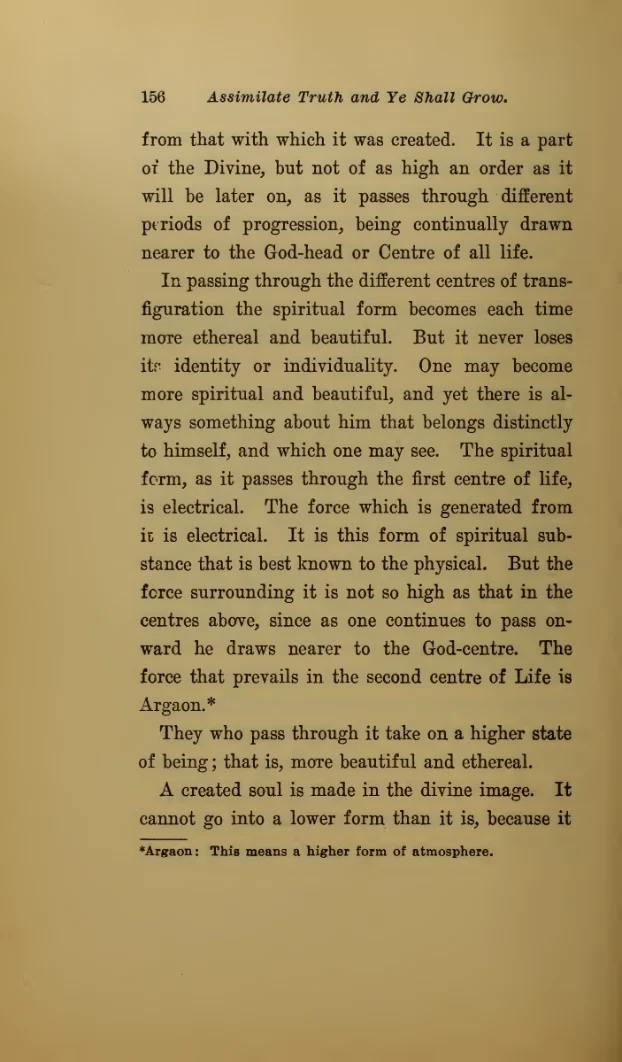
Celestion Study of Man (1903), printed p. 156, Library Reader page 153. The footnote gives the book’s definition of Argaon.
Lumitheca Library, edition IMJ-0055-E001. Public-domain 1903 text and page image; extracted from the checksum-verified retained scan. · Image source ↗ · Public Domain
See references (7)
- The Angels’ Diary and Celestion Study of Man, Reader page 152
- The Angels’ Diary and Celestion Study of Man, Reader page 153
- The Angels’ Diary and Celestion Study of Man, Reader page 154
- The Angels’ Diary and Celestion Study of Man, Reader page 155
- The Angels’ Diary and Celestion Study of Man, Reader page 158
- The Angels’ Diary and Celestion Study of Man, Reader page 159
- The Angels’ Diary and Celestion Study of Man, Denver, 1903
Evolution of Immortality by Rosicruciæ
Freeman Benjamin Dowd, writing as Rosicruciæ in Evolution of Immortality, allows both progress and retrogression. Habitual desire is said to draw a person towards a corresponding future embodiment, including an animal form. His argument therefore permits precisely the kind of downward movement that Celestion Study of Man rejects. [7][8][9][10][11]
Continuity and the direction of change
Argaon is the atmosphere or force of one stage. The spiritual body is what changes as a person passes through it. Keeping both in view explains why the chapter can describe a transformation while treating the person’s identity as continuous. [2]
Both books preserve personal identity through changes of condition. Celestion Study of Man makes spiritual evolution an advance through successive centres. Dowd allows habits and desires to lead to a lower embodiment. Their disagreement is about which changes an enduring person can undergo. [2][3][4][6][7][8][9][10][11]
See references (9)
- The Angels’ Diary and Celestion Study of Man, Reader page 153
- The Angels’ Diary and Celestion Study of Man, Reader page 154
- The Angels’ Diary and Celestion Study of Man, Reader page 155
- The Angels’ Diary and Celestion Study of Man, Reader page 159
- Evolution of Immortality, printed p. 40, Reader page 37
- Evolution of Immortality, printed p. 41, Reader page 38
- Evolution of Immortality, printed p. 42, Reader page 39
- Evolution of Immortality, printed p. 43, Reader page 40
- Evolution of Immortality, printed p. 44, Reader page 41
Read further in the library
The Angels’ Diary and Celestion Study of Man
Reading note
The 1903 volume supplies the distinct teaching or narrated experience discussed in the attributed account, with exact Library page references.
Evolution of Immortality
Reading note
An argument for repeated embodiment that explicitly permits human-to-animal transmigration and acknowledges limits to its evidence.
Sources
See references (12)
- The Angels’ Diary and Celestion Study of Man, Reader page 152Effie M. Shirey and Charles Samson, The Angels’ Diary and Celestion Study of Man (1903), communicated through Elizabeth Maud Weatherhead according to the volume’s acknowledgment. Accounts below refer to the exact retained Library edition IMJ-0055-E001.Read this page in The Angels’ Diary and Celestion Study of Man ↗Return to text ↑
- The Angels’ Diary and Celestion Study of Man, Reader page 153Effie M. Shirey and Charles Samson, The Angels’ Diary and Celestion Study of Man (1903), communicated through Elizabeth Maud Weatherhead according to the volume’s acknowledgment. Accounts below refer to the exact retained Library edition IMJ-0055-E001.Read this page in The Angels’ Diary and Celestion Study of Man ↗Return to text ↑
- The Angels’ Diary and Celestion Study of Man, Reader page 154Effie M. Shirey and Charles Samson, The Angels’ Diary and Celestion Study of Man (1903), communicated through Elizabeth Maud Weatherhead according to the volume’s acknowledgment. Accounts below refer to the exact retained Library edition IMJ-0055-E001.Read this page in The Angels’ Diary and Celestion Study of Man ↗Return to text ↑
- The Angels’ Diary and Celestion Study of Man, Reader page 155Effie M. Shirey and Charles Samson, The Angels’ Diary and Celestion Study of Man (1903), communicated through Elizabeth Maud Weatherhead according to the volume’s acknowledgment. Accounts below refer to the exact retained Library edition IMJ-0055-E001.Read this page in The Angels’ Diary and Celestion Study of Man ↗Return to text ↑
- The Angels’ Diary and Celestion Study of Man, Reader page 158Effie M. Shirey and Charles Samson, The Angels’ Diary and Celestion Study of Man (1903), communicated through Elizabeth Maud Weatherhead according to the volume’s acknowledgment. Accounts below refer to the exact retained Library edition IMJ-0055-E001.Read this page in The Angels’ Diary and Celestion Study of Man ↗Return to text ↑
- The Angels’ Diary and Celestion Study of Man, Reader page 159Effie M. Shirey and Charles Samson, The Angels’ Diary and Celestion Study of Man (1903), communicated through Elizabeth Maud Weatherhead according to the volume’s acknowledgment. Accounts below refer to the exact retained Library edition IMJ-0055-E001.Read this page in The Angels’ Diary and Celestion Study of Man ↗Return to text ↑
- Evolution of Immortality, printed p. 40, Reader page 37Rosicruciæ (catalogued as Freeman Benjamin Dowd), Evolution of Immortality. Eulian Publishing Company, Salem, 1900.Read this page in Evolution of Immortality ↗Return to text ↑
- Evolution of Immortality, printed p. 41, Reader page 38Rosicruciæ (catalogued as Freeman Benjamin Dowd), Evolution of Immortality. Eulian Publishing Company, Salem, 1900.Read this page in Evolution of Immortality ↗Return to text ↑
- Evolution of Immortality, printed p. 42, Reader page 39Rosicruciæ (catalogued as Freeman Benjamin Dowd), Evolution of Immortality. Eulian Publishing Company, Salem, 1900.Read this page in Evolution of Immortality ↗Return to text ↑
- Evolution of Immortality, printed p. 43, Reader page 40Rosicruciæ (catalogued as Freeman Benjamin Dowd), Evolution of Immortality. Eulian Publishing Company, Salem, 1900.Read this page in Evolution of Immortality ↗Return to text ↑
- Evolution of Immortality, printed p. 44, Reader page 41Rosicruciæ (catalogued as Freeman Benjamin Dowd), Evolution of Immortality. Eulian Publishing Company, Salem, 1900.Read this page in Evolution of Immortality ↗Return to text ↑
- The Angels’ Diary and Celestion Study of Man, Denver, 1903 ↗Library of Congress catalogue and preface note.Return to text ↑