The Nine Greek Muses: Names, Roles and Symbols
Meet the nine Greek Muses through named portraits, familiar roles and symbols. Read Hesiod’s list and follow Urania to Milton’s Paradise Lost.
In this article
Look up a Muse by name
These portraits are by Virgil Solis. Each card gives the familiar role and an object or detail visible in his print.
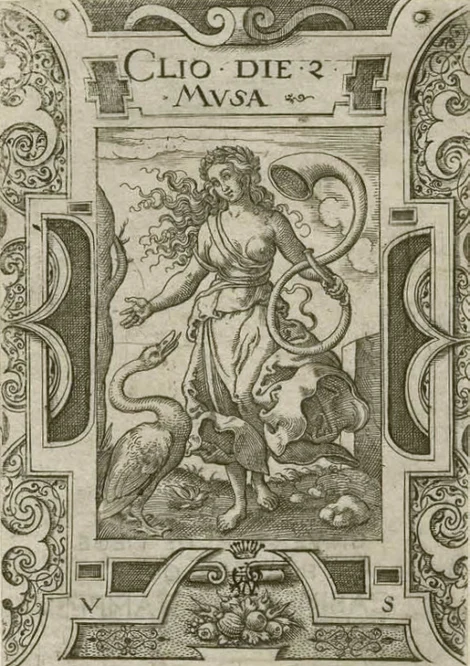 ClioHistorySolis shows round emblems
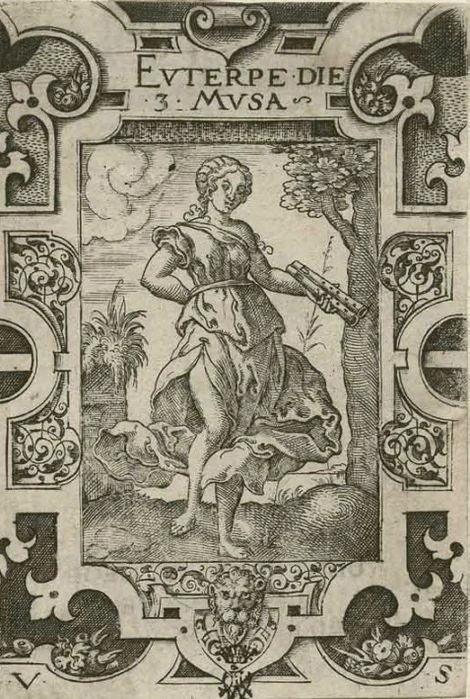 EuterpeMusic and flute-playingSolis shows a long instrument
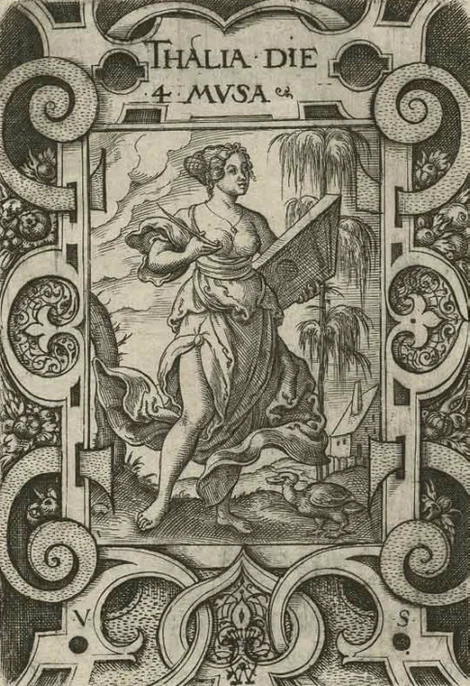 ThaliaComedySolis shows an open book
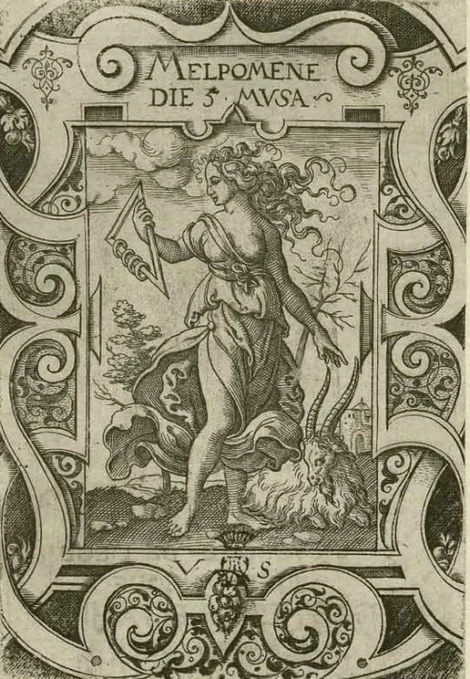 MelpomeneTragedySolis shows a triangular object
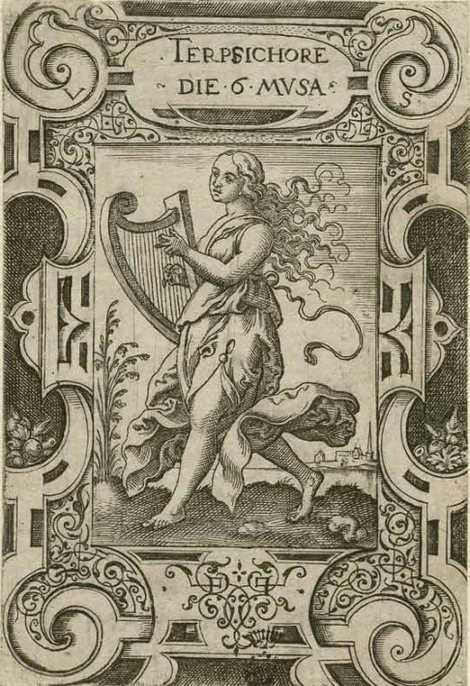 TerpsichoreDance and the chorusSolis shows a harp
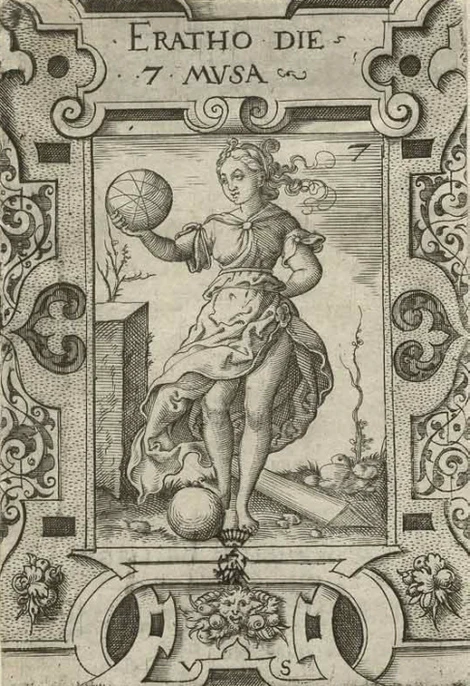 EratoLove poetrySolis shows a globe
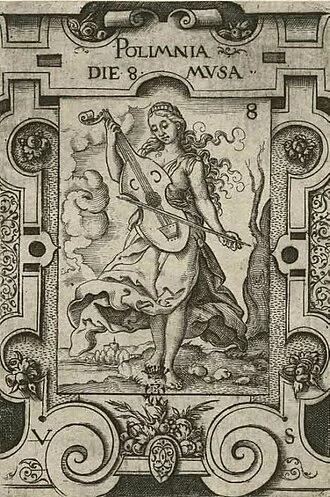 PolyhymniaHymns and sacred songSolis shows a stringed instrument
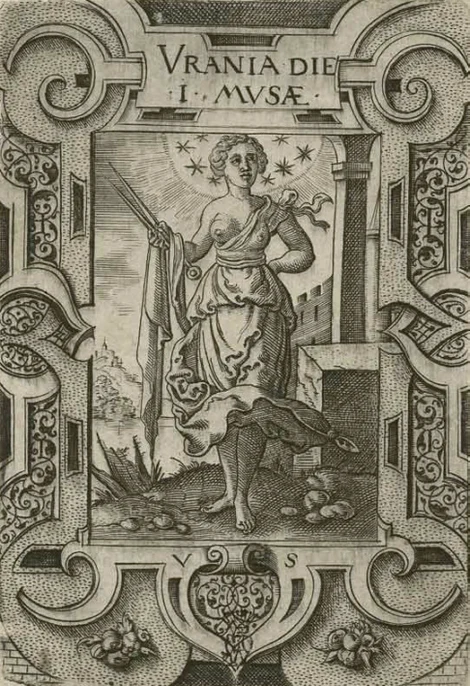 UraniaAstronomySolis shows stars and a rod
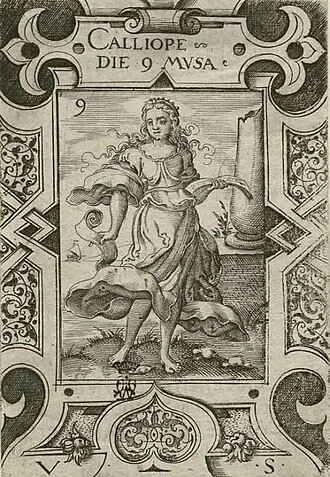 CalliopeEpic poetry and eloquenceSolis shows vessels
Who are the nine Greek Muses?
The nine Muses named in Hesiod’s Theogony are Clio, Euterpe, Thalia, Melpomene, Terpsichore, Erato, Polyhymnia, Urania and Calliope. They are daughters of Zeus and Mnemosyne, whose name means Memory. Hesiod introduces the group through singing and gives Calliope particular attention. The familiar list of nine separate specialties belongs to the way later readers and artists organised the Muses. [1][2][6]
The lookup below the introduction uses a named engraving for each Muse. The role gives you the customary domain. The second line tells you what Solis actually shows. Those descriptions can differ: try finding the Muse with the globe before reading her name. [6][9][18]
Why is Memory their mother?
The Muses meet Hesiod while he tends sheep on Helicon. They give him a voice with which to sing of past and future. Later they give certain kings the power to settle disputes through persuasive speech. A shared capacity runs through the two scenes: knowing how to call events and judgments to mind in a form an audience can hear. [1]
The poem also connects song with relief from grief. Someone distressed by a recent loss can turn to a singer and remember the deeds of earlier people and gods. The gift of Memory can therefore make one thing present while allowing a listener to set something else down for a while. [1]
Were there always nine Muses?
Pausanias records a Helicon tradition of three Muses named Melete, Mneme and Aoede, associated with practice, memory and song. He then reports that Pierus established nine at Thespiae. Diodorus also records the disagreement between lists of three and nine. These ancient accounts show how a place and its traditions could shape the number and names people gave the Muses. [3][2]
How can you identify a Muse in art?
Start with an inscription or an object record. Then read the pose, instrument and company. Solis prints the name of each Muse above her figure, while Claude’s drawing leaves more work to the viewer. Several of Claude’s figures can be identified from their objects or movements. With others, a group context remains the strongest clue. [9][10][7]
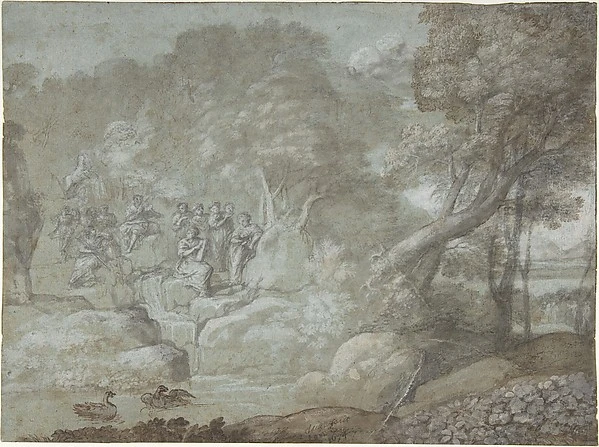
Claude gives some of the women familiar objects and identifies others through pose. The Met reads the striding figure at the far left as Terpsichore and the woman with a trumpet nearby as Clio.
Claude Lorrain, Landscape with Apollo and the Muses, 1674. The Metropolitan Museum of Art, Rogers Fund, 1961, 61.59. Open Access. · Image source ↗ · Public Domain
Clio · history
As a Muse of history, Clio is often pictured with a book or scroll. The Met identifies her by a trumpet in Claude Lorrain’s landscape, where the instrument suggests the fame transmitted by history. In Solis, the printed name above the figure can identify her even when the props are less familiar. [13][10]
See references (2)
Euterpe · music and flute-playing
Flute-playing is the role that most readily distinguishes Euterpe from the other musical Muses. Greek instruments translated as flutes can include the reed-pipe called the aulos. When you compare a pair of pipes with the many strings in the Terpsichore print, keep the pictured object and the customary domain separate. [14][6]
Thalia · comedy
Thalia is associated with comedy. A comic mask helps identify her in many later works, and the Met uses the mask to identify her in Claude’s drawing. Solis gives his Thalia an open book. Find the printed name first, then compare how different artists mark the same role. [15][10]
See references (2)
Melpomene · tragedy
Melpomene’s familiar domain is tragedy. A tragic mask can distinguish her from Thalia. The association is later than Hesiod’s list, and Diodorus explains the name through singing rather than assigning a theatrical mask. That difference helps explain why a labelled image can show a less familiar object. [16][2][6]
Terpsichore · dance and the chorus
Ancient choral dance combines movement with music, which helps explain why a Muse of dance can hold an instrument. In Solis she carries a large harp. In Claude’s drawing the Met instead points to the stride of the figure at the far left to identify her. [17][10][6]
Erato · love poetry
Erato is associated with lyric poetry, especially love poetry. Diodorus ties her name to being loved, and a lyre appears on some Roman depictions. Solis gives the named Erato a globe. This is an especially clear case for checking captions or a museum record instead of assigning every globe to Urania. [18][2][6][8]
Polyhymnia · hymns and sacred song
Polyhymnia is commonly associated with hymns. The Walters also records a connection with pantomime and tentatively identifies one of its leaning statues as Polyhymnia. That tentative attribution reflects a recurring problem with sculpture: pose, restoration and lost objects can make identifications less secure than an engraved name. [19][6][7]
Urania · astronomy
Urania is associated with astronomy. A globe can help identify her, especially with a pointer or compass, but the object is not a universal label. Solis puts stars around her head. Diodorus explains her name by looking upward to heaven and describes the power of thought to raise the soul. [20][2][6][8]
Calliope · epic poetry and eloquence
Hesiod singles Calliope out for her connection with kings and persuasive speech. The familiar association with epic poetry can be read through later images of her with a book or scroll. Ovid also has her perform the Muses’ song about Proserpina, a reading that connects poetry and performance. [21][1][10][4]
From Calliope’s song to Milton’s Urania
In Ovid’s contest scene the Muses choose Calliope as their singer. She tries the strings of her instrument and begins the story of Ceres and Proserpina. In the Library attributed to Apollodorus, she is also the mother of Orpheus, who can move stones and trees with his singing. The two accounts give a reader connections between a named Muse, a performance and the stories sung about the underworld. [4][5]
Milton opens Book VII by calling on Urania. He immediately qualifies the name and places the inspiration he seeks outside the company of the nine at Olympus. Read that distinction on the exact Doré-edition Reader page. It shows a poet using the old language of invocation to state where the authority for his own song comes from. [11][12]
Read further in the library
Paradise Lost: Illustrated by Gustave Doré
Reading note
Read Milton’s invocation to Urania at the opening of Book VII.
Sources
See references (21)
- Hesiod, Theogony 1–115 and 915–917 · Names, memory and speech ↗Center for Hellenic Studies, Harvard University.Return to text ↑
- Diodorus Siculus, Library of History 4.7 · Three or nine Muses and the names ↗C. H. Oldfather’s translation, Theoi Classical Texts Library.Return to text ↑
- Pausanias, Description of Greece 9.29.1–4 · The older three at Helicon ↗W. H. S. Jones’s translation, Theoi Classical Texts Library.Return to text ↑
- Ovid, Metamorphoses 5.294–678 · The song contest and Calliope’s performance ↗A. S. Kline’s translation, University of Virginia Ovid Collection.Return to text ↑
- Pseudo-Apollodorus, Library 1.3.2 · Calliope and Orpheus ↗Greek and English, Durham University’s Living Poets project.Return to text ↑
- Walters Art Museum · Seated Muse and guide to the nine domains ↗Walters Art Museum collection record 23.84.Return to text ↑
- Walters Art Museum · Leaning Muse, Probably Polyhymnia ↗Walters Art Museum collection record 23.90.Return to text ↑
- Roman Sarcophagi in The Metropolitan Museum of Art · The Muses and Sirens ↗The Met, curatorial catalogue and reading of the Muses and Sirens sarcophagus.Return to text ↑
- Warburg Institute · Virgil Solis’s cycle of engraved Muses ↗Warburg Institute Iconographic Database, c. 1550–1562.Return to text ↑
- Claude Lorrain, Landscape with Apollo and the Muses ↗Claude Lorrain, Landscape with Apollo and the Muses, 1674. The Metropolitan Museum of Art, Rogers Fund, 1961, 61.59. Open Access.Return to text ↑
- John Milton, Paradise Lost VII.1–39 · Invocation to Urania ↗University of Toronto, Representative Poetry Online, 1674 text.Return to text ↑
- Paradise Lost, Book VII · Milton calls on UraniaJohn Milton, Paradise Lost, illustrated by Gustave Doré. Lumitheca source leaf 203, printed page 165.Read this page in Paradise Lost: Illustrated by Gustave Doré ↗Return to text ↑
- Virgil Solis · Clio ↗Virgil Solis, engraved Muse cycle, c. 1550–1562. Public-domain reproduction.Return to text ↑
- Virgil Solis · Euterpe ↗Virgil Solis, engraved Muse cycle, c. 1550–1562. Public-domain reproduction.Return to text ↑
- Virgil Solis · Thalia ↗Virgil Solis, engraved Muse cycle, c. 1550–1562. Public-domain reproduction.Return to text ↑
- Virgil Solis · Melpomene ↗Virgil Solis, engraved Muse cycle, c. 1550–1562. Public-domain reproduction.Return to text ↑
- Virgil Solis · Terpsichore ↗Virgil Solis, engraved Muse cycle, c. 1550–1562. Public-domain reproduction.Return to text ↑
- Virgil Solis · Erato ↗Virgil Solis, engraved Muse cycle, c. 1550–1562. Public-domain reproduction.Return to text ↑
- Virgil Solis · Polyhymnia ↗Virgil Solis, engraved Muse cycle, c. 1550–1562. Public-domain reproduction.Return to text ↑
- Virgil Solis · Urania ↗Virgil Solis, engraved Muse cycle, c. 1550–1562. Public-domain reproduction.Return to text ↑
- Virgil Solis · Calliope ↗Virgil Solis, engraved Muse cycle, c. 1550–1562. Public-domain reproduction.Return to text ↑