Orpheus and Eurydice: Why He Looked Back
Why does Orpheus look back and lose Eurydice? Compare Virgil’s and Ovid’s accounts, their different farewells, and the reunion Ovid writes later.
In this article
Compare the glance and its consequences
Start at the threshold, then work back to each poet’s account of why the pair were there.
Orpheus and Eurydice in Virgil and Ovid
The same turn of the head brings a different farewell in each poem.
Why does he turn?
- Virgil
- A sudden frenzy overtakes him on the edge of daylight.
- Ovid
- He fears she may falter and is eager to see her.
What does she say?
- Virgil
- She asks whose madness has destroyed them and says the Fates call her back.
- Ovid
- She gives a farewell he can scarcely hear. The narrator asks what she could fault but his love.
How did she die?
- Virgil
- A snake bites her while she is fleeing Aristaeus.
- Ovid
- A snake bites her after the wedding while she walks with Naiads.
What happens after Orpheus dies?
- Virgil
- His head calls Eurydice’s name, and the riverbanks echo it.
- Ovid
- In Book 11 his shade finds Eurydice, and he can look back safely.
Why did Orpheus look back?
Orpheus looks back just short of the world of the living, breaking the condition of Eurydice’s return. Virgil describes a sudden frenzy that takes hold of a lover who has almost reached the light. Ovid describes fear that Eurydice may falter, together with an eagerness to see her. The action is the same in both poems. Its motive is easier to name in Ovid, while Virgil gives the impulse the speed and force of something Orpheus scarcely understands. [1][2][3][4]
Rodin gives this split second a physical shape. Look at the space between the hand, the face and the figure at the entrance. The museum describes a man who hesitates because he cannot feel or hear Eurydice. The statue lets a viewer stay with that uncertainty for much longer than either poem does, in the instant before the condition takes effect. [8][2][3]
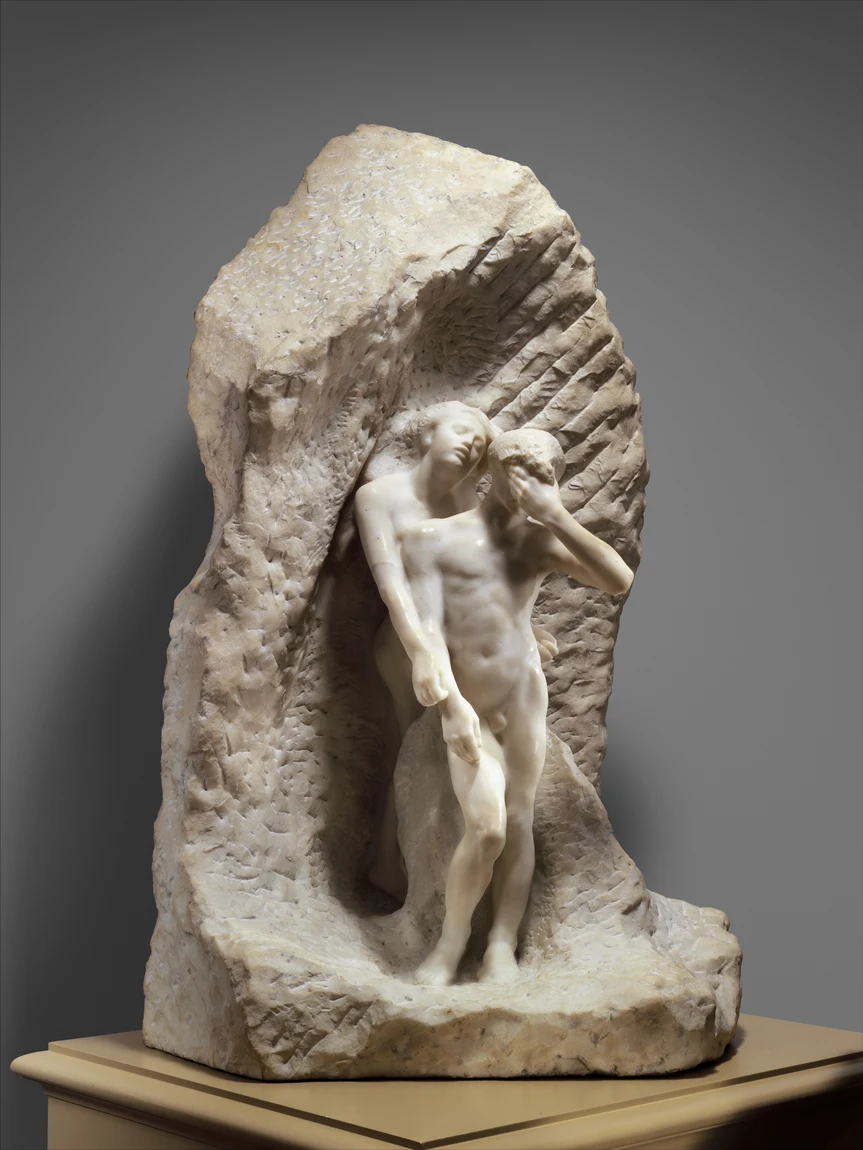
Rodin shows the instant before the look. One figure steps forward out of the stone, while the other remains close to the dark entrance. The Met reads the gesture as hesitation at the threshold.
Auguste Rodin, Orpheus and Eurydice, modeled ca. 1887, carved 1893, marble. The Metropolitan Museum of Art, Gift of Thomas F. Ryan, 1910, 10.63.2. Open Access. · Image source ↗ · Public Domain
How does Eurydice die the first time?
Go back to the first encounter with the snake. In Virgil, Proteus tells Aristaeus that Eurydice died while fleeing him. The story answers a question about Aristaeus’s ruined hives, where responsibility for the loss is part of the account. Ovid begins close to the wedding. Hymen arrives, but the torch gives a bad omen. Eurydice is walking with a group of Naiads when the snake bites her, and Aristaeus is absent from the episode. [1][3]
Both poets make the death something Orpheus tries to undo with song. Virgil brings up a crowd of shades and has Ixion’s wheel stop turning. Ovid also suspends torments, but gives the singer a speech that explains his request. Orpheus asks for the return of years cut short. He accepts that Eurydice must eventually come back to the realm all mortals enter. [1][3]
What condition did the underworld impose?
Virgil introduces the condition as Orpheus is already going back. Proserpina has required Eurydice to follow behind, and the story hurries to the moment he stops. In Ovid the condition is stated before they start uphill. The way is steep, silent and dark. We already know that Eurydice walks slowly from her wound. Her pace gives the reader a concrete reason to understand his concern even as the path brings them close to success. [2][3][4]
The Met suggests that Raimondi’s engraving shows Eurydice just after she is called forward. Corot’s much later landscape pictures the journey as a passage through trees, with the travellers’ hands joined. Read the pictures in that order. One draws attention to the handover and the effort to move. The other spends time on the dangerous interval while they are both still travelling. Their gestures are choices the artists have made from the story. [9][10][6][3]
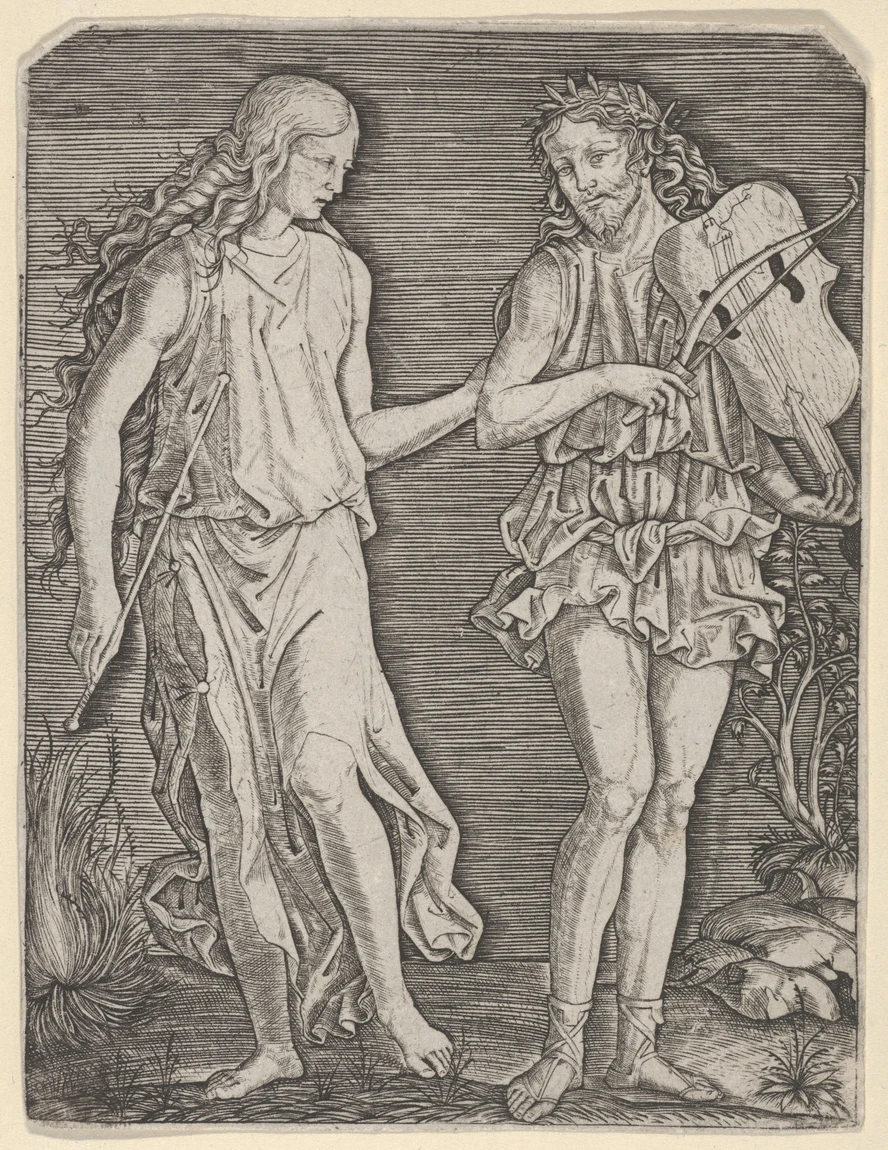
The Met suggests Raimondi may be showing the moment Eurydice is handed back to Orpheus. Her recent wound still affects the way she walks in Ovid’s account.
Marcantonio Raimondi, Orpheus and Eurydice, ca. 1500–1506, engraving. The Metropolitan Museum of Art, The Elisha Whittelsey Collection, The Elisha Whittelsey Fund, 1956, 56.581.12. Open Access. · Image source ↗ · Public Domain
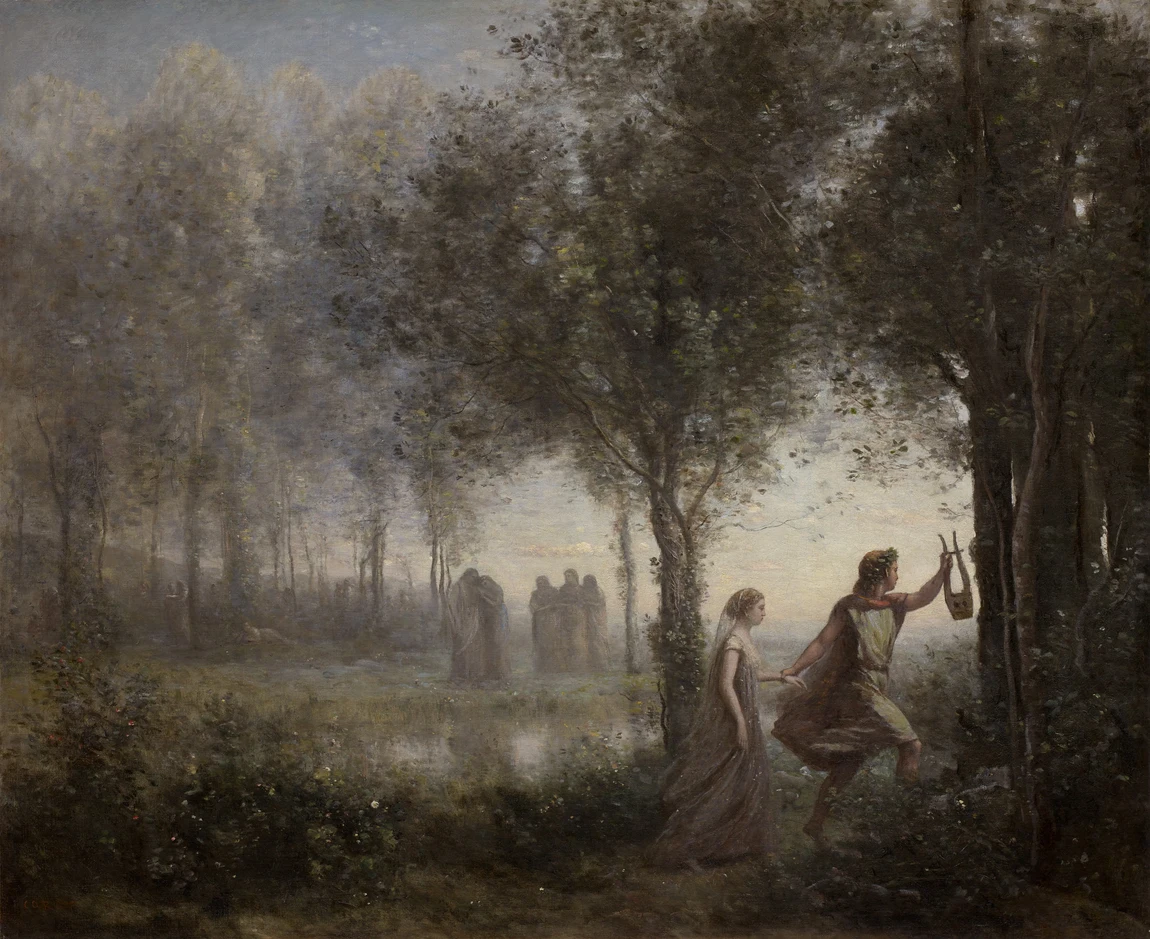
Corot depicts the journey. The lyre is raised and the travellers hold hands, even while the landscape around them remains shadowed. The painting gives that short interval its own scene.
Jean-Baptiste-Camille Corot, Orpheus Leading Eurydice from the Underworld, 1861, oil on canvas. Museum of Fine Arts, Houston, 87.190. Public-domain reproduction via Wikimedia Commons. · Image source ↗ · Public Domain
See references (6)
- Virgil, Georgics 4.467–493 · The condition and the look
- Ovid, Metamorphoses 10.1–85 · The descent, the look and the farewell
- Ovid, Metamorphoses 10.48–63 · Eurydice’s slow step and the glance
- Museum of Fine Arts, Houston · Corot’s Orpheus Leading Eurydice
- Marcantonio Raimondi · Orpheus and Eurydice
- Camille Corot · Orpheus Leading Eurydice from the Underworld
What does Eurydice say when he looks back?
In the Georgics, Eurydice asks what madness has destroyed them both. She says the Fates are calling her back, and reaches out before she disappears like smoke. Virgil has already invited sympathy for Orpheus’s impulse by calling it pardonable if the dead knew how to pardon. Eurydice’s speech lets the person losing her life a second time describe what the same impulse has cost her. [1][2]
Ovid also gives Eurydice words. She gives a final farewell that Orpheus can barely hear. The narrator asks what she could blame him for except loving her. The contrast is between a speech that questions the act and a farewell whose surrounding narration defends the lover. A reader can hear that distinction even though the two endings both leave him reaching after someone he can no longer hold. [1][3][4]
Do Orpheus and Eurydice ever meet again?
In Ovid they do. Book 10 ends the rescue attempt with a ferryman who refuses to let Orpheus cross again. Book 11 resumes the story after women kill him. His shade finds Eurydice, and they can walk side by side or take turns leading. He can look back safely. Ovid reuses the smallest movement from the earlier disaster and changes what it does. The reunion takes place among the dead. [3][5]
Virgil ends with a different image. After Orpheus is torn apart, his severed head calls Eurydice’s name as it floats down the Hebrus. The banks echo it. The song and the name outlast the body, and the poem gives the listener an echo in place of another meeting. [1]
Where does Dante place Orpheus?
In Inferno IV Dante sees Orpheus among the figures in Limbo, near Linus, Tully and Seneca in Cary’s translation. The exact Reader page preserves the order of the names. Virgil, author of one of the Roman tellings, is the pilgrim’s guide in the scene. Dante puts Orpheus himself among the remembered minds and artists of antiquity without staging his attempt to bring Eurydice back. [7][1]
Read further in the library
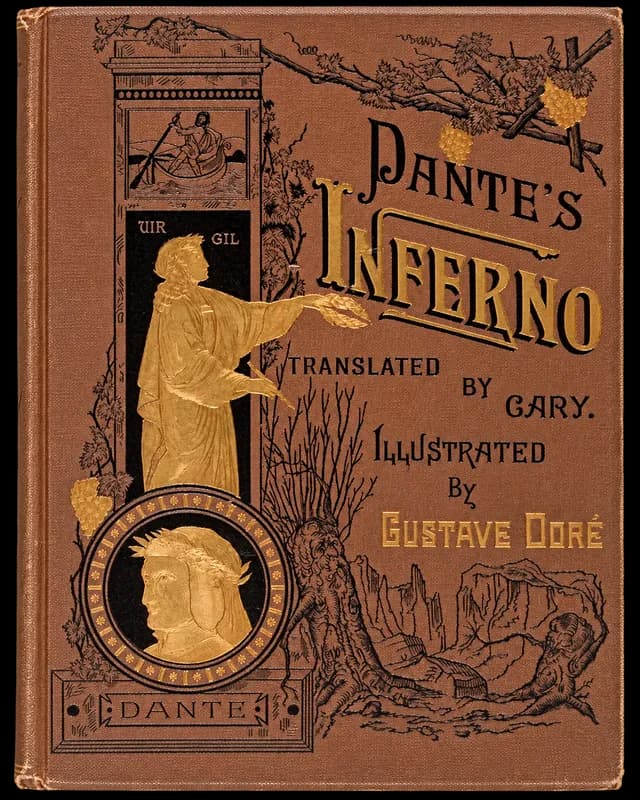
Dante's Inferno
Reading note
Read Dante’s encounter with Orpheus among the shades of Limbo.
Sources
See references (10)
- Virgil, Georgics 4.453–527 · Orpheus and Eurydice ↗John Martyn, 1746 second edition, transcribed by the University of Canterbury from its James Logie Memorial Collection.Return to text ↑
- Virgil, Georgics 4.467–493 · The condition and the look ↗Latin text and notes, Dickinson College Commentaries.Return to text ↑
- Ovid, Metamorphoses 10.1–85 · The descent, the look and the farewell ↗Brookes More’s translation, Perseus Digital Library.Return to text ↑
- Ovid, Metamorphoses 10.48–63 · Eurydice’s slow step and the glance ↗Latin text with line numbers, University of Virginia, Metamorphoses Illustratae.Return to text ↑
- Ovid, Metamorphoses 11.61–66 · The final reunion ↗Brookes More’s translation, Perseus Digital Library.Return to text ↑
- Museum of Fine Arts, Houston · Corot’s Orpheus Leading Eurydice ↗Museum of Fine Arts, Houston, object 87.190, in the museum’s Google Arts & Culture collection.Return to text ↑
- Cary’s Inferno IV · Orpheus among the shades of LimboDante Alighieri, Inferno, translated by Henry Francis Cary. Thompson & Thomas, printed p. 26, Lumitheca source leaf 44.Read this page in Dante's Inferno ↗Return to text ↑
- Auguste Rodin · Orpheus and Eurydice ↗Auguste Rodin, Orpheus and Eurydice, modeled ca. 1887, carved 1893, marble. The Metropolitan Museum of Art, Gift of Thomas F. Ryan, 1910, 10.63.2. Open Access.Return to text ↑
- Marcantonio Raimondi · Orpheus and Eurydice ↗Marcantonio Raimondi, Orpheus and Eurydice, ca. 1500–1506, engraving. The Metropolitan Museum of Art, The Elisha Whittelsey Collection, The Elisha Whittelsey Fund, 1956, 56.581.12. Open Access.Return to text ↑
- Camille Corot · Orpheus Leading Eurydice from the Underworld ↗Jean-Baptiste-Camille Corot, Orpheus Leading Eurydice from the Underworld, 1861, oil on canvas. Museum of Fine Arts, Houston, 87.190. Public-domain reproduction via Wikimedia Commons.Return to text ↑