Persephone and the Pomegranate: What the Myth Actually Says
Compare Persephone’s pomegranate in the Homeric Hymn, Apollodorus and Ovid. Follow the story and see how each source divides her year.
In this article
Compare the three versions
The fruit, the witness and the division of the year change from one version to another.
How each source divides Persephone’s year
Each bar represents one year. The filled part shows time in the underworld.
Homeric Hymn to Demeter
One third belowTwo thirds aboveHades gives the fruit. Persephone says he compelled her to eat.
Pseudo-Apollodorus, Library
One third belowTwo thirds aboveHades gives a single seed. Ascalaphus testifies.
Ovid, Metamorphoses
Half belowHalf aboveProserpina takes the fruit and eats seven seeds. Ascalaphus sees her.
Why does Hades give Persephone the pomegranate?
In the Homeric Hymn to Demeter, Hades gives Persephone some pomegranate so that she cannot stay with Demeter all year. The hymn describes a third of the year below and two thirds with her mother and the other gods. Ovid tells the episode differently: Proserpina picks the fruit herself, eats seven seeds, and spends half the year in each realm. The seeds and the division belong to the source telling the story. [5][6][9]
Read the scene twice in the hymn. The narrator presents the gift while Hermes is there to bring Persephone back. Later Persephone tells Demeter that she was compelled to eat. Hearing her account changes the scene’s emphasis. It is her account of a departure she had hoped would bring her home, and belongs alongside the hymn’s insistence that she was taken against her will. [4][5][1]
See references (5)
- Homeric Hymn to Demeter 1–45 · Flowers, abduction and outcry
- Homeric Hymn to Demeter 334–385 · Hermes and the return
- Homeric Hymn to Demeter 371–374, 405–413 · The pomegranate
- Homeric Hymn to Demeter 441–470 · The division of the year
- Ovid, Metamorphoses 5.520–571 · The orchard, seven seeds and equal division
The abduction, Demeter’s search and the return
The hymn follows Demeter for much of the story. Its opening explains Zeus’s part in the abduction before Demeter learns what happened. The search moves from torchlight to Eleusis, and the crisis widens when the earth ceases to yield a crop. This sequence explains why Zeus eventually sends a messenger and why the agreement must address both Persephone’s return and Demeter’s withdrawal. [1][2][3][4][6]
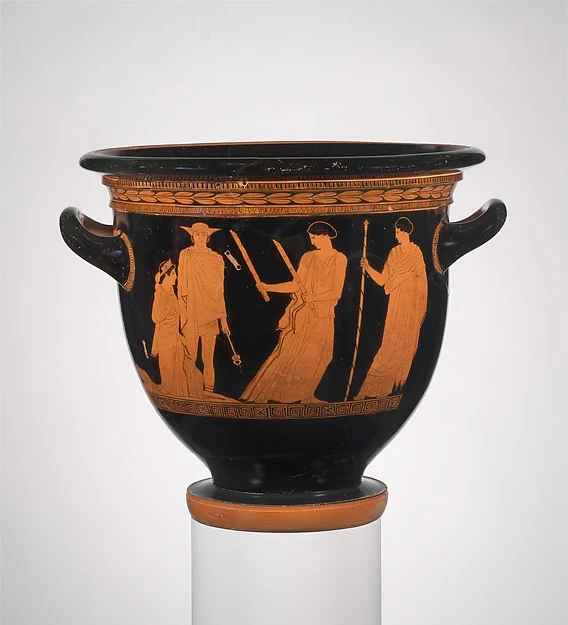
Persephone rises from a cleft in the earth. Demeter waits on the right. The vase shows the return, which can be identified independently of how much of the year any text assigns below ground.
Attributed to the Persephone Painter, Attic terracotta bell-krater, ca. 440 BCE. The Metropolitan Museum of Art, Fletcher Fund, 1928, 28.57.23. Open Access. · Image source ↗ · Public Domain
- The meadow
Persephone is taken
She reaches for a narcissus on the plain of Nysa. The ground opens and Hades carries her away. [1]
- The search
Demeter asks who heard or saw
Hekate has heard her cry. Helios tells Demeter that Hades took Persephone with Zeus’s permission. [2]
- Eleusis
The earth withholds its harvest
Demeter grieves at the temple. She keeps the seed below the ground and refuses to restore growth until she sees her daughter. [3]
- The return
- The settlement
Persephone will return each year
Zeus accepts a division of the year. The hymn’s Rarian field begins to flourish again. [6]
See references (6)
- Homeric Hymn to Demeter 1–45 · Flowers, abduction and outcry
- Homeric Hymn to Demeter 47–89 · Demeter, Hekate and Helios
- Homeric Hymn to Demeter 301–333 · Demeter withholds growth
- Homeric Hymn to Demeter 334–385 · Hermes and the return
- Homeric Hymn to Demeter 371–374, 405–413 · The pomegranate
- Homeric Hymn to Demeter 441–470 · The division of the year
How many pomegranate seeds does Persephone eat?
The Homeric Hymn episode centres on the pomegranate Hades gives her. Nagy’s translation calls it a berry of the pomegranate, and Evelyn-White and other translations commonly say a seed. The hymn gives the fraction separately. It has no statement equating each seed with a month. [5][6]
The Library attributed to Apollodorus explicitly describes a single seed given by Pluto. Persephone swallows it without foreseeing the result. Ascalaphus testifies, and Demeter punishes him. The resulting division agrees with the hymn’s third below, even though the witness belongs to this version. [8][6]
In Ovid, Jupiter initially makes return conditional on abstaining from food below. Proserpina picks the pomegranate in the garden and eats seven seeds. Ascalaphus sees her, and the poem proceeds to the equal division. Seven seeds and half of a twelve-month year appear in the same account. The familiar explanation that six seeds correspond to six months cannot be used as a summary of these three texts. [9][8][6]
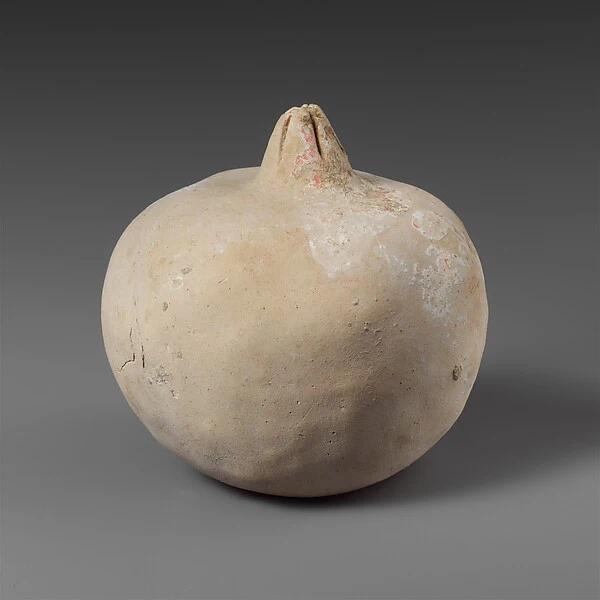
This terracotta pomegranate is a material example of the fruit in Greek art. Its form helps explain why a single fruit can be recognisable without showing or counting its seeds.
Greek terracotta pomegranate, fifth to fourth century BCE. The Metropolitan Museum of Art, Fletcher Fund, 1924, 24.97.110. Open Access. · Image source ↗ · Public Domain
How long does Persephone stay in the underworld?
The fractions are clear, but their use as a fixed seasonal calendar calls for care. The Homeric Hymn associates the return with spring flowers and a revived field. It also spends much of the plot on Demeter’s refusal to permit crops to grow. The order matters. The harvest fails during the crisis over her daughter. The agreement at the end then sets out what will happen each year. [7][3][6]
Leighton makes one moment stand for that change. Hermes bridges the dark opening and Demeter’s sunlit world. The ancient bell-krater also makes the boundary visible, with Persephone rising from a cleft. Each artist gives the reunion a physical setting. Neither image by itself supplies a seed count or tells us which fraction an ancient reader had in mind. [12][10][6]
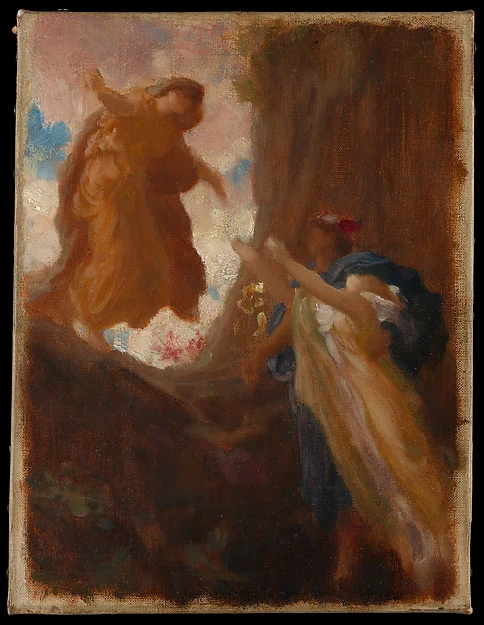
In Leighton’s oil study, Hermes supports Persephone as she reaches toward Demeter. A change from dark earth to blue sky makes the return visible within a single scene.
Frederic, Lord Leighton, The Return of Persephone, ca. 1890–91. The Metropolitan Museum of Art, Bequest of James David Draper, from the Robert Isaacson Collection, 2019, 2021.10.1. Open Access. · Image source ↗ · Public Domain
What does the pomegranate symbolise?
The strongest answer starts with the fruit’s action in the plot. Eating below keeps Persephone connected to the underworld after Hermes brings her out. The two episodes about seeds in the hymn have different effects: Demeter holds grain beneath the earth to force an answer from the gods, and the pomegranate affects where Persephone can remain. Reading those scenes next to each other helps explain why the fruit can carry both ideas of growth and associations with the dead. [5][3][6][11]
Later illustrations can emphasise her position as queen rather than the moment she eats. Rawson’s plate in The Eleusinian and Bacchic Mysteries presents Proserpina and Pluto with the Furies. Bayley’s The Lost Language of Symbolism presents Persephone enthroned beneath an arch. Use those exact Reader leaves to compare what an image of a ruler does with what the hymn’s pomegranate episode does. [13][14][5]
See references (6)
Read further in the library

The Eleusinian and Bacchic Mysteries
Reading note
See Rawson’s Underworld Court plate in the exact Library edition.
The Lost Language of Symbolism, Volume I
Reading note
Compare Bayley’s plate of the enthroned Persephone.
Sources
See references (14)
- Homeric Hymn to Demeter 1–45 · Flowers, abduction and outcry ↗Gregory Nagy, translation for Harvard’s Center for Hellenic Studies. Line numbers follow the Homeric Hymn to Demeter.Return to text ↑
- Homeric Hymn to Demeter 47–89 · Demeter, Hekate and Helios ↗Gregory Nagy, translation for Harvard’s Center for Hellenic Studies. Line numbers follow the Homeric Hymn to Demeter.Return to text ↑
- Homeric Hymn to Demeter 301–333 · Demeter withholds growth ↗Gregory Nagy, translation for Harvard’s Center for Hellenic Studies. Line numbers follow the Homeric Hymn to Demeter.Return to text ↑
- Homeric Hymn to Demeter 334–385 · Hermes and the return ↗Gregory Nagy, translation for Harvard’s Center for Hellenic Studies. Line numbers follow the Homeric Hymn to Demeter.Return to text ↑
- Homeric Hymn to Demeter 371–374, 405–413 · The pomegranate ↗Gregory Nagy, translation for Harvard’s Center for Hellenic Studies. Line numbers follow the Homeric Hymn to Demeter.Return to text ↑
- Homeric Hymn to Demeter 441–470 · The division of the year ↗Gregory Nagy, translation for Harvard’s Center for Hellenic Studies. Line numbers follow the Homeric Hymn to Demeter.Return to text ↑
- Homeric Hymn to Demeter · Complete text and notes ↗Gregory Nagy, Center for Hellenic Studies, Harvard University.Return to text ↑
- Pseudo-Apollodorus, Library 1.5.3 · The seed and Ascalaphus ↗James George Frazer’s translation, Perseus Digital Library transcription hosted by Alpheios.Return to text ↑
- Ovid, Metamorphoses 5.520–571 · The orchard, seven seeds and equal division ↗Brookes More’s translation, Theoi Classical Texts Library.Return to text ↑
- Attic bell-krater attributed to the Persephone Painter ↗Attributed to the Persephone Painter, Attic terracotta bell-krater, ca. 440 BCE. The Metropolitan Museum of Art, Fletcher Fund, 1928, 28.57.23. Open Access.Return to text ↑
- Greek terracotta pomegranate ↗Greek terracotta pomegranate, fifth to fourth century BCE. The Metropolitan Museum of Art, Fletcher Fund, 1924, 24.97.110. Open Access.Return to text ↑
- Frederic Leighton · The Return of Persephone ↗Frederic, Lord Leighton, The Return of Persephone, ca. 1890–91. The Metropolitan Museum of Art, Bequest of James David Draper, from the Robert Isaacson Collection, 2019, 2021.10.1. Open Access.Return to text ↑
- A. L. Rawson · Pluto, Proserpina and the FuriesIllustration in Thomas Taylor, The Eleusinian and Bacchic Mysteries, edited by Alexander Wilder, Lumitheca edition IMJ-0480-E001, source leaf 13.Read this page in The Eleusinian and Bacchic Mysteries ↗Return to text ↑
- Harold Bayley · The enthroned PersephoneThe Lost Language of Symbolism, Volume I, Lumitheca edition IMJ-0448-E002, source leaf 327.Read this page in The Lost Language of Symbolism, Volume I ↗Return to text ↑