Hades (Underworld)
Explore Hades as the Greek realm of the dead through Homer, funerary practice and Plato, with a separate look at Virgil’s Roman underworld.
In this article
What is Hades?
Hades is the realm of the dead in ancient Greek accounts, sharing its name with the god who rules there. Persephone appears beside him as its queen. The inhabitants are often imagined as shades: people whose connection with embodied life has ended. This entry concerns that realm and the changing ways writers described it. [2]
A useful starting point is the relationship between death and remembrance. Greek funerary customs gave the dead a place within family and civic life, even when poetry represented their existence as distant and diminished. The underworld could be imagined through stories, while obligations to the departed were expressed through burial, offerings and care for graves. [2]
Shades and remembrance
Odysseus among the shades
In Odyssey XI, Odysseus reaches a dark region beside Ocean and summons the dead with offerings. Elpenor asks for burial. Achilles values the poorest living existence above kingship among the dead, yet takes pleasure in news of his son. Personal attachments survive the separation from life. The same episode includes the exceptional punishments of Tantalus and Sisyphus. Its shades do not all share one fate, and its punishments do not turn the entire realm into a destination reserved for the wicked. [1]
Burial and the obligations of the living
The Met’s account describes preparation of the body, its laying out, the funeral procession and interment. Women of the family played prominent roles in mourning and in visits to the tomb. Offerings and grave monuments sustained remembrance. These acts placed death within a network of continuing responsibilities. They also explain why an unburied person could be such a troubling figure in a story: the transition had left an obligation unmet. [2]
A mourner at the grave
A white-ground lekythos attributed to the Achilles Painter, made around 440 BCE, places mourning on an object associated with funerary use. In the view reproduced here, a figure stands beside a grave monument. Its quiet scale brings the subject back from epic journeys to the act of remembering a particular dead person. The vessel records an artistic treatment of loss; it is not a diagram of the underworld. [5]
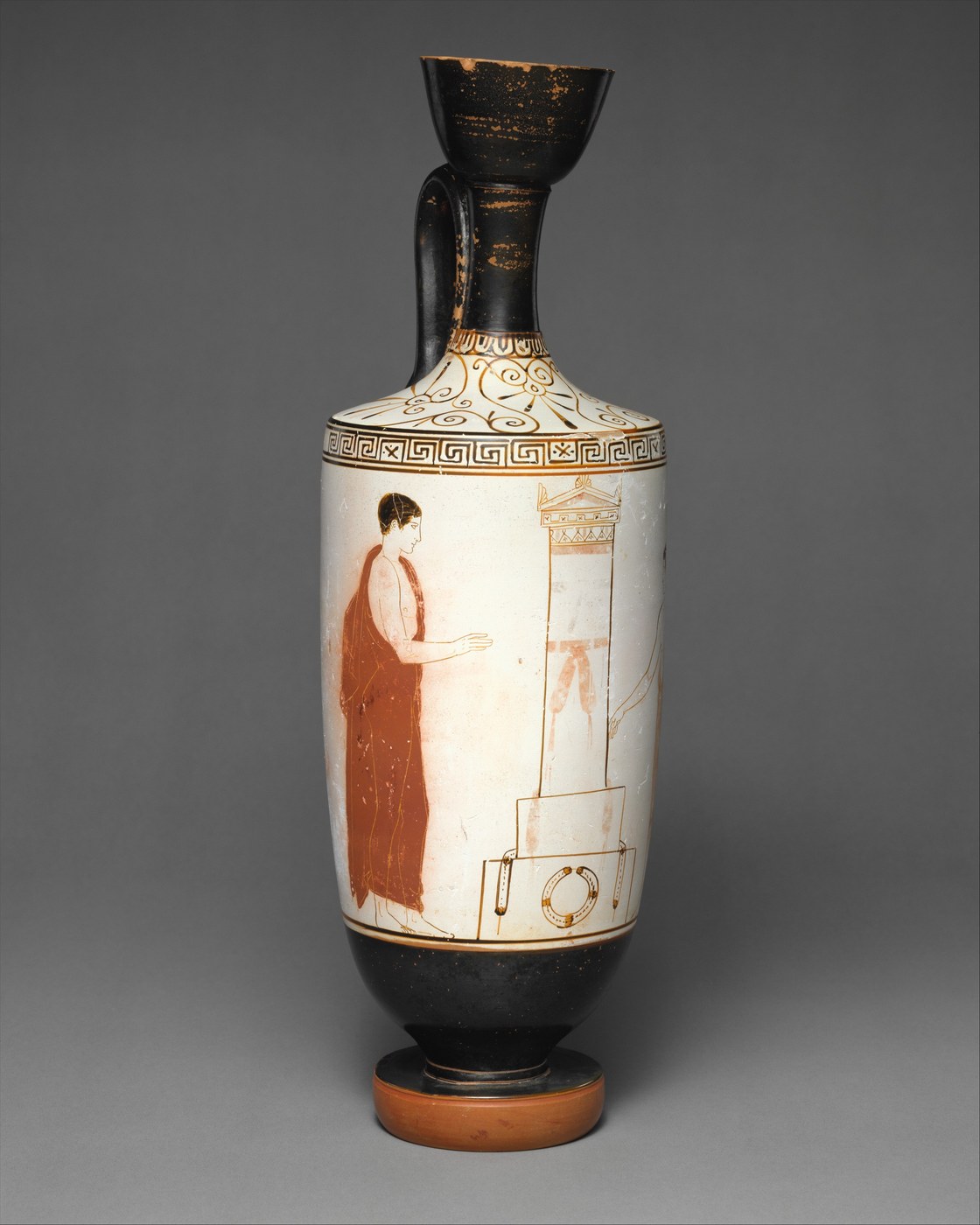
Terracotta lekythos attributed to the Achilles Painter, ca. 440 BCE. A funerary image of remembrance.
The Metropolitan Museum of Art. Gift of Norbert Schimmel Trust, 1989. Accession 1989.281.72. Public Domain (CC0). · Museum record ↗ · CC0
Judgment and later poetry
Plato’s underworld and the choice of a life
At the end of the Republic, Socrates tells the story of Er, a soldier who returns to life and reports what he has seen after death. Judges send souls towards rewards or punishments. Later, the souls gather before choosing their next lives. The choice becomes a test of what they have learned. [3]
The story connects the fate of a soul with justice and the capacity to judge a life well. Prestige, power or apparent good fortune can conceal disastrous choices. Responsibility rests with the chooser. Plato’s account makes the afterlife part of a philosophical argument about how to live, rather than merely adding landmarks to Homer’s narrative. Its sequence of judgment, recompense and renewed embodiment also shows how much could change between different Greek treatments of the dead. [3]
Virgil’s Roman journey below
Aeneid VI leads Aeneas through an underworld with distinct regions. Charon’s crossing, encounters with the dead, the punishments of Tartarus and the blessed fields belong to one extended journey. In Elysium, Aeneas meets Anchises, whose account joins purification and rebirth to a vision of Rome’s future. The poem adopts Greek material within a Roman story of ancestry and destiny. Its richly organized landscape is one influential version of the realm, not a key that makes every earlier Greek passage describe the same system. [4]
Sources
- Odyssey, Book XI ↗Homer, translated by Samuel Butler; Internet Classics ArchiveReturn to text ↑
- Death, Burial, and the Afterlife in Ancient Greece ↗Department of Greek and Roman Art, The Metropolitan Museum of Art, 2003Return to text ↑
- Republic, Book X: the Myth of Er ↗Plato, translated by Benjamin Jowett; philosophical narrativeReturn to text ↑
- Aeneid, Book VI ↗Virgil, translated by John Dryden; Roman epic receptionReturn to text ↑
- Terracotta lekythos (oil flask), 1989.281.72 ↗The Metropolitan Museum of Art; attributed to the Achilles Painter, ca. 440 BCEReturn to text ↑
About this article & its sources
Hades as a realm rather than a profile of its divine ruler. Selected literary accounts and funerary evidence retain their different settings; they are not assembled into one fixed ancient doctrine.
Passage attributions
What is Hades?
Passage 1: Department of Greek and Roman Art, The Metropolitan Museum of Art, 2003.
Passage 2: Department of Greek and Roman Art, The Metropolitan Museum of Art, 2003.
Odysseus among the shades
Passage 1: Homer, translated by Samuel Butler; Internet Classics Archive.
Burial and the obligations of the living
Passage 1: Department of Greek and Roman Art, The Metropolitan Museum of Art, 2003.
A mourner at the grave
Passage 1: The Metropolitan Museum of Art; attributed to the Achilles Painter, ca. 440 BCE.
Plato’s underworld and the choice of a life
Passage 1: Plato, translated by Benjamin Jowett; philosophical narrative.
Passage 2: Plato, translated by Benjamin Jowett; philosophical narrative.
Virgil’s Roman journey below
Passage 1: Virgil, translated by John Dryden; Roman epic reception.