Elysium
Discover Elysium and the Islands of the Blessed in Homer, Hesiod, Pindar and Virgil, tracing changing ideas of privilege, virtue and life after death.
In this article
What is Elysium?
Elysium is a blessed destination in Greek and Roman poetry, also known as the Elysian Fields. In Odyssey IV, Proteus tells Menelaus that the gods will convey him to a distant Elysian plain. Gentle winds replace harsh weather. His promised privilege is tied to his marriage to Helen and his resulting relationship with Zeus. [1]
Greek poetic visions
A promise made to Menelaus
This passage does not describe a reward available to everyone who lives well. Nor does Menelaus first die and undergo the judgment familiar from later accounts: he is promised an exceptional removal from ordinary mortal life. The particular recipient matters as much as the pleasant landscape. [1]
Hesiod’s Islands of the Blessed
Works and Days places some of the heroic generation on the Islands of the Blessed, far from ordinary human life, beside Ocean. There the earth supplies abundant fruit. The passage belongs within a poem that distinguishes successive kinds of humanity and considers their different fates. The heroes’ destination is part of that wider account. [2]
The island setting resembles the remoteness and ease of Homer’s Elysian plain, but resemblance does not settle every detail. One poem speaks of Menelaus and a plain; the other gives a privileged dwelling to members of the heroic generation. Reading them together reveals a family of images: distance from ordinary suffering, divine favour and a land whose abundance removes the struggle for subsistence. Keeping their differences visible is more illuminating than turning the islands into a province on a single reconstructed map. [2]
Pindar and the ethical afterlife
Pindar’s Olympian 2 gives conduct afterlife consequences. In the translated passage discussed by Henry Spelman, the good enjoy an existence freed from exhausting labour and tears, while others suffer. The blessed life accompanies the company of honoured gods and fidelity to oaths. The contrast makes moral action central to the poem’s religious imagination. [3]
Spelman argues that the ode combines circulating ideas to create a distinctive vision. Its language can be read as religious without reducing the poem to a coded statement of one sect’s doctrine. This matters because descriptions of Elysium are often compressed into a tidy progression from heroic privilege to moral reward. The individual texts are richer than that outline: genre, audience and poetic purpose help shape what blessedness means in each account. Pindar’s victory ode gives ethical excellence a place within the cosmos it creates. [3]
The blessed fields in Virgil
Virgil places the blessed fields within Aeneas’s journey through the realm of the dead. Here souls enjoy music, exercise and a transformed landscape with its own light. Aeneas finds Anchises, and the meeting becomes a lesson about purification, the soul and future lives. [4]
Anchises’s explanation includes cleansing and, for souls destined to return, forgetfulness before rebirth. Elysium therefore participates in a larger movement through death and renewed life. The episode also leads towards Rome’s future. Its blessed landscape carries a Roman poem’s concerns with memory, descent and the generations yet to come. [4]
The Elysian Fields on a Viennese stage
A 1678 etching turns the Elysian Fields into a theatrical landscape. Made by Mathäus Küsel after Ludovico Ottavio Burnacini, it belongs to a series of designs for La Monarchia Latina Trionfante, an opera staged in Vienna to celebrate the birth of Archduke Joseph. The avenue of trees, musicians and figures in clouds place blessed existence within the visual language of a court performance. This is a seventeenth-century reception of Elysium, alongside the distinct ancient poetic accounts above. [5]
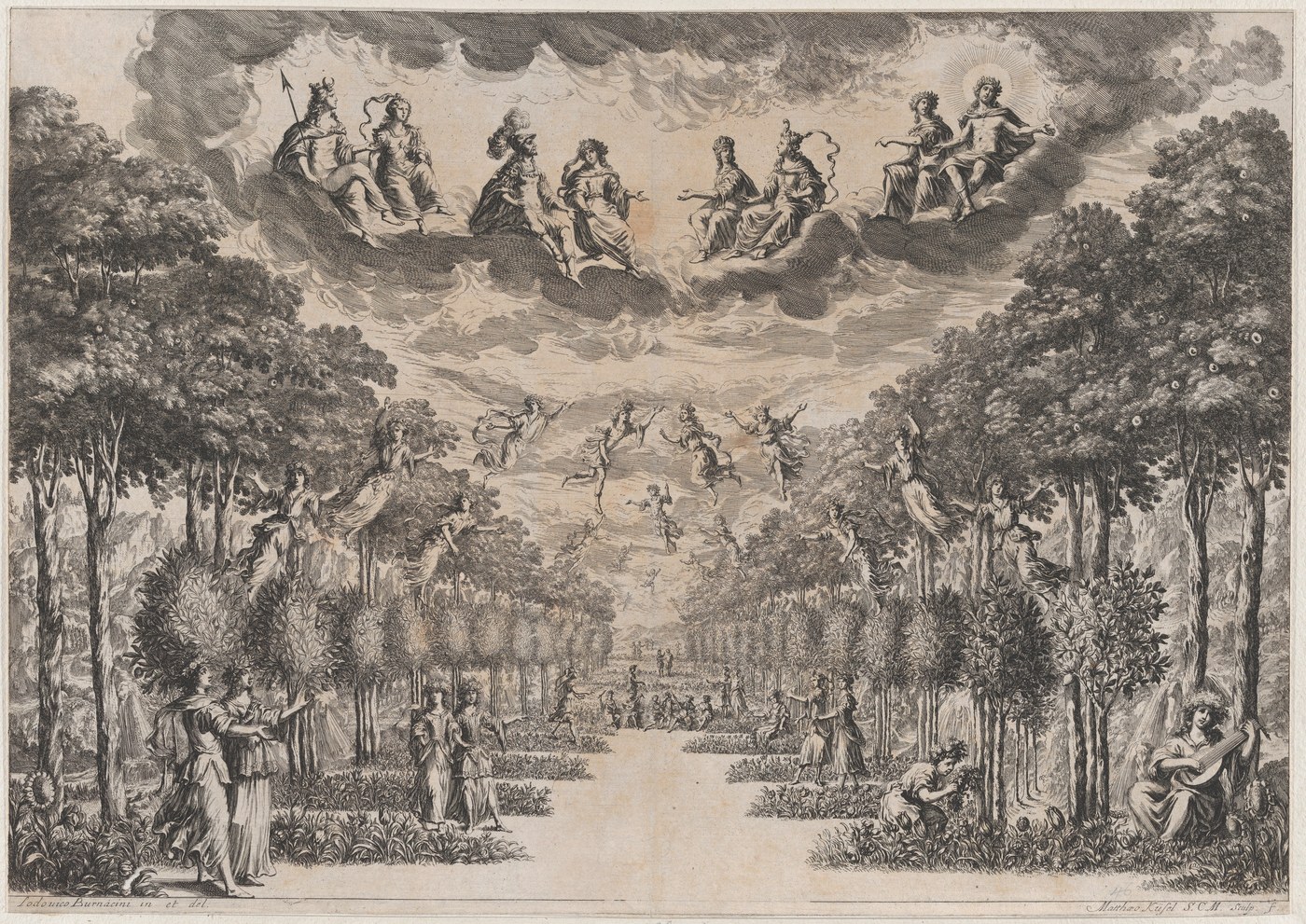
Mathäus Küsel, after Ludovico Ottavio Burnacini, The Elysian Fields; set design from La Monarchia Latina Trionfante, 1678. Etching.
The Metropolitan Museum of Art. Harris Brisbane Dick Fund, 1953. Accession 53.600.3581. Public Domain (CC0). · Museum record ↗ · CC0
Sources
- Odyssey, Book IV ↗Homer, translated by Samuel Butler; Menelaus and the Elysian plainReturn to text ↑
- Works and Days, lines 156–173 ↗Hesiod, translated by Gregory Nagy; Kosmos Society sourcebook, lines 156–173, PDF page 8.Return to text ↑
- Ethics, audience and eschatology in Pindar’s Olympian 2 ↗Henry Spelman, Journal of Hellenic Studies 144 (2024), 48–64; open-access research and translated passagesReturn to text ↑
- Aeneid, Book VI ↗Virgil, translated by John Dryden; Roman epicReturn to text ↑
- The Elysian Fields; set design from 'La Monarchia Latina Trionfante' ↗The Metropolitan Museum of Art; accession 53.600.3581Return to text ↑
About this article & its sources
Selected Greek and Roman literary visions of blessed existence. Elysium and the Islands of the Blessed are related traditions whose geography, inhabitants and conditions of admission vary by text.
Passage attributions
What is Elysium?
Passage 1: Homer, translated by Samuel Butler; Menelaus and the Elysian plain.
A promise made to Menelaus
Passage 1: Homer, translated by Samuel Butler; Menelaus and the Elysian plain.
Hesiod’s Islands of the Blessed
Passage 1: Hesiod; heroic generation and the Islands of the Blessed. Relevant indexed passage inspected; full live page unavailable..
Passage 2: Hesiod; heroic generation and the Islands of the Blessed. Relevant indexed passage inspected; full live page unavailable..
Pindar and the ethical afterlife
Passage 1: Henry Spelman, Journal of Hellenic Studies 144 (2024), 48–64; open-access research and translated passages.
Passage 2: Henry Spelman, Journal of Hellenic Studies 144 (2024), 48–64; open-access research and translated passages.
The blessed fields in Virgil
Passage 1: Virgil, translated by John Dryden; Roman epic.
Passage 2: Virgil, translated by John Dryden; Roman epic.
The Elysian Fields on a Viennese stage
Passage 1: Inspected object, collection record and actual historical image.