Greek Gods Family Tree: From Chaos to the Olympians
Follow the Greek gods from Gaia and Uranus through the Titans to Zeus and the Olympians. Compare rival accounts of Athena and Aphrodite’s origins.
In this article
The Olympian family at a glance
Follow the generations in Hesiod. Select a branch for its source passages and variations.
From earth and sky
The children of the Titans
Branches of the Olympian family
From Chaos to Gaia, Uranus and the Titans
Hesiod’s Theogony begins with Chaos and then brings in Gaia, Tartarus and Eros. The poem opens with an order of appearance. A family tree starts to branch when it tells us who gives birth to whom. Gaia produces Uranus, the sky, and later bears the Titans with him. Oceanus, Rhea and Cronus belong to that generation, alongside other children who have their own stories. [1]
Cronus overthrows Uranus with Gaia’s help. He then swallows the children he has with Rhea because he expects a child to overthrow him in turn. Rhea hides Zeus and gives Cronus a wrapped stone. Zeus grows up and his siblings return. This succession of Uranus, Cronus and Zeus is what gives the first half of the family tree its direction. [1]
The six children of Cronus and Rhea
Hestia, Demeter, Hera, Hades, Poseidon and Zeus are siblings. Hera also becomes Zeus’s wife. Hades belongs to this immediate family and rules the dead. Many familiar lists of Olympians leave him out because his home is below the earth. A list of twelve Olympians and a genealogy answer different questions. [1]
Follow Hades into the Compendium for the separate stories connected to the realm of the dead. On this tree his place is straightforward: he stands in the same generation as Zeus and Poseidon. [1]
Zeus’s children and the Olympian branches
- Hera and Zeus. Hesiod gives this pair Hebe, Ares and Eileithyia. The same poem gives Hera an account of Hephaestus’s birth without a father, so the smith belongs on a specially labelled branch. [1]
- Demeter and Zeus. Their daughter Persephone belongs to the next generation. Zeus’s brother Hades takes her to the underworld, connecting the two sides of the tree. [1]
- Leto and Zeus. Apollo and Artemis are children of Leto. Leto is herself a daughter of the Titans Coeus and Phoebe, so the pair connects two lines of Titans’ descendants. [1]
- Maia and Zeus. Their child is Hermes. Maia is a daughter of Atlas, who belongs to the lineage of the Titan Iapetus. [1]
- Semele and Zeus. Their son is Dionysus. Hesiod says Semele was mortal and gives both mother and son a place among the immortals. [1]
- Metis and Zeus. Zeus swallows Metis while she is pregnant. Hesiod later describes Athena springing from Zeus’s head. Set the pregnancy and the visible birth side by side when drawing her branch. [1][3]
Why Aphrodite and Athena look different across family trees
Hesiod places Aphrodite’s birth after Cronus wounds Uranus. She comes ashore from the sea foam. In Iliad 5, the injured Aphrodite takes refuge with Dione, her mother, and the poem associates her with Zeus as father. A single unlabelled parent line obscures a real choice between sources. [1][2]
Look for the small armed Athena on the painted cup. The artist shows her appearing in the immediate presence of Zeus, a moment an audience could recognise without seeing the earlier story of Metis. Keep the cup, Hesiod’s genealogy and Homer’s scene distinct when explaining what each witness shows. [1][3]
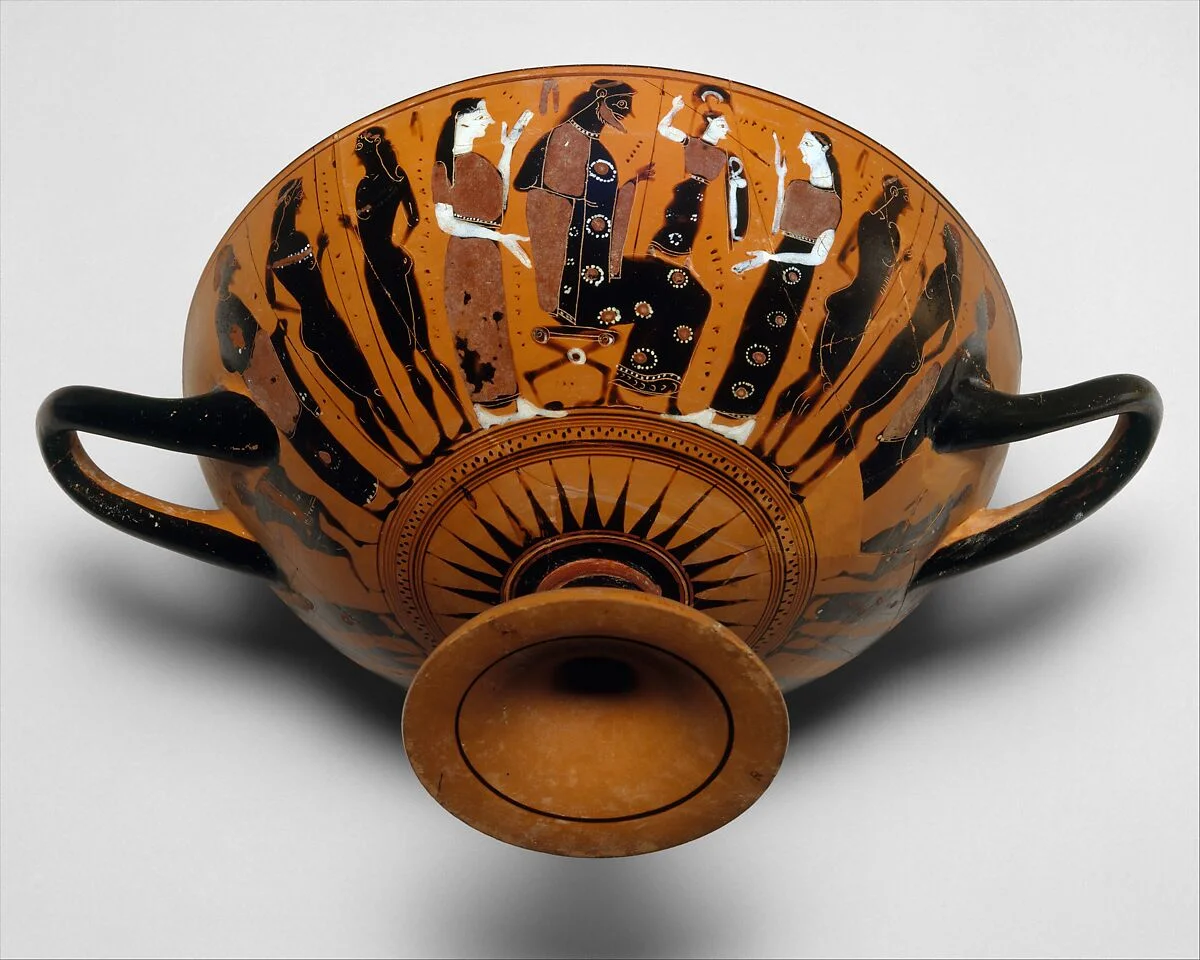
The Birth of Athena on an Attic kylix attributed to the Painter of the Nicosia Olpe, ca. 550 BCE.
The Metropolitan Museum of Art. Rogers Fund, 1906. Accession 06.1097. Public domain. · Image source ↗ · Public Domain
Sources
See references (3)
- Hesiod, Theogony, lines 116–210, 453–506 and 886–944 ↗Center for Hellenic Studies translation of Hesiod’s TheogonyReturn to text ↑
- Homer, Iliad 5: Aphrodite and Dione ↗Homer, Iliad Book 5, translated by A. T. MurrayReturn to text ↑
- The birth of Athena, Attic black-figure kylix ↗The Metropolitan Museum of Art, 06.1097, public domainReturn to text ↑