Greek and Roman Gods: An Illustrated Comparison Chart
Compare 15 Greek and Roman gods by name, role, and image. See where Greek stories, Roman worship, and familiar symbols tell different parts of the story.
In this article
Look up the Greek and Roman names
Search either name or a shared role. Open a pairing for examples from texts, worship or art.
Zeus Jupiter
Sky, lightning and authority
Jupiter’s promise in the Aeneid places Rome’s future inside a story about divine rule.
Read about Zeus and JupiterHera Juno
Marriage and royal authority
Virgil makes Juno the protector of Carthage and an opponent of the Trojans’ arrival in Italy.
Read about Hera and JunoPoseidon Neptune
Sea and waters
The sea god’s name changes in Latin epic, while Virgil gives Neptune a distinct part in restoring order after Juno’s storm.
Read about Poseidon and NeptuneDemeter Ceres
Grain and harvest
The Homeric Hymn takes Demeter to Eleusis. Cato addresses Ceres before a Roman harvest.
Read about Demeter and Ceres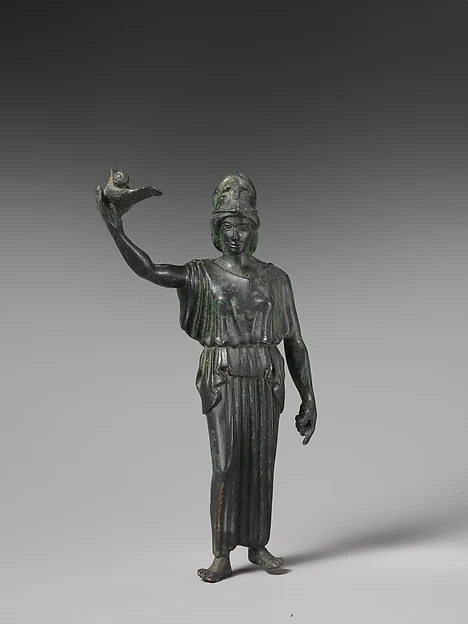
Athena Minerva
Crafts, judgment and strategy
Athena’s owl appears on Athenian coinage. Minerva also belongs to Rome’s Capitoline triad.
Read about Athena and MinervaApollo Apollo
Music, prophecy and healing
The name is shared. Virgil gives Apollo’s prophetess at Cumae a role in guiding Aeneas.
Read about Apollo and ApolloArtemis Diana
Hunting and wild places
Roman images often adopt the Greek huntress type. A particular sanctuary or inscription helps identify the local cult.
Read about Artemis and Diana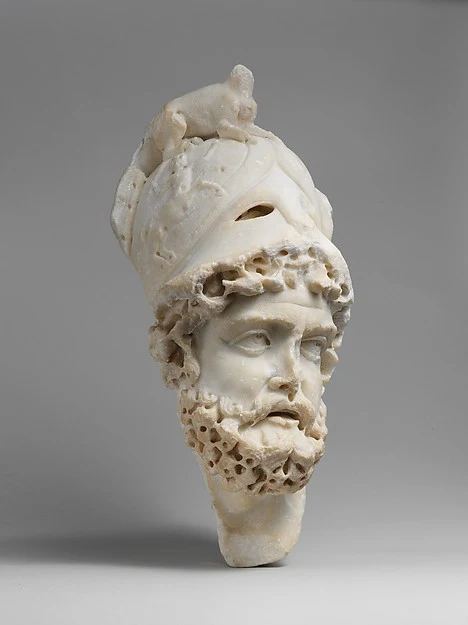
Ares Mars
War
Cato asks Mars to protect crops and livestock as well as the household.
Read about Ares and Mars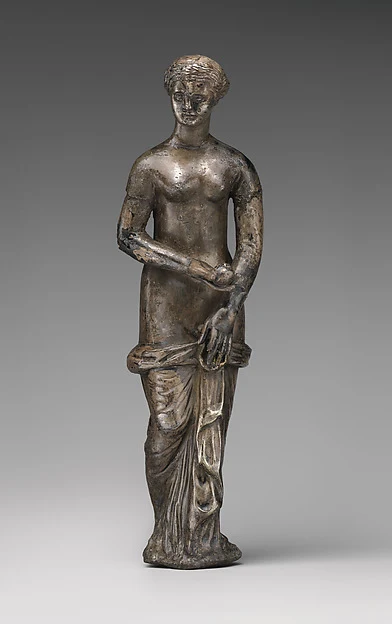
Aphrodite Venus
Love and desire
The apple links Venus to the judgment of Paris. Virgil’s Venus also pleads for her son Aeneas and his descendants.
Read about Aphrodite and VenusHephaestus Vulcan
Fire and metalworking
The divine smith makes Achilles’s armor in Homer and Aeneas’s armor in Virgil.
Read about Hephaestus and VulcanHermes Mercury
Travel, messages and exchange
Hermes’s boundary pillars and the Roman emphasis on Mercury’s protection of merchants show differently documented uses.
Read about Hermes and MercuryDionysus Bacchus
Wine, festivals and theatre
A search for Roman Bacchus may also lead to rites called Bacchic. Study the evidence for the specific author, ritual or object.
Read about Dionysus and BacchusHestia Vesta
Hearth and sacred fire
Roman Vesta’s fire had a public home and attendants. The Greek hearth is the starting point for the comparison.
Read about Hestia and VestaHades Pluto or Dis
Rule of the underworld
Roman poems can call the ruler Dis, while Pluto appears on the later Rawson plate linked below.
Read about Hades and Pluto or DisPersephone Proserpina
The underworld queen and her return
Ovid’s story and the Greek hymn give different details about her return and time below.
Read about Persephone and Proserpina
How do Greek and Roman god names correspond?
Zeus corresponds to Jupiter, Athena to Minerva and Aphrodite to Venus. Those familiar pairings help when moving between Greek and Latin stories. Roman worship also drew on Italic and Etruscan traditions, and the same familiar figure can acquire a different public role or appear in a different local cult. Use the chart to find the names, then use the examples below to see what survives the comparison. [1][2][5]
Ask three questions about a pairing. Which story is being told? What is the person praying for? What evidence identifies the object? A poet, a farmer and a sculptor can give you three different answers about the same god. [6][10][17]
See references (6)
Zeus, Jupiter, Hera and the gods of the city
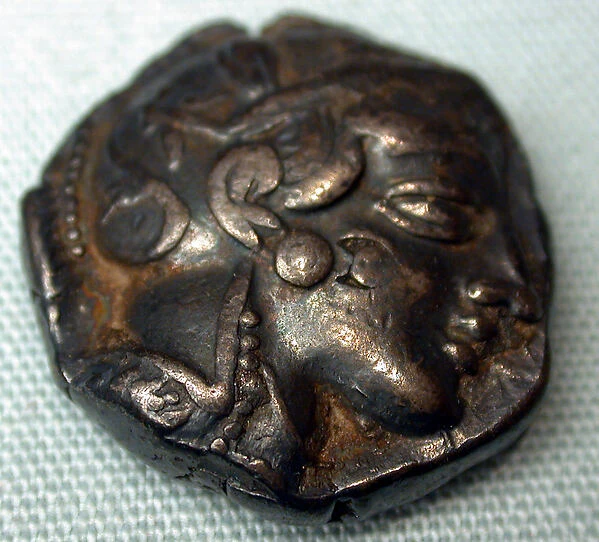
The obverse shows Athena. Her owl belongs on the reverse of this Athenian coin type.
Athenian silver tetradrachm, ca. 440–404 BC. The Metropolitan Museum of Art, Bequest of Nanette B. Kelekian, 2020, 2021.40.80. Open Access. · Image source ↗ · Public Domain
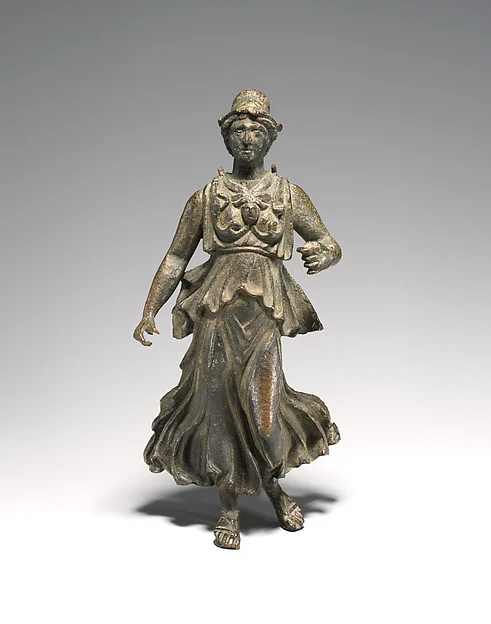
Minerva’s helmet and dress make the Greek comparison possible while the object’s Roman context supplies another part of its identity.
Roman bronze Minerva, 2nd century CE. The Metropolitan Museum of Art, Rogers Fund, 1919, 19.192.51. Open Access. · Image source ↗ · Public Domain
Why are Ares and Mars paired?
Both have a strong association with war. In the Iliad, Ares is wounded and goes to Zeus, who reproaches him for delighting in battle and conflict. In the Roman relief, Mars wears a helmet and the Met links the fragment tentatively to an imperial monument. The two sources describe different things: a divine combatant in Greek epic and a figure associated with Roman victory in public art. [6][17]
Cato’s farm prayer asks Father Mars for healthy people and animals and for crops and vineyards to thrive. Cato’s instructions have the sacrificial animals led around the farm. It gives you a concrete Roman use of the name that goes well beyond the battlefield. [10]
How does Venus take on a Roman role?
The Met’s Roman silver Venus holds an apple. Its catalogue connects the apple to the choice of Paris, where she appears with the goddesses known in Greek as Hera and Athena. Here Roman art preserves a Greek narrative clue. In the Aeneid, Venus also pleads for her son Aeneas. Jupiter’s answer puts her maternal role within the future the poem imagines for Rome. [20][7]
Demeter, Ceres and the names of the underworld
The Greek hymn links Demeter and Persephone’s story to Eleusis and its rites. Cato gives Ceres a different kind of appearance: she receives an offering before the harvest. Reading both shows the difference between a poem explaining sacred relationships and a farming manual describing what a household should do in a particular season. [12][11][3]
The Latin poem Ovid gives the ruler below the name Dis and tells of Proserpina’s abduction. Modern readers will also encounter Pluto and Proserpina together. Rawson’s later plate in the Lumitheca Reader is an exact example, with both names in the caption. In comparing the stories, keep track of what the individual source calls each figure and how it divides the daughter’s time above and below. [12][13][16]
What changes when a Roman poet retells a Greek story?
Apollo’s name needs no substitution, but his sanctuary and the person who speaks for him can change. Virgil brings Aeneas to Cumae to meet Apollo’s Sibyl. Earlier in the poem Neptune stills the storm that drove the Trojans off course. The move from Greek to Latin names helps identify the sea god, while the Latin narrative gives him his own place in the voyage. [7][8][1]
Hephaestus makes Achilles’s shield in the Iliad. In the Aeneid, Venus asks Vulcan to arm Aeneas, and the finished shield includes scenes from Rome’s future. Pairing the smiths lets you recognise the reused episode. Reading the two ekphrases, or descriptions of works of art, shows how the second shield changes the time and political meaning of what the hero carries. [6][9]
See references (5)
How can you tell who a sculpture represents?
A huntress wearing short clothing and carrying a bow can evoke Artemis or Diana. An object’s date, findspot, inscription and original use give the image a firmer identity. The same caution applies to Hermes and Mercury. Herms served as boundary and doorway markers in the Greek and Roman worlds, while the Met’s Roman guide also points to Mercury’s protection of merchants. [1][2][4]
A title such as Bacchus can point to the wine god identified with Greek Dionysus, while inscriptions and archaeological finds may tell us about specific rites. The Met’s account of Bacchic and Orphic inscriptions shows why grouping images under a divine name only begins the work of understanding worship. [2][3]
Where do Vesta, Janus and the Lares fit?
The paired hearth goddesses are Hestia and Vesta. Ovid describes Vesta through the continually tended fire, an example of the public importance a hearth can take on at Rome. He also gives Janus a voice and asks him to explain his form and his relation to gates. Janus’s story belongs beside the comparison chart because he has no simple matching figure in the usual Olympian pairings. [1][2][15][14]
The Lares bring the question back to an individual household. The bronze Lar shown here carries a drinking vessel and a shallow dish. It helps distinguish the small standing figure of a household protector from the large relief of Mars that may have belonged to a public monument. [2][18][17]
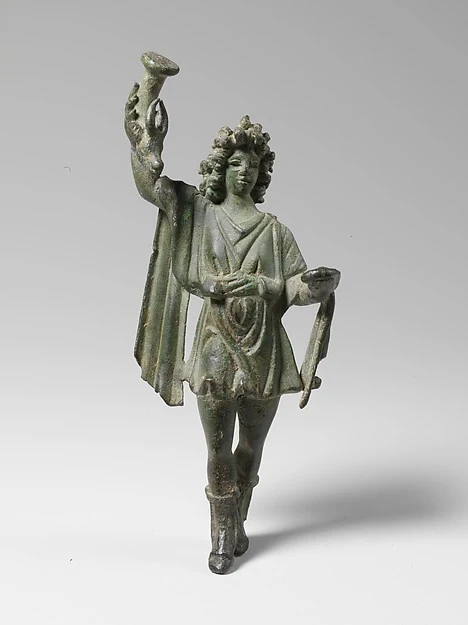
The raised vessel and shallow dish belong to a small Roman figure meant for household devotion.
Roman bronze Lar, ca. 1st century CE. The Metropolitan Museum of Art, Rogers Fund, 1922, 22.139.15. Open Access. · Image source ↗ · Public Domain
Read further in the library

The Eleusinian and Bacchic Mysteries
Reading note
Compare Rawson’s use of the names Pluto and Proserpina in an exact Reader plate.
Sources
See references (22)
- The Met · Greek Gods and Religious Practices ↗Department of Greek and Roman Art, The Met, essay on Greek gods and sanctuaries.Return to text ↑
- The Met · Roman Art, The Gods of the Romans ↗The Met’s Roman Art, A Resource for Educators, printed pages 76–77.Return to text ↑
- The Met · Mystery Cults in the Greek and Roman World ↗Department of Greek and Roman Art, The Met.Return to text ↑
- The Met · Retrospective Styles in Greek and Roman Sculpture ↗The Met’s account of herms and their use as markers.Return to text ↑
- The Met · Major Divinities in Greek, Etruscan and Roman Religion ↗The Met’s Etruscan Art catalogue, comparison table.Return to text ↑
- Homer, Iliad 5.840–909 and 18.468–617 · Ares and the shield of Achilles ↗Center for Hellenic Studies, Harvard University.Return to text ↑
- Virgil, Aeneid 1.1–156 and 223–296 · Juno, Neptune, Venus and Jupiter ↗A. S. Kline’s translation, Book I.Return to text ↑
- Virgil, Aeneid 6.1–155 · Apollo and the Sibyl ↗A. S. Kline’s translation, Book VI.Return to text ↑
- Virgil, Aeneid 8.370–453 and 608–731 · Vulcan and the shield of Aeneas ↗A. S. Kline’s translation, Book VIII.Return to text ↑
- Cato, On Agriculture 141 · Prayer to Mars ↗W. D. Hooper and H. B. Ash’s translation, University of Chicago LacusCurtius.Return to text ↑
- Cato, On Agriculture 134 · Offering to Ceres ↗W. D. Hooper and H. B. Ash’s translation, University of Chicago LacusCurtius.Return to text ↑
- Homeric Hymn to Demeter 1–32 and 360–482 · Abduction, return and rites ↗Gregory Nagy’s translation, Center for Hellenic Studies.Return to text ↑
- Ovid, Metamorphoses 5.385–571 · Dis, Proserpina and Ceres ↗A. S. Kline’s translation, University of Virginia Ovid Collection.Return to text ↑
- Ovid, Fasti 1.89–144 · Janus and the gates ↗James George Frazer’s translation, Theoi.Return to text ↑
- Ovid, Fasti 6.249–304 · Vesta’s fire ↗James George Frazer’s translation, Theoi.Return to text ↑
- A. L. Rawson · Pluto, Proserpina and the FuriesPlate in Thomas Taylor, The Eleusinian and Bacchic Mysteries, edited by Alexander Wilder. Lumitheca source leaf 13.Read this page in The Eleusinian and Bacchic Mysteries ↗Return to text ↑
- Roman relief fragment of Mars ↗Roman relief fragment of Mars, early 3rd century CE. The Metropolitan Museum of Art, Rogers Fund, 1918, 18.145.49. Open Access.Return to text ↑
- Roman bronze Lar ↗Roman bronze Lar, ca. 1st century CE. The Metropolitan Museum of Art, Rogers Fund, 1922, 22.139.15. Open Access.Return to text ↑
- Greek bronze Athena flying her owl ↗Greek bronze Athena flying her owl, ca. 460 BCE. The Metropolitan Museum of Art, Harris Brisbane Dick Fund, 1950, 50.11.1. Open Access.Return to text ↑
- Roman silver Venus ↗Roman silver Venus, 1st–2nd century CE. The Metropolitan Museum of Art, Gift of Christos G. Bastis, in honor of Philippe de Montebello, 1995, 1995.539.14. Open Access.Return to text ↑
- Roman bronze Minerva ↗Roman bronze Minerva, 2nd century CE. The Metropolitan Museum of Art, Rogers Fund, 1919, 19.192.51. Open Access.Return to text ↑
- Athenian silver tetradrachm ↗Athenian silver tetradrachm, ca. 440–404 BC. The Metropolitan Museum of Art, Bequest of Nanette B. Kelekian, 2020, 2021.40.80. Open Access.Return to text ↑