Spiritual Distance
Spiritual distance in Swedenborg changes with a person’s inward state. Compare his account of nearness with the journeys in two Spiritualist books.
In this article
What is spiritual distance?
Spiritual distance describes what makes people or places near or far in an account of unseen worlds. In Emanuel Swedenborg’s heaven, a change of inward state can bring two people into one another’s presence or make them vanish from view. [1][2][3][10][11][12][13][14]
Other writers ask whether it takes a decision, a guide, a vehicle or a journey on foot to reach a place. The way someone travels can tell a reader as much as the place they reach. [2][3][12][13][14]
See references (8)
- Heaven and Its Wonders and Hell, printed p. 141, Reader page 148
- Heaven and Its Wonders and Hell, printed p. 142, Reader page 149
- Heaven and Its Wonders and Hell, printed p. 143, Reader page 150
- Life and Labor in the Spirit World, printed p. 321, Reader page 322
- Life and Labor in the Spirit World, printed p. 322, Reader page 323
- Life and Labor in the Spirit World, printed p. 379, Reader page 380
- Life and Labor in the Spirit World, printed p. 383, Reader page 384
- Life and Labor in the Spirit World, printed p. 415, Reader page 416
Heaven and Its Wonders and Hell by Emanuel Swedenborg
Emanuel Swedenborg opens the space chapter of Heaven and Its Wonders and Hell by acknowledging the paradox: things appear in place and space, while angels do not think of space as people on earth do. In §192, changes of place are changes of the interiors. He says his spirit travelled while his body remained where it was. [1]
In §194, intense desire for another’s presence brings a person into a corresponding state. Aversion produces separation. People visible to one another while in agreement can disappear from one another when their states diverge. The explanation makes visibility relational rather than simply optical. [2]
To someone eager to arrive, the path seems short. To someone unwilling, it seems long. Swedenborg compares the first experience to thinking of something with such attention that it seems present. [2][3]
He then interprets scriptural dimensions through good, truth and their degrees. The measures of the New Jerusalem become qualities of a church rather than an architectural specification. Spatial interpretation is therefore part of his reading of scripture as well as his description of heavenly experience. [3][4]
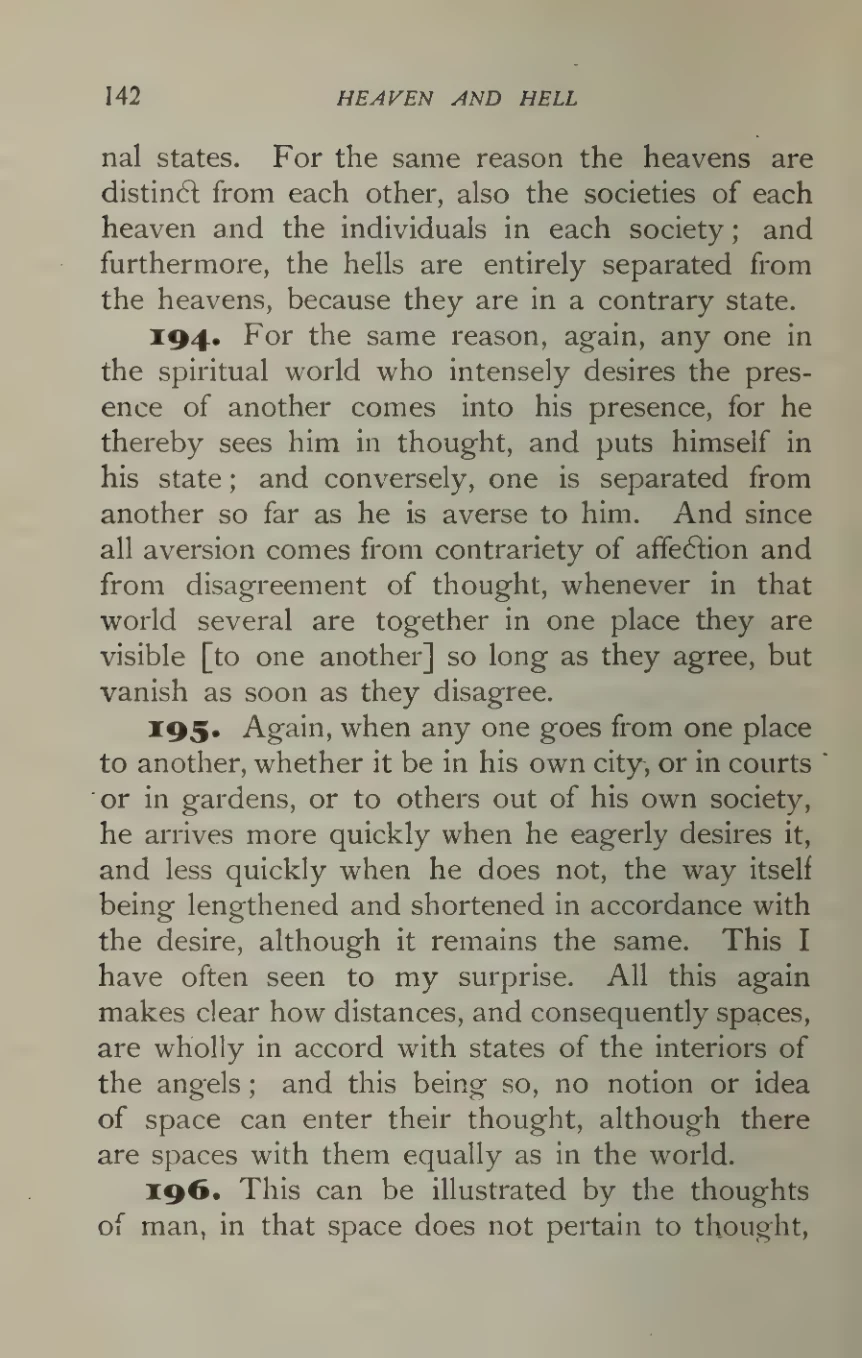
Heaven and Its Wonders and Hell (1916), printed p. 142, Library Reader page 149. Section 194 connects presence with desire and agreement.
Emanuel Swedenborg, Heaven and Its Wonders and Hell, J. C. Ager translation, New York, 1916. Public-domain historical page from the checksum-verified Library PDF. · Image source ↗ · Public Domain
A Wanderer in the Spirit Lands: Franchezzo, transcribed by A. Farnese
Franchezzo, in the narrative transcribed by A. Farnese, cannot simply float through the Mountains of Selfish Oppression. Entering the region’s conditions limits his movement. He and a former pirate use a rope, climbing and coordinated effort to bring some prisoners out of pits. [5][6][7]
Life and Labor in the Spirit World: Shelhamer’s spirit-band
Life and Labor in the Spirit World, credited to the medium M. T. Shelhamer’s spirit-band, describes several ways of moving through spiritual surroundings. In Spirit May’s account, children use vehicles and also develop an ability to move through will. The discussion makes acquired confidence and practice part of the picture, instead of assigning every inhabitant an identical immediate capacity. [9][10][11]
The contribution attributed to John Critchley Prince describes concentrating his will on a desired place and travelling with a guide. Other journeys are taken slowly on foot so that the travellers can enjoy what they see. The narrative can therefore retain a route as a pleasure even where another manner of arrival is possible. [12][13]
A later scene starts with homesickness. Prince says that he can now reach a desired place at once. He arrives to find his mother saying that she has been calling for him all day. The story lets the reader see the same encounter from the two ends of the journey. [14][15]
See references (7)
- Life and Labor in the Spirit World, printed p. 278, Reader page 279
- Life and Labor in the Spirit World, printed p. 321, Reader page 322
- Life and Labor in the Spirit World, printed p. 322, Reader page 323
- Life and Labor in the Spirit World, printed p. 379, Reader page 380
- Life and Labor in the Spirit World, printed p. 383, Reader page 384
- Life and Labor in the Spirit World, printed p. 415, Reader page 416
- Life and Labor in the Spirit World, printed p. 416, Reader page 417
The Divine Comedy by Dante Alighieri
Dante gives descent a physical shape in Inferno XVII. The pilgrim rides on Geryon and feels the terror of the plunge. The illustrated episode makes otherworldly distance felt as a height the traveller has to descend. [16][8]
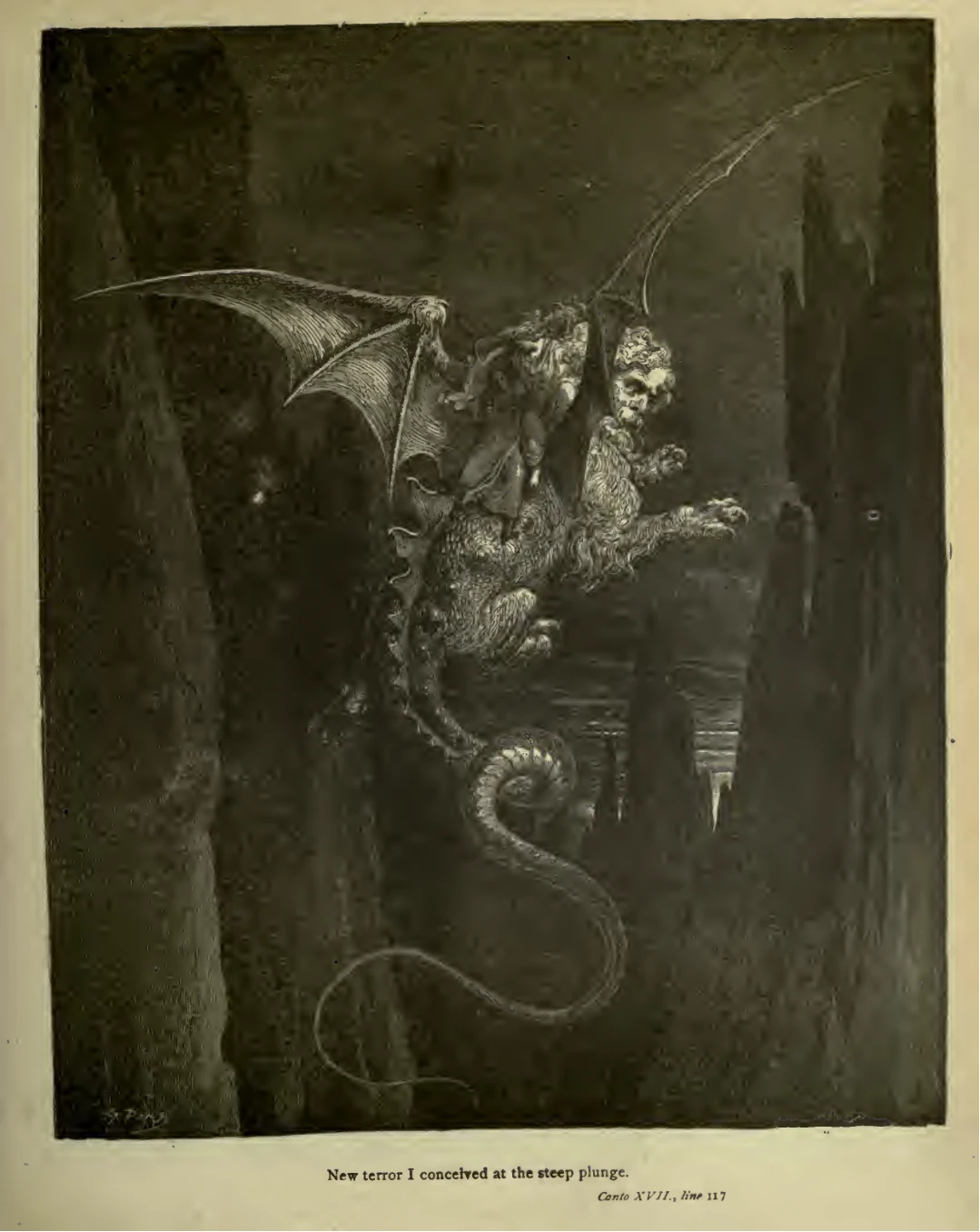
Gustave Doré, Inferno XVII. Dante and Virgil descend on Geryon.
Inferno, undated New Edition. Dante Alighieri, translated by Henry Francis Cary, designs by Gustave Doré. Thompson & Thomas, Chicago. Historical text and original designs Public Domain. · Image source ↗ · Public Domain
See references (2)
What makes a place easier to reach?
For Swedenborg, affinity can make two people present to each other. Prince describes directing his will towards a destination and sometimes choosing a slower walk to enjoy what he sees. Affection shapes both accounts, and in Prince’s a traveller can still choose what to do along the way. [1][2][4][3][12][13][14]
Franchezzo and his companion have to climb and lower a rope in the Mountains of Selfish Oppression. In that scene, the restriction gives their cooperation a purpose. The journey matters because reaching another person takes work. [1][2][5][6][7][3]
See references (10)
- Heaven and Its Wonders and Hell, printed p. 141, Reader page 148
- Heaven and Its Wonders and Hell, printed p. 142, Reader page 149
- Heaven and Its Wonders and Hell, printed p. 143, Reader page 150
- Heaven and Its Wonders and Hell, printed p. 144, Reader page 151
- A Wanderer in the Spirit Lands, printed p. 170, Reader page 179
- A Wanderer in the Spirit Lands, printed p. 171, Reader page 180
- A Wanderer in the Spirit Lands, printed p. 172, Reader page 181
- Life and Labor in the Spirit World, printed p. 379, Reader page 380
- Life and Labor in the Spirit World, printed p. 383, Reader page 384
- Life and Labor in the Spirit World, printed p. 415, Reader page 416
Read further in the library

Heaven and Its Wonders and Hell
Reading note
The separately titled account draws on exact passages in the consulted Library edition.

A Wanderer in the Spirit Lands
Reading note
Separately attributed comparison with exact previously researched Library passages.
Dante's Inferno
Reading note
Separately attributed primary Library account, cited on exact verified Reader leaves.
Life and Labour in the Spirit World
Reading note
The separately titled account draws on exact passages in the consulted Library edition.
Sources
See references (16)
- Heaven and Its Wonders and Hell, printed p. 141, Reader page 148Emanuel Swedenborg, Heaven and Its Wonders and Hell, From Things Heard and Seen, translated by J. C. Ager. American Swedenborg Printing and Publishing Society, New York, 1916. Latin original first published in 1758. Numbered sections and exact pages refer to this consulted edition. Claims of spiritual experience remain attributed.Read this page in Heaven and Its Wonders and Hell ↗Return to text ↑
- Heaven and Its Wonders and Hell, printed p. 142, Reader page 149Emanuel Swedenborg, Heaven and Its Wonders and Hell, From Things Heard and Seen, translated by J. C. Ager. American Swedenborg Printing and Publishing Society, New York, 1916. Latin original first published in 1758. Numbered sections and exact pages refer to this consulted edition. Claims of spiritual experience remain attributed.Read this page in Heaven and Its Wonders and Hell ↗Return to text ↑
- Heaven and Its Wonders and Hell, printed p. 143, Reader page 150Emanuel Swedenborg, Heaven and Its Wonders and Hell, From Things Heard and Seen, translated by J. C. Ager. American Swedenborg Printing and Publishing Society, New York, 1916. Latin original first published in 1758. Numbered sections and exact pages refer to this consulted edition. Claims of spiritual experience remain attributed.Read this page in Heaven and Its Wonders and Hell ↗Return to text ↑
- Heaven and Its Wonders and Hell, printed p. 144, Reader page 151Emanuel Swedenborg, Heaven and Its Wonders and Hell, From Things Heard and Seen, translated by J. C. Ager. American Swedenborg Printing and Publishing Society, New York, 1916. Latin original first published in 1758. Numbered sections and exact pages refer to this consulted edition. Claims of spiritual experience remain attributed.Read this page in Heaven and Its Wonders and Hell ↗Return to text ↑
- A Wanderer in the Spirit Lands, printed p. 170, Reader page 179A Wanderer in the Spirit Lands, attributed to the spirit Franchezzo and transcribed by A. Farnese. W. J. Sinkins, London. Title page undated; preface dated 1896. The narrator’s experiences and the guides’ explanations are reported claims, not independently established observations.Read this page in A Wanderer in the Spirit Lands ↗Return to text ↑
- A Wanderer in the Spirit Lands, printed p. 171, Reader page 180A Wanderer in the Spirit Lands, attributed to the spirit Franchezzo and transcribed by A. Farnese. W. J. Sinkins, London. Title page undated; preface dated 1896. The narrator’s experiences and the guides’ explanations are reported claims, not independently established observations.Read this page in A Wanderer in the Spirit Lands ↗Return to text ↑
- A Wanderer in the Spirit Lands, printed p. 172, Reader page 181A Wanderer in the Spirit Lands, attributed to the spirit Franchezzo and transcribed by A. Farnese. W. J. Sinkins, London. Title page undated; preface dated 1896. The narrator’s experiences and the guides’ explanations are reported claims, not independently established observations.Read this page in A Wanderer in the Spirit Lands ↗Return to text ↑
- Dante’s Inferno, Reader page 120Dante Alighieri, The Divine Comedy, translated by Henry Francis Cary, designs by Gustave Doré. Inferno: undated New Edition, Thompson & Thomas, Chicago. Purgatory and Paradise: New Edition, Thompson & Thomas, Chicago, 1901. Canto arguments are editorial matter and are distinguished from the poem.Read this page in Dante's Inferno ↗Return to text ↑
- Life and Labor in the Spirit World, printed p. 278, Reader page 279Members of the Spirit-Band of Miss M. T. Shelhamer, Life and Labor in the Spirit World, Second Thousand, Boston: Colby & Rich, 1885. Exact Library edition IMJ-0202-E001. Parts I, II and III are respectively attributed to Spirit Violet, Spirit May and John Critchley Prince. Original metadata and retained Library PageRefs verified; consequential passages checked against actual Library facsimiles. Original Library PDF bytes remain unavailable.Read this page in Life and Labour in the Spirit World ↗Return to text ↑
- Life and Labor in the Spirit World, printed p. 321, Reader page 322Members of the Spirit-Band of Miss M. T. Shelhamer, Life and Labor in the Spirit World, Second Thousand, Boston: Colby & Rich, 1885. Exact Library edition IMJ-0202-E001. Parts I, II and III are respectively attributed to Spirit Violet, Spirit May and John Critchley Prince. Original metadata and retained Library PageRefs verified; consequential passages checked against actual Library facsimiles. Original Library PDF bytes remain unavailable.Read this page in Life and Labour in the Spirit World ↗Return to text ↑
- Life and Labor in the Spirit World, printed p. 322, Reader page 323Members of the Spirit-Band of Miss M. T. Shelhamer, Life and Labor in the Spirit World, Second Thousand, Boston: Colby & Rich, 1885. Exact Library edition IMJ-0202-E001. Parts I, II and III are respectively attributed to Spirit Violet, Spirit May and John Critchley Prince. Original metadata and retained Library PageRefs verified; consequential passages checked against actual Library facsimiles. Original Library PDF bytes remain unavailable.Read this page in Life and Labour in the Spirit World ↗Return to text ↑
- Life and Labor in the Spirit World, printed p. 379, Reader page 380Members of the Spirit-Band of Miss M. T. Shelhamer, Life and Labor in the Spirit World, Second Thousand, Boston: Colby & Rich, 1885. Exact Library edition IMJ-0202-E001. Parts I, II and III are respectively attributed to Spirit Violet, Spirit May and John Critchley Prince. Original metadata and retained Library PageRefs verified; consequential passages checked against actual Library facsimiles. Original Library PDF bytes remain unavailable.Read this page in Life and Labour in the Spirit World ↗Return to text ↑
- Life and Labor in the Spirit World, printed p. 383, Reader page 384Members of the Spirit-Band of Miss M. T. Shelhamer, Life and Labor in the Spirit World, Second Thousand, Boston: Colby & Rich, 1885. Exact Library edition IMJ-0202-E001. Parts I, II and III are respectively attributed to Spirit Violet, Spirit May and John Critchley Prince. Original metadata and retained Library PageRefs verified; consequential passages checked against actual Library facsimiles. Original Library PDF bytes remain unavailable.Read this page in Life and Labour in the Spirit World ↗Return to text ↑
- Life and Labor in the Spirit World, printed p. 415, Reader page 416Members of the Spirit-Band of Miss M. T. Shelhamer, Life and Labor in the Spirit World, Second Thousand, Boston: Colby & Rich, 1885. Exact Library edition IMJ-0202-E001. Parts I, II and III are respectively attributed to Spirit Violet, Spirit May and John Critchley Prince. Original metadata and retained Library PageRefs verified; consequential passages checked against actual Library facsimiles. Original Library PDF bytes remain unavailable.Read this page in Life and Labour in the Spirit World ↗Return to text ↑
- Life and Labor in the Spirit World, printed p. 416, Reader page 417Members of the Spirit-Band of Miss M. T. Shelhamer, Life and Labor in the Spirit World, Second Thousand, Boston: Colby & Rich, 1885. Exact Library edition IMJ-0202-E001. Parts I, II and III are respectively attributed to Spirit Violet, Spirit May and John Critchley Prince. Original metadata and retained Library PageRefs verified; consequential passages checked against actual Library facsimiles. Original Library PDF bytes remain unavailable.Read this page in Life and Labour in the Spirit World ↗Return to text ↑
- Inferno, Canto XVII, Reader page 123Dante Alighieri, translated by Henry Francis Cary.Read this page in Dante's Inferno ↗Return to text ↑