The Mountains of Selfish Oppression
The Mountains of Selfish Oppression hold prisoners in A Wanderer in the Spirit Lands. See how seamanship helps the rescuers and where their work has to stop.
In this article
Understanding the concept
The Mountains of Selfish Oppression are a region in A Wanderer in the Spirit Lands where spirits are trapped in pits. The book makes the confinement mirror suffering they once imposed on other people. [1][2][3]
The rescue calls for ordinary skills. A sailor works out how to make a rope and gets down to the people calling for help. Franchezzo has to work with him from above. [2]
A Wanderer in the Spirit Lands: Franchezzo, transcribed by A. Farnese
In the account attributed to Franchezzo and transcribed by A. Farnese, the travellers have to climb rather than move freely above the region. From higher ground they hear people in the pits below them. [1]
The former pirate draws on seamanship to reach the captives. Franchezzo takes the load from above. The work needs them to know what the other person can do and to trust them to do it. [2]
A light appears and a voice tells them when their permitted service is over. The explanation associates the pits with suffering the captives caused in other lives on earth. The language of self-created prisons makes the setting a consequence of conduct rather than an arbitrary dungeon. [3]
The same explanation refuses an unrestricted happy ending. Some prisoners still wish to hurt others and cannot yet be released. A desire for liberty has to become a desire to do good with it. The helpers must distinguish a cry for relief from the readiness to live differently. [3]
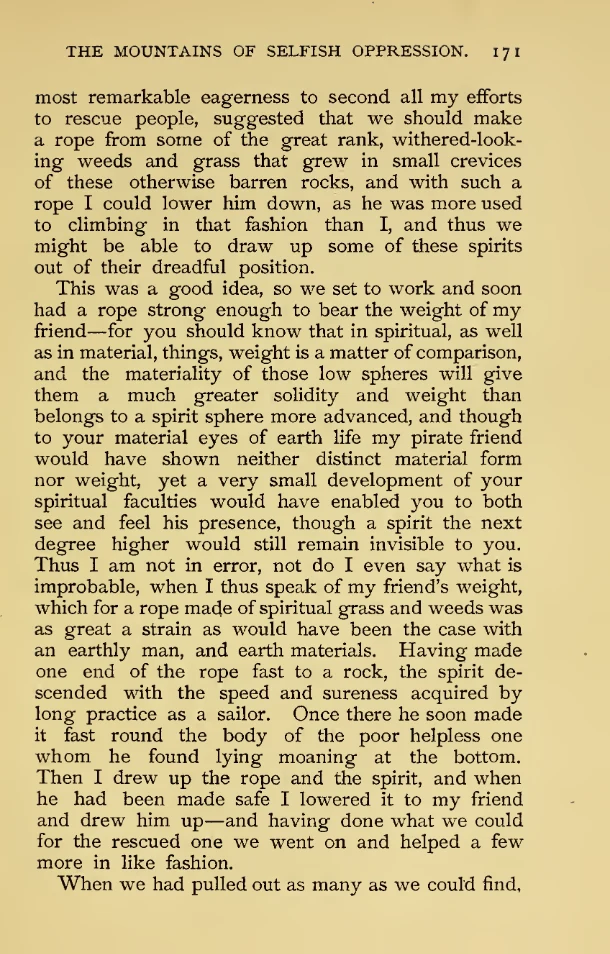
Source facsimile: A Wanderer in the Spirit Lands (1896), printed p. 171, Reader page 180.
A Wanderer in the Spirit Lands, W. J. Sinkins, London, preface dated 1896. Public-domain historical page from the checksum-verified Library PDF. · Image source ↗ · Public Domain
What the rescuers can do, and where they stop
The voice in the story explains the pits as a consequence of what their occupants did. The captives’ cries give the helpers a reason to respond. Whether someone still intends to harm others determines what the helpers are permitted to do. [3]
In the nearby Forest of Desolation the helpers find nobody they can yet reach. In the mountains they can answer some voices and have a way of getting to them. The two visits give the same wish to help different results. [2][3][4][5]
Read further in the library

A Wanderer in the Spirit Lands
Reading note
The separately titled account draws on exact passages in the consulted Library edition.
Sources
See references (5)
- A Wanderer in the Spirit Lands, printed p. 170, Reader page 179A Wanderer in the Spirit Lands, attributed to the spirit Franchezzo and transcribed by A. Farnese. W. J. Sinkins, London. Title page undated; preface dated 1896. The narrator’s experiences and the guides’ explanations are reported claims, not independently established observations.Read this page in A Wanderer in the Spirit Lands ↗Return to text ↑
- A Wanderer in the Spirit Lands, printed p. 171, Reader page 180A Wanderer in the Spirit Lands, attributed to the spirit Franchezzo and transcribed by A. Farnese. W. J. Sinkins, London. Title page undated; preface dated 1896. The narrator’s experiences and the guides’ explanations are reported claims, not independently established observations.Read this page in A Wanderer in the Spirit Lands ↗Return to text ↑
- A Wanderer in the Spirit Lands, printed p. 172, Reader page 181A Wanderer in the Spirit Lands, attributed to the spirit Franchezzo and transcribed by A. Farnese. W. J. Sinkins, London. Title page undated; preface dated 1896. The narrator’s experiences and the guides’ explanations are reported claims, not independently established observations.Read this page in A Wanderer in the Spirit Lands ↗Return to text ↑
- A Wanderer in the Spirit Lands, printed p. 173, Reader page 182A Wanderer in the Spirit Lands, attributed to the spirit Franchezzo and transcribed by A. Farnese. W. J. Sinkins, London. Title page undated; preface dated 1896. The narrator’s experiences and the guides’ explanations are reported claims, not independently established observations.Read this page in A Wanderer in the Spirit Lands ↗Return to text ↑
- A Wanderer in the Spirit Lands, printed p. 174, Reader page 183A Wanderer in the Spirit Lands, attributed to the spirit Franchezzo and transcribed by A. Farnese. W. J. Sinkins, London. Title page undated; preface dated 1896. The narrator’s experiences and the guides’ explanations are reported claims, not independently established observations.Read this page in A Wanderer in the Spirit Lands ↗Return to text ↑