The Forest of Desolation
The Forest of Desolation traps spirits in a hostile woodland. A failed rescue in A Wanderer in the Spirit Lands shows why willingness to help matters.
In this article
Understanding the concept
The Forest of Desolation is a woodland in A Wanderer in the Spirit Lands where branches and roots hold people prisoner. Franchezzo is told the captives once took pleasure in watching others suffer. [1][2][3]
He tries to find out whether a rescue is possible. The answer turns the question back on the captives: would any of them bear a hardship for someone else? [2][3]
A Wanderer in the Spirit Lands: Franchezzo, transcribed by A. Farnese
In Franchezzo’s account, transcribed by A. Farnese, the forest follows the Mountains of Selfish Oppression. Leafless trees give way to grasping branches, rope-like roots, clinging slime and entangling moss. The landscape appears to act against those caught within it. [1][2]
Threatening animals come near without being able to touch the prisoners. The account associates the place with people who enjoyed spectacles of cruelty and the pain of others. Its setting reverses the relation between secure spectator and exposed sufferer. [2]
Franchezzo asks whether help is possible. The answer makes mercy towards another person the necessary opening: a willingness to bear something for someone else would change the condition. Yet he is told that nobody there is presently ready for the help available. [2][3]
Franchezzo has to leave without freeing anyone. The guide’s answer leaves open the possibility that a captive may eventually be ready to do something for another person. [3]
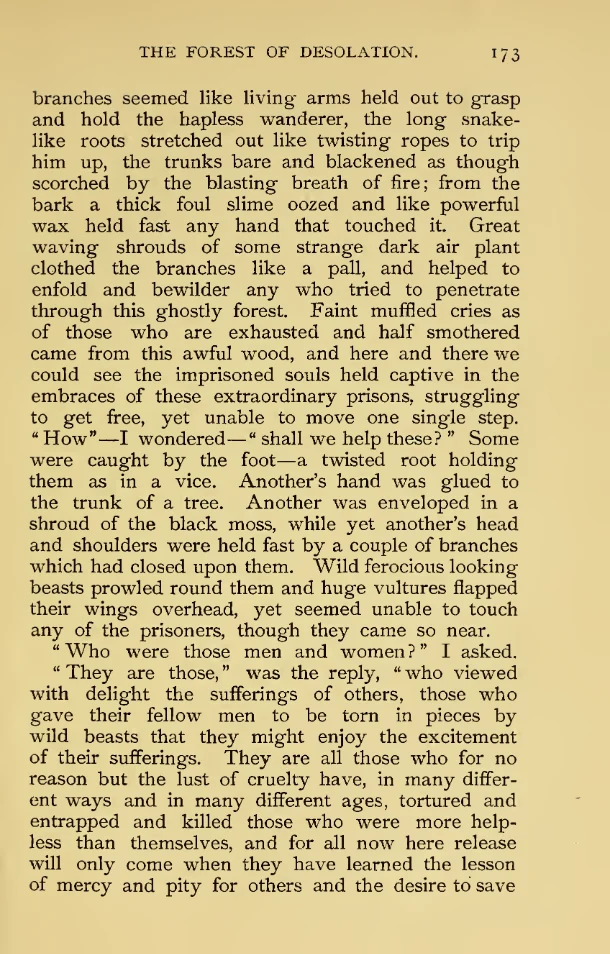
A Wanderer in the Spirit Lands (1896), printed p. 173, Library Reader page 182. The branches, roots and growths make the woodland itself a prison.
A Wanderer in the Spirit Lands, W. J. Sinkins, London, preface dated 1896. Public-domain historical page from the checksum-verified Library PDF. · Image source ↗ · Public Domain
Why the forest resists rescue
In the preceding mountain episode, a rope and two cooperating rescuers can reach some captives. In the forest, the obstacle is the absence of somebody ready to respond. The two scenes ask what help can accomplish under different conditions. [4][1][2][3]
The story makes the forest an answer to its own question about how cruelty continues after death. Its reversal puts the former spectator in the place of someone who needs mercy. [2][3]
Read further in the library

A Wanderer in the Spirit Lands
Reading note
The separately titled account draws on exact passages in the consulted Library edition.
Sources
See references (4)
- A Wanderer in the Spirit Lands, printed p. 172, Reader page 181A Wanderer in the Spirit Lands, attributed to the spirit Franchezzo and transcribed by A. Farnese. W. J. Sinkins, London. Title page undated; preface dated 1896. The narrator’s experiences and the guides’ explanations are reported claims, not independently established observations.Read this page in A Wanderer in the Spirit Lands ↗Return to text ↑
- A Wanderer in the Spirit Lands, printed p. 173, Reader page 182A Wanderer in the Spirit Lands, attributed to the spirit Franchezzo and transcribed by A. Farnese. W. J. Sinkins, London. Title page undated; preface dated 1896. The narrator’s experiences and the guides’ explanations are reported claims, not independently established observations.Read this page in A Wanderer in the Spirit Lands ↗Return to text ↑
- A Wanderer in the Spirit Lands, printed p. 174, Reader page 183A Wanderer in the Spirit Lands, attributed to the spirit Franchezzo and transcribed by A. Farnese. W. J. Sinkins, London. Title page undated; preface dated 1896. The narrator’s experiences and the guides’ explanations are reported claims, not independently established observations.Read this page in A Wanderer in the Spirit Lands ↗Return to text ↑
- A Wanderer in the Spirit Lands, printed p. 171, Reader page 180A Wanderer in the Spirit Lands, attributed to the spirit Franchezzo and transcribed by A. Farnese. W. J. Sinkins, London. Title page undated; preface dated 1896. The narrator’s experiences and the guides’ explanations are reported claims, not independently established observations.Read this page in A Wanderer in the Spirit Lands ↗Return to text ↑