Sannyasa
Sannyasa is renunciation in Hindu religious life. Compare the Bhagavad Gita’s inward freedom, the Tantra’s rites and Vivekananda’s account of vocation.
In this article
Understanding the concept
Sannyasa is renunciation in Hindu religious life. It can name the vocation of leaving household life for spiritual practice. The Bhagavad Gita also asks when a person who continues to act can be called a renunciant. [1][5][6][7][8]
A sannyasin is a person who has undertaken renunciation. The texts approach that change through a ritual passage, a way of life or freedom from depending on the rewards of action. [6][9][7][8]
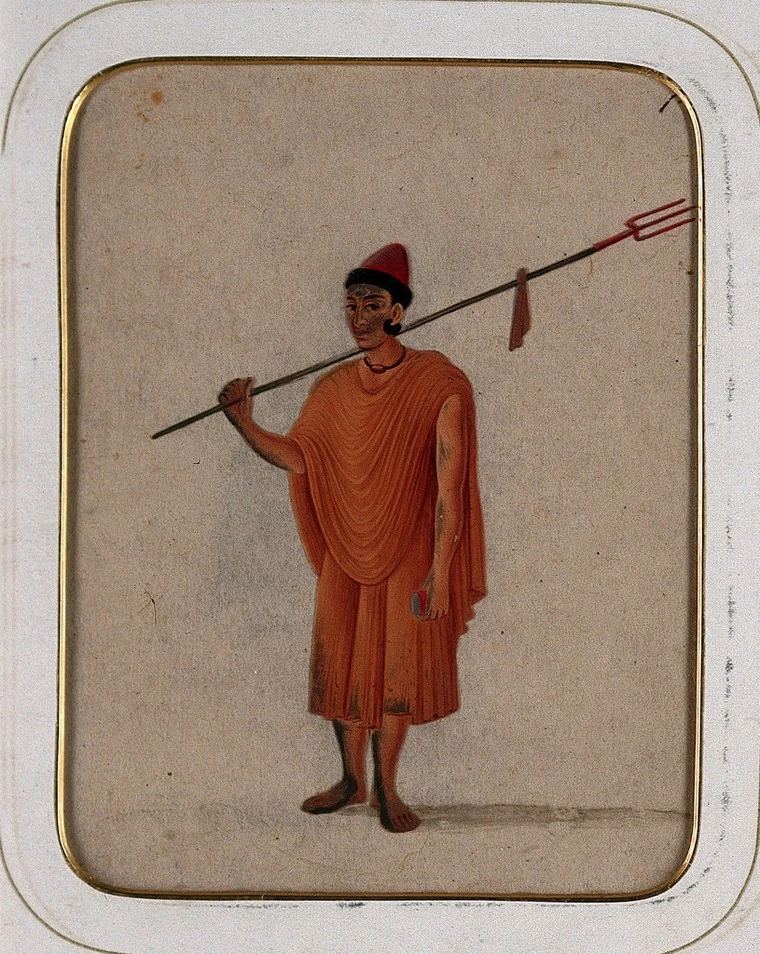
A figure catalogued as a sadhu or sannyasi carries a trident. The Wellcome Collection dates the painting to the nineteenth century and describes the affiliation as probably Hindu, possibly Buddhist.
Unidentified Indian artist, [between 1800 and 1899?]. Wellcome Collection, 581405i. Public Domain Mark. · Image source ↗ · Public Domain
The Bhagavad Gita: the renunciant who still acts
In Bhagavad Gita 6.1, Krishna calls the person who performs the action required of them without depending on its fruits a sannyasin and yogin. Giving up the fires or ceasing to act alone does not settle the question. In 5.2 he commends both renunciation and Karma Yoga, giving Karma Yoga precedence in that comparison. [1][2]
The Mahanirvana Tantra: entering ascetic life
In Arthur Avalon’s translation of the Mahanirvana Tantra, VIII.17–19 addresses what the aspirant owes to dependants before leaving. Verses 240–244 describe funeral rites performed for the aspirant. Later verses describe freedom from possession, equanimity and knowledge of the detached soul. The rites mark the passage into another religious status. [3]
Karma-Yoga by Swami Vivekananda
Swami Vivekananda gives the householder and renunciant different duties. In his parable a young renunciant refuses marriage and a kingdom. A family of birds meets its own test through an extreme act of hospitality. Both lives ask for steadiness in what the person has chosen. [6][9][10][11][12][13][14][15]
In Vivekananda’s retelling of the Vyadha Gita, a monk proud of his spiritual power has to learn from a housewife and a meat-seller. Knowledge in the story appears where the monk least expects to find it. [16][17][18][19]
Vivekananda’s account of vairagya locates attachment in the mind. A person in a desert can still cling to the body, and someone on a throne can relinquish possessiveness. He asks what the person is able and willing to give up. [7][8][20][21]
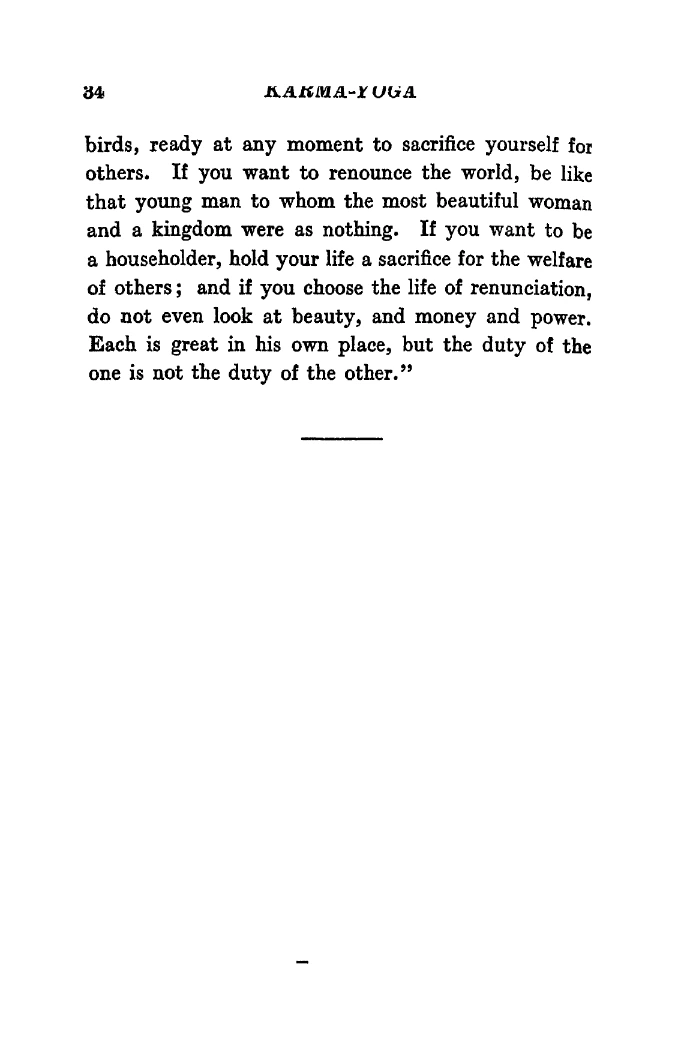
Karma-Yoga (1939), Library Reader page 36. Vivekananda concludes his parable by distinguishing the tests of the householder and the renunciant.
Swami Vivekananda, Karma-Yoga, English second printing in the 1939 combined volume. Historical public-domain text, exact checksum-verified Library scan. · Image source ↗ · Public Domain
See references (16)
- Karma-Yoga, Reader page 24
- Karma-Yoga, Reader page 102
- Karma-Yoga, printed p. 101, Reader page 103
- Karma-Yoga, Reader page 31
- Karma-Yoga, Reader page 50
- Karma-Yoga, Reader page 32
- Karma-Yoga, Reader page 33
- Karma-Yoga, Reader page 34
- Karma-Yoga, Reader page 35
- Karma-Yoga, Reader page 36
- Karma-Yoga, Reader page 58
- Karma-Yoga, Reader page 59
- Karma-Yoga, Reader page 60
- Karma-Yoga, Reader page 61
- Karma-Yoga, Reader page 19
- Karma-Yoga, Reader page 20
Leaving a role and relinquishing attachment
The Tantra gives departure from household life a ritual form and considers what must happen before it. The Gita makes continued action compatible with renunciation. Vivekananda shows how a household and a monastic life can each test whether a person remains attached to what they have or what they can do. [1][3][7][8]
Read further in the library
Karma Yoga
Reading note
The separately titled account draws on exact passages in the consulted Library edition.
Sources
See references (21)
- Bhagavad Gita 6.1, translated by Swami Mukundananda ↗Bhagavad Gita 6.1, Sanskrit and Swami Mukundananda’s translation. The translation interprets the verse devotionally; verse and modern commentary are distinguished.Return to text ↑
- Bhagavad Gita 5.2, translated by Swami Mukundananda ↗Bhagavad Gita 5.2, in Swami Mukundananda’s devotional translation. The verse commends both renunciation and Karma Yoga, while preferring Karma Yoga in the comparison.Return to text ↑
- Mahanirvana Tantra, chapter VIII, verses 8–23, 35–39, 62–63 and 221–279, Arthur Avalon translation ↗Mahanirvana Tantra, translated by Arthur Avalon (Sir John Woodroffe), 1913. Selected numbered verses of chapter VIII. This is a separately consulted translation, not a claim that Vivekananda quoted a translation published after his death.Return to text ↑
- A sadhu or sannyasi carrying a trident over his shoulders ↗Unidentified Indian artist, [between 1800 and 1899?]. Wellcome Collection 581405i. Historical artwork with Public Domain Mark.
- Karma-Yoga, Reader page 23Swami Vivekananda, Karma-Yoga, in Karma-Yoga & Bhakti-Yoga, English second printing, Ramakrishna-Vivekananda Center of New York, Inc., 1939. Exact Library edition IMJ-0097-E002. Only the Karma-Yoga part is used in this crawl; the old Work slug mentioning Hindi does not identify this edition’s language.Read this page in Karma Yoga ↗Return to text ↑
- Karma-Yoga, Reader page 24Swami Vivekananda, Karma-Yoga, in Karma-Yoga & Bhakti-Yoga, English second printing, Ramakrishna-Vivekananda Center of New York, Inc., 1939. Exact Library edition IMJ-0097-E002. Only the Karma-Yoga part is used in this crawl; the old Work slug mentioning Hindi does not identify this edition’s language.Read this page in Karma Yoga ↗Return to text ↑
- Karma-Yoga, Reader page 102Swami Vivekananda, Karma-Yoga, in Karma-Yoga & Bhakti-Yoga, English second printing, Ramakrishna-Vivekananda Center of New York, Inc., 1939. Exact Library edition IMJ-0097-E002. Only the Karma-Yoga part is used in this crawl; the old Work slug mentioning Hindi does not identify this edition’s language.Read this page in Karma Yoga ↗Return to text ↑
- Karma-Yoga, printed p. 101, Reader page 103Swami Vivekananda, Karma-Yoga, in Karma-Yoga & Bhakti-Yoga, English second printing, Ramakrishna-Vivekananda Center of New York, Inc., 1939. Exact Library edition IMJ-0097-E002. Only the Karma-Yoga part is used in this crawl; the old Work slug mentioning Hindi does not identify this edition’s language.Read this page in Karma Yoga ↗Return to text ↑
- Karma-Yoga, Reader page 31Swami Vivekananda, Karma-Yoga, in Karma-Yoga & Bhakti-Yoga, English second printing, Ramakrishna-Vivekananda Center of New York, Inc., 1939. Exact Library edition IMJ-0097-E002. Only the Karma-Yoga part is used in this crawl; the old Work slug mentioning Hindi does not identify this edition’s language.Read this page in Karma Yoga ↗Return to text ↑
- Karma-Yoga, Reader page 50Swami Vivekananda, Karma-Yoga, in Karma-Yoga & Bhakti-Yoga, English second printing, Ramakrishna-Vivekananda Center of New York, Inc., 1939. Exact Library edition IMJ-0097-E002. Only the Karma-Yoga part is used in this crawl; the old Work slug mentioning Hindi does not identify this edition’s language.Read this page in Karma Yoga ↗Return to text ↑
- Karma-Yoga, Reader page 32Swami Vivekananda, Karma-Yoga, in Karma-Yoga & Bhakti-Yoga, English second printing, Ramakrishna-Vivekananda Center of New York, Inc., 1939. Exact Library edition IMJ-0097-E002. Only the Karma-Yoga part is used in this crawl; the old Work slug mentioning Hindi does not identify this edition’s language.Read this page in Karma Yoga ↗Return to text ↑
- Karma-Yoga, Reader page 33Swami Vivekananda, Karma-Yoga, in Karma-Yoga & Bhakti-Yoga, English second printing, Ramakrishna-Vivekananda Center of New York, Inc., 1939. Exact Library edition IMJ-0097-E002. Only the Karma-Yoga part is used in this crawl; the old Work slug mentioning Hindi does not identify this edition’s language.Read this page in Karma Yoga ↗Return to text ↑
- Karma-Yoga, Reader page 34Swami Vivekananda, Karma-Yoga, in Karma-Yoga & Bhakti-Yoga, English second printing, Ramakrishna-Vivekananda Center of New York, Inc., 1939. Exact Library edition IMJ-0097-E002. Only the Karma-Yoga part is used in this crawl; the old Work slug mentioning Hindi does not identify this edition’s language.Read this page in Karma Yoga ↗Return to text ↑
- Karma-Yoga, Reader page 35Swami Vivekananda, Karma-Yoga, in Karma-Yoga & Bhakti-Yoga, English second printing, Ramakrishna-Vivekananda Center of New York, Inc., 1939. Exact Library edition IMJ-0097-E002. Only the Karma-Yoga part is used in this crawl; the old Work slug mentioning Hindi does not identify this edition’s language.Read this page in Karma Yoga ↗Return to text ↑
- Karma-Yoga, Reader page 36Swami Vivekananda, Karma-Yoga, in Karma-Yoga & Bhakti-Yoga, English second printing, Ramakrishna-Vivekananda Center of New York, Inc., 1939. Exact Library edition IMJ-0097-E002. Only the Karma-Yoga part is used in this crawl; the old Work slug mentioning Hindi does not identify this edition’s language.Read this page in Karma Yoga ↗Return to text ↑
- Karma-Yoga, Reader page 58Swami Vivekananda, Karma-Yoga, in Karma-Yoga & Bhakti-Yoga, English second printing, Ramakrishna-Vivekananda Center of New York, Inc., 1939. Exact Library edition IMJ-0097-E002. Only the Karma-Yoga part is used in this crawl; the old Work slug mentioning Hindi does not identify this edition’s language.Read this page in Karma Yoga ↗Return to text ↑
- Karma-Yoga, Reader page 59Swami Vivekananda, Karma-Yoga, in Karma-Yoga & Bhakti-Yoga, English second printing, Ramakrishna-Vivekananda Center of New York, Inc., 1939. Exact Library edition IMJ-0097-E002. Only the Karma-Yoga part is used in this crawl; the old Work slug mentioning Hindi does not identify this edition’s language.Read this page in Karma Yoga ↗Return to text ↑
- Karma-Yoga, Reader page 60Swami Vivekananda, Karma-Yoga, in Karma-Yoga & Bhakti-Yoga, English second printing, Ramakrishna-Vivekananda Center of New York, Inc., 1939. Exact Library edition IMJ-0097-E002. Only the Karma-Yoga part is used in this crawl; the old Work slug mentioning Hindi does not identify this edition’s language.Read this page in Karma Yoga ↗Return to text ↑
- Karma-Yoga, Reader page 61Swami Vivekananda, Karma-Yoga, in Karma-Yoga & Bhakti-Yoga, English second printing, Ramakrishna-Vivekananda Center of New York, Inc., 1939. Exact Library edition IMJ-0097-E002. Only the Karma-Yoga part is used in this crawl; the old Work slug mentioning Hindi does not identify this edition’s language.Read this page in Karma Yoga ↗Return to text ↑
- Karma-Yoga, Reader page 19Swami Vivekananda, Karma-Yoga, in Karma-Yoga & Bhakti-Yoga, English second printing, Ramakrishna-Vivekananda Center of New York, Inc., 1939. Exact Library edition IMJ-0097-E002. Only the Karma-Yoga part is used in this crawl; the old Work slug mentioning Hindi does not identify this edition’s language.Read this page in Karma Yoga ↗Return to text ↑
- Karma-Yoga, Reader page 20Swami Vivekananda, Karma-Yoga, in Karma-Yoga & Bhakti-Yoga, English second printing, Ramakrishna-Vivekananda Center of New York, Inc., 1939. Exact Library edition IMJ-0097-E002. Only the Karma-Yoga part is used in this crawl; the old Work slug mentioning Hindi does not identify this edition’s language.Read this page in Karma Yoga ↗Return to text ↑