Vyadha Gita
The Vyadha Gita is the Mahabharata’s teaching of a righteous meat-seller. Follow the ascetic who learns about anger, care and duty from unexpected teachers.
In this article
Understanding the concept
The Vyadha Gita is a teaching in the Mahabharata associated with a righteous meat-seller, also called a fowler. A housewife sends an ascetic to him after confronting the ascetic about his anger. The person he expected least to teach him turns out to understand duty better than he does. [1][2][3][4]
Vivekananda retells the story in Karma-Yoga. The housewife and the meat-seller show what attention to everyday responsibilities can teach someone who has cultivated extraordinary powers in isolation. [5][3][4][6]
The Mahabharata: Kausika and the righteous fowler
In Kisari Mohan Ganguli’s translation, Kausika regrets killing a she-crane in anger. A housewife who keeps him waiting rebukes that anger and sends him to Mithila. The fowler there says he sells meat killed by others. His teaching places truthfulness and care for those who depend on him within an account of duty. [1][2]
Karma-Yoga by Swami Vivekananda
Swami Vivekananda begins with a young sannyasin who has practised for years in a forest. Angered by a crow and crane, he burns them with a glance and feels pleased with his power. When a housewife later makes him wait for alms, he again becomes angry, only to discover that she knows about the birds. [5][3]
The woman explains that she has been nursing her ill husband. She attributes her knowledge to performing her responsibilities and sends the monk to a meat-seller. The monk recoils at the idea of learning from such a person, but follows her advice. [3]
The teacher completes his market business, takes the visitor home and attends to his elderly parents. He then answers questions about soul and God. Vivekananda identifies the teaching as the Vyadha Gita of the Mahabharata, and describes it as a high expression of Vedanta. [4]
The butcher rejects the visitor’s judgement that his occupation must make his knowledge impossible. He attributes his understanding to unattached performance of the responsibilities into which he was born. Vivekananda closes the example by relating wholehearted duty to the realization of the soul. [4][6][7]
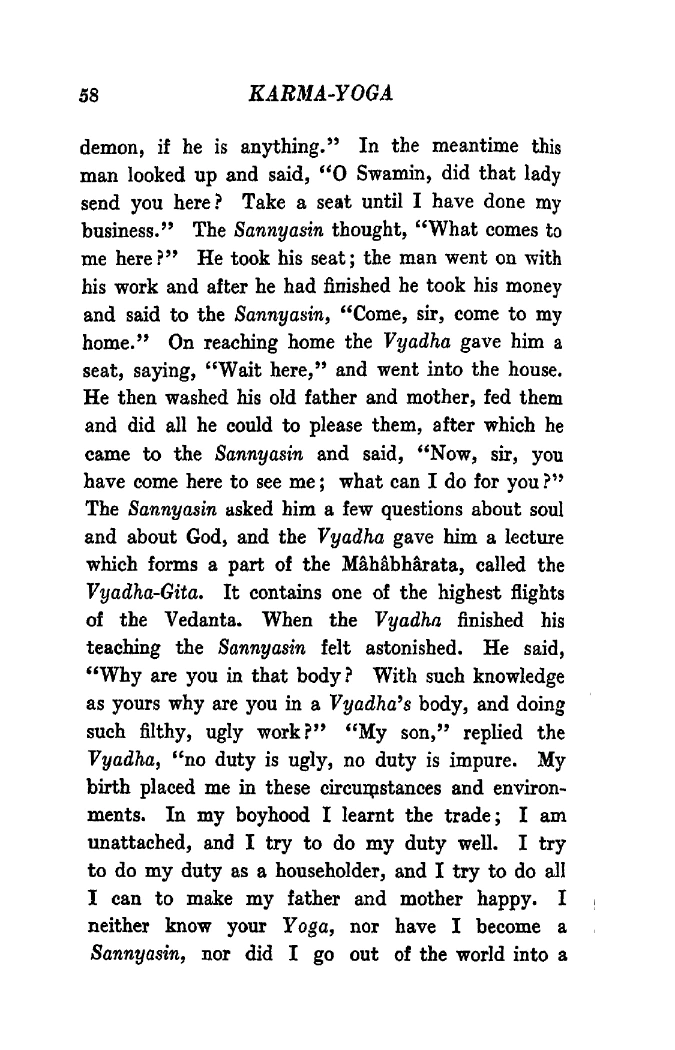
Karma-Yoga (1939), Library Reader page 60. The visiting monk learns from the meat-seller after watching him care for his parents.
Swami Vivekananda, Karma-Yoga, English second printing in the 1939 combined volume. Historical public-domain text, exact checksum-verified Library scan. · Image source ↗ · Public Domain
The teachers and what the retelling changes
Ganguli’s Kausika regrets killing one crane. Vivekananda’s monk first takes pride in destroying a crow and a crane. The housewife in the epic serves a hungry husband, while her counterpart in the retelling cares for a sick one. Vivekananda uses the changes to make the contrast between spiritual power and careful service immediate. [1][5][3]
The fowler in Ganguli’s text names the limits of what he does in trade and talks about duty within a society organised by birth. The episode lets him challenge the ascetic’s judgment while preserving the inherited social framework in which the characters speak. [2][4]
Read further in the library
Karma Yoga
Reading note
The separately titled account draws on exact passages in the consulted Library edition.
Sources
See references (7)
- Mahabharata, Vana Parva, section CCV, translated by Kisari Mohan Ganguli ↗Mahabharata, Book 3, section CCV (205), in Kisari Mohan Ganguli’s translation. Kausika, the she-crane and the housewife. Exact passage, without an unverified Library edition link.Return to text ↑
- Mahabharata, Vana Parva, section CCVI, translated by Kisari Mohan Ganguli ↗Mahabharata, Book 3, section CCVI (206), in Kisari Mohan Ganguli’s translation. The encounter with the righteous fowler and his account of his work.Return to text ↑
- Karma-Yoga, Reader page 59Swami Vivekananda, Karma-Yoga, in Karma-Yoga & Bhakti-Yoga, English second printing, Ramakrishna-Vivekananda Center of New York, Inc., 1939. Exact Library edition IMJ-0097-E002. Only the Karma-Yoga part is used in this crawl; the old Work slug mentioning Hindi does not identify this edition’s language.Read this page in Karma Yoga ↗Return to text ↑
- Karma-Yoga, Reader page 60Swami Vivekananda, Karma-Yoga, in Karma-Yoga & Bhakti-Yoga, English second printing, Ramakrishna-Vivekananda Center of New York, Inc., 1939. Exact Library edition IMJ-0097-E002. Only the Karma-Yoga part is used in this crawl; the old Work slug mentioning Hindi does not identify this edition’s language.Read this page in Karma Yoga ↗Return to text ↑
- Karma-Yoga, Reader page 58Swami Vivekananda, Karma-Yoga, in Karma-Yoga & Bhakti-Yoga, English second printing, Ramakrishna-Vivekananda Center of New York, Inc., 1939. Exact Library edition IMJ-0097-E002. Only the Karma-Yoga part is used in this crawl; the old Work slug mentioning Hindi does not identify this edition’s language.Read this page in Karma Yoga ↗Return to text ↑
- Karma-Yoga, Reader page 61Swami Vivekananda, Karma-Yoga, in Karma-Yoga & Bhakti-Yoga, English second printing, Ramakrishna-Vivekananda Center of New York, Inc., 1939. Exact Library edition IMJ-0097-E002. Only the Karma-Yoga part is used in this crawl; the old Work slug mentioning Hindi does not identify this edition’s language.Read this page in Karma Yoga ↗Return to text ↑
- Karma-Yoga, Reader page 62Swami Vivekananda, Karma-Yoga, in Karma-Yoga & Bhakti-Yoga, English second printing, Ramakrishna-Vivekananda Center of New York, Inc., 1939. Exact Library edition IMJ-0097-E002. Only the Karma-Yoga part is used in this crawl; the old Work slug mentioning Hindi does not identify this edition’s language.Read this page in Karma Yoga ↗Return to text ↑