Vairagya
Vairagya is dispassion or non-attachment in yoga. Read how Vivekananda connects it with care, work and the freedom to act without claiming a reward.
In this article
Understanding the concept
Vairagya is dispassion or non-attachment in yoga. It loosens the hold of what a person wants to possess or keep. Swami Vivekananda asks how someone can continue to care, work and give while letting go of the need to call the result their own. [2][3][4]
Vivekananda places the question in the mind. Someone living in rags may still be preoccupied with what they want. Someone with wealth or responsibility can ask what their position has led them to cling to. [3][4]
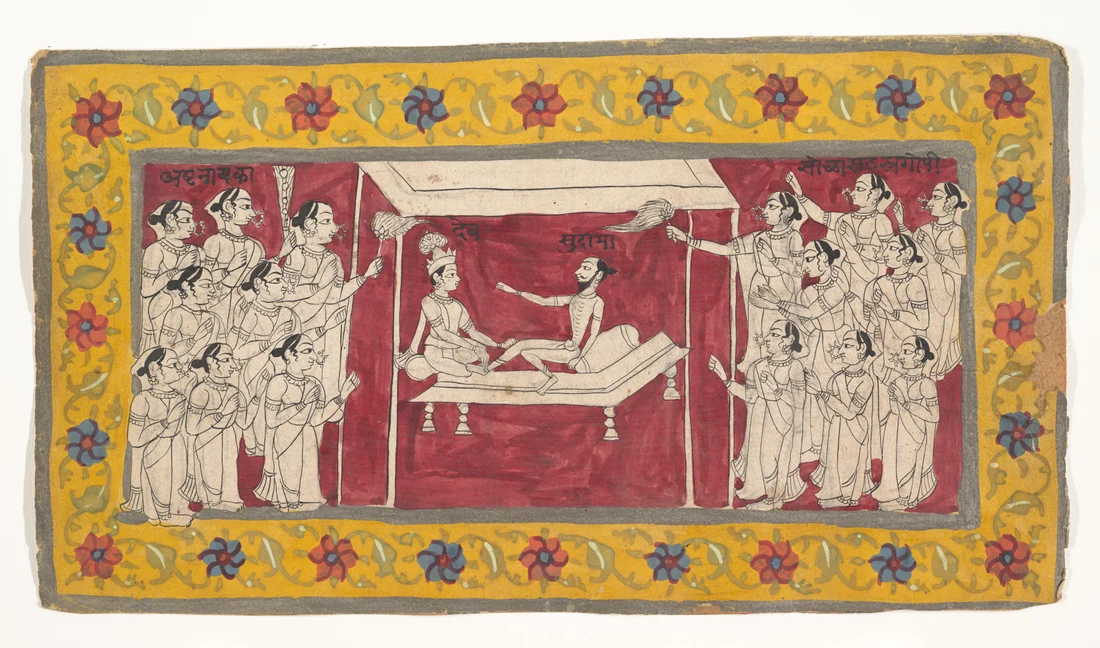
Krishna with an Ascetic, Maharashtra, c. 1850. Krishna speaks with the ascetic as a crowd gathers around them.
The Metropolitan Museum of Art, Purchase, Mr. and Mrs. Peter Findlay Gift, 1979; object 1979.12.2. Open Access. · Image source ↗ · CC0
Raja-Yoga by Swami Vivekananda: practice and non-attachment
In Raja-Yoga, Swami Vivekananda translates Yoga Sutra I.12 as a pairing of practice and non-attachment. I.15 describes going beyond thirst for things one has experienced or heard about. I.16 goes further, linking knowledge of purusha, the conscious self, to dispassion towards the qualities of nature. [1]
Karma-Yoga by Swami Vivekananda
Vivekananda asks what happens when giving becomes a demand for recognition. He makes the same point about love through the example of someone who wants a beloved person constantly nearby and under their direction. Both examples give attachment a familiar form. [5][6][7][8][9]
In an analogy he attributes to Ramakrishna, a nurse cares tenderly for a child she does not claim as her own. The care is real even though it gives her no lasting possession. Vivekananda extends the image to what people habitually call theirs and, for a believer, regards as belonging to God. [10][11][5][6]
Vivekananda likens the worker to a lotus leaf on which water does not stay. He calls this inward freedom vairagya and contrasts a person on a throne with someone in rags. Either could be more attached than the other. [3][4]
A person who believes in God can offer the results of work to God. A person without that belief can work through will and discrimination. The two approaches ask the worker to let go of making each outcome a personal possession. [4][12]
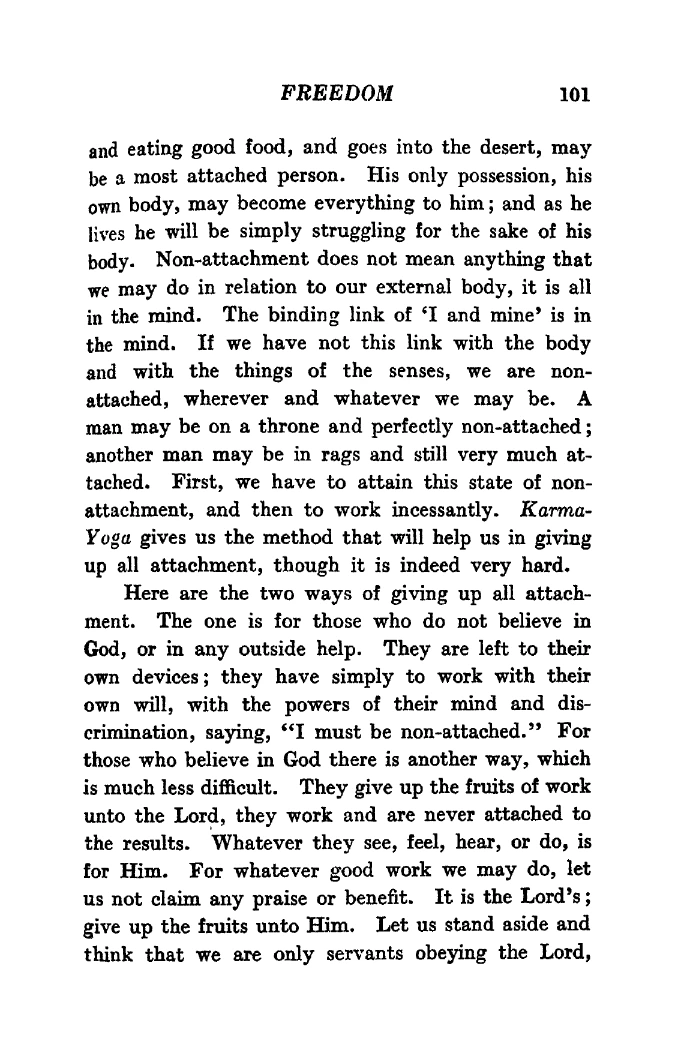
Karma-Yoga (1939), printed p. 101, Library Reader page 103. Vivekananda describes two approaches to giving up attachment to results.
Swami Vivekananda, Karma-Yoga, English second printing in the 1939 combined volume. Historical public-domain text, exact checksum-verified Library scan. · Image source ↗ · Public Domain
Initiation and Its Results by Rudolf Steiner
Rudolf Steiner’s Initiation and Its Results includes right valuation among four qualifications for spiritual training. These qualities must become lived habits. He connects them with claimed changes in etheric organs, while warning against treating small daily duties as spiritually negligible. [13][14][15][16]
Letting go while continuing to act
Karma-Yoga asks how care and action can continue while the demand for a private return falls away. Vivekananda’s commentary on Patanjali asks what practice and dispassion do for restraint of the mind. The same disposition has a place in different kinds of work. [8][9][5][6][3][4][1]
Steiner gives enduring habits a place in spiritual training and insists that small duties still matter. He explains these habits through etheric development. Vivekananda’s account follows what a person holds onto while doing the work. [13][14][15][16][3][4]
See references (11)
- Patanjali’s Yoga Aphorisms I.12–16, I.18 and I.50–51, translated and explained by Swami Vivekananda in Raja-Yoga
- Karma-Yoga, Reader page 102
- Karma-Yoga, printed p. 101, Reader page 103
- Karma-Yoga, Reader page 46
- Karma-Yoga, Reader page 47
- Karma-Yoga, Reader page 44
- Karma-Yoga, Reader page 45
- Initiation and Its Results, printed p. 47, Reader page 46
- Initiation and Its Results, printed p. 48, Reader page 47
- Initiation and Its Results, printed p. 49, Reader page 48
- Initiation and Its Results, printed p. 50, Reader page 49
Read further in the library
Karma Yoga
Reading note
The separately titled account draws on exact passages in the consulted Library edition.

Initiation and Its Results
Reading note
Separately attributed comparison with exact previously researched Library passages.
Sources
See references (17)
- Patanjali’s Yoga Aphorisms I.12–16, I.18 and I.50–51, translated and explained by Swami Vivekananda in Raja-Yoga ↗Swami Vivekananda’s translation and commentary on Yoga Sutra chapter I in Raja-Yoga. This is a second book by the same interpreter, not independent corroboration. Sutra numbers identify passages; no unverified Library pagination supplied.Return to text ↑
- Karma-Yoga, Reader page 101Swami Vivekananda, Karma-Yoga, in Karma-Yoga & Bhakti-Yoga, English second printing, Ramakrishna-Vivekananda Center of New York, Inc., 1939. Exact Library edition IMJ-0097-E002. Only the Karma-Yoga part is used in this crawl; the old Work slug mentioning Hindi does not identify this edition’s language.Read this page in Karma Yoga ↗Return to text ↑
- Karma-Yoga, Reader page 102Swami Vivekananda, Karma-Yoga, in Karma-Yoga & Bhakti-Yoga, English second printing, Ramakrishna-Vivekananda Center of New York, Inc., 1939. Exact Library edition IMJ-0097-E002. Only the Karma-Yoga part is used in this crawl; the old Work slug mentioning Hindi does not identify this edition’s language.Read this page in Karma Yoga ↗Return to text ↑
- Karma-Yoga, printed p. 101, Reader page 103Swami Vivekananda, Karma-Yoga, in Karma-Yoga & Bhakti-Yoga, English second printing, Ramakrishna-Vivekananda Center of New York, Inc., 1939. Exact Library edition IMJ-0097-E002. Only the Karma-Yoga part is used in this crawl; the old Work slug mentioning Hindi does not identify this edition’s language.Read this page in Karma Yoga ↗Return to text ↑
- Karma-Yoga, Reader page 46Swami Vivekananda, Karma-Yoga, in Karma-Yoga & Bhakti-Yoga, English second printing, Ramakrishna-Vivekananda Center of New York, Inc., 1939. Exact Library edition IMJ-0097-E002. Only the Karma-Yoga part is used in this crawl; the old Work slug mentioning Hindi does not identify this edition’s language.Read this page in Karma Yoga ↗Return to text ↑
- Karma-Yoga, Reader page 47Swami Vivekananda, Karma-Yoga, in Karma-Yoga & Bhakti-Yoga, English second printing, Ramakrishna-Vivekananda Center of New York, Inc., 1939. Exact Library edition IMJ-0097-E002. Only the Karma-Yoga part is used in this crawl; the old Work slug mentioning Hindi does not identify this edition’s language.Read this page in Karma Yoga ↗Return to text ↑
- Karma-Yoga, Reader page 87Swami Vivekananda, Karma-Yoga, in Karma-Yoga & Bhakti-Yoga, English second printing, Ramakrishna-Vivekananda Center of New York, Inc., 1939. Exact Library edition IMJ-0097-E002. Only the Karma-Yoga part is used in this crawl; the old Work slug mentioning Hindi does not identify this edition’s language.Read this page in Karma Yoga ↗Return to text ↑
- Karma-Yoga, Reader page 44Swami Vivekananda, Karma-Yoga, in Karma-Yoga & Bhakti-Yoga, English second printing, Ramakrishna-Vivekananda Center of New York, Inc., 1939. Exact Library edition IMJ-0097-E002. Only the Karma-Yoga part is used in this crawl; the old Work slug mentioning Hindi does not identify this edition’s language.Read this page in Karma Yoga ↗Return to text ↑
- Karma-Yoga, Reader page 45Swami Vivekananda, Karma-Yoga, in Karma-Yoga & Bhakti-Yoga, English second printing, Ramakrishna-Vivekananda Center of New York, Inc., 1939. Exact Library edition IMJ-0097-E002. Only the Karma-Yoga part is used in this crawl; the old Work slug mentioning Hindi does not identify this edition’s language.Read this page in Karma Yoga ↗Return to text ↑
- Karma-Yoga, Reader page 85Swami Vivekananda, Karma-Yoga, in Karma-Yoga & Bhakti-Yoga, English second printing, Ramakrishna-Vivekananda Center of New York, Inc., 1939. Exact Library edition IMJ-0097-E002. Only the Karma-Yoga part is used in this crawl; the old Work slug mentioning Hindi does not identify this edition’s language.Read this page in Karma Yoga ↗Return to text ↑
- Karma-Yoga, Reader page 86Swami Vivekananda, Karma-Yoga, in Karma-Yoga & Bhakti-Yoga, English second printing, Ramakrishna-Vivekananda Center of New York, Inc., 1939. Exact Library edition IMJ-0097-E002. Only the Karma-Yoga part is used in this crawl; the old Work slug mentioning Hindi does not identify this edition’s language.Read this page in Karma Yoga ↗Return to text ↑
- Karma-Yoga, Reader page 104Swami Vivekananda, Karma-Yoga, in Karma-Yoga & Bhakti-Yoga, English second printing, Ramakrishna-Vivekananda Center of New York, Inc., 1939. Exact Library edition IMJ-0097-E002. Only the Karma-Yoga part is used in this crawl; the old Work slug mentioning Hindi does not identify this edition’s language.Read this page in Karma Yoga ↗Return to text ↑
- Initiation and Its Results, printed p. 47, Reader page 46Rudolf Steiner, Initiation and Its Results: A Sequel to The Way of Initiation, translated by Clifford Bax. First American Edition, 1909. Macoy Publishing and Masonic Supply Co., New York; Max Gysi, London. Claims of clairvoyant perception and subtle organs remain attributed. References identify the exact consulted Library edition.Read this page in Initiation and Its Results ↗Return to text ↑
- Initiation and Its Results, printed p. 48, Reader page 47Rudolf Steiner, Initiation and Its Results: A Sequel to The Way of Initiation, translated by Clifford Bax. First American Edition, 1909. Macoy Publishing and Masonic Supply Co., New York; Max Gysi, London. Claims of clairvoyant perception and subtle organs remain attributed. References identify the exact consulted Library edition.Read this page in Initiation and Its Results ↗Return to text ↑
- Initiation and Its Results, printed p. 49, Reader page 48Rudolf Steiner, Initiation and Its Results: A Sequel to The Way of Initiation, translated by Clifford Bax. First American Edition, 1909. Macoy Publishing and Masonic Supply Co., New York; Max Gysi, London. Claims of clairvoyant perception and subtle organs remain attributed. References identify the exact consulted Library edition.Read this page in Initiation and Its Results ↗Return to text ↑
- Initiation and Its Results, printed p. 50, Reader page 49Rudolf Steiner, Initiation and Its Results: A Sequel to The Way of Initiation, translated by Clifford Bax. First American Edition, 1909. Macoy Publishing and Masonic Supply Co., New York; Max Gysi, London. Claims of clairvoyant perception and subtle organs remain attributed. References identify the exact consulted Library edition.Read this page in Initiation and Its Results ↗Return to text ↑
- Krishna with an Ascetic, ca. 1850, Maharashtra, Marathi, The Metropolitan Museum of Art, 1979.12.2 ↗Official museum record and Open Access API identify the painting, historical setting and public-domain image status.