Four Qualifications for Spiritual Training
Steiner’s four qualifications are discernment, right valuation, six cultivated qualities and a longing for freedom. Read what each is meant to develop.
In this article
Understanding the concept
The four qualifications for spiritual training are dispositions Rudolf Steiner presents as preparation for initiation. They concern discernment, right valuation, six qualities of thought and conduct, and a longing for freedom. The third qualification contains six parts. [1][2][3]
Initiation and Its Results by Rudolf Steiner
In Initiation and Its Results, Rudolf Steiner explains what the dispositions are meant to change in the student. A person has to practise the distinction between the enduring and the passing until it begins to change ordinary judgment. [1]
Understanding a qualification gives the student words for it. Living it gives the student chances to act on it again and see where its application becomes difficult. [2]
Steiner immediately qualifies what right valuation means for daily life. Small actions can matter within the wider world. The student is not supposed to dismiss ordinary responsibilities because a dramatic spiritual attainment appears more important. [3]
Steiner connects the desired freedom with release from a narrowly personal standpoint. He also argues that the qualifications express a wisdom shared by religions. That wider history is part of the author’s own interpretation. [3][4]
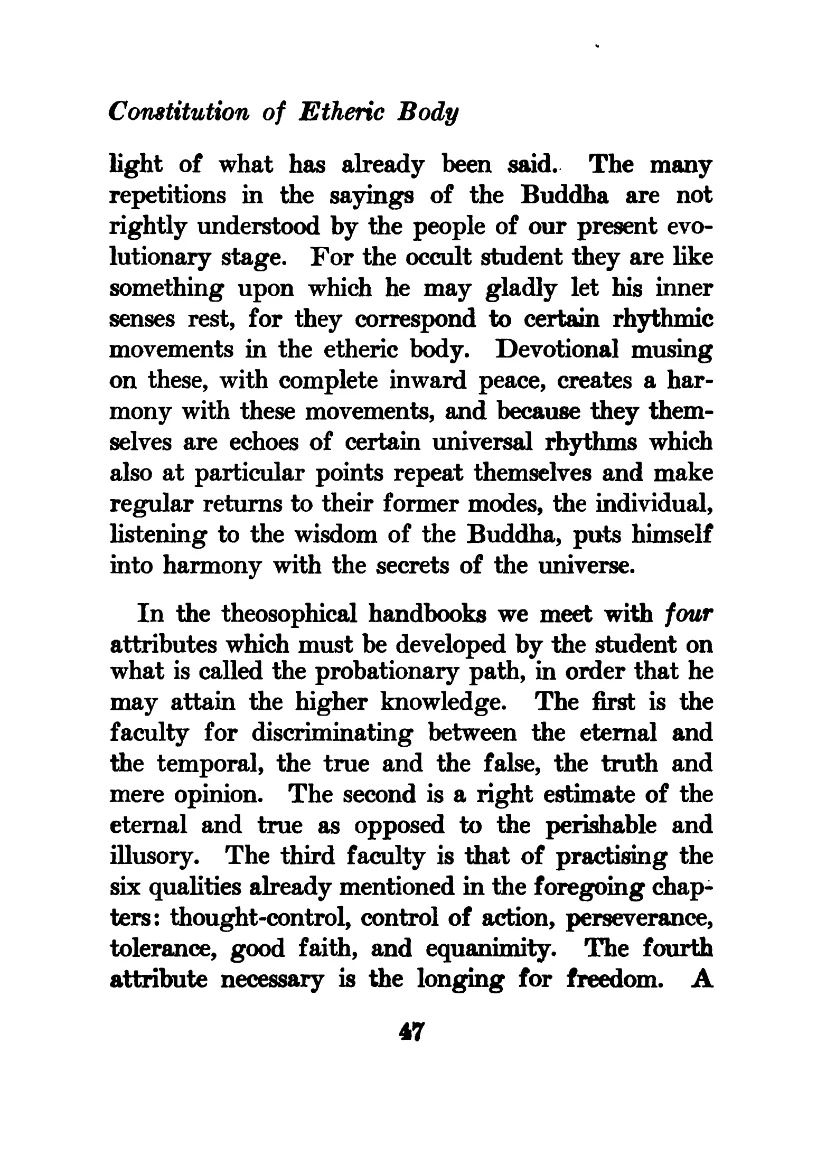
Source facsimile: Initiation and Its Results (1909), printed p. 47, Reader page 46.
Rudolf Steiner, Initiation and Its Results, Clifford Bax translation, First American Edition, 1909. Public-domain historical page from the checksum-verified Library PDF. · Image source ↗ · Public Domain
- Discernment
- Distinguish the eternal from the temporal, truth from falsehood, and truth from mere opinion.
- Right valuation
- Value the enduring and true in relation to what is passing, while recognising the significance of ordinary duties.
- Six cultivated qualities
- Control of thought, control of action, perseverance, tolerance, good faith and equanimity.
- Longing for freedom
- Seek release from the limits of a narrowly personal standpoint.
The four qualifications in order
- Discernment. Distinguish the enduring from the passing. Steiner associates it with establishing the initial head centre and preparing for the larynx. [2][3][1]
- Right valuation. Give lasting qualities their due without overlooking small actions in ordinary life. Steiner connects this habit with the etheric network. [2][3]
- The six qualities. Cultivate coherent thought, consistent action, perseverance, tolerance, openness and equanimity. Steiner relates them to the twelve-petalled heart lotus. [2][3]
- The longing for freedom. Seek release from a narrowly personal standpoint. In Steiner’s account this brings the etheric heart organ to fruition. [2][3][4]
Heaven and Its Wonders and Hell by Emanuel Swedenborg
Emanuel Swedenborg’s Heaven and Its Wonders and Hell makes a person’s ruling love central to spiritual character. After death, what had been concealed by outward habits is said to be disclosed until speech and conduct express the person’s inward direction. [12][13][14][15]
Training a disposition and disclosing one
Steiner’s eight functions concern the throat lotus. The six qualities concern the heart lotus and appear as one of these four qualifications. Readers encounter several counts because the author is organizing different groups of practices. [5][6][7][8][9][10][11][1][2][3]
Steiner asks how a learner can develop dispositions through practice. Swedenborg describes a ruling love that directs the person and becomes visible after death. Both give a lasting habit more weight than a single outward action. [12][13][14][15][1][2][3]
See references (14)
- Initiation and Its Results, printed p. 47, Reader page 46
- Initiation and Its Results, printed p. 48, Reader page 47
- Initiation and Its Results, printed p. 49, Reader page 48
- Initiation and Its Results, printed p. 16, Reader page 16
- Initiation and Its Results, printed p. 17, Reader page 17
- Initiation and Its Results, printed p. 18, Reader page 18
- Initiation and Its Results, printed p. 19, Reader page 19
- Initiation and Its Results, printed p. 27, Reader page 27
- Initiation and Its Results, printed p. 28, Reader page 28
- Initiation and Its Results, printed p. 29, Reader page 29
- Heaven and Its Wonders and Hell, printed p. 421, Reader page 428
- Heaven and Its Wonders and Hell, printed p. 423, Reader page 430
- Heaven and Its Wonders and Hell, printed p. 424, Reader page 431
- Heaven and Its Wonders and Hell, printed p. 427, Reader page 434
Read further in the library

Initiation and Its Results
Reading note
The separately titled account draws on exact passages in the consulted Library edition.

Heaven and Its Wonders and Hell
Reading note
Separately attributed comparison with exact previously researched Library passages.
Sources
See references (15)
- Initiation and Its Results, printed p. 47, Reader page 46Rudolf Steiner, Initiation and Its Results: A Sequel to The Way of Initiation, translated by Clifford Bax. First American Edition, 1909. Macoy Publishing and Masonic Supply Co., New York; Max Gysi, London. Claims of clairvoyant perception and subtle organs remain attributed. References identify the exact consulted Library edition.Read this page in Initiation and Its Results ↗Return to text ↑
- Initiation and Its Results, printed p. 48, Reader page 47Rudolf Steiner, Initiation and Its Results: A Sequel to The Way of Initiation, translated by Clifford Bax. First American Edition, 1909. Macoy Publishing and Masonic Supply Co., New York; Max Gysi, London. Claims of clairvoyant perception and subtle organs remain attributed. References identify the exact consulted Library edition.Read this page in Initiation and Its Results ↗Return to text ↑
- Initiation and Its Results, printed p. 49, Reader page 48Rudolf Steiner, Initiation and Its Results: A Sequel to The Way of Initiation, translated by Clifford Bax. First American Edition, 1909. Macoy Publishing and Masonic Supply Co., New York; Max Gysi, London. Claims of clairvoyant perception and subtle organs remain attributed. References identify the exact consulted Library edition.Read this page in Initiation and Its Results ↗Return to text ↑
- Initiation and Its Results, printed p. 50, Reader page 49Rudolf Steiner, Initiation and Its Results: A Sequel to The Way of Initiation, translated by Clifford Bax. First American Edition, 1909. Macoy Publishing and Masonic Supply Co., New York; Max Gysi, London. Claims of clairvoyant perception and subtle organs remain attributed. References identify the exact consulted Library edition.Read this page in Initiation and Its Results ↗Return to text ↑
- Initiation and Its Results, printed p. 16, Reader page 16Rudolf Steiner, Initiation and Its Results: A Sequel to The Way of Initiation, translated by Clifford Bax. First American Edition, 1909. Macoy Publishing and Masonic Supply Co., New York; Max Gysi, London. Claims of clairvoyant perception and subtle organs remain attributed. References identify the exact consulted Library edition.Read this page in Initiation and Its Results ↗Return to text ↑
- Initiation and Its Results, printed p. 17, Reader page 17Rudolf Steiner, Initiation and Its Results: A Sequel to The Way of Initiation, translated by Clifford Bax. First American Edition, 1909. Macoy Publishing and Masonic Supply Co., New York; Max Gysi, London. Claims of clairvoyant perception and subtle organs remain attributed. References identify the exact consulted Library edition.Read this page in Initiation and Its Results ↗Return to text ↑
- Initiation and Its Results, printed p. 18, Reader page 18Rudolf Steiner, Initiation and Its Results: A Sequel to The Way of Initiation, translated by Clifford Bax. First American Edition, 1909. Macoy Publishing and Masonic Supply Co., New York; Max Gysi, London. Claims of clairvoyant perception and subtle organs remain attributed. References identify the exact consulted Library edition.Read this page in Initiation and Its Results ↗Return to text ↑
- Initiation and Its Results, printed p. 19, Reader page 19Rudolf Steiner, Initiation and Its Results: A Sequel to The Way of Initiation, translated by Clifford Bax. First American Edition, 1909. Macoy Publishing and Masonic Supply Co., New York; Max Gysi, London. Claims of clairvoyant perception and subtle organs remain attributed. References identify the exact consulted Library edition.Read this page in Initiation and Its Results ↗Return to text ↑
- Initiation and Its Results, printed p. 27, Reader page 27Rudolf Steiner, Initiation and Its Results: A Sequel to The Way of Initiation, translated by Clifford Bax. First American Edition, 1909. Macoy Publishing and Masonic Supply Co., New York; Max Gysi, London. Claims of clairvoyant perception and subtle organs remain attributed. References identify the exact consulted Library edition.Read this page in Initiation and Its Results ↗Return to text ↑
- Initiation and Its Results, printed p. 28, Reader page 28Rudolf Steiner, Initiation and Its Results: A Sequel to The Way of Initiation, translated by Clifford Bax. First American Edition, 1909. Macoy Publishing and Masonic Supply Co., New York; Max Gysi, London. Claims of clairvoyant perception and subtle organs remain attributed. References identify the exact consulted Library edition.Read this page in Initiation and Its Results ↗Return to text ↑
- Initiation and Its Results, printed p. 29, Reader page 29Rudolf Steiner, Initiation and Its Results: A Sequel to The Way of Initiation, translated by Clifford Bax. First American Edition, 1909. Macoy Publishing and Masonic Supply Co., New York; Max Gysi, London. Claims of clairvoyant perception and subtle organs remain attributed. References identify the exact consulted Library edition.Read this page in Initiation and Its Results ↗Return to text ↑
- Heaven and Its Wonders and Hell, printed p. 421, Reader page 428Emanuel Swedenborg, Heaven and Its Wonders and Hell, translated by J. C. Ager. The American Swedenborg Printing and Publishing Society, New York, 1916. Original Latin work first published in 1758.Read this page in Heaven and Its Wonders and Hell ↗Return to text ↑
- Heaven and Its Wonders and Hell, printed p. 423, Reader page 430Emanuel Swedenborg, Heaven and Its Wonders and Hell, translated by J. C. Ager. The American Swedenborg Printing and Publishing Society, New York, 1916. Original Latin work first published in 1758.Read this page in Heaven and Its Wonders and Hell ↗Return to text ↑
- Heaven and Its Wonders and Hell, printed p. 424, Reader page 431Emanuel Swedenborg, Heaven and Its Wonders and Hell, translated by J. C. Ager. The American Swedenborg Printing and Publishing Society, New York, 1916. Original Latin work first published in 1758.Read this page in Heaven and Its Wonders and Hell ↗Return to text ↑
- Heaven and Its Wonders and Hell, printed p. 427, Reader page 434Emanuel Swedenborg, Heaven and Its Wonders and Hell, translated by J. C. Ager. The American Swedenborg Printing and Publishing Society, New York, 1916. Original Latin work first published in 1758.Read this page in Heaven and Its Wonders and Hell ↗Return to text ↑