Can Non-Christians Enter Swedenborg’s Heaven?
Yes, Swedenborg says people outside Christian churches can enter heaven. His answer centres on charity in life and what people can learn after death.
In this article
Understanding the concept
Yes. Emanuel Swedenborg says that people born outside Christian churches can enter heaven. He considers how they acknowledge the Divine and practise charity in the religion they know. [1][2][3][4]
His answer ends within his Christian theology. People who lived in charity can receive instruction after death, learn what they had no opportunity to learn on earth and come to acknowledge the Lord. [4][5][6]
See references (6)
- Heaven and Its Wonders and Hell, printed p. 258, Reader page 265
- Heaven and Its Wonders and Hell, printed p. 259, Reader page 266
- Heaven and Its Wonders and Hell, printed p. 260, Reader page 267
- Heaven and Its Wonders and Hell, printed p. 261, Reader page 268
- Heaven and Its Wonders and Hell, printed p. 262, Reader page 269
- Heaven and Its Wonders and Hell, printed p. 269, Reader page 276
Heaven and Its Wonders and Hell by Emanuel Swedenborg
In §318 of Heaven and Its Wonders and Hell, Swedenborg argues that a person bears no blame for growing up where the Lord is unknown. He grounds that argument in divine love’s desire to save everyone. [1]
He distinguishes inward motive from outward conformity. Avoiding injury from regard for the Divine and the neighbour differs, in his model, from avoiding it only for reputation or gain. The same outward behaviour does not necessarily express the same governing love. [2][3]
Section 321 describes careful instruction by angels. Swedenborg holds that people already living in mutual charity can receive what they lacked knowledge of on earth. This instruction culminates in his doctrine of the Lord’s divine humanity; he does not imagine salvation independent of the Lord. [4][5]
Swedenborg says some spirits recoil from the name Christian because of what they saw Christians do in life. The episode asks what the conduct of Christians gave other people reason to believe. [7][8]
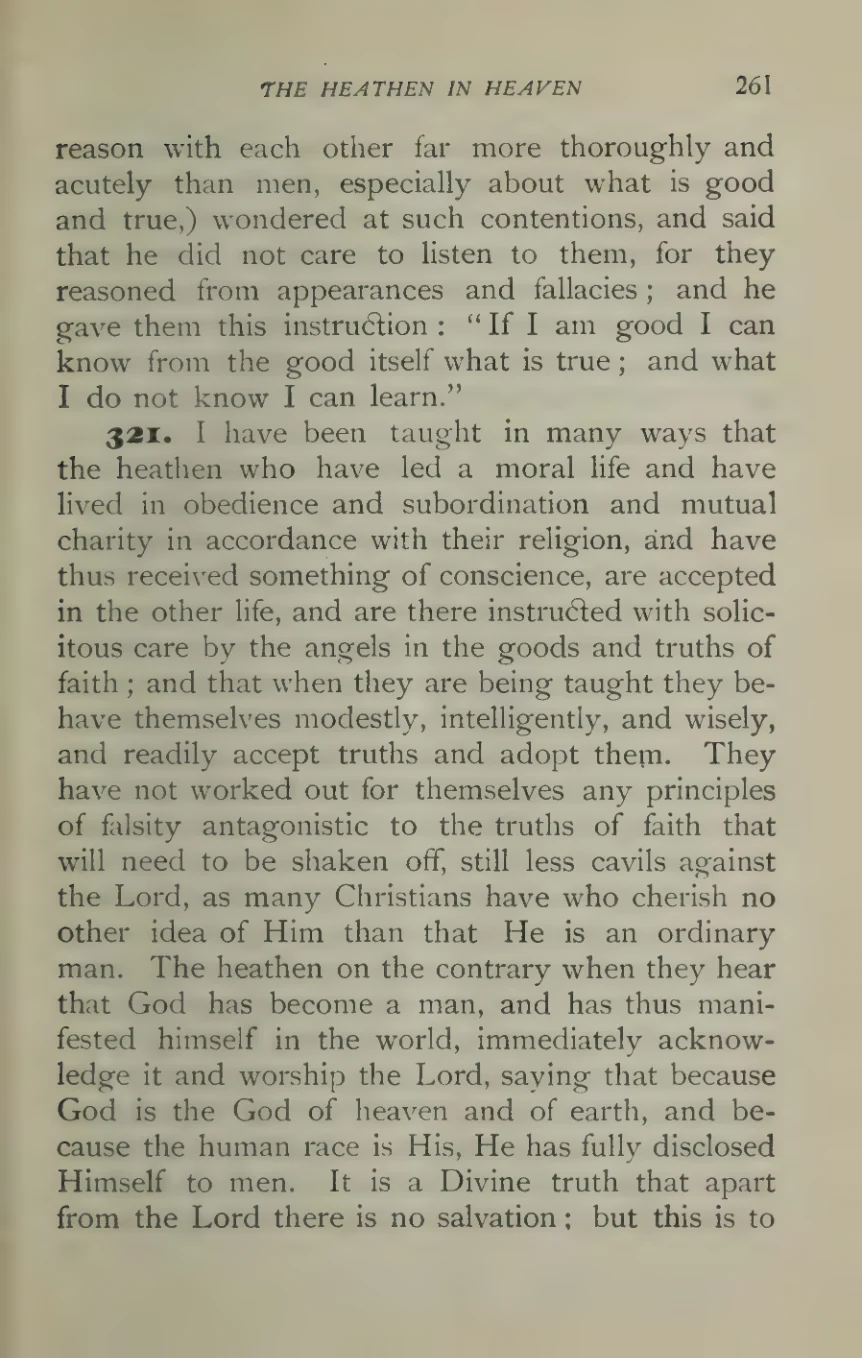
Heaven and Its Wonders and Hell (1916), printed p. 261, Library Reader page 268. Section 321 connects a life of charity with reception and instruction.
Emanuel Swedenborg, Heaven and Its Wonders and Hell, J. C. Ager translation, New York, 1916. Public-domain historical page from the checksum-verified Library PDF. · Image source ↗ · Public Domain
See references (7)
- Heaven and Its Wonders and Hell, printed p. 258, Reader page 265
- Heaven and Its Wonders and Hell, printed p. 259, Reader page 266
- Heaven and Its Wonders and Hell, printed p. 260, Reader page 267
- Heaven and Its Wonders and Hell, printed p. 261, Reader page 268
- Heaven and Its Wonders and Hell, printed p. 262, Reader page 269
- Heaven and Its Wonders and Hell, printed p. 266, Reader page 273
- Heaven and Its Wonders and Hell, printed p. 267, Reader page 274
The Divine Comedy by Dante Alighieri
In Paradise XIX, Dante Alighieri’s eagle asks the reader to consider a just person born where Christ is unknown. It cautions against presuming to judge from a limited view. Paradise XX then names the Roman emperor Trajan and the Trojan Ripheus among the blessed and gives each a particular history of faith and grace. [11][12][13][14][15][16][17]
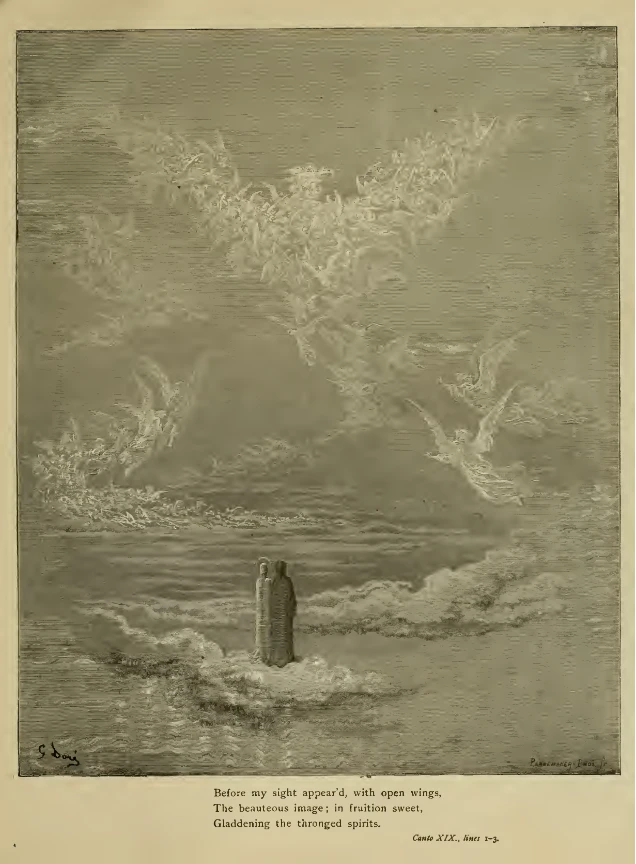
Gustave Doré, Paradise XIX. The speaking eagle bears the question of a just person born where Christ is unknown.
Purgatory and Paradise, 1901. Dante Alighieri, translated by Henry Francis Cary, designs by Gustave Doré. Thompson & Thomas, Chicago. Historical text and original designs Public Domain. · Image source ↗ · Public Domain
Charity, grace and the limits of judgment
Swedenborg describes a general way that people with a charitable life can be received and taught. Dante gives the reader two surprising cases and a warning about the limits of human judgment. Both ask what birth and profession can tell a reader about someone’s destination. [1][2][3][9][6][11][12][13][14][15][16][17][4][5]
The 1916 translation calls the chapter “The Heathen in Heaven”. That term reflects the Christian categories of the source. The chapter tells us how Swedenborg understood the people he discusses and what he thought a life of charity makes possible. [1][5][10][7][8][9]
See references (17)
- Heaven and Its Wonders and Hell, printed p. 258, Reader page 265
- Heaven and Its Wonders and Hell, printed p. 259, Reader page 266
- Heaven and Its Wonders and Hell, printed p. 260, Reader page 267
- Heaven and Its Wonders and Hell, printed p. 261, Reader page 268
- Heaven and Its Wonders and Hell, printed p. 262, Reader page 269
- Heaven and Its Wonders and Hell, printed p. 269, Reader page 276
- Heaven and Its Wonders and Hell, printed p. 266, Reader page 273
- Heaven and Its Wonders and Hell, printed p. 267, Reader page 274
- Heaven and Its Wonders and Hell, printed p. 268, Reader page 275
- Heaven and Its Wonders and Hell, printed p. 264, Reader page 271
- Purgatory and Paradise, Reader page 297
- Purgatory and Paradise, Reader page 298
- Purgatory and Paradise, Reader page 299
- Purgatory and Paradise, Reader page 301
- Purgatory and Paradise, Reader page 302
- Purgatory and Paradise, Reader page 303
- Purgatory and Paradise, Reader page 304
Read further in the library

Heaven and Its Wonders and Hell
Reading note
The separately titled account draws on exact passages in the consulted Library edition.
Purgatory and Paradise: The Vision of Dante
Reading note
Separately attributed comparison with exact previously researched Library passages.
Sources
See references (18)
- Heaven and Its Wonders and Hell, printed p. 258, Reader page 265Emanuel Swedenborg, Heaven and Its Wonders and Hell, From Things Heard and Seen, translated by J. C. Ager. American Swedenborg Printing and Publishing Society, New York, 1916. Latin original first published in 1758. Numbered sections and exact pages refer to this consulted edition. Claims of spiritual experience remain attributed.Read this page in Heaven and Its Wonders and Hell ↗Return to text ↑
- Heaven and Its Wonders and Hell, printed p. 259, Reader page 266Emanuel Swedenborg, Heaven and Its Wonders and Hell, From Things Heard and Seen, translated by J. C. Ager. American Swedenborg Printing and Publishing Society, New York, 1916. Latin original first published in 1758. Numbered sections and exact pages refer to this consulted edition. Claims of spiritual experience remain attributed.Read this page in Heaven and Its Wonders and Hell ↗Return to text ↑
- Heaven and Its Wonders and Hell, printed p. 260, Reader page 267Emanuel Swedenborg, Heaven and Its Wonders and Hell, From Things Heard and Seen, translated by J. C. Ager. American Swedenborg Printing and Publishing Society, New York, 1916. Latin original first published in 1758. Numbered sections and exact pages refer to this consulted edition. Claims of spiritual experience remain attributed.Read this page in Heaven and Its Wonders and Hell ↗Return to text ↑
- Heaven and Its Wonders and Hell, printed p. 261, Reader page 268Emanuel Swedenborg, Heaven and Its Wonders and Hell, From Things Heard and Seen, translated by J. C. Ager. American Swedenborg Printing and Publishing Society, New York, 1916. Latin original first published in 1758. Numbered sections and exact pages refer to this consulted edition. Claims of spiritual experience remain attributed.Read this page in Heaven and Its Wonders and Hell ↗Return to text ↑
- Heaven and Its Wonders and Hell, printed p. 262, Reader page 269Emanuel Swedenborg, Heaven and Its Wonders and Hell, From Things Heard and Seen, translated by J. C. Ager. American Swedenborg Printing and Publishing Society, New York, 1916. Latin original first published in 1758. Numbered sections and exact pages refer to this consulted edition. Claims of spiritual experience remain attributed.Read this page in Heaven and Its Wonders and Hell ↗Return to text ↑
- Heaven and Its Wonders and Hell, printed p. 269, Reader page 276Emanuel Swedenborg, Heaven and Its Wonders and Hell, From Things Heard and Seen, translated by J. C. Ager. American Swedenborg Printing and Publishing Society, New York, 1916. Latin original first published in 1758. Numbered sections and exact pages refer to this consulted edition. Claims of spiritual experience remain attributed.Read this page in Heaven and Its Wonders and Hell ↗Return to text ↑
- Heaven and Its Wonders and Hell, printed p. 266, Reader page 273Emanuel Swedenborg, Heaven and Its Wonders and Hell, From Things Heard and Seen, translated by J. C. Ager. American Swedenborg Printing and Publishing Society, New York, 1916. Latin original first published in 1758. Numbered sections and exact pages refer to this consulted edition. Claims of spiritual experience remain attributed.Read this page in Heaven and Its Wonders and Hell ↗Return to text ↑
- Heaven and Its Wonders and Hell, printed p. 267, Reader page 274Emanuel Swedenborg, Heaven and Its Wonders and Hell, From Things Heard and Seen, translated by J. C. Ager. American Swedenborg Printing and Publishing Society, New York, 1916. Latin original first published in 1758. Numbered sections and exact pages refer to this consulted edition. Claims of spiritual experience remain attributed.Read this page in Heaven and Its Wonders and Hell ↗Return to text ↑
- Heaven and Its Wonders and Hell, printed p. 268, Reader page 275Emanuel Swedenborg, Heaven and Its Wonders and Hell, From Things Heard and Seen, translated by J. C. Ager. American Swedenborg Printing and Publishing Society, New York, 1916. Latin original first published in 1758. Numbered sections and exact pages refer to this consulted edition. Claims of spiritual experience remain attributed.Read this page in Heaven and Its Wonders and Hell ↗Return to text ↑
- Heaven and Its Wonders and Hell, printed p. 264, Reader page 271Emanuel Swedenborg, Heaven and Its Wonders and Hell, From Things Heard and Seen, translated by J. C. Ager. American Swedenborg Printing and Publishing Society, New York, 1916. Latin original first published in 1758. Numbered sections and exact pages refer to this consulted edition. Claims of spiritual experience remain attributed.Read this page in Heaven and Its Wonders and Hell ↗Return to text ↑
- Purgatory and Paradise, Reader page 297Dante Alighieri, The Divine Comedy, translated by Henry Francis Cary, designs by Gustave Doré. Inferno: undated New Edition, Thompson & Thomas, Chicago. Purgatory and Paradise: New Edition, Thompson & Thomas, Chicago, 1901. Canto arguments are editorial matter and are distinguished from the poem.Read this page in Purgatory and Paradise: The Vision of Dante ↗Return to text ↑
- Purgatory and Paradise, Reader page 298Dante Alighieri, The Divine Comedy, translated by Henry Francis Cary, designs by Gustave Doré. Inferno: undated New Edition, Thompson & Thomas, Chicago. Purgatory and Paradise: New Edition, Thompson & Thomas, Chicago, 1901. Canto arguments are editorial matter and are distinguished from the poem.Read this page in Purgatory and Paradise: The Vision of Dante ↗Return to text ↑
- Purgatory and Paradise, Reader page 299Dante Alighieri, The Divine Comedy, translated by Henry Francis Cary, designs by Gustave Doré. Inferno: undated New Edition, Thompson & Thomas, Chicago. Purgatory and Paradise: New Edition, Thompson & Thomas, Chicago, 1901. Canto arguments are editorial matter and are distinguished from the poem.Read this page in Purgatory and Paradise: The Vision of Dante ↗Return to text ↑
- Purgatory and Paradise, Reader page 301Dante Alighieri, The Divine Comedy, translated by Henry Francis Cary, designs by Gustave Doré. Inferno: undated New Edition, Thompson & Thomas, Chicago. Purgatory and Paradise: New Edition, Thompson & Thomas, Chicago, 1901. Canto arguments are editorial matter and are distinguished from the poem.Read this page in Purgatory and Paradise: The Vision of Dante ↗Return to text ↑
- Purgatory and Paradise, Reader page 302Dante Alighieri, The Divine Comedy, translated by Henry Francis Cary, designs by Gustave Doré. Inferno: undated New Edition, Thompson & Thomas, Chicago. Purgatory and Paradise: New Edition, Thompson & Thomas, Chicago, 1901. Canto arguments are editorial matter and are distinguished from the poem.Read this page in Purgatory and Paradise: The Vision of Dante ↗Return to text ↑
- Purgatory and Paradise, Reader page 303Dante Alighieri, The Divine Comedy, translated by Henry Francis Cary, designs by Gustave Doré. Inferno: undated New Edition, Thompson & Thomas, Chicago. Purgatory and Paradise: New Edition, Thompson & Thomas, Chicago, 1901. Canto arguments are editorial matter and are distinguished from the poem.Read this page in Purgatory and Paradise: The Vision of Dante ↗Return to text ↑
- Purgatory and Paradise, Reader page 304Dante Alighieri, The Divine Comedy, translated by Henry Francis Cary, designs by Gustave Doré. Inferno: undated New Edition, Thompson & Thomas, Chicago. Purgatory and Paradise: New Edition, Thompson & Thomas, Chicago, 1901. Canto arguments are editorial matter and are distinguished from the poem.Read this page in Purgatory and Paradise: The Vision of Dante ↗Return to text ↑
- Purgatory and Paradise, Reader page 293Dante Alighieri, The Divine Comedy, translated by Henry Francis Cary, designs by Gustave Doré. Inferno: undated New Edition, Thompson & Thomas, Chicago. Purgatory and Paradise: New Edition, Thompson & Thomas, Chicago, 1901. Canto arguments are editorial matter and are distinguished from the poem.Read this page in Purgatory and Paradise: The Vision of Dante ↗