The Nine Realms of Norse Mythology and Yggdrasil
Explore Asgard, Midgard and the other realms often shown around Yggdrasil. Compare the Eddas’ nine worlds, three roots and differing accounts.
In this article
Two maps of Yggdrasil’s roots
The Eddas describe the tree from different vantage points. Compare the three roots before reading the modern nine-realm list.
The roots in the poem and the prose
This chart shows which places each text names. The numbered rows give the order of each text’s list.
First root named
- Grímnismál 31
- Hel lives beneath one.
- Gylfaginning 15
- One root is among the Æsir.
Second root named
- Grímnismál 31
- Frost giants live beneath another.
- Gylfaginning 15
- One root extends among frost giants, where the gap once was.
Third root named
- Grímnismál 31
- Human beings live beneath the third.
- Gylfaginning 15
- One root extends over Niflheim, with Hvergelmir beneath it.
Do the Eddas list all nine realms?
Two Eddic poems speak of nine worlds. At the start of Völuspá a seer remembers nine worlds and an ancient tree. In Vafþrúðnismál a giant describes travelling through nine worlds in a contest of knowledge with Odin. Neither passage stops to name nine destinations in sequence. The list below is a practical collection of places that readers often see in modern maps. [1][3]
Yggdrasil gives those stories a shared point of reference. Grímnismál places Hel, frost giants and human beings beneath three roots. In Snorri’s Gylfaginning, one root extends among the gods, another among the frost giants and another over Niflheim. Comparing the two gives a better reading aid than assigning each of nine worlds to a fixed branch. [2][4]
Nine familiar realm names and where to find them
- Asgard. In Snorri’s account Asgard is the home or stronghold of the Æsir. Its name is separate from Valhalla, the hall associated with Odin. [4][2]
- Midgard. The enclosed place of human beings. In Gylfaginning it is made from Ymir’s brows, with a sea and the giant territories beyond it. [4]
- Jotunheim. The land of the giants. Snorri places a root of Yggdrasil among the frost giants and situates Mímir’s well in that region. [4]
- Vanaheim. The home associated with the Vanir, from which Njord comes before living among the Æsir. Vafþrúðnismál uses his origin to explain his place among the gods. [3][4]
- Alfheim. Grímnismál says the gods gave Alfheim to Freyr as a tooth-gift. Snorri makes it the dwelling of the light elves. [2][4]
- Nidavellir or Svartalfheim. Völuspá names Nidavellir in connection with a hall of Sindri’s kin. Snorri names Svartalfheim in an episode involving dwarfs. Modern lists often put one name or the other in this slot. Treat their equivalence as a modern simplification. [1][4]
- Niflheim. A region of cold and mist in Snorri’s creation story. It contains the spring Hvergelmir and gives an important reference point for the roots of the tree. [4]
- Muspelheim. The hot region at the southern side of Snorri’s creation account. Surtr guards its boundary and enters the story again at Ragnarök. [4]
- Hel. The name of a ruler and of the realm linked to her. Read Grímnismál and Gylfaginning together to see why modern maps differ on where to draw Hel in relation to Niflheim. [2][4]
The wells, the eagle and the creatures of Yggdrasil
Grímnismál follows a squirrel between the eagle above and Níðhöggr below. It also describes harts feeding on the tree. Völuspá places the norns at the well of Urðr. These recurring routes and meetings are easier to trace in the poems than a single diagram of the nine worlds. They make the tree a living place where events happen. [2][1]
Bagge’s nineteenth-century illustration helps readers see the tree as a whole. Its visual arrangement belongs to the illustrator’s edition. Use it alongside the two different accounts of the roots and notice which links come from a stanza and which came later on the printed page. [5][2][4]
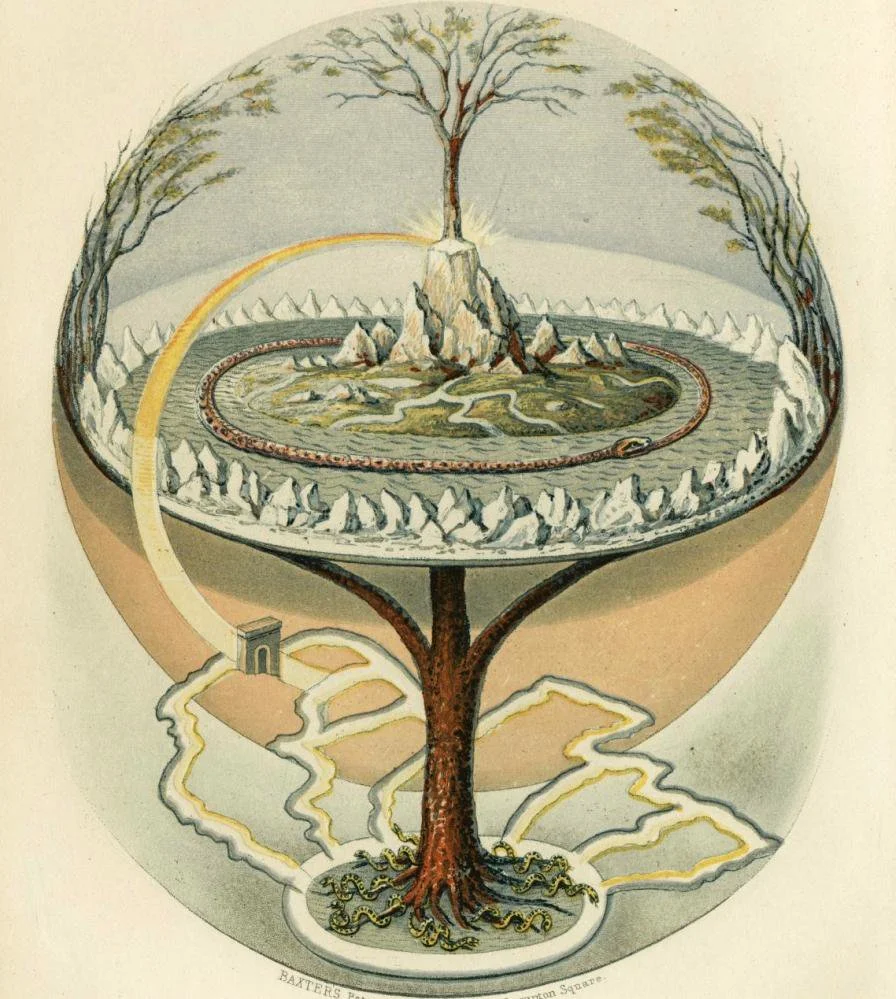
Oluf Olufsen Bagge’s nineteenth-century Yggdrasil, published in Northern Antiquities in 1847.
Public-domain illustration via Wikimedia Commons. · Image source ↗ · Public Domain
Read further in the library
The Children of Odin
Reading note
Padraic Colum’s illustrated modern retelling of the Norse myths.
Sources
See references (5)
- Völuspá, stanzas 2, 19–20 and 37 ↗The Poetic Edda, translated by H. A. BellowsReturn to text ↑
- Grímnismál, stanzas 4–5 and 29–35 ↗The Poetic Edda, translated by H. A. BellowsReturn to text ↑
- Vafþrúðnismál, stanzas 38–43 ↗The Poetic Edda, translated by H. A. BellowsReturn to text ↑
- Snorri Sturluson, Gylfaginning ↗The Prose Edda, translated by Arthur Gilchrist Brodeur, 1916Return to text ↑
- Oluf Olufsen Bagge, Yggdrasil, 1847 ↗Northern Antiquities, public-domain plate via Wikimedia CommonsReturn to text ↑