Valhalla, Fólkvangr and Hel in Norse Mythology
Where do the dead go in Norse mythology? Compare Odin’s Valhalla, Freyja’s Fólkvangr and Hel in the Eddas, with exact links to the passages.
In this article
Compare the three destinations
Choose a destination to open the relevant passages and see what each source says.
Where do the dead go in Norse mythology?
The Eddas describe several destinations. Odin selects battle-slain people for Valhalla. In Grímnismál, Freyja takes half the slain in Fólkvangr and Odin has the other half. In Snorri’s prose, Hel receives those sent to her and also holds Baldr after his violent death. The passages have different aims, so read each statement in the story or poem that makes it. [1][2][5][7]
These three names are the starting points here. A hall, a domain and a ruler’s realm are different kinds of place. The images above distinguish a Viking-Age carved object from later works that interpret Freyja and the story of Hel. [9][14][15][11]
See references (8)
- Grímnismál 8 · Odin chooses the slain at Valhalla
- Grímnismál 14 · Freyja and the division of the slain
- Gylfaginning 34 · Hel receives authority over the dead sent to her
- Gylfaginning 49 · Hermóðr rides to Hel after Baldr’s death
- Swedish History Museum · Tjängvidestenen
- Swedish History Museum · Sources for Norse mythology
- Freyja Seeking Her Husband
- Hermod before Hela
Valhalla · Odin’s hall of the slain
Grímnismál 8 places the golden hall in Glaðsheimr and describes Odin choosing those who have died by weapons. Stanza 23 gives the hall hundreds of doors and describes eight hundred fighters emerging from each to face the wolf. The scale of the image belongs to the poem’s account of the army gathered for the final battle. [1][3]
Gylfaginning 41 follows the Einherjar inside Odin’s hall. When they have armed themselves, they fight one another in the enclosure. They then ride back to sit and drink. The episode gives a daily routine to the fighters whose massed departure the poem describes. Read it alongside the stanza about Freyja before generalising about all those who die in battle. [6][3][2]
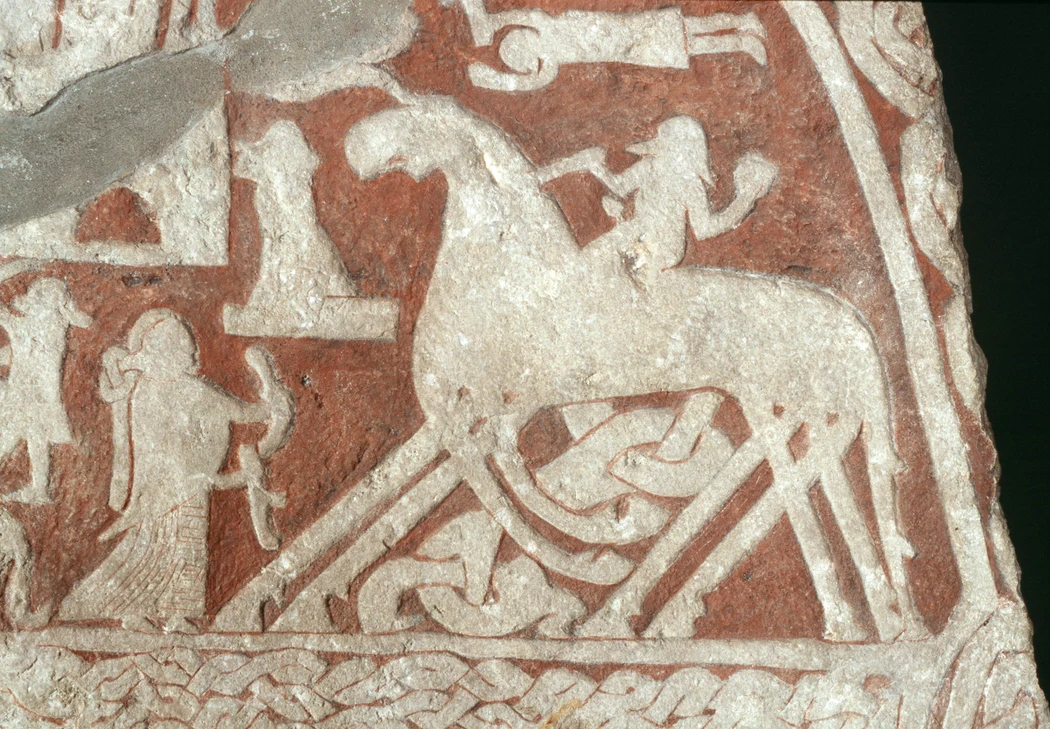
The horse and horn-bearing figure have been read as a welcome related to Valhalla. The rider’s identity remains open to interpretation.
Christer Åhlin, Swedish History Museum, 108203_HST. CC BY 4.0. Resized for the web. · Image source ↗ · CC BY 4.0
Fólkvangr · Freyja’s share of the slain
Grímnismál 14 says Freyja chooses half the slain each day. She decides the seating in the hall, and Odin has the other half. Fólkvangr is the ninth place named in this passage’s sequence. That number belongs to the poem’s enumeration and supplies no rule for how a particular fighter is selected. [2][1]
Gylfaginning 24 quotes the stanza while describing Freyja. The prose calls her hall Sessrúmnir. The poem supplies the division, and the prose helps distinguish the wider dwelling from the named hall. Both accounts leave the criteria of individual selection open. The cat-drawn chariot described later in that chapter inspired images like Blommér’s painting. [2][4][14]
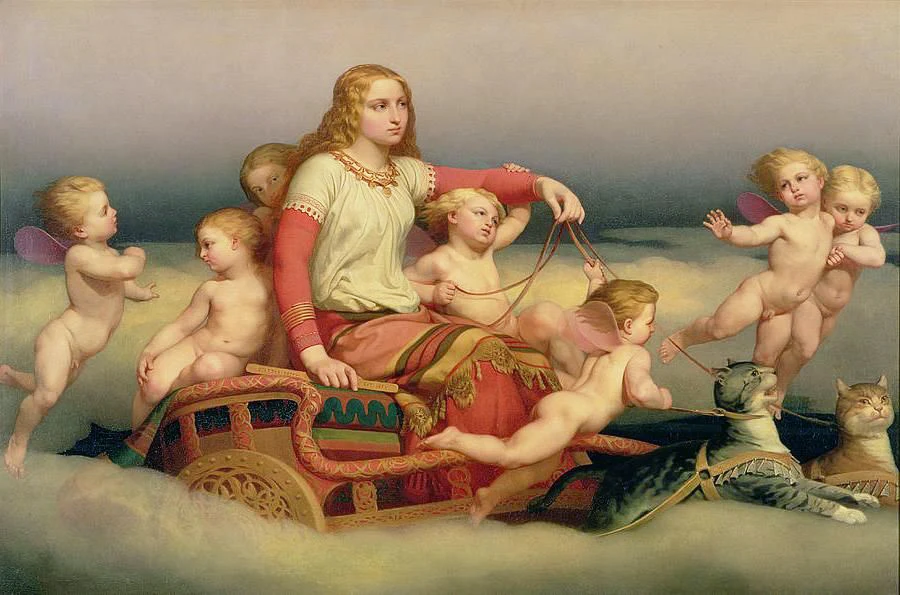
Blommér depicts Freyja with her cats, an attribute also mentioned in Gylfaginning 24. The painting is a nineteenth-century interpretation of a different episode.
Nils Blommér, 1852, Nationalmuseum, NM 1198. Public domain. · Image source ↗ · Public Domain
Hel · the ruler and the realm
Hel is the name of Loki’s daughter and is also used for the destination to which Hermóðr rides. In Gylfaginning 34 Odin sends her into Niflheim and grants her authority over those sent to her, described there as people who die of illness or old age. The passage evokes a forbidding household by giving names to its gate, dish, bed and other furnishings. [5][7]
Gylfaginning 49 gives Baldr a very different death and still places him in Hel’s hall. Hermóðr rides to the river Gjöll, crosses the bridge, jumps the gate on Sleipnir and finds Baldr seated in the hall. Hel sets a condition for his return. This story makes it hard to use the description in chapter 34 as a universal rule. [5][7]
Hel can sound like the English word hell to a modern reader. Baldr’s presence in her hall shows why it is misleading to infer that every person sent there is being punished for wrongdoing. Snorri gives a distinct account of punitive dwellings in chapter 52. The episodes can be read together while preserving the work each scene does. [7][8]
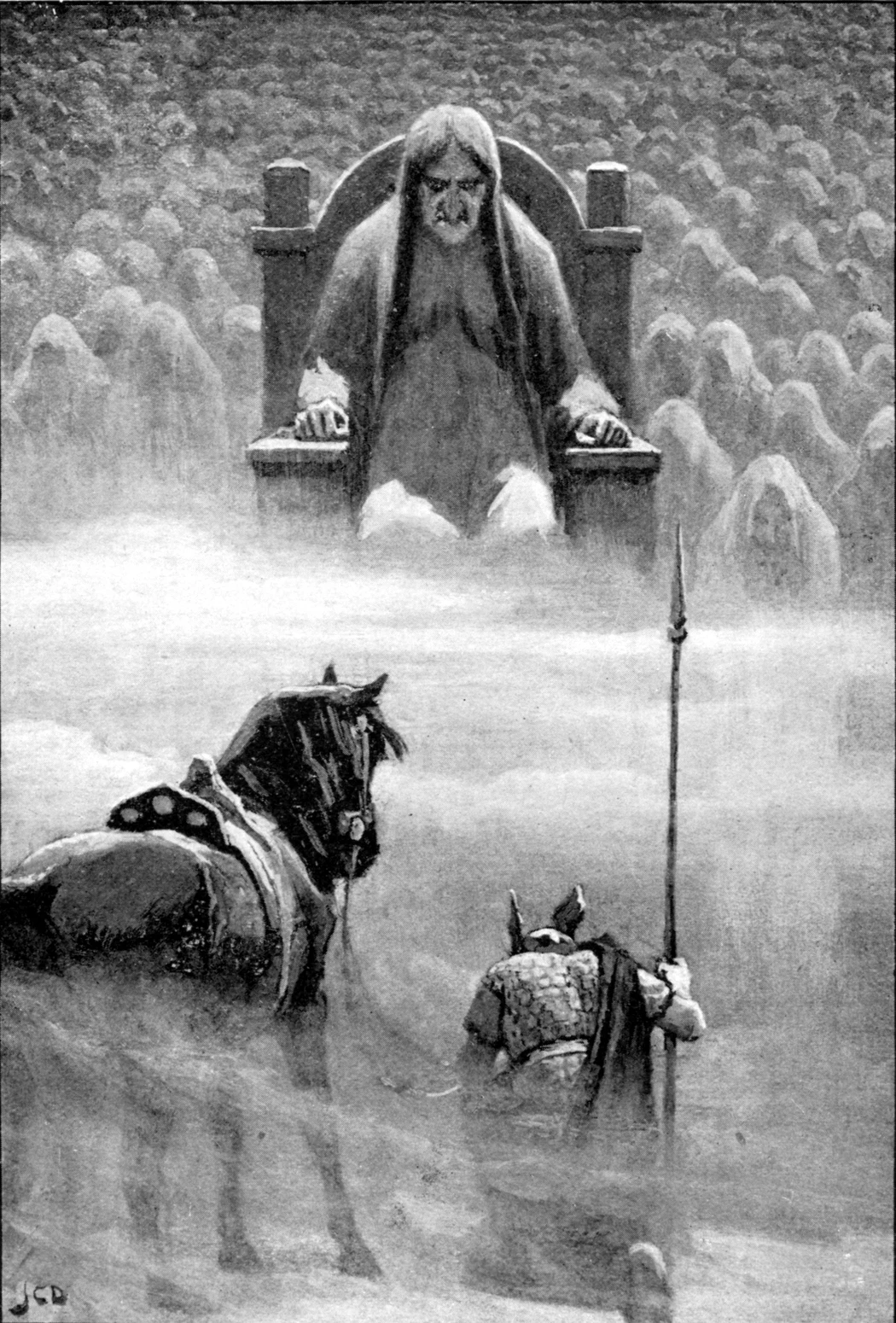
Dollman’s illustration follows the encounter in Snorri in which Hermóðr speaks to Hel herself.
John Charles Dollman, 1909, published in H. A. Guerber’s Myths of the Norsemen. Public domain. · Image source ↗ · Public Domain
Which passage tells you what?
Use the direct links to compare a stanza with a whole prose episode. In the parallel edition, select the named historical English translation or read the Old Norse. The passages answer different questions about selection, daily life and who can leave the realm. [1][2][6][7]
- Who chooses for Valhalla?
- Grímnismál 8 names Odin. Gylfaginning 41 describes the fighters once they are in his hall.
- Who shares the battle-dead?
- Grímnismál 14 names Freyja and Odin. Gylfaginning 24 quotes the stanza and also names Freyja’s hall.
- Who goes to Hel?
- Gylfaginning 34 mentions illness and old age. Gylfaginning 49 sends Baldr there after a violent death.
See references (6)
- Grímnismál 8 · Odin chooses the slain at Valhalla
- Grímnismál 14 · Freyja and the division of the slain
- Gylfaginning 24 · Freyja and her hall Sessrúmnir
- Gylfaginning 34 · Hel receives authority over the dead sent to her
- Gylfaginning 41 · The daily life of the Einherjar
- Gylfaginning 49 · Hermóðr rides to Hel after Baldr’s death
What can a stone or a grave tell us?
The Viking-Age picture stone from Tjängvide shows a many-legged horse, a rider and a figure with a horn. Its museum catalogue identifies Sleipnir among the motifs. A research exhibition record allows more than one reading of the rider, including Odin and a dead person arriving at Valhalla. The carved shapes are visible evidence. The proposed names depend on comparison with stories and other images. [9][10][13]
The Eddic works were written down after the Viking Age. Burial archaeology meanwhile preserves a range of local practices, including differences in what happened to the body and how a burial was marked. The evidence can show how people commemorated the dead. It rarely identifies by name the place a family expected a particular person to go. [11][12]
Read Colum’s version beside Snorri
In Colum’s retelling, Hermod reaches the bridge on printed page 196. On page 197 the bridge-keeper tells him what will have to happen before Hela releases Baldur. On page 198 Thaukt refuses to weep and Hermod concludes he cannot go on to Hela’s dwelling. Each page opens at that moment in the Reader. [16][17][18]
Compare Gylfaginning 49. Hermóðr travels past the bridge and talks directly to Hel, who states the condition. The meeting is the scene Dollman illustrates. Keeping the two accounts open side by side shows which parts a reteller has kept and where the action has moved. [7][17][18][15]
Read further in the library
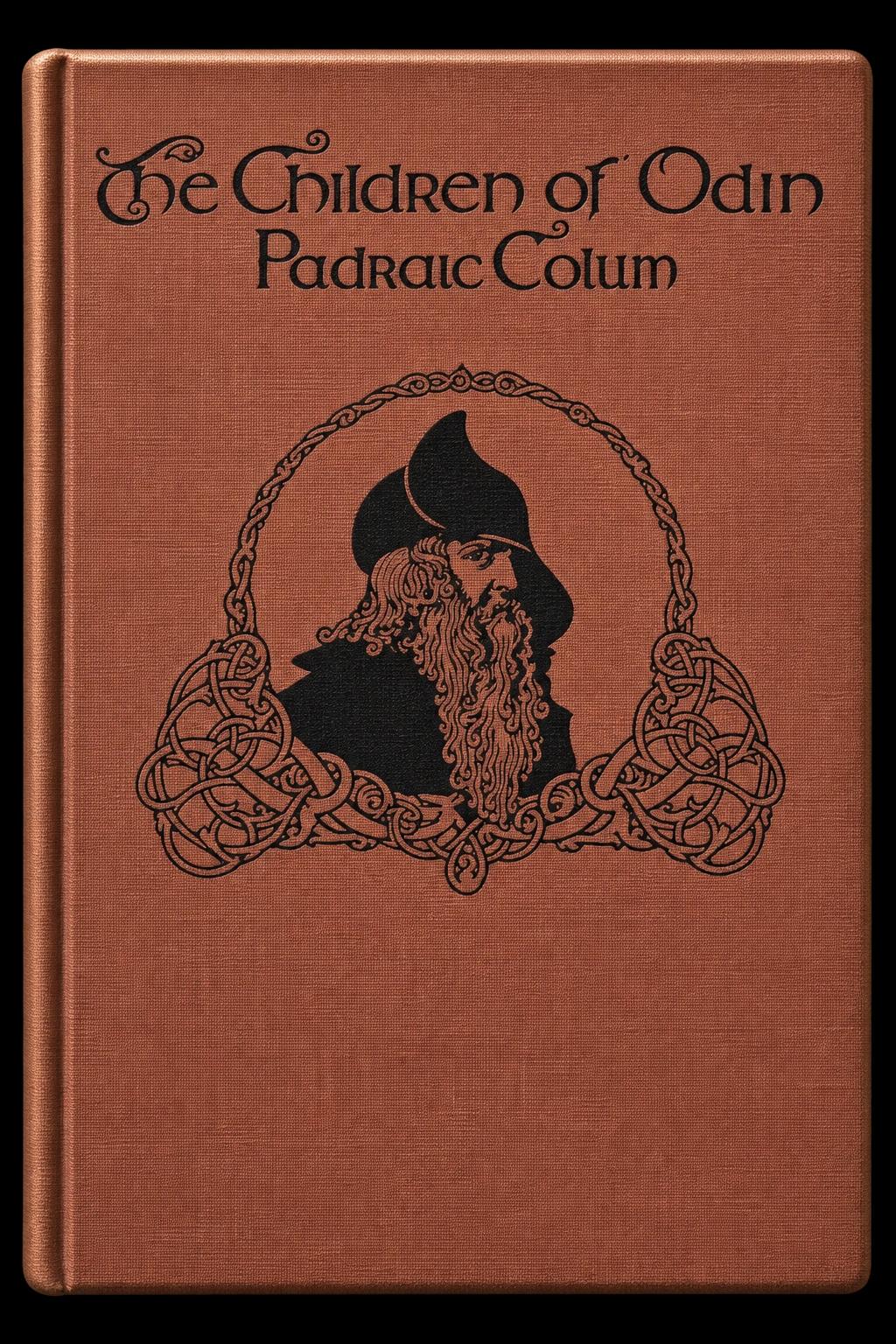
The Children of Odin
Reading note
Read Hermod’s approach to Hela’s realm, the bridge-keeper’s condition and the failed ransom in Colum.
Sources
See references (18)
- Grímnismál 8 · Odin chooses the slain at Valhalla ↗Henry Adams Bellows, The Poetic Edda (1923), numbered stanza, with the Old Norse beside it.Return to text ↑
- Grímnismál 14 · Freyja and the division of the slain ↗Henry Adams Bellows, The Poetic Edda (1923), numbered stanza, with the Old Norse beside it.Return to text ↑
- Grímnismál 23 · The hall’s doors and the battle with the wolf ↗Henry Adams Bellows, The Poetic Edda (1923), numbered stanza, with the Old Norse beside it.Return to text ↑
- Gylfaginning 24 · Freyja and her hall Sessrúmnir ↗Snorri Sturluson, The Prose Edda, Arthur Gilchrist Brodeur translation (1916).Return to text ↑
- Gylfaginning 34 · Hel receives authority over the dead sent to her ↗Snorri Sturluson, The Prose Edda, Arthur Gilchrist Brodeur translation (1916).Return to text ↑
- Gylfaginning 41 · The daily life of the Einherjar ↗Snorri Sturluson, The Prose Edda, Arthur Gilchrist Brodeur translation (1916).Return to text ↑
- Gylfaginning 49 · Hermóðr rides to Hel after Baldr’s death ↗Snorri Sturluson, The Prose Edda, Arthur Gilchrist Brodeur translation (1916).Return to text ↑
- Gylfaginning 52 · Dwelling places after Ragnarök ↗Snorri Sturluson, The Prose Edda, Arthur Gilchrist Brodeur translation (1916).Return to text ↑
- Swedish History Museum · Tjängvidestenen ↗Object 108203_HST, Gotland, dated 800–1100 by the museum.Return to text ↑
- Nara to Norwich · Tjängvide Memorial Stone ↗Research exhibition record discusses Odin or the deceased as possible identities for the rider.Return to text ↑
- Swedish History Museum · Sources for Norse mythology ↗Curatorial introduction to the Eddas and to using objects and later written sources.Return to text ↑
- Swedish History Museum · The living and the dead ↗Curatorial account of variation in burial and funerary ceremonies.Return to text ↑
- Tjängvide picture stone, detail ↗Christer Åhlin, Swedish History Museum, 108203_HST. CC BY 4.0. Resized for the web.Return to text ↑
- Freyja Seeking Her Husband ↗Nils Blommér, 1852, Nationalmuseum, NM 1198. Public domain.Return to text ↑
- Hermod before Hela ↗John Charles Dollman, 1909, published in H. A. Guerber’s Myths of the Norsemen. Public domain.Return to text ↑
- Colum, printed page 196 · Hermod reaches the bridge and speaks with its keeperPadraic Colum, The Children of Odin, printed page 196.Read this page in The Children of Odin ↗Return to text ↑
- Colum, printed page 197 · The condition for Baldur’s returnPadraic Colum, The Children of Odin, printed page 197.Read this page in The Children of Odin ↗Return to text ↑
- Colum, printed page 198 · Thaukt refuses and Hermod turns backPadraic Colum, The Children of Odin, printed page 198.Read this page in The Children of Odin ↗Return to text ↑