Michael Maier, Atalanta Fugiens (1618)
The Philosophical Coral in Maier
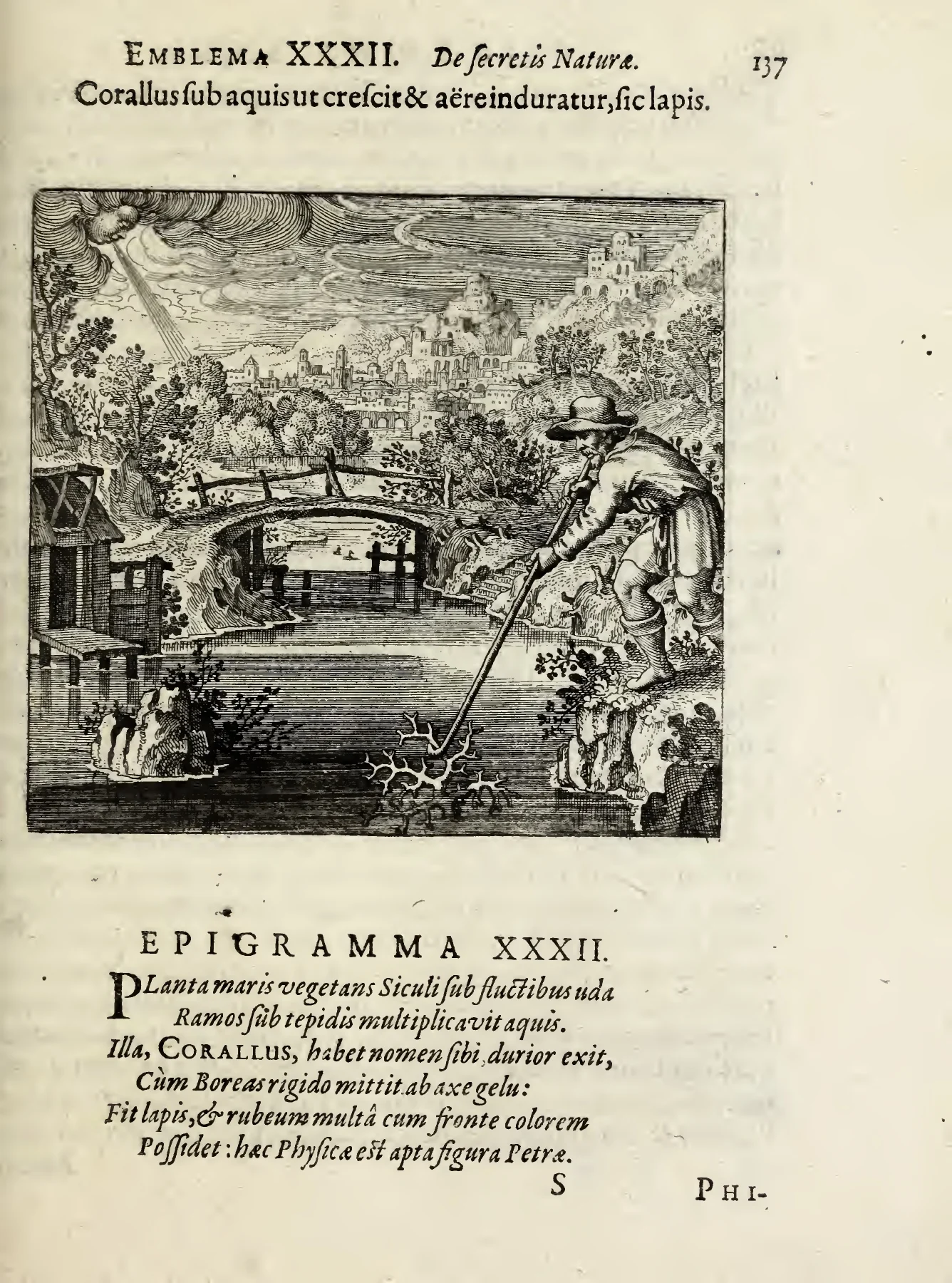
In Emblem XXXII, a man gathers branching coral from the water. Maier’s motto compares coral growing under water and hardening in air with the stone. The discourse treats coral as a marine plant and asks where its hardening and colouring powers arise. He then develops an analogy between coral’s growth and the imagined development of the philosophical stone from a mercurial water. Redness becomes especially important in the final account of coagulation. The passage moves between marine curiosities, historical natural philosophy and an alchemical theory of growth. Those accounts explain why this particular image interested Maier; they are not modern descriptions of coral, amber or the biological production of marine substances.
Loading your archive…
In the sources
Growth and hardening
DocumentedThe motto compares underwater growth and hardening in air with the stone; the discourse elaborates the comparison.
Redness and coagulation
DocumentedMaier links the coral comparison with the appearance of a red colour in the stone’s final coagulation.
Context & interpretation
Maier’s early modern natural philosophy is attributed as historical thought. Coral’s classification and the alchemical changes described here are not presented as current biological or chemical facts.
Original passages
Source 1
Atalanta Fugiens
CorallusOpen this page in the book
Passage & edition details
Location recorded at citation review: Atalanta Fugiens (1618), Emblem 32, printed p. 137
Actual original Latin plate and complete two-page discourse inspected; short Latin identifiers use normalized spacing/ligatures. Historical English translation consulted.
- Edition
- IMJ-0287-E001
- Reader page
- IMJ-0287-E001-P0138
- Original scan leaf
- 145
- Recorded leaf number
- 145
- Current Reader position
- 138
- Reader verification
- Source-preserving update confirmed
Source 2
Atalanta Fugiens
lapidem suum vegetabilemOpen this page in the book
Passage & edition details
Location recorded at citation review: Atalanta Fugiens (1618), Emblem 32, printed p. 138
Actual original Latin plate and complete two-page discourse inspected; short Latin identifiers use normalized spacing/ligatures. Historical English translation consulted.
- Edition
- IMJ-0287-E001
- Reader page
- IMJ-0287-E001-P0139
- Original scan leaf
- 146
- Recorded leaf number
- 146
- Current Reader position
- 139
- Reader verification
- Source-preserving update confirmed
Source 3
Atalanta Fugiens
ColorOpen this page in the book
Passage & edition details
Location recorded at citation review: Atalanta Fugiens (1618), Emblem 32, printed p. 139
Actual original Latin plate and complete two-page discourse inspected; short Latin identifiers use normalized spacing/ligatures. Historical English translation consulted.
- Edition
- IMJ-0287-E001
- Reader page
- IMJ-0287-E001-P0140
- Original scan leaf
- 147
- Recorded leaf number
- 147
- Current Reader position
- 140
- Reader verification
- Source-preserving update confirmed
Illustrations
Continue exploring
Ceres, Thetis and Alchemical Nurture
Maier pairs the nurture of Triptolemus and Achilles with the gradual strengthening of his philosophical stone.
Same subject and traditionFour Guides to Alchemy in Maier
Nature, reason, experience and reading become a guide, staff, spectacles and lamp in Maier’s image of inquiry.
Same subject and traditionMercury and Vulcan at the Hearth
Two Mercuries and a furnace introduce Maier’s distinction between the subject’s inward qualities and the heat applied from outside.
Same subject and traditionNaaman’s Washing in Maier
The biblical washing in Jordan becomes Maier’s analogy for the purification of the philosophers’ brass.