Michael Maier, Atalanta Fugiens (1618)
The Potter’s Art in Maier
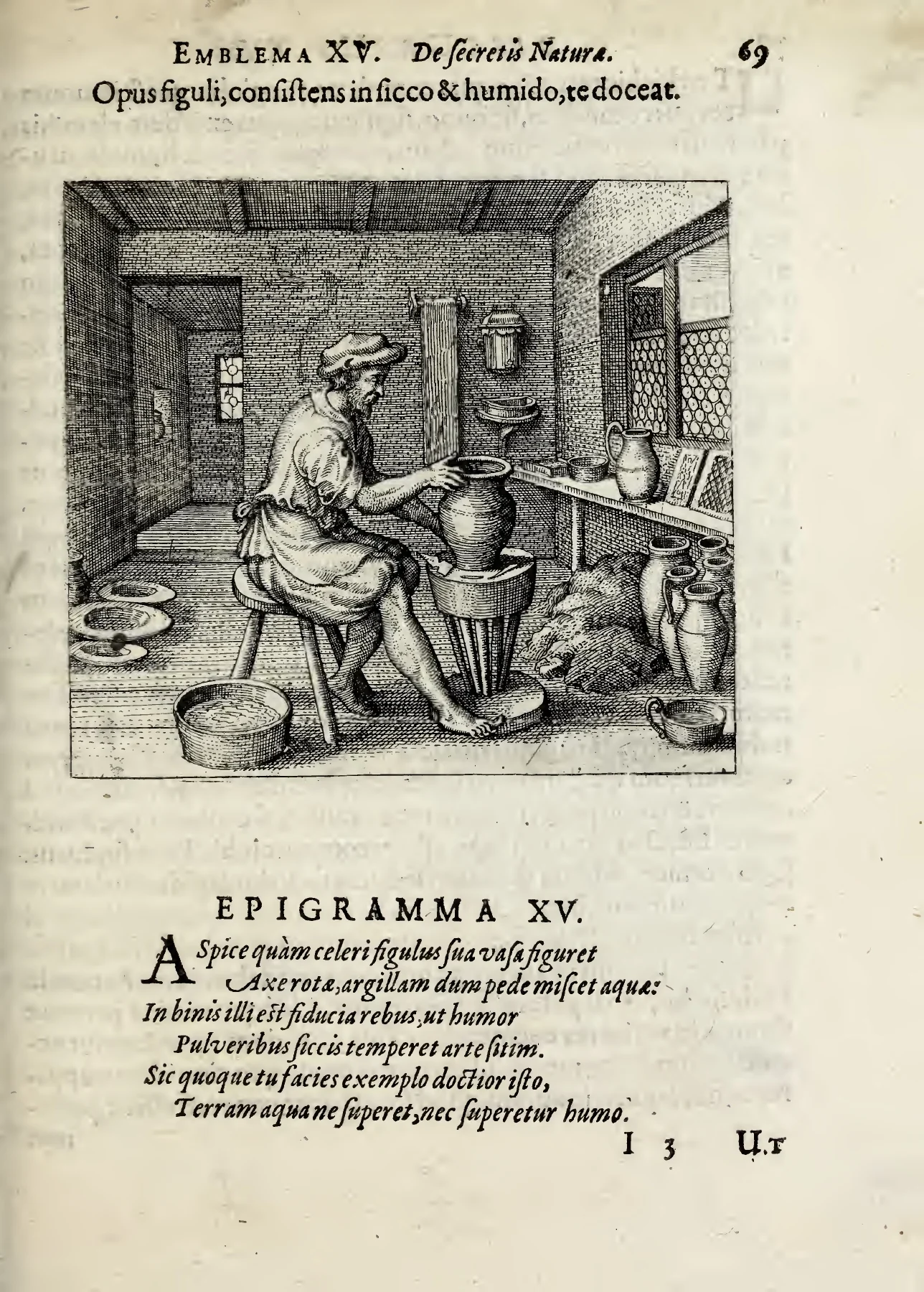
Maier’s fifteenth emblem turns an ordinary workshop into an alchemical comparison. The potter combines clay and water, shapes the mixture on a wheel, allows it to dry and then hardens the vessel in fire. The discourse explains the cooperation of dryness and moisture before drawing a parallel with the philosophers’ work. Maier also limits that parallel: a potter gives a vessel an artificial shape, whereas the tincture he seeks is supposed to acquire a natural form. He follows the comparison with a cautionary account of someone who expected conjurations to turn stored stones into precious metals. The image therefore joins practical craft with an argument about the proper scope of alchemy. It does not claim that firing an ordinary pot produces the philosophers’ stone.
Loading your archive…
In the sources
A sequence of craft operations
DocumentedMaier describes mixing, shaping, drying and firing as the potter’s contribution to a durable vessel.
The comparison has limits
DocumentedThe discourse distinguishes artificial pottery from the natural form claimed for the philosophical tincture and criticises impossible expectations.
Context & interpretation
The account is limited to Maier’s stated comparison between pottery and the philosophical work. It distinguishes the ordinary fired vessel from his claimed natural tincture and gives no recipe for metallic transmutation.
Original passages
Source 1
Atalanta Fugiens
Opus figuliOpen this page in the book
Passage & edition details
Location recorded at citation review: Atalanta Fugiens (1618), Emblem 15, printed p. 69
Actual original Latin plate and complete two-page discourse inspected; short Latin identifiers use normalized spacing/ligatures. Historical English translation consulted.
- Edition
- IMJ-0287-E001
- Reader page
- IMJ-0287-E001-P0070
- Original scan leaf
- 77
- Recorded leaf number
- 77
- Current Reader position
- 70
- Reader verification
- Source-preserving update confirmed
Source 2
Atalanta Fugiens
figulus lutum aquae miscetOpen this page in the book
Passage & edition details
Location recorded at citation review: Atalanta Fugiens (1618), Emblem 15, printed p. 70
Actual original Latin plate and complete two-page discourse inspected; short Latin identifiers use normalized spacing/ligatures. Historical English translation consulted.
- Edition
- IMJ-0287-E001
- Reader page
- IMJ-0287-E001-P0071
- Original scan leaf
- 78
- Recorded leaf number
- 78
- Current Reader position
- 71
- Reader verification
- Source-preserving update confirmed
Source 3
Atalanta Fugiens
res impossibilesOpen this page in the book
Passage & edition details
Location recorded at citation review: Atalanta Fugiens (1618), Emblem 15, printed p. 71
Actual original Latin plate and complete two-page discourse inspected; short Latin identifiers use normalized spacing/ligatures. Historical English translation consulted.
- Edition
- IMJ-0287-E001
- Reader page
- IMJ-0287-E001-P0072
- Original scan leaf
- 79
- Recorded leaf number
- 79
- Current Reader position
- 72
- Reader verification
- Source-preserving update confirmed
Illustrations
Continue exploring
Ceres, Thetis and Alchemical Nurture
Maier pairs the nurture of Triptolemus and Achilles with the gradual strengthening of his philosophical stone.
Same subject and traditionFour Guides to Alchemy in Maier
Nature, reason, experience and reading become a guide, staff, spectacles and lamp in Maier’s image of inquiry.
Same subject and traditionMercury and Vulcan at the Hearth
Two Mercuries and a furnace introduce Maier’s distinction between the subject’s inward qualities and the heat applied from outside.
Same subject and traditionNaaman’s Washing in Maier
The biblical washing in Jordan becomes Maier’s analogy for the purification of the philosophers’ brass.