Michael Maier, Atalanta Fugiens (1618)
Naaman’s Washing in Maier
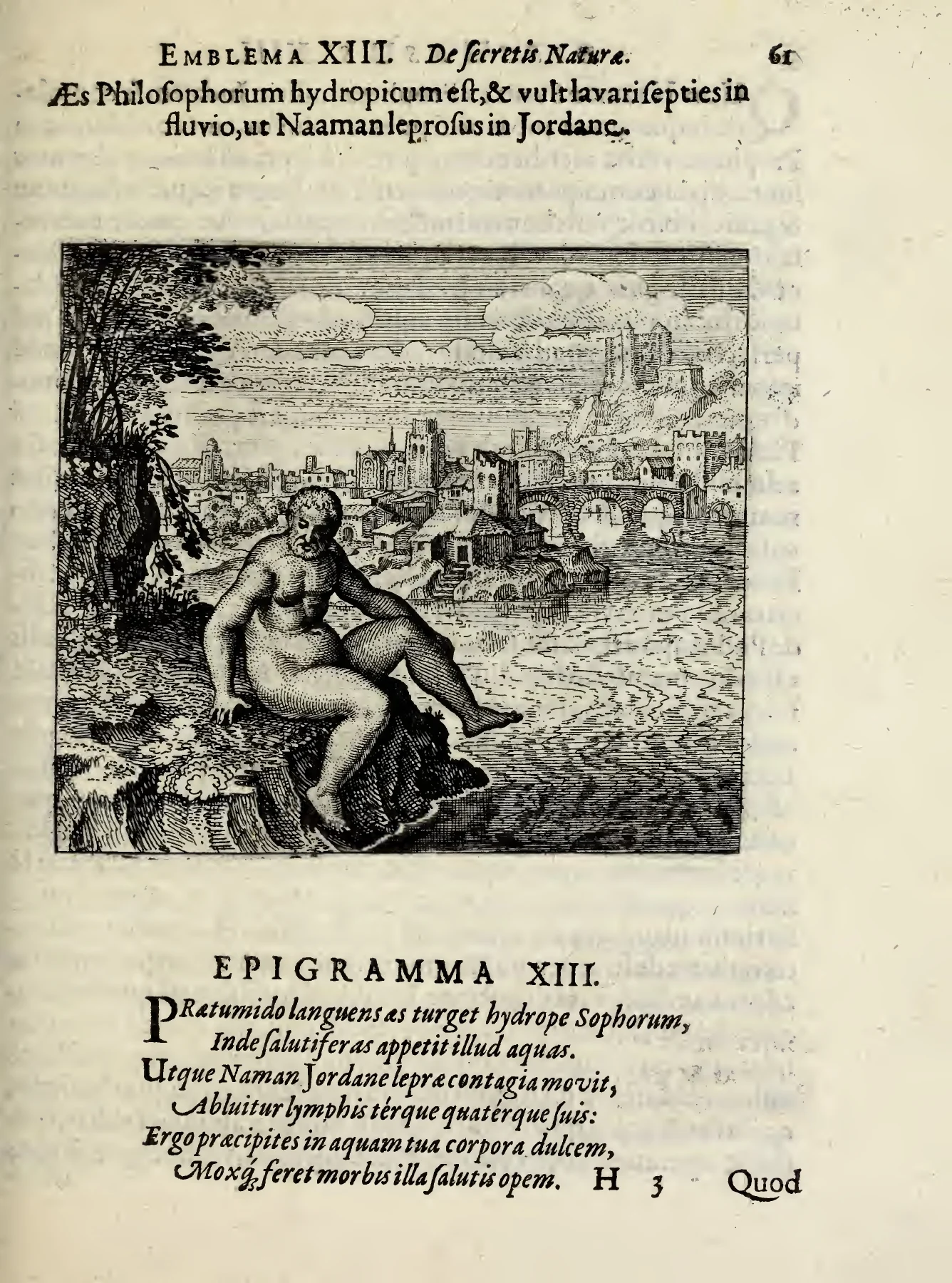
A solitary bather sits beside a river and a distant town in Maier’s thirteenth emblem. Its motto compares the philosophers’ brass, described as swollen with dropsy, to Naaman washing seven times in Jordan. The opening discourse attributes Naaman’s cure to divine power, then considers the alchemical subject through the language of illness and recovery. The comparison gives a familiar scriptural scene a second function inside Maier’s account of purification. His later discussion relies on the medical theories of his own period; the emblem’s claim is a historical analogy between bodies and materials.
Loading your archive…
In the sources
Seven washings
DocumentedThe motto explicitly names Naaman and Jordan and specifies seven washings for the philosophical brass.
A miracle becomes an analogy
DocumentedMaier first attributes the biblical cure to divine omnipotence before applying the language of recovery to his alchemical subject.
Context & interpretation
This is Maier’s alchemical use of the Naaman narrative. The bodily language belongs to his historical account of purification. The scriptural allusion and its comparison with an imperfect material define the scope of this record.
Original passages
Source 1
Atalanta Fugiens
ut Naaman leprosus in JordaneOpen this page in the book
Passage & edition details
Location recorded at citation review: Atalanta Fugiens (1618), Emblem 13, motto, engraving and epigram, printed p. 61
Original scan and printed heading inspected; short Latin quotation normalizes spacing and ligatures. Historical English text consulted in Furnace and Fugue.
- Edition
- IMJ-0287-E001
- Reader page
- IMJ-0287-E001-P0062
- Original scan leaf
- 69
- Recorded leaf number
- 69
- Current Reader position
- 62
- Reader verification
- Source-preserving update confirmed
Source 2
Atalanta Fugiens
divinae omnipotentiae miraculum estOpen this page in the book
Passage & edition details
Location recorded at citation review: Atalanta Fugiens (1618), Emblem 13, Latin discourse, printed p. 62
Original scan and printed heading inspected; short Latin quotation normalizes spacing and ligatures. Historical English text consulted in Furnace and Fugue.
- Edition
- IMJ-0287-E001
- Reader page
- IMJ-0287-E001-P0063
- Original scan leaf
- 70
- Recorded leaf number
- 70
- Current Reader position
- 63
- Reader verification
- Source-preserving update confirmed
Source 3
Atalanta Fugiens
calor operator estOpen this page in the book
Passage & edition details
Location recorded at citation review: Atalanta Fugiens (1618), Emblem 13, Latin discourse, printed p. 63
Original scan and printed heading inspected; short Latin quotation normalizes spacing and ligatures. Historical English text consulted in Furnace and Fugue.
- Edition
- IMJ-0287-E001
- Reader page
- IMJ-0287-E001-P0064
- Original scan leaf
- 71
- Recorded leaf number
- 71
- Current Reader position
- 64
- Reader verification
- Source-preserving update confirmed
Illustrations
Continue exploring
Ceres, Thetis and Alchemical Nurture
Maier pairs the nurture of Triptolemus and Achilles with the gradual strengthening of his philosophical stone.
Same subject and traditionFour Guides to Alchemy in Maier
Nature, reason, experience and reading become a guide, staff, spectacles and lamp in Maier’s image of inquiry.
Same subject and traditionMercury and Vulcan at the Hearth
Two Mercuries and a furnace introduce Maier’s distinction between the subject’s inward qualities and the heat applied from outside.
Same subject and traditionPallas and the Golden Rain in Maier
Pallas’s birth and a shower of gold at Rhodes become an explicitly allegorical reading of myth and alchemical wisdom.