Michael Maier, Atalanta Fugiens (1618)
Pallas and the Golden Rain in Maier
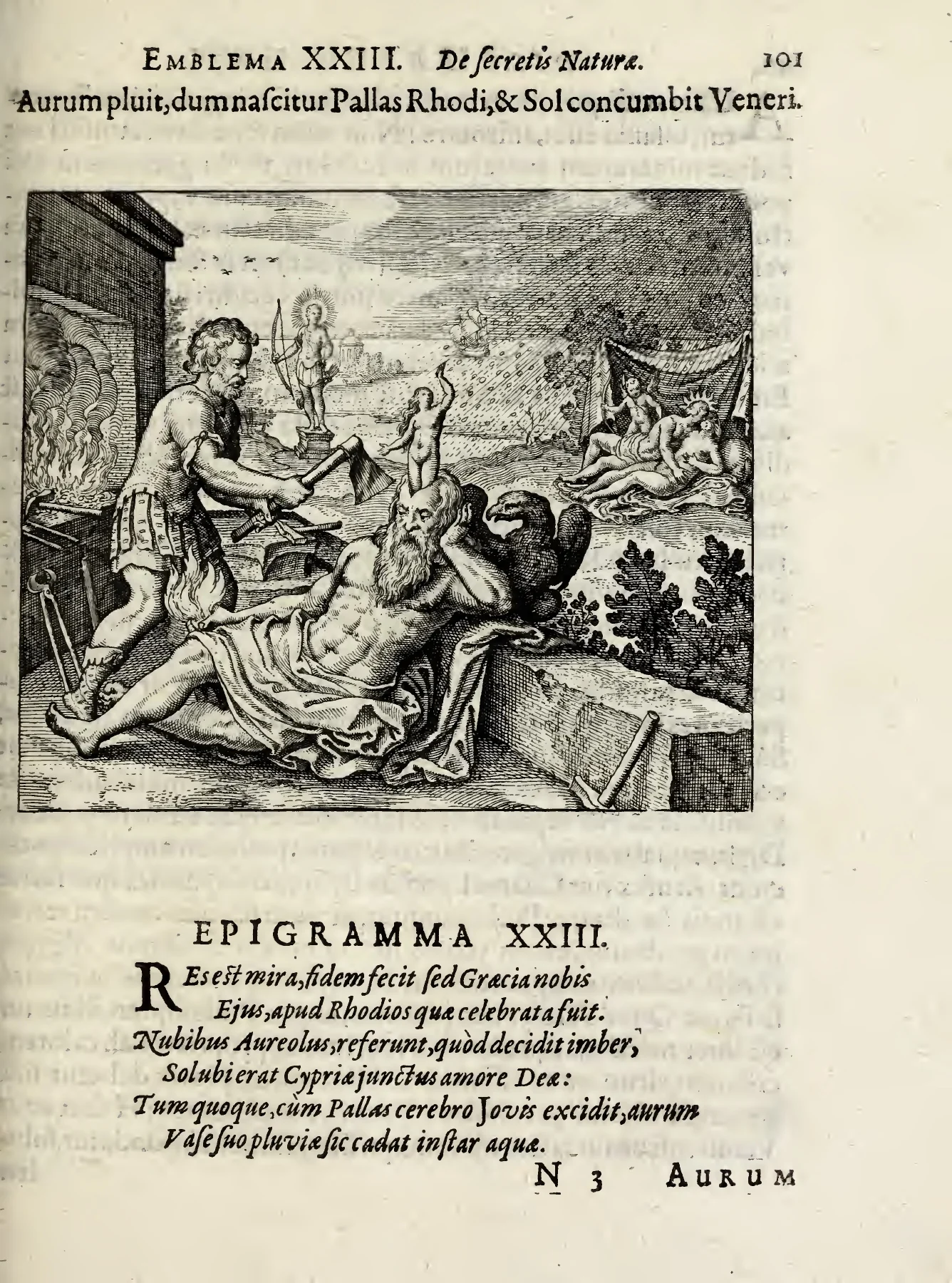
Maier’s twenty-third engraving combines Pallas emerging from Jupiter’s head with a shower of gold and a distant scene of Venus and the Sun. The motto joins these events at Rhodes. Rather than defending golden rain as ordinary weather, the discourse opens by rejecting a literal reading. Maier connects the island’s names and roses with his account of changing mercurial matter, and later identifies Pallas with wisdom. The entry follows that deliberate reinterpretation of inherited myth: the image offers a scene to decode, and the accompanying prose explains why its apparent impossibilities should be read figuratively.
Loading your archive…
In the sources
Several myths in one image
DocumentedThe motto and engraving combine Pallas’s birth, Venus and the Sun, and a golden shower at Rhodes.
Maier rejects a literal shower
DocumentedThe opening discourse says that golden rain requires an allegorical understanding; its continuation identifies Pallas with wisdom.
Context & interpretation
The account concerns Maier’s explanation of Emblem XXIII. His story of Rhodes and its gods is treated as the emblem’s historical argument. The source’s own opening argument explains why its fantastic events require an allegorical reading.
Original passages
Source 1
Atalanta Fugiens
Aurum pluit, dum nascitur Pallas RhodiOpen this page in the book
Passage & edition details
Location recorded at citation review: Atalanta Fugiens (1618), Emblem 23, motto, engraving and epigram, printed p. 101
Original scan and printed heading inspected; short Latin quotation normalizes spacing and ligatures. Historical English text consulted in Furnace and Fugue.
- Edition
- IMJ-0287-E001
- Reader page
- IMJ-0287-E001-P0102
- Original scan leaf
- 109
- Recorded leaf number
- 109
- Current Reader position
- 102
- Reader verification
- Source-preserving update confirmed
Source 2
Atalanta Fugiens
nisi allegoricè intelligereturOpen this page in the book
Passage & edition details
Location recorded at citation review: Atalanta Fugiens (1618), Emblem 23, Latin discourse, printed p. 102
Original scan and printed heading inspected; short Latin quotation normalizes spacing and ligatures. Historical English text consulted in Furnace and Fugue.
- Edition
- IMJ-0287-E001
- Reader page
- IMJ-0287-E001-P0103
- Original scan leaf
- 110
- Recorded leaf number
- 110
- Current Reader position
- 103
- Reader verification
- Source-preserving update confirmed
Source 3
Atalanta Fugiens
Est enim Pallas, sapientia seu sophiaOpen this page in the book
Passage & edition details
Location recorded at citation review: Atalanta Fugiens (1618), Emblem 23, Latin discourse, printed p. 103
Original scan and printed heading inspected; short Latin quotation normalizes spacing and ligatures. Historical English text consulted in Furnace and Fugue.
- Edition
- IMJ-0287-E001
- Reader page
- IMJ-0287-E001-P0104
- Original scan leaf
- 111
- Recorded leaf number
- 111
- Current Reader position
- 104
- Reader verification
- Source-preserving update confirmed
Illustrations
Continue exploring
Ceres, Thetis and Alchemical Nurture
Maier pairs the nurture of Triptolemus and Achilles with the gradual strengthening of his philosophical stone.
Same subject and traditionFour Guides to Alchemy in Maier
Nature, reason, experience and reading become a guide, staff, spectacles and lamp in Maier’s image of inquiry.
Same subject and traditionMercury and Vulcan at the Hearth
Two Mercuries and a furnace introduce Maier’s distinction between the subject’s inward qualities and the heat applied from outside.
Same subject and traditionNaaman’s Washing in Maier
The biblical washing in Jordan becomes Maier’s analogy for the purification of the philosophers’ brass.