Michael Maier, Atalanta Fugiens (1618)
The Old Man in the Dew-House
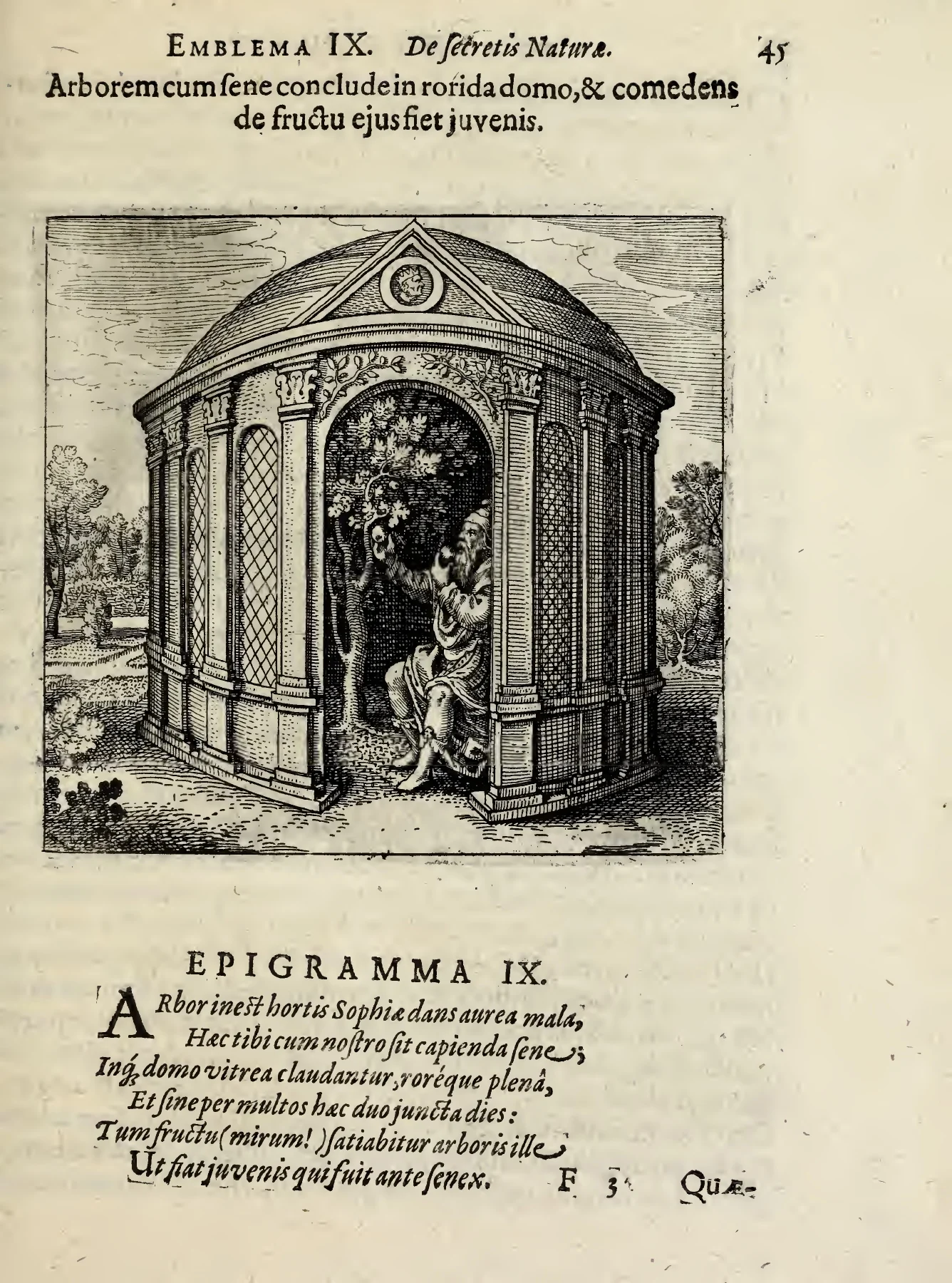
Maier’s ninth emblem places an old man beside a fruit tree inside a round glazed enclosure. The discourse begins with growth and decline and compares ageing with a lamp whose fuel is running out. It then interprets the old man and tree through an alchemical contrast between the white colour of age and the red colour of youth. The enclosure must be moist with dew rather than dry. Maier relates this moisture to the tree’s growth and the imagined renewal of the figure within it. The passage also contains historical physiological speculation and reports about restoring youth. These belong to the text’s medical and alchemical worldview; they are not demonstrated treatments. Within the emblem sequence, the image presents renewal through a carefully described environment and a change of colour.
Loading your archive…
In the sources
The enclosed tree and figure
DocumentedThe plate places an aged man and tree within a glazed house; the discourse specifies a moist rather than dry enclosure.
Ageing and colour
DocumentedMaier discusses ageing through a lamp analogy before contrasting white age with red youth in the alchemical reading.
Context & interpretation
This entry presents historical symbolism and physiology. Claims about rejuvenation remain attributed to Maier and his cited authors; none is offered as health advice or a proven treatment.
Original passages
Source 1
Atalanta Fugiens
Arborem cum sene concludeOpen this page in the book
Passage & edition details
Location recorded at citation review: Atalanta Fugiens (1618), Emblem 9, printed p. 45
Original Latin plate or discourse and printed pagination actually inspected; historical English translation consulted for interpretation.
- Edition
- IMJ-0287-E001
- Reader page
- IMJ-0287-E001-P0046
- Original scan leaf
- 53
- Recorded leaf number
- 53
- Current Reader position
- 46
- Reader verification
- Source-preserving update confirmed
Source 2
Atalanta Fugiens
in lampade triaOpen this page in the book
Passage & edition details
Location recorded at citation review: Atalanta Fugiens (1618), Emblem 9, printed p. 46
Original Latin plate or discourse and printed pagination actually inspected; historical English translation consulted for interpretation.
- Edition
- IMJ-0287-E001
- Reader page
- IMJ-0287-E001-P0047
- Original scan leaf
- 54
- Recorded leaf number
- 54
- Current Reader position
- 47
- Reader verification
- Source-preserving update confirmed
Source 3
Atalanta Fugiens
non sicca, sed rore humidaOpen this page in the book
Passage & edition details
Location recorded at citation review: Atalanta Fugiens (1618), Emblem 9, printed p. 47
Original Latin plate or discourse and printed pagination actually inspected; historical English translation consulted for interpretation.
- Edition
- IMJ-0287-E001
- Reader page
- IMJ-0287-E001-P0048
- Original scan leaf
- 55
- Recorded leaf number
- 55
- Current Reader position
- 48
- Reader verification
- Source-preserving update confirmed
Illustrations
Continue exploring
Ceres, Thetis and Alchemical Nurture
Maier pairs the nurture of Triptolemus and Achilles with the gradual strengthening of his philosophical stone.
Same subject and traditionFour Guides to Alchemy in Maier
Nature, reason, experience and reading become a guide, staff, spectacles and lamp in Maier’s image of inquiry.
Same subject and traditionMercury and Vulcan at the Hearth
Two Mercuries and a furnace introduce Maier’s distinction between the subject’s inward qualities and the heat applied from outside.
Same subject and traditionNaaman’s Washing in Maier
The biblical washing in Jordan becomes Maier’s analogy for the purification of the philosophers’ brass.