The Lost Books of the Bible: Which Books Are in Which Bibles?
Compare biblical canons and the 1611 King James Apocrypha. See where Tobit, 1 Enoch, Jubilees and the Prayer of Manasseh are read and preserved.
In this article
Find the same book in different Bibles
Choose a book or a tradition, then check the list, printed leaf or manuscript that gives the answer.
- Tanakh and Westminster
Chronicles and Malachi
Shared books in a different order
Compare the last books of Sefaria’s Tanakh list and the Westminster Old Testament. - Catholic Bible
Tobit and Susanna
A whole book and an addition to a book
Find one title in the list and one passage inside Daniel. - King James Bible, 1611
The printed Apocrypha
A separate block of fourteen entries
Find the two Esdras titles, Tobit and the Prayer of Manasseh on the exact contents leaf. - Greek Orthodox Great Compline
The Prayer of Manasseh
A work heard in worship
A service text puts this prayer in context. - Ethiopian Orthodox Tewahedo
1 Enoch and Jubilees
Two writings preserved in Ethiopic
Compare the church list and the earlier fragments from Qumran. - Codex Sinaiticus
Barnabas and Hermas
Books copied into one ancient Bible
Look up the folio where Revelation ends and Barnabas begins.
Why do Bible book lists differ?
“Lost books of the Bible” can mean several things. Tobit is Scripture in the Catholic list and appears in the separately printed Apocrypha of the 1611 King James Bible. The Ethiopian Orthodox Tewahedo Church also includes 1 Enoch and Jubilees. Both works survive and can be read. Begin by identifying the book, then ask which edition or religious community gives it a place. [3][6][11]
A canon is a community’s accepted collection of sacred books. A table of contents tells you what a printer put in a volume. A manuscript witness tells you that somebody copied a text. These can answer different questions about the same work. The 1611 contents page illustrates the distinction because it prints a set of books under its own heading between the two Testaments. [5][6][17]
The Jewish Tanakh and the Westminster list
The Tanakh is the Jewish collection arranged as Torah, Prophets and Writings. Its order differs from the familiar Christian Old Testament sequence. Look at Chronicles in Sefaria’s list. Its two parts close the Writings, while Westminster puts them among the historical books near the beginning. Both lists contain Malachi, but it closes the Old Testament only in the Westminster list. [1][2]
The Westminster Confession names 39 Old Testament books and 27 New Testament books by the usual modern Protestant count. It places the books it calls Apocrypha outside the canon. That is a specific confessional judgment. The Church of England’s Article VI describes an additional group of books it reads for instruction and distinguishes those books from the ones it uses to establish doctrine. [2][5]
What the Catholic deuterocanonical books include
The Catholic Catechism names 46 Old Testament books and 27 New Testament books. The Old Testament includes seven separately titled books outside the Westminster list: Tobit, Judith, Wisdom, Sirach, Baruch, and 1 and 2 Maccabees. Catholic editions also preserve material within Esther and Daniel that is absent from the shorter forms of those books. [3][4][2]
Look for Susanna under Daniel 13 and Bel and the Dragon under Daniel 14 in the New American Bible. The 1611 King James contents page places both in the Apocrypha. It also puts the additional Esther material there. Titles, placement and counts have to be read together, especially when the difference is part of a book rather than a separate volume. [4][6]
What the 1611 King James Bible actually printed
The page has three blocks. The Old Testament occupies the upper block and the New Testament is at the bottom. Between them sit the books called Apocrypha. The middle block includes Tobit and Judith, but also 1 and 2 Esdras and the Prayer of Manasseh. Those last three names do not occur as books in the Catholic Catechism’s list. [6][7][3]
The printed evidence gives a practical way to answer “Is this in the King James Bible?” Check which printing you mean. The title King James identifies a translation, while an individual volume’s contents determine whether it prints these additional books. Article VI gives a separate answer about how the Church of England reads such material. [6][7][5]
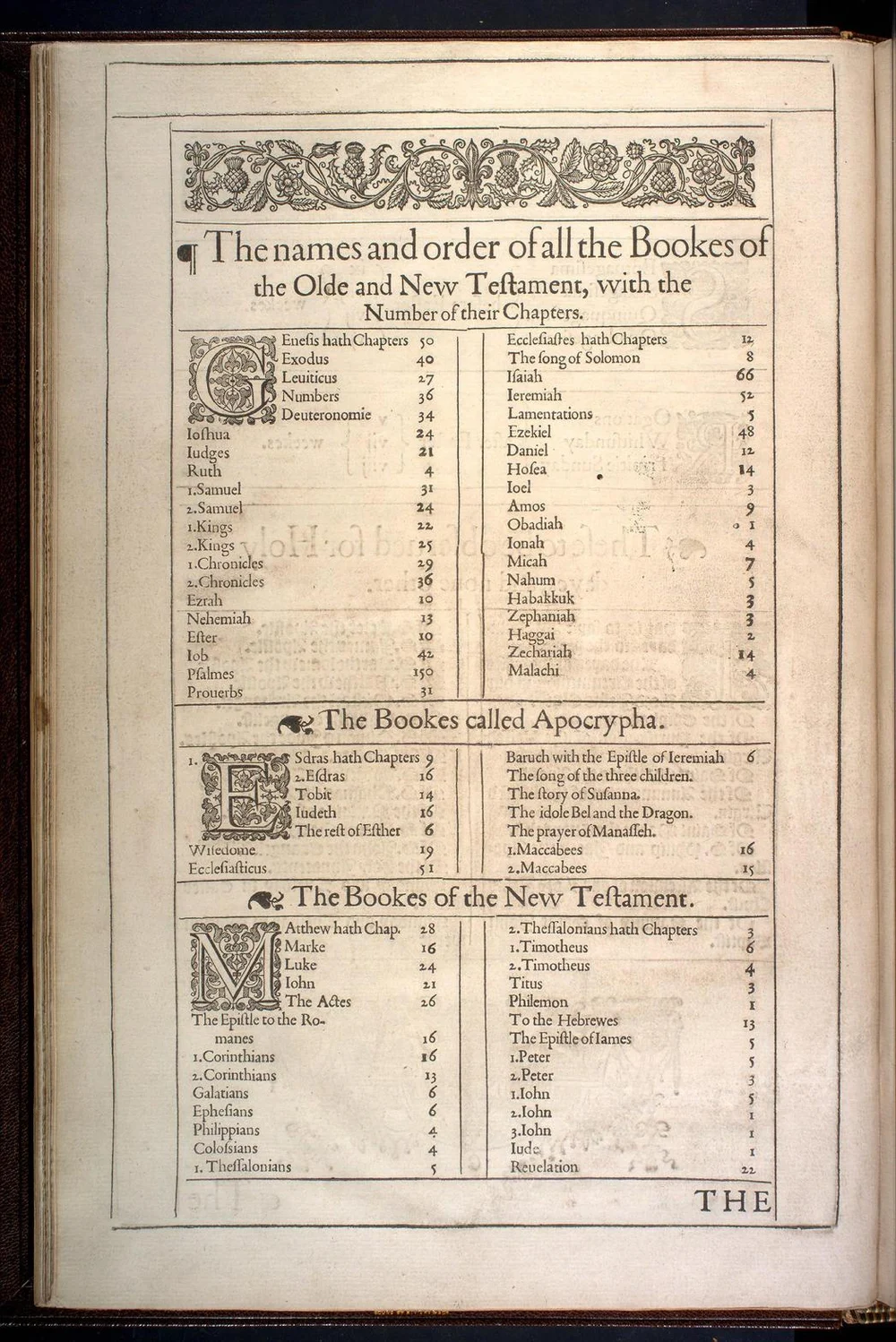
Find Tobit in the left column of the middle block and the Prayer of Manasseh on the right. Both were printed in this Bible, under the Apocrypha heading. King James Bible, 1611, contents leaf.
Robert Barker, London, 1611. Internet Archive, scan leaf 37. Public-domain facsimile in the United States. · Image source ↗ · Public Domain
Greek Orthodox reading and the Septuagint
The Greek Orthodox Archdiocese of America traces its Old Testament usage to the Greek Septuagint. Its explanation distinguishes canonical books and books traditionally appointed to be read. One archdiocesan teaching resource includes 3 Maccabees. That title is absent from both the Catholic Catechism list and the 1611 King James Apocrypha. [8][9][3][6]
The Prayer of Manasseh offers a different kind of evidence. The archdiocese’s text of Great Compline has a place for it in the service itself. The 1611 contents also prints the prayer. A service book can show how a work is used, even when a list of bound Bible books cannot answer that question. [10][6]
Where 1 Enoch and Jubilees belong
The Ethiopian Orthodox Tewahedo Church describes an 81-book canon and identifies Enoch and Jubilees within the books it recognises. The complete works were transmitted in Ethiopic. The British Library’s Endangered Archives catalogue identifies a manuscript at the Institute of Ethiopian Studies that contains both. [11][12]
The Dead Sea Scrolls preserve a different layer of their history. The Israel Antiquities Authority catalogues Aramaic fragments of Enoch and describes Jubilees among the works found in the scrolls. These witnesses show ancient circulation. Ethiopian Orthodox reception is the evidence for the works’ place in that living tradition. [15][16][11]
Compare Jude 14–15 with the opening prophecy in 1 Enoch. The New American Bible’s notes identify the connection with 1 Enoch 1:9. That recognition gives a reason to read the two passages together. The same edition’s list of biblical books tells you the status of 1 Enoch in that Catholic edition. [13][14][4]
See references (7)
How to read a “lost books” collection
An ancient manuscript can preserve books beside one another that modern editions place differently. In Codex Sinaiticus, the British Library records the end of Revelation and the opening of the Epistle of Barnabas on the same folio, 334r. The Shepherd of Hermas follows in the surviving manuscript. This is a definite fact about that copy and a point of departure for questions about its use. [17]
For a modern collection, find the editor, the translation and the title of each work. Use its contents to locate the text, then check the edition or community that is said to receive it. Start with a traceable example. Read Tobit in the Catholic edition and the 1611 list, or compare Jude’s citation with the opening of 1 Enoch and the Ethiopian Church’s account of that book. [4][6][13][14][11]
Sources
See references (17)
- The Tanakh in Sefaria’s Jewish text library ↗Sefaria’s Tanakh catalogue, arranged as Torah, Prophets and Writings.Return to text ↑
- Westminster Confession of Faith, chapter 1 §§2–3 ↗Presbyterian Church of Aotearoa New Zealand, text of the Westminster Confession of Faith.Return to text ↑
- Catechism of the Catholic Church §120 · Canon of Scripture ↗Catholic Church, Catechism §120, list and counting convention for the two Testaments.Return to text ↑
- New American Bible · Old and New Testament books ↗United States Conference of Catholic Bishops, New American Bible, Revised Edition.Return to text ↑
- Articles of Religion VI · Canonical books and other reading ↗Church of England, Article VI of the Thirty-Nine Articles in the Book of Common Prayer.Return to text ↑
- King James Bible, 1611 · Original contents leaf ↗Printed by Robert Barker, London, 1611. Internet Archive scan leaf 37, visually checked.Return to text ↑
- King James Bible, 1611 · Morgan Library catalogue ↗The Morgan Library & Museum, first-edition copy, catalogue of preliminaries and contents.Return to text ↑
- The Greek Old Testament in Eastern Orthodox practice ↗Greek Orthodox Archdiocese of America, account of the Septuagint and books appointed to be read.Return to text ↑
- The Bible in the Orthodox Church · Books and examples ↗Greek Orthodox Metropolis of San Francisco, Religious Education, Fr. Steven Tsichlis, The Bible in the Orthodox Church.Return to text ↑
- The Prayer of Manasseh in Great Compline ↗Greek Orthodox Archdiocese of America, Great Compline service text.Return to text ↑
- Ethiopian Orthodox Tewahedo Church · Canonical books ↗The Ethiopian Orthodox Tewahedo Church’s presentation of its 81-book canon and its account of Enoch and Jubilees.Return to text ↑
- One Ethiopic manuscript preserving both Enoch and Jubilees ↗British Library Endangered Archives Programme, EAP286/1/1/409, digitised from the Institute of Ethiopian Studies.Return to text ↑
- Jude 14–15 and the note on 1 Enoch ↗United States Conference of Catholic Bishops, Jude 14–15 and the edition’s cross-reference to 1 Enoch 1:9.Return to text ↑
- 1 Enoch 1 · The opening prophecy ↗The Book of Enoch in R. H. Charles’s translation, first chapter.Return to text ↑
- 4Q201 · Aramaic fragments of Enoch ↗Israel Antiquities Authority, Leon Levy Dead Sea Scrolls Digital Library, manuscript 4Q201.Return to text ↑
- Jubilees among the Dead Sea Scrolls ↗Israel Antiquities Authority, account of the range and status of works found in the scrolls.Return to text ↑
- Codex Sinaiticus · Contents and surviving folios ↗British Library, Add MS 43725, including the end of Revelation and start of Barnabas on folio 334r.Return to text ↑