Heavenly Music
Heavenly music can mean celestial harmony, welcome or healing. Compare Dante, The Angels’ Diary and Theosophical accounts of music and creation.
In this article
What does this mean?
Heavenly music is sound or harmony associated with a divine or celestial world. Some books give it familiar forms: a choir, an organ or a relative singing at a welcome. Others use it to explain how distinct voices or realms can belong to a single order. [3][4][2][10][11]
Who plays or listens changes what the scene means. A voice may remind a newcomer of home, help someone in distress or join other voices in worship. [4][8][13][14]
See references (8)
- The Angels’ Diary and Celestion Study of Man, Reader page 82
- The Angels’ Diary and Celestion Study of Man, Reader page 34
- The Angels’ Diary and Celestion Study of Man, Reader page 37
- The Angels’ Diary and Celestion Study of Man, Reader page 83
- The Angels’ Diary and Celestion Study of Man, Reader page 187
- The Angels’ Diary and Celestion Study of Man, Reader page 188
- The Angels’ Diary and Celestion Study of Man, Reader page 190
- The Angels’ Diary and Celestion Study of Man, Reader page 191
Sound, colour and creation
Watchers of the Seven Spheres by H. K. Challoner
In The Divine Musician, H. K. Challoner describes stars, human feeling and the smallest particles as parts of a larger harmony. The devas say they give notes and chords visible forms above a performance. Besant and Leadbeater’s Gounod plate offers a related image: coloured shapes painted above the church where the music sounds. [95][96][94]
The poem also hears birds, wind, water and evening bells as elements of nature’s song. It ends with the possibility of people and devas responding together, tied to self-discipline and service. The speaker’s task is thus more than interpreting a performance. It is to work with the discord and harmony it attributes to human life. [97][98][99]
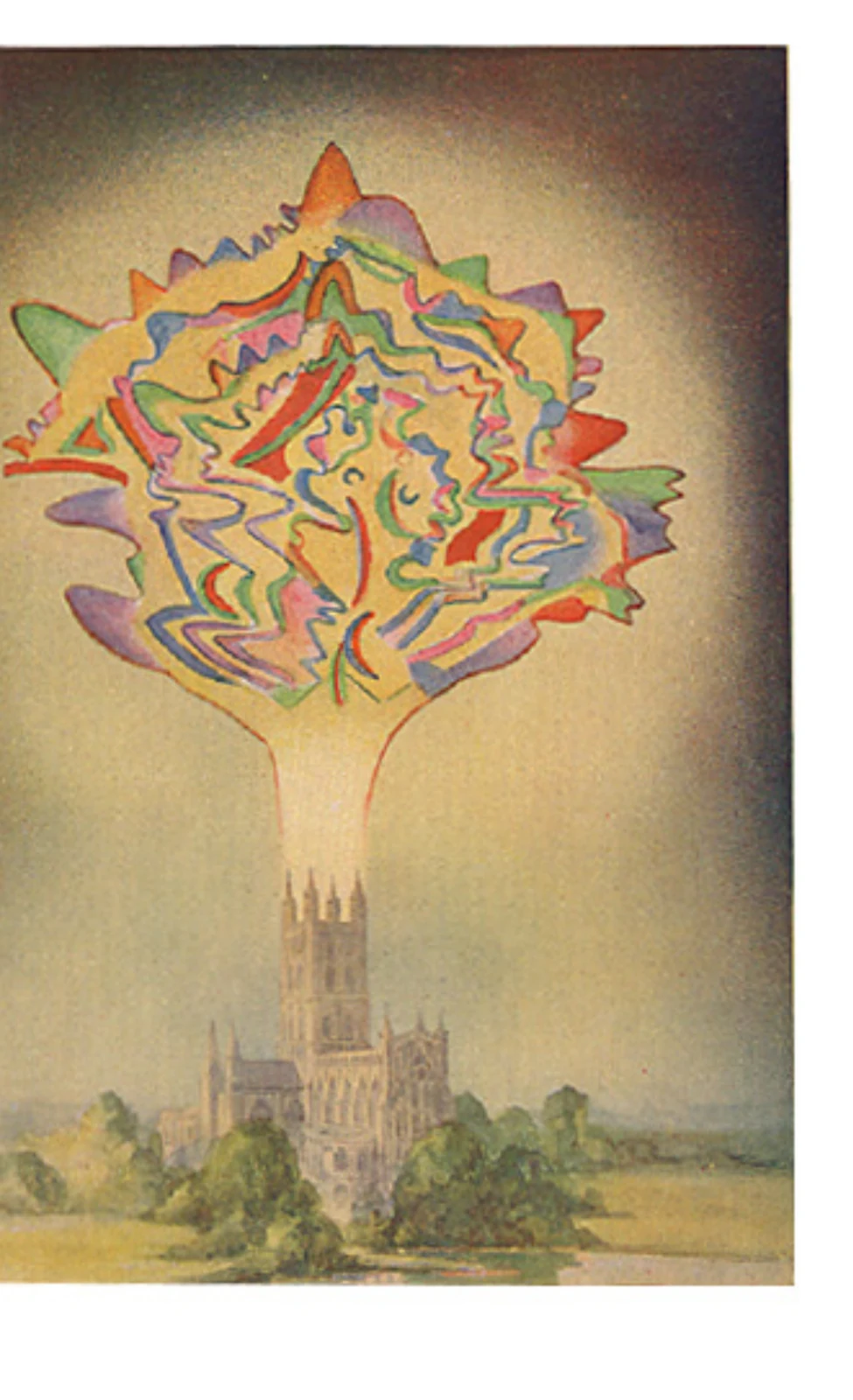
Besant and Leadbeater’s Gounod plate pictures a form they associate with music sung in a church. Challoner describes devas building coloured forms above performances and assigns their work an ethical purpose.
Annie Besant and C. W. Leadbeater, Thought-Forms (1901). Historical public-domain plate retained from the Library edition. The artists’ interpretation is part of the book’s account. · Image source ↗ · Public Domain
Challoner and the other accounts
Hodson imagines orders of beings echoing a creative Word through successive worlds. Challoner also attends to particular performances and their listeners. Her speaker gives the musician a role in directing feeling and attention towards the divine. [95][96][97][99][90][91][92][93]
See references (8)
- The Kingdom of the Gods, Reader page 10
- The Kingdom of the Gods, Reader page 11
- The Kingdom of the Gods, Reader page 213
- The Kingdom of the Gods, Reader page 214
- Watchers of the Seven Spheres, Reader page 56
- Watchers of the Seven Spheres, Reader page 57
- Watchers of the Seven Spheres, Reader page 58
- Watchers of the Seven Spheres, Reader page 60
The Kingdom of the Gods by Geoffrey Hodson
Geoffrey Hodson calls the music of the spheres an ongoing act of creation. He imagines angelic hosts passing the creative Word from one level of existence to another. At each level, the harmonies take a new form and help produce the structures of the natural world. [90][91][92][93]
In his account of the angel of music, the Word can be silent before a creative cycle and uttered during it. The voices of individual beings contribute to the whole chord, and the archangelic hosts echo the Word through worlds of increasing density. Human music is one brief physical expression of an activity that his symbolism places behind the forms of nature. [92][93]
The Angels’ Diary describes music as something people hear together, with choirs and named performers in the Temple of Light. Hodson’s music of the spheres is primarily an account of how the cosmos comes into form. The books can both connect music with divine life while giving it different work to do. [91][92][93][6][2][8]
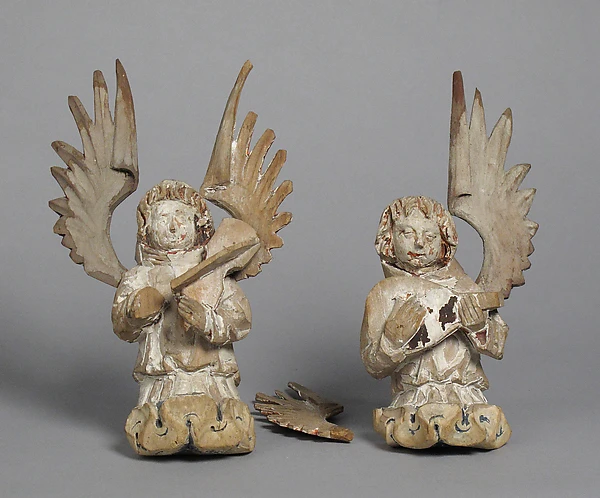
This fifteenth-century French carving gives heavenly music a visible form through an angel playing an instrument.
Angel Playing Instrument. The Metropolitan Museum of Art. The Cloisters Collection, 1925. · Image source ↗ · CC0
See references (7)
- The Angels’ Diary and Celestion Study of Man, Reader page 82
- The Angels’ Diary and Celestion Study of Man, Reader page 80
- The Angels’ Diary and Celestion Study of Man, Reader page 83
- The Kingdom of the Gods, Reader page 10
- The Kingdom of the Gods, Reader page 11
- The Kingdom of the Gods, Reader page 213
- The Kingdom of the Gods, Reader page 214
Welcome, worship and care
Life Here and Hereafter: Charlotte E. Dresser and Fred Rafferty
In Life Here and Hereafter, received chiefly by Charlotte E. Dresser and edited by Fred Rafferty, an isolated spirit first hears a steady tone. The music gets his attention before he can understand the people trying to help him. In that account, hearing comes before conversation. [78][79]
A later merchant’s account follows a similar movement. Musical sounds quiet his long experience of fear, and only later does he recognise other people. Music here is an opening for companionship within the narrative, not simply a reward for someone already happy and oriented. [80][81][82][83]
Its use is not automatic in every case. When the French woman can see helpers but cannot hear them, the circle first tries gestures and says music may be attempted later. Elsewhere concerts and musical study belong to ordinary enjoyment and education. The same art has several roles, with different responses from particular listeners. [84][85][86][87][88]
See references (11)
- Life Here and Hereafter, Reader page 28
- Life Here and Hereafter, Reader page 29
- Life Here and Hereafter, Reader page 171
- Life Here and Hereafter, Reader page 172
- Life Here and Hereafter, Reader page 173
- Life Here and Hereafter, Reader page 174
- Life Here and Hereafter, Reader page 16
- Life Here and Hereafter, Reader page 17
- Life Here and Hereafter, Reader page 127
- Life Here and Hereafter, Reader page 231
- Life Here and Hereafter, Reader page 232
The Angels’ Diary
In the diary attributed to Effie M. Shirey, music first belongs to a welcoming world. Sound seems to come from every direction as the traveller walks with her brother. At a family gathering, Alice Samson sings while listeners throw flowers. In an ancestor’s concert hall, an air sung inwardly is said to set instruments sounding without hands touching them. [3][4][5]
The Temple of Light gives the music a communal scale. Thousands of voices join without discord. An immense organ is played by composers named as Handel, Beethoven, Mozart and Mendelssohn, and the account also imagines Emma Abbott singing. The narrator hears a continuity of artistic identity within a transformed setting. [6][7][2][8][9]
The architecture accommodates the same ideal of shared experience. However many arrive, everyone can see. The choir’s added voices enrich the occasion without a struggle for space or attention. The description links celestial harmony with a community in which each participant can receive the blessing. [2][8]
The later chapter on music considers its earthly source. It presents musical creation as something first heard within the soul, then expressed through instruments. The brook and the wind offer examples of harmony in nature. The writer also describes a remembered melody reaching someone through feelings that ordinary argument has failed to awaken. [10][11][12]
Heavenly performance is placed at the far end of this developing capacity. The book names compositions attributed to composers in the celestial world and calls them music for an unfolded soul. These titles are part of its communicated account of artistic life after death. [13][14]
A relative’s voice offers welcome, a choir gathers a community in worship, and the account of composition locates artistic inspiration within the soul. The musical scenes serve different purposes. [4][8][11]
The volume attributed to Effie M. Shirey and Charles Samson calls music a material expression of a divine voice. Its chapter on music argues that a work should reach deeper than pleasing combinations of tones and stir the listener’s inward life. [56]
The composer is said to withdraw into the sanctuary of the soul, or subliminal consciousness, before producing a work through physical means. Mozart, Beethoven, Wagner, Liszt, Bach and Mendelssohn appear as examples in the author’s argument. Their inclusion is an interpretation of creativity, rather than testimony from those composers about the proposed process. [57]
Listening also has a role. A remembered melody can awaken feelings associated with an earlier life, while the sounds of woods, wind and water supply models of harmony. The text assigns different emotional qualities to different composers and encourages the development of a wider range of response. [57][58][59]
Music produced within an earthly composer’s experience differs from music heard during an afterlife journey. The volume connects both with an unfolding soul, but one concerns the origin of a work and the other its setting and audience. That distinction helps compare inspiration with reports of heavenly choirs. [56][57][59]
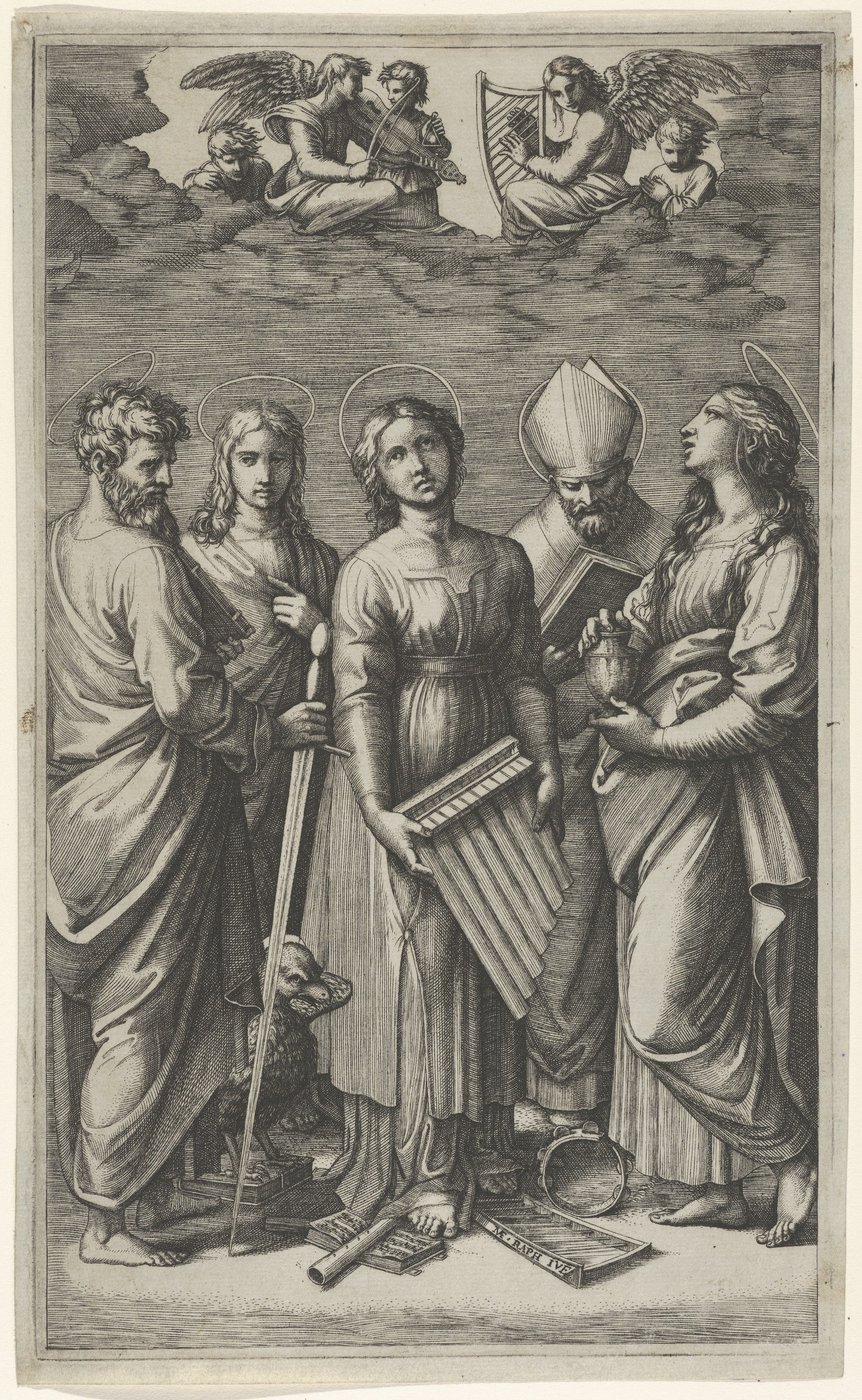
Marcantonio Raimondi after Raphael, Saint Cecilia with saints and musical angels, ca. 1515–16. The engraving places the listening saint beneath a company of celestial musicians.
The Metropolitan Museum of Art. Harris Brisbane Dick Fund, 1917, accession 17.3.573. Public Domain (CC0). · Image source ↗ · CC0
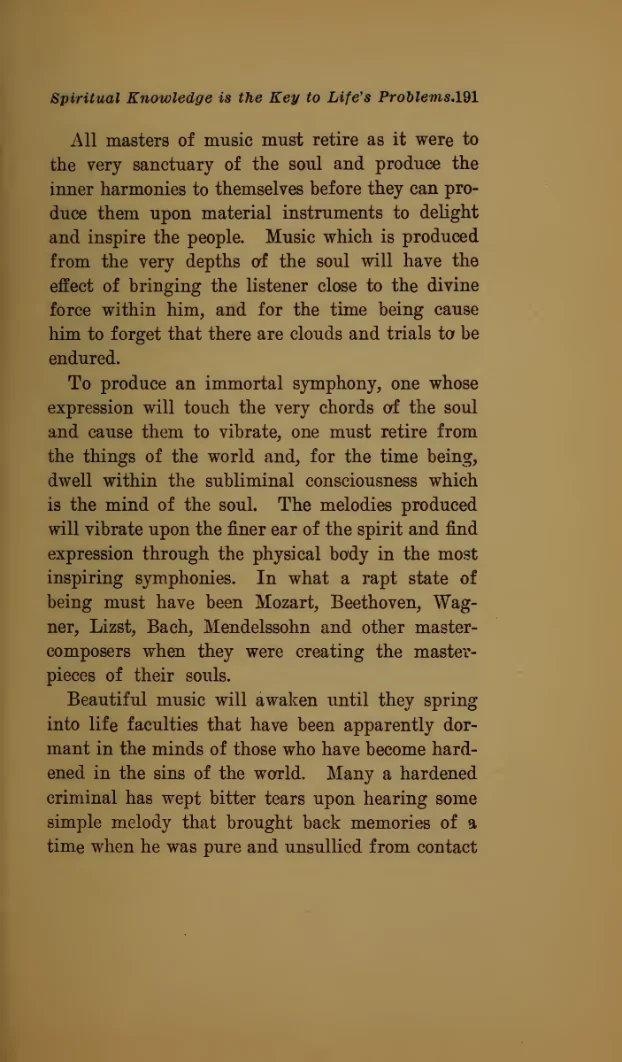
Source facsimile: Music and the subconscious mind, The Angels’ Diary and Celestion Study of Man (1903), Reader page 188. This is the printed account discussed here.
Lumitheca Library, edition IMJ-0055-E001. Public-domain 1903 text and page image; extracted from the checksum-verified retained scan. · Image source ↗ · Public Domain
See references (17)
- The Angels’ Diary and Celestion Study of Man, Reader page 82
- The Angels’ Diary and Celestion Study of Man, Reader page 34
- The Angels’ Diary and Celestion Study of Man, Reader page 37
- The Angels’ Diary and Celestion Study of Man, Reader page 46
- The Angels’ Diary and Celestion Study of Man, Reader page 80
- The Angels’ Diary and Celestion Study of Man, Reader page 81
- The Angels’ Diary and Celestion Study of Man, Reader page 83
- The Angels’ Diary and Celestion Study of Man, Reader page 84
- The Angels’ Diary and Celestion Study of Man, Reader page 187
- The Angels’ Diary and Celestion Study of Man, Reader page 188
- The Angels’ Diary and Celestion Study of Man, Reader page 189
- The Angels’ Diary and Celestion Study of Man, Reader page 190
- The Angels’ Diary and Celestion Study of Man, Reader page 191
- The Angels’ Diary and Celestion Study of Man, Reader page 187
- The Angels’ Diary and Celestion Study of Man, Reader page 188
- The Angels’ Diary and Celestion Study of Man, Reader page 189
- The Angels’ Diary and Celestion Study of Man, Reader page 190
Gone West by J. S. M. Ward
J. S. M. Ward’s Gone West gives music a place in everyday life beyond death. Visiting schools of music, Ward describes composition, symphonies and a singer performing in a concert hall. H. J. L., one of Ward’s reported spirit contributors, includes theatres among the same recreations. Artistic life continues through learning, making new work and enjoying performances with others. [16]
Access to art follows the book’s hierarchy of spiritual development. H. J. L. says the finest productions belong to higher divisions, beyond the capacities of his own. He also describes familiar earthly works being revised to remove passages judged harmful. These restrictions give his musical world a particular moral and theological character. [16][17]
Music also appears in a house of refuge for suffering spirits. A bright figure plays a soothing hymn on a harp beside someone in severe mental distress. The guide explains the performance as a response to that individual’s pain. Here music becomes an act of care within the book’s account of spiritual rescue. [18]
A later hospital visit extends this use of sound. A harpist plays for people resting outdoors, and a violin is heard beside another distressed person’s bed. Gardens, water, art and performance form an environment intended to restore calm. These are details of Ward’s narrated spirit world and its imagined care for the dead. [19][20]
A Subaltern in Spirit Land by J. S. M. Ward
Music in J. S. M. Ward’s A Subaltern in Spirit Land includes familiar institutions and different audiences. A hospital nurse distinguishes soothing concerts for patients from the stronger entertainment offered by a nearby theatre and opera house. The setting is the astral plane rather than the highest heaven. Music accompanies adjustment and convalescence within a world still recognisably shaped by earthly tastes. [21][22]
Rex, Ward’s deceased brother, later reports hearing Faust, Lohengrin and The Huguenots, as well as a version of Alkestis which he attributes to Wagner composing after death. Within the account, Wagner inhabits a higher sphere and communicates the work to performers below. Rex compares its style with the composer’s earlier earthly operas and describes a company of capable singers without famous names. Ward supplies a claimed musical encounter and a story of transmission between spheres, rather than a score or independently established addition to Wagner’s earthly catalogue. [23][24]
The example broadens the meaning of afterlife music beyond angelic praise. Performers, listeners, venues and remembered repertoires continue to matter. The hospital concert and the opera serve different purposes, while the alleged new composition allows creativity to continue across the book’s divisions of the next world. [22][23][24]
Later chapters place music within collective occasions as well. Rescued soldiers join cheerful songs at their reception, while the Christmas episode includes choral worship in the astral counterpart of Ypres Cathedral. Rex also reports a new opera, The Three Magi, which he attributes to Mozart composing on the spirit plane. These are distinct uses of music within Ward’s account: social welcome, religious participation and alleged creative transmission. The reported opera is not independently established by the narrative. [25][26][27][28]
See references (8)
- A Subaltern in Spirit Land, printed p. 135, Reader page 150
- A Subaltern in Spirit Land, printed p. 136, Reader page 151
- A Subaltern in Spirit Land, printed p. 137, Reader page 152
- A Subaltern in Spirit Land, printed p. 138, Reader page 153
- A Subaltern in Spirit Land, printed p. 189, Reader page 204
- A Subaltern in Spirit Land, printed p. 253, Reader page 268
- A Subaltern in Spirit Land, printed p. 254, Reader page 269
- A Subaltern in Spirit Land, printed p. 256, Reader page 271
The Encyclopaedia of Death and Life in Spirit-World, Volume I
J. R. Francis’s The Encyclopaedia of Death and Life in Spirit-World, Volume I, uses music to make arrival in the next life recognisable as a welcome. In the unsigned dialogue ‘Thrilling Narrative of a Magdalen’, Claude remembers becoming unconscious and awakening among loving spirits who greet her with music. The sound belongs to a gathering of companions, joining reassurance to the recognition of a new condition. [29][30]
‘The Passage to the Spirit Side of Life’ gives sound a wider setting. In a communication from a recipient’s elder brother, the newcomer awakens beside a flowing stream. The turf seems to respond musically beneath his steps, the air carries sweet sounds, and voices add melodies. Music appears to animate the landscape itself, rather than coming only from an identifiable choir or instrument. [31][32]
The scene leads into an encounter with a guide who asks the newcomer to stand with dignity and help others. Musical delight introduces a life with responsibilities. A note at the end of this account cautions that its joyful reception should not be treated as universal. These passages describe two reported welcomes; they do not set out a common musical system or identify their sounds with particular earthly compositions. [32][33][34]
In D. D. Glass’s separate guided vision, music belongs to a community of learners. Three women play an instrument resembling an enlarged piano while others sing. When the performance ends, they return to their responsibilities as teachers and pupils. The scene places musical enjoyment within continuing study and service, rather than presenting celestial music as an occupation detached from every other activity. [35][36]
See references (8)
- The Encyclopaedia of Death and Life in Spirit-World, Volume I, printed p. 33, Reader page 32
- The Encyclopaedia of Death and Life in Spirit-World, Volume I, printed p. 40, Reader page 39
- The Encyclopaedia of Death and Life in Spirit-World, Volume I, printed p. 46, Reader page 45
- The Encyclopaedia of Death and Life in Spirit-World, Volume I, printed p. 48, Reader page 47
- The Encyclopaedia of Death and Life in Spirit-World, Volume I, printed p. 49, Reader page 48
- The Encyclopaedia of Death and Life in Spirit-World, Volume I, printed p. 51, Reader page 50
- The Encyclopaedia of Death and Life in Spirit-World, Volume I, printed p. 253, Reader page 252
- The Encyclopaedia of Death and Life in Spirit-World, Volume I, printed p. 254, Reader page 253
The Divine Comedy by Dante Alighieri
Dante Alighieri’s Divine Comedy repeatedly makes heavenly life audible through coordinated voices. Justinian compares the differing degrees of blessedness to different voices producing sweet music. In the Sun, the wise souls circle Dante and Beatrice, pause together and resume their song. The narrator compares their cooperation to the parts of a clock calling the worshipper to prayer. Difference supplies the harmony. [37][38][39]
On Mars, lights forming a cross move past one another while their combined sound resembles strings heard together. Dante catches words of praise without comprehending the entire hymn. Elsewhere the blessed answer an angel’s celebration of Mary with her name and the Regina coeli. These songs belong to acts of shared attention: they praise, answer and express delight in another’s joy. [41][43]
The poem also gives silence a purpose. On Saturn, Peter Damian explains that the music has ceased because Dante’s mortal hearing could not bear it, just as Beatrice restrains her smile for his sake. The silence reflects the visitor’s limit. The heavenly company continues to possess the joy whose full expression would overwhelm him. [42]
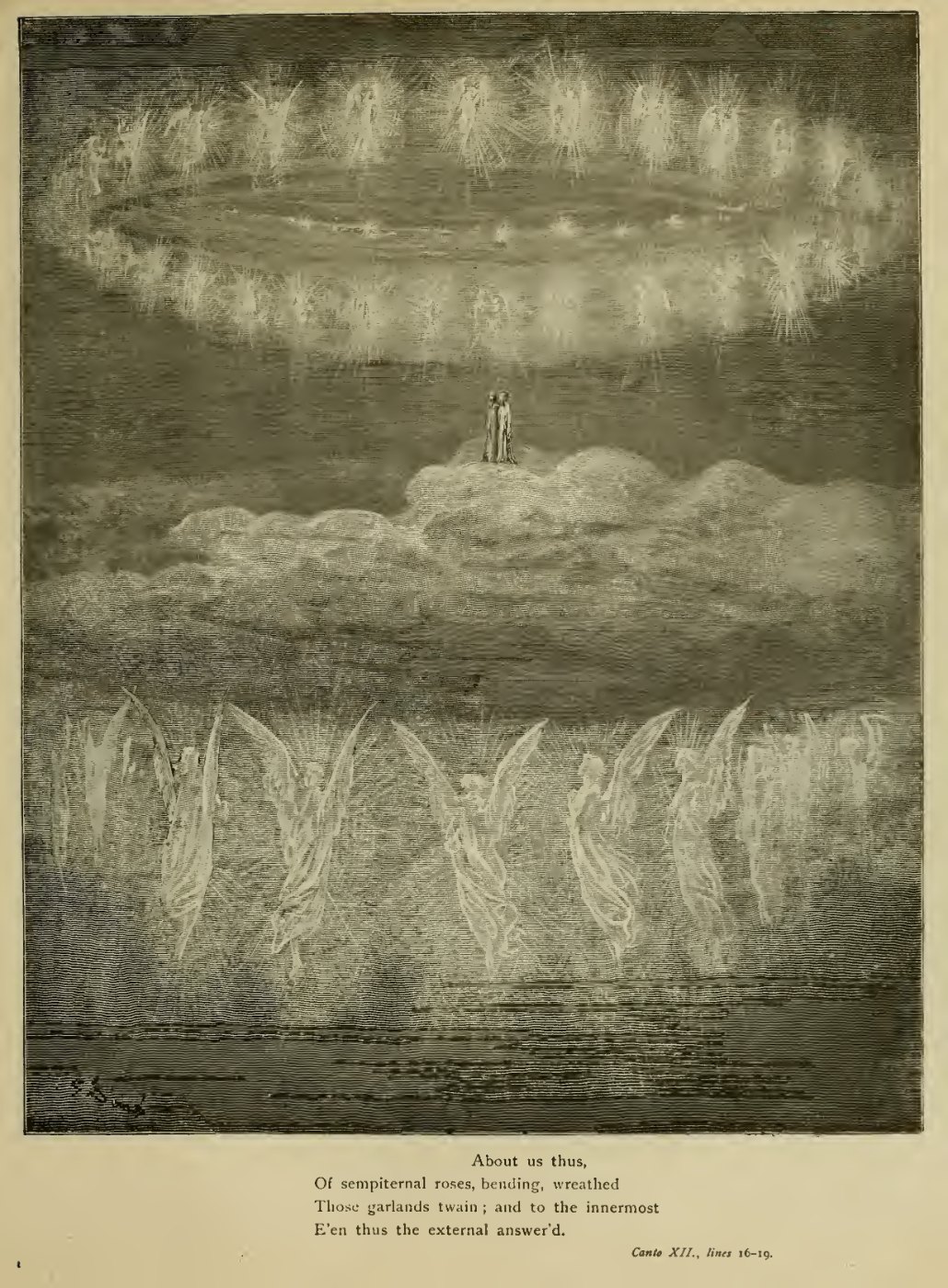
The answering garlands of Paradise XII, in Doré’s design. Their coordinated movement and song make harmony a shared action, joining two circles without merging them into one voice.
Design by Gustave Doré. Purgatory and Paradise, Henry Francis Cary translation, Thompson & Thomas, Chicago, 1901. Public Domain. · Image source ↗ · Public Domain
See references (6)
- Purgatory and Paradise, Paradise VI, Reader page 232
- Purgatory and Paradise, Paradise X, Reader page 251
- Purgatory and Paradise, Paradise X, printed p. 203, Reader page 253
- Purgatory and Paradise, Paradise XIV, printed p. 219, Reader page 271
- Purgatory and Paradise, Paradise XXI, printed p. 248, Reader page 306
- Purgatory and Paradise, Paradise XXIII, printed p. 259, Reader page 319
A Wanderer in the Spirit Lands
In A Wanderer in the Spirit Lands, attributed to Franchezzo and transcribed by A. Farnese, music accompanies welcome, shared work and memory. The Brotherhood’s return from Hell is followed by a performance in which changing musical phrases interpret the members’ experiences while those experiences appear in a mirror. The music mourns, struggles, consoles and rejoices with the scenes. [47][48][49]
The father explains the performance through the book’s proposed relationship between emotion and sound. People associated with the circles of art, music and literature can perceive their corresponding expressions. Later, Hassein, the narrator’s guide, distinguishes intellectual or artistic accomplishment from moral advancement: a musician’s greater skill does not alone place that person in a higher moral sphere. [49][50][51][52]
This distinction also appears in the temptation by Franchezzo’s ancestor. The music offered there is compelling yet allied to domination and destructive desire. Beautiful sound is not automatically a reliable guide to goodness in this narrative. At the Golden Gates, by contrast, familiar songs become an expression of a community’s affection and welcome. [45][46][53]
In the closing vision, earthly composers attempt to express music heard from the spiritual world through the resources available to them. The result is a proposed source for creative inspiration, not a claim that a surviving score can independently verify the supernatural origin of its music. [54][55]
See references (11)
- A Wanderer in the Spirit Lands, Reader page 204
- A Wanderer in the Spirit Lands, Reader page 205
- A Wanderer in the Spirit Lands, Reader page 237
- A Wanderer in the Spirit Lands, Reader page 238
- A Wanderer in the Spirit Lands, Reader page 239
- A Wanderer in the Spirit Lands, Reader page 260
- A Wanderer in the Spirit Lands, Reader page 261
- A Wanderer in the Spirit Lands, Reader page 262
- A Wanderer in the Spirit Lands, Reader page 288
- A Wanderer in the Spirit Lands, Reader page 300
- A Wanderer in the Spirit Lands, Reader page 301
Life and Labor in the Spirit World: Shelhamer’s spirit-band
In the collection credited to the medium M. T. Shelhamer’s spirit-band, Spirit Violet makes music part of shared spiritual life. Summerland bells inspire devotion and carry comfort towards troubled people, while Zencollia has a hall devoted to musical learning. Music belongs to work, worship and the cultivation of an art. [60][61][62][63][64][65]
The second part, attributed to Spirit May, follows a child called Flora and her wind-harp. The story imagines musical influence reaching living people who need reassurance. Its episodes have different outcomes: a feverish man recovers, while other scenes comfort people approaching death. The music’s narrative purpose includes peace and companionship rather than a promise of physical recovery. [66][67][68][69][70][71][72][73]
The contribution attributed to John Critchley Prince places musicians within a wider community of artists. He describes their continued striving towards an ideal, then gives their highest work as awakening musical powers in receptive living people. A celestial performance and the cultivation of another musician are connected aims. [74][75][76][77]
See references (18)
- Life and Labor in the Spirit World, printed p. 24, Reader page 25
- Life and Labor in the Spirit World, printed p. 25, Reader page 26
- Life and Labor in the Spirit World, printed p. 26, Reader page 27
- Life and Labor in the Spirit World, printed p. 27, Reader page 28
- Life and Labor in the Spirit World, printed p. 58, Reader page 59
- Life and Labor in the Spirit World, printed p. 59, Reader page 60
- Life and Labor in the Spirit World, printed p. 282, Reader page 283
- Life and Labor in the Spirit World, printed p. 283, Reader page 284
- Life and Labor in the Spirit World, printed p. 284, Reader page 285
- Life and Labor in the Spirit World, printed p. 285, Reader page 286
- Life and Labor in the Spirit World, printed p. 286, Reader page 287
- Life and Labor in the Spirit World, printed p. 287, Reader page 288
- Life and Labor in the Spirit World, printed p. 288, Reader page 289
- Life and Labor in the Spirit World, printed p. 289, Reader page 290
- Life and Labor in the Spirit World, printed p. 419, Reader page 420
- Life and Labor in the Spirit World, printed p. 420, Reader page 421
- Life and Labor in the Spirit World, printed p. 421, Reader page 422
- Life and Labor in the Spirit World, printed p. 422, Reader page 423
Welcome, care and celestial order
The Angels’ Diary uses a family song as a welcome. Ward gives music a place in school, concert hall and hospital. Franchezzo brings the Brotherhood together through a performance that lets the members hear and see what they have lived through. [3][4][5][19][20][21][22][47][48][49]
Dante gives different degrees of blessedness the harmony of different voices singing together. He also lets the music fall silent when it would be too much for a living listener. Both sound and silence tell the reader where the traveller stands. [37][38][39][42]
Dante measures a soul’s place through the chorus it joins. Shelhamer’s Flora uses a wind-harp to reach particular people. A work of care and a vision of divine order give music different purposes in the two books. [37][38][39][41][43][69][70][71][72][73]
Dresser and Rafferty place the listener in the spirit world. Shelhamer sends Flora’s music towards the living. In both accounts the act of listening can begin a relationship with a helper. [66][67][68][69][70][71][72][73][78][79][82][83]
See references (28)
- The Angels’ Diary and Celestion Study of Man, Reader page 34
- The Angels’ Diary and Celestion Study of Man, Reader page 37
- The Angels’ Diary and Celestion Study of Man, Reader page 46
- Gone West, printed p. 65, Reader page 78
- Gone West, printed p. 66, Reader page 79
- A Subaltern in Spirit Land, printed p. 135, Reader page 150
- A Subaltern in Spirit Land, printed p. 136, Reader page 151
- Purgatory and Paradise, Paradise VI, Reader page 232
- Purgatory and Paradise, Paradise X, Reader page 251
- Purgatory and Paradise, Paradise X, printed p. 203, Reader page 253
- Purgatory and Paradise, Paradise XIV, printed p. 219, Reader page 271
- Purgatory and Paradise, Paradise XXI, printed p. 248, Reader page 306
- Purgatory and Paradise, Paradise XXIII, printed p. 259, Reader page 319
- A Wanderer in the Spirit Lands, Reader page 237
- A Wanderer in the Spirit Lands, Reader page 238
- A Wanderer in the Spirit Lands, Reader page 239
- Life and Labor in the Spirit World, printed p. 282, Reader page 283
- Life and Labor in the Spirit World, printed p. 283, Reader page 284
- Life and Labor in the Spirit World, printed p. 284, Reader page 285
- Life and Labor in the Spirit World, printed p. 285, Reader page 286
- Life and Labor in the Spirit World, printed p. 286, Reader page 287
- Life and Labor in the Spirit World, printed p. 287, Reader page 288
- Life and Labor in the Spirit World, printed p. 288, Reader page 289
- Life and Labor in the Spirit World, printed p. 289, Reader page 290
- Life Here and Hereafter, Reader page 28
- Life Here and Hereafter, Reader page 29
- Life Here and Hereafter, Reader page 173
- Life Here and Hereafter, Reader page 174
Read further in the library
The Angels’ Diary and Celestion Study of Man
Reading note
Listening inside the Temple of Light. Read the original passage in the 1903 edition.

Gone West
Reading note
Ward’s separately attributed account, with exact pages of the consulted edition.

A Subaltern in Spirit Land: A Sequel to Gone West
Reading note
Ward’s sequel supplies a distinct account of this subject, cited to the 1920 edition.

The Encyclopaedia of Death and Life in the Spirit-World, Volume I
Reading note
Distinct accounts from the 1903 fourth edition, with each contributor and exact printed page identified.
Purgatory and Paradise: The Vision of Dante
Reading note
Dante’s distinct literary account, linked to exact leaves of the consulted Cary translation.

A Wanderer in the Spirit Lands
Reading note
Music interprets memories and welcomes travellers, while a temptation scene separates artistic power from moral worth.
Life and Labour in the Spirit World
Reading note
The separately titled account draws on exact passages in the consulted Library edition.

Life Here and Hereafter
Reading note
The separately titled account draws on exact passages in the consulted Library edition.
The Kingdom of the Gods
Reading note
The separately titled account draws on exact passages in the consulted Library edition.
Thought-Forms
Reading note
Separately attributed primary Library account, cited on exact verified Reader leaves.
Watchers of the Seven Spheres
Reading note
The separately titled account draws on exact passages in the consulted Library edition.
Sources
See references (99)
- The Angels’ Diary, Reader page 75The Angels’ Diary (1903), attributed to Effie M. Shirey and Charles SamsonRead this page in The Angels’ Diary and Celestion Study of Man ↗
- The Angels’ Diary and Celestion Study of Man, Reader page 82Effie M. Shirey and Charles Samson, The Angels’ Diary and Celestion Study of Man (1903).Read this page in The Angels’ Diary and Celestion Study of Man ↗Return to text ↑
- The Angels’ Diary and Celestion Study of Man, Reader page 34Effie M. Shirey and Charles Samson, The Angels’ Diary and Celestion Study of Man (1903).Read this page in The Angels’ Diary and Celestion Study of Man ↗Return to text ↑
- The Angels’ Diary and Celestion Study of Man, Reader page 37Effie M. Shirey and Charles Samson, The Angels’ Diary and Celestion Study of Man (1903).Read this page in The Angels’ Diary and Celestion Study of Man ↗Return to text ↑
- The Angels’ Diary and Celestion Study of Man, Reader page 46Effie M. Shirey and Charles Samson, The Angels’ Diary and Celestion Study of Man (1903).Read this page in The Angels’ Diary and Celestion Study of Man ↗Return to text ↑
- The Angels’ Diary and Celestion Study of Man, Reader page 80Effie M. Shirey and Charles Samson, The Angels’ Diary and Celestion Study of Man (1903).Read this page in The Angels’ Diary and Celestion Study of Man ↗Return to text ↑
- The Angels’ Diary and Celestion Study of Man, Reader page 81Effie M. Shirey and Charles Samson, The Angels’ Diary and Celestion Study of Man (1903).Read this page in The Angels’ Diary and Celestion Study of Man ↗Return to text ↑
- The Angels’ Diary and Celestion Study of Man, Reader page 83Effie M. Shirey and Charles Samson, The Angels’ Diary and Celestion Study of Man (1903).Read this page in The Angels’ Diary and Celestion Study of Man ↗Return to text ↑
- The Angels’ Diary and Celestion Study of Man, Reader page 84Effie M. Shirey and Charles Samson, The Angels’ Diary and Celestion Study of Man (1903).Read this page in The Angels’ Diary and Celestion Study of Man ↗Return to text ↑
- The Angels’ Diary and Celestion Study of Man, Reader page 187Effie M. Shirey and Charles Samson, The Angels’ Diary and Celestion Study of Man (1903).Read this page in The Angels’ Diary and Celestion Study of Man ↗Return to text ↑
- The Angels’ Diary and Celestion Study of Man, Reader page 188Effie M. Shirey and Charles Samson, The Angels’ Diary and Celestion Study of Man (1903).Read this page in The Angels’ Diary and Celestion Study of Man ↗Return to text ↑
- The Angels’ Diary and Celestion Study of Man, Reader page 189Effie M. Shirey and Charles Samson, The Angels’ Diary and Celestion Study of Man (1903).Read this page in The Angels’ Diary and Celestion Study of Man ↗Return to text ↑
- The Angels’ Diary and Celestion Study of Man, Reader page 190Effie M. Shirey and Charles Samson, The Angels’ Diary and Celestion Study of Man (1903).Read this page in The Angels’ Diary and Celestion Study of Man ↗Return to text ↑
- The Angels’ Diary and Celestion Study of Man, Reader page 191Effie M. Shirey and Charles Samson, The Angels’ Diary and Celestion Study of Man (1903).Read this page in The Angels’ Diary and Celestion Study of Man ↗Return to text ↑
- Marcantonio Raimondi after Raphael, Saint Cecilia with saints and musical angels, ca. ↗The Metropolitan Museum of Art. Harris Brisbane Dick Fund, 1917, accession 17.3.573. Public Domain (CC0).
- Gone West, printed p. 58, Reader page 71J. S. M. Ward, Gone West, 1920 third impression in the 2009 Geoff Cutler digital transcription.Read this page in Gone West ↗Return to text ↑
- Gone West, printed p. 59, Reader page 72J. S. M. Ward, Gone West, 1920 third impression in the 2009 Geoff Cutler digital transcription.Read this page in Gone West ↗Return to text ↑
- Gone West, printed p. 50, Reader page 63J. S. M. Ward, Gone West, 1920 third impression in the 2009 Geoff Cutler digital transcription.Read this page in Gone West ↗Return to text ↑
- Gone West, printed p. 65, Reader page 78J. S. M. Ward, Gone West, 1920 third impression in the 2009 Geoff Cutler digital transcription.Read this page in Gone West ↗Return to text ↑
- Gone West, printed p. 66, Reader page 79J. S. M. Ward, Gone West, 1920 third impression in the 2009 Geoff Cutler digital transcription.Read this page in Gone West ↗Return to text ↑
- A Subaltern in Spirit Land, printed p. 135, Reader page 150J. S. M. Ward, A Subaltern in Spirit Land: A Sequel to Gone West, William Rider & Son, 1920.Read this page in A Subaltern in Spirit Land: A Sequel to Gone West ↗Return to text ↑
- A Subaltern in Spirit Land, printed p. 136, Reader page 151J. S. M. Ward, A Subaltern in Spirit Land: A Sequel to Gone West, William Rider & Son, 1920.Read this page in A Subaltern in Spirit Land: A Sequel to Gone West ↗Return to text ↑
- A Subaltern in Spirit Land, printed p. 137, Reader page 152J. S. M. Ward, A Subaltern in Spirit Land: A Sequel to Gone West, William Rider & Son, 1920.Read this page in A Subaltern in Spirit Land: A Sequel to Gone West ↗Return to text ↑
- A Subaltern in Spirit Land, printed p. 138, Reader page 153J. S. M. Ward, A Subaltern in Spirit Land: A Sequel to Gone West, William Rider & Son, 1920.Read this page in A Subaltern in Spirit Land: A Sequel to Gone West ↗Return to text ↑
- A Subaltern in Spirit Land, printed p. 189, Reader page 204J. S. M. Ward, A Subaltern in Spirit Land: A Sequel to Gone West, William Rider & Son, 1920.Read this page in A Subaltern in Spirit Land: A Sequel to Gone West ↗Return to text ↑
- A Subaltern in Spirit Land, printed p. 253, Reader page 268J. S. M. Ward, A Subaltern in Spirit Land: A Sequel to Gone West, William Rider & Son, 1920.Read this page in A Subaltern in Spirit Land: A Sequel to Gone West ↗Return to text ↑
- A Subaltern in Spirit Land, printed p. 254, Reader page 269J. S. M. Ward, A Subaltern in Spirit Land: A Sequel to Gone West, William Rider & Son, 1920.Read this page in A Subaltern in Spirit Land: A Sequel to Gone West ↗Return to text ↑
- A Subaltern in Spirit Land, printed p. 256, Reader page 271J. S. M. Ward, A Subaltern in Spirit Land: A Sequel to Gone West, William Rider & Son, 1920.Read this page in A Subaltern in Spirit Land: A Sequel to Gone West ↗Return to text ↑
- The Encyclopaedia of Death and Life in Spirit-World, Volume I, printed p. 33, Reader page 32J. R. Francis (compiler), The Encyclopaedia of Death and Life in Spirit-World, Volume I, fourth edition, Progressive Thinker Publishing House, Chicago, 1903. Individual contributors identified in the text.Read this page in The Encyclopaedia of Death and Life in the Spirit-World, Volume I ↗Return to text ↑
- The Encyclopaedia of Death and Life in Spirit-World, Volume I, printed p. 40, Reader page 39J. R. Francis (compiler), The Encyclopaedia of Death and Life in Spirit-World, Volume I, fourth edition, Progressive Thinker Publishing House, Chicago, 1903. Individual contributors identified in the text.Read this page in The Encyclopaedia of Death and Life in the Spirit-World, Volume I ↗Return to text ↑
- The Encyclopaedia of Death and Life in Spirit-World, Volume I, printed p. 46, Reader page 45J. R. Francis (compiler), The Encyclopaedia of Death and Life in Spirit-World, Volume I, fourth edition, Progressive Thinker Publishing House, Chicago, 1903. Individual contributors identified in the text.Read this page in The Encyclopaedia of Death and Life in the Spirit-World, Volume I ↗Return to text ↑
- The Encyclopaedia of Death and Life in Spirit-World, Volume I, printed p. 48, Reader page 47J. R. Francis (compiler), The Encyclopaedia of Death and Life in Spirit-World, Volume I, fourth edition, Progressive Thinker Publishing House, Chicago, 1903. Individual contributors identified in the text.Read this page in The Encyclopaedia of Death and Life in the Spirit-World, Volume I ↗Return to text ↑
- The Encyclopaedia of Death and Life in Spirit-World, Volume I, printed p. 49, Reader page 48J. R. Francis (compiler), The Encyclopaedia of Death and Life in Spirit-World, Volume I, fourth edition, Progressive Thinker Publishing House, Chicago, 1903. Individual contributors identified in the text.Read this page in The Encyclopaedia of Death and Life in the Spirit-World, Volume I ↗Return to text ↑
- The Encyclopaedia of Death and Life in Spirit-World, Volume I, printed p. 51, Reader page 50J. R. Francis (compiler), The Encyclopaedia of Death and Life in Spirit-World, Volume I, fourth edition, Progressive Thinker Publishing House, Chicago, 1903. Individual contributors identified in the text.Read this page in The Encyclopaedia of Death and Life in the Spirit-World, Volume I ↗Return to text ↑
- The Encyclopaedia of Death and Life in Spirit-World, Volume I, printed p. 253, Reader page 252D. D. Glass, account reproduced in J. R. Francis (compiler), The Encyclopaedia of Death and Life in Spirit-World, Volume I, fourth edition, Chicago, 1903, printed pp. 253–257.Read this page in The Encyclopaedia of Death and Life in the Spirit-World, Volume I ↗Return to text ↑
- The Encyclopaedia of Death and Life in Spirit-World, Volume I, printed p. 254, Reader page 253D. D. Glass, account reproduced in J. R. Francis (compiler), The Encyclopaedia of Death and Life in Spirit-World, Volume I, fourth edition, Chicago, 1903, printed pp. 253–257.Read this page in The Encyclopaedia of Death and Life in the Spirit-World, Volume I ↗Return to text ↑
- Purgatory and Paradise, Paradise VI, Reader page 232Dante Alighieri, The Divine Comedy, translated by Henry Francis Cary, designs by Gustave Doré. Inferno: Thompson & Thomas, Chicago, undated New Edition; Purgatory and Paradise: Thompson & Thomas, Chicago, 1901.Read this page in Purgatory and Paradise: The Vision of Dante ↗Return to text ↑
- Purgatory and Paradise, Paradise X, Reader page 251Dante Alighieri, The Divine Comedy, translated by Henry Francis Cary, designs by Gustave Doré. Inferno: Thompson & Thomas, Chicago, undated New Edition; Purgatory and Paradise: Thompson & Thomas, Chicago, 1901.Read this page in Purgatory and Paradise: The Vision of Dante ↗Return to text ↑
- Purgatory and Paradise, Paradise X, printed p. 203, Reader page 253Dante Alighieri, The Divine Comedy, translated by Henry Francis Cary, designs by Gustave Doré. Inferno: Thompson & Thomas, Chicago, undated New Edition; Purgatory and Paradise: Thompson & Thomas, Chicago, 1901.Read this page in Purgatory and Paradise: The Vision of Dante ↗Return to text ↑
- Purgatory and Paradise, Paradise XIV, printed p. 217, Reader page 269Dante Alighieri, The Divine Comedy, translated by Henry Francis Cary, designs by Gustave Doré. Inferno: Thompson & Thomas, Chicago, undated New Edition; Purgatory and Paradise: Thompson & Thomas, Chicago, 1901.Read this page in Purgatory and Paradise: The Vision of Dante ↗
- Purgatory and Paradise, Paradise XIV, printed p. 219, Reader page 271Dante Alighieri, The Divine Comedy, translated by Henry Francis Cary, designs by Gustave Doré. Inferno: Thompson & Thomas, Chicago, undated New Edition; Purgatory and Paradise: Thompson & Thomas, Chicago, 1901.Read this page in Purgatory and Paradise: The Vision of Dante ↗Return to text ↑
- Purgatory and Paradise, Paradise XXI, printed p. 248, Reader page 306Dante Alighieri, The Divine Comedy, translated by Henry Francis Cary, designs by Gustave Doré. Inferno: Thompson & Thomas, Chicago, undated New Edition; Purgatory and Paradise: Thompson & Thomas, Chicago, 1901.Read this page in Purgatory and Paradise: The Vision of Dante ↗Return to text ↑
- Purgatory and Paradise, Paradise XXIII, printed p. 259, Reader page 319Dante Alighieri, The Divine Comedy, translated by Henry Francis Cary, designs by Gustave Doré. Inferno: Thompson & Thomas, Chicago, undated New Edition; Purgatory and Paradise: Thompson & Thomas, Chicago, 1901.Read this page in Purgatory and Paradise: The Vision of Dante ↗Return to text ↑
- Purgatory and Paradise, Paradise XII, Reader page 259Dante Alighieri, The Divine Comedy, translated by Henry Francis Cary. Inferno: undated New Edition, Thompson & Thomas, Chicago. Purgatory and Paradise: New Edition, Thompson & Thomas, Chicago, 1901. Designs by Gustave Doré.Read this page in Purgatory and Paradise: The Vision of Dante ↗
- A Wanderer in the Spirit Lands, Reader page 204Franchezzo (source attribution), A Wanderer in the Spirit Lands, transcribed by A. Farnese. W. J. Sinkins, London, 1896. Date confirmed on the consulted title-page facsimile.Read this page in A Wanderer in the Spirit Lands ↗Return to text ↑
- A Wanderer in the Spirit Lands, Reader page 205Franchezzo (source attribution), A Wanderer in the Spirit Lands, transcribed by A. Farnese. W. J. Sinkins, London, 1896. Date confirmed on the consulted title-page facsimile.Read this page in A Wanderer in the Spirit Lands ↗Return to text ↑
- A Wanderer in the Spirit Lands, Reader page 237Franchezzo (source attribution), A Wanderer in the Spirit Lands, transcribed by A. Farnese. W. J. Sinkins, London, 1896. Date confirmed on the consulted title-page facsimile.Read this page in A Wanderer in the Spirit Lands ↗Return to text ↑
- A Wanderer in the Spirit Lands, Reader page 238Franchezzo (source attribution), A Wanderer in the Spirit Lands, transcribed by A. Farnese. W. J. Sinkins, London, 1896. Date confirmed on the consulted title-page facsimile.Read this page in A Wanderer in the Spirit Lands ↗Return to text ↑
- A Wanderer in the Spirit Lands, Reader page 239Franchezzo (source attribution), A Wanderer in the Spirit Lands, transcribed by A. Farnese. W. J. Sinkins, London, 1896. Date confirmed on the consulted title-page facsimile.Read this page in A Wanderer in the Spirit Lands ↗Return to text ↑
- A Wanderer in the Spirit Lands, Reader page 260Franchezzo (source attribution), A Wanderer in the Spirit Lands, transcribed by A. Farnese. W. J. Sinkins, London, 1896. Date confirmed on the consulted title-page facsimile.Read this page in A Wanderer in the Spirit Lands ↗Return to text ↑
- A Wanderer in the Spirit Lands, Reader page 261Franchezzo (source attribution), A Wanderer in the Spirit Lands, transcribed by A. Farnese. W. J. Sinkins, London, 1896. Date confirmed on the consulted title-page facsimile.Read this page in A Wanderer in the Spirit Lands ↗Return to text ↑
- A Wanderer in the Spirit Lands, Reader page 262Franchezzo (source attribution), A Wanderer in the Spirit Lands, transcribed by A. Farnese. W. J. Sinkins, London, 1896. Date confirmed on the consulted title-page facsimile.Read this page in A Wanderer in the Spirit Lands ↗Return to text ↑
- A Wanderer in the Spirit Lands, Reader page 288Franchezzo (source attribution), A Wanderer in the Spirit Lands, transcribed by A. Farnese. W. J. Sinkins, London, 1896. Date confirmed on the consulted title-page facsimile.Read this page in A Wanderer in the Spirit Lands ↗Return to text ↑
- A Wanderer in the Spirit Lands, Reader page 300Franchezzo (source attribution), A Wanderer in the Spirit Lands, transcribed by A. Farnese. W. J. Sinkins, London, 1896. Date confirmed on the consulted title-page facsimile.Read this page in A Wanderer in the Spirit Lands ↗Return to text ↑
- A Wanderer in the Spirit Lands, Reader page 301Franchezzo (source attribution), A Wanderer in the Spirit Lands, transcribed by A. Farnese. W. J. Sinkins, London, 1896. Date confirmed on the consulted title-page facsimile.Read this page in A Wanderer in the Spirit Lands ↗Return to text ↑
- The Angels’ Diary and Celestion Study of Man, Reader page 187Effie M. Shirey and Charles Samson, The Angels’ Diary and Celestion Study of Man (1903), communicated through Elizabeth Maud Weatherhead according to the volume’s acknowledgment. Accounts below refer to the exact retained Library edition IMJ-0055-E001.Read this page in The Angels’ Diary and Celestion Study of Man ↗Return to text ↑
- The Angels’ Diary and Celestion Study of Man, Reader page 188Effie M. Shirey and Charles Samson, The Angels’ Diary and Celestion Study of Man (1903), communicated through Elizabeth Maud Weatherhead according to the volume’s acknowledgment. Accounts below refer to the exact retained Library edition IMJ-0055-E001.Read this page in The Angels’ Diary and Celestion Study of Man ↗Return to text ↑
- The Angels’ Diary and Celestion Study of Man, Reader page 189Effie M. Shirey and Charles Samson, The Angels’ Diary and Celestion Study of Man (1903), communicated through Elizabeth Maud Weatherhead according to the volume’s acknowledgment. Accounts below refer to the exact retained Library edition IMJ-0055-E001.Read this page in The Angels’ Diary and Celestion Study of Man ↗Return to text ↑
- The Angels’ Diary and Celestion Study of Man, Reader page 190Effie M. Shirey and Charles Samson, The Angels’ Diary and Celestion Study of Man (1903), communicated through Elizabeth Maud Weatherhead according to the volume’s acknowledgment. Accounts below refer to the exact retained Library edition IMJ-0055-E001.Read this page in The Angels’ Diary and Celestion Study of Man ↗Return to text ↑
- Life and Labor in the Spirit World, printed p. 24, Reader page 25Members of the Spirit-Band of Miss M. T. Shelhamer, Life and Labor in the Spirit World, Second Thousand, Boston: Colby & Rich, 1885. Exact Library edition IMJ-0202-E001. Parts I, II and III are respectively attributed to Spirit Violet, Spirit May and John Critchley Prince. Original metadata and retained Library PageRefs verified; consequential passages checked against actual Library facsimiles. Original Library PDF bytes remain unavailable.Read this page in Life and Labour in the Spirit World ↗Return to text ↑
- Life and Labor in the Spirit World, printed p. 25, Reader page 26Members of the Spirit-Band of Miss M. T. Shelhamer, Life and Labor in the Spirit World, Second Thousand, Boston: Colby & Rich, 1885. Exact Library edition IMJ-0202-E001. Parts I, II and III are respectively attributed to Spirit Violet, Spirit May and John Critchley Prince. Original metadata and retained Library PageRefs verified; consequential passages checked against actual Library facsimiles. Original Library PDF bytes remain unavailable.Read this page in Life and Labour in the Spirit World ↗Return to text ↑
- Life and Labor in the Spirit World, printed p. 26, Reader page 27Members of the Spirit-Band of Miss M. T. Shelhamer, Life and Labor in the Spirit World, Second Thousand, Boston: Colby & Rich, 1885. Exact Library edition IMJ-0202-E001. Parts I, II and III are respectively attributed to Spirit Violet, Spirit May and John Critchley Prince. Original metadata and retained Library PageRefs verified; consequential passages checked against actual Library facsimiles. Original Library PDF bytes remain unavailable.Read this page in Life and Labour in the Spirit World ↗Return to text ↑
- Life and Labor in the Spirit World, printed p. 27, Reader page 28Members of the Spirit-Band of Miss M. T. Shelhamer, Life and Labor in the Spirit World, Second Thousand, Boston: Colby & Rich, 1885. Exact Library edition IMJ-0202-E001. Parts I, II and III are respectively attributed to Spirit Violet, Spirit May and John Critchley Prince. Original metadata and retained Library PageRefs verified; consequential passages checked against actual Library facsimiles. Original Library PDF bytes remain unavailable.Read this page in Life and Labour in the Spirit World ↗Return to text ↑
- Life and Labor in the Spirit World, printed p. 58, Reader page 59Members of the Spirit-Band of Miss M. T. Shelhamer, Life and Labor in the Spirit World, Second Thousand, Boston: Colby & Rich, 1885. Exact Library edition IMJ-0202-E001. Parts I, II and III are respectively attributed to Spirit Violet, Spirit May and John Critchley Prince. Original metadata and retained Library PageRefs verified; consequential passages checked against actual Library facsimiles. Original Library PDF bytes remain unavailable.Read this page in Life and Labour in the Spirit World ↗Return to text ↑
- Life and Labor in the Spirit World, printed p. 59, Reader page 60Members of the Spirit-Band of Miss M. T. Shelhamer, Life and Labor in the Spirit World, Second Thousand, Boston: Colby & Rich, 1885. Exact Library edition IMJ-0202-E001. Parts I, II and III are respectively attributed to Spirit Violet, Spirit May and John Critchley Prince. Original metadata and retained Library PageRefs verified; consequential passages checked against actual Library facsimiles. Original Library PDF bytes remain unavailable.Read this page in Life and Labour in the Spirit World ↗Return to text ↑
- Life and Labor in the Spirit World, printed p. 282, Reader page 283Members of the Spirit-Band of Miss M. T. Shelhamer, Life and Labor in the Spirit World, Second Thousand, Boston: Colby & Rich, 1885. Exact Library edition IMJ-0202-E001. Parts I, II and III are respectively attributed to Spirit Violet, Spirit May and John Critchley Prince. Original metadata and retained Library PageRefs verified; consequential passages checked against actual Library facsimiles. Original Library PDF bytes remain unavailable.Read this page in Life and Labour in the Spirit World ↗Return to text ↑
- Life and Labor in the Spirit World, printed p. 283, Reader page 284Members of the Spirit-Band of Miss M. T. Shelhamer, Life and Labor in the Spirit World, Second Thousand, Boston: Colby & Rich, 1885. Exact Library edition IMJ-0202-E001. Parts I, II and III are respectively attributed to Spirit Violet, Spirit May and John Critchley Prince. Original metadata and retained Library PageRefs verified; consequential passages checked against actual Library facsimiles. Original Library PDF bytes remain unavailable.Read this page in Life and Labour in the Spirit World ↗Return to text ↑
- Life and Labor in the Spirit World, printed p. 284, Reader page 285Members of the Spirit-Band of Miss M. T. Shelhamer, Life and Labor in the Spirit World, Second Thousand, Boston: Colby & Rich, 1885. Exact Library edition IMJ-0202-E001. Parts I, II and III are respectively attributed to Spirit Violet, Spirit May and John Critchley Prince. Original metadata and retained Library PageRefs verified; consequential passages checked against actual Library facsimiles. Original Library PDF bytes remain unavailable.Read this page in Life and Labour in the Spirit World ↗Return to text ↑
- Life and Labor in the Spirit World, printed p. 285, Reader page 286Members of the Spirit-Band of Miss M. T. Shelhamer, Life and Labor in the Spirit World, Second Thousand, Boston: Colby & Rich, 1885. Exact Library edition IMJ-0202-E001. Parts I, II and III are respectively attributed to Spirit Violet, Spirit May and John Critchley Prince. Original metadata and retained Library PageRefs verified; consequential passages checked against actual Library facsimiles. Original Library PDF bytes remain unavailable.Read this page in Life and Labour in the Spirit World ↗Return to text ↑
- Life and Labor in the Spirit World, printed p. 286, Reader page 287Members of the Spirit-Band of Miss M. T. Shelhamer, Life and Labor in the Spirit World, Second Thousand, Boston: Colby & Rich, 1885. Exact Library edition IMJ-0202-E001. Parts I, II and III are respectively attributed to Spirit Violet, Spirit May and John Critchley Prince. Original metadata and retained Library PageRefs verified; consequential passages checked against actual Library facsimiles. Original Library PDF bytes remain unavailable.Read this page in Life and Labour in the Spirit World ↗Return to text ↑
- Life and Labor in the Spirit World, printed p. 287, Reader page 288Members of the Spirit-Band of Miss M. T. Shelhamer, Life and Labor in the Spirit World, Second Thousand, Boston: Colby & Rich, 1885. Exact Library edition IMJ-0202-E001. Parts I, II and III are respectively attributed to Spirit Violet, Spirit May and John Critchley Prince. Original metadata and retained Library PageRefs verified; consequential passages checked against actual Library facsimiles. Original Library PDF bytes remain unavailable.Read this page in Life and Labour in the Spirit World ↗Return to text ↑
- Life and Labor in the Spirit World, printed p. 288, Reader page 289Members of the Spirit-Band of Miss M. T. Shelhamer, Life and Labor in the Spirit World, Second Thousand, Boston: Colby & Rich, 1885. Exact Library edition IMJ-0202-E001. Parts I, II and III are respectively attributed to Spirit Violet, Spirit May and John Critchley Prince. Original metadata and retained Library PageRefs verified; consequential passages checked against actual Library facsimiles. Original Library PDF bytes remain unavailable.Read this page in Life and Labour in the Spirit World ↗Return to text ↑
- Life and Labor in the Spirit World, printed p. 289, Reader page 290Members of the Spirit-Band of Miss M. T. Shelhamer, Life and Labor in the Spirit World, Second Thousand, Boston: Colby & Rich, 1885. Exact Library edition IMJ-0202-E001. Parts I, II and III are respectively attributed to Spirit Violet, Spirit May and John Critchley Prince. Original metadata and retained Library PageRefs verified; consequential passages checked against actual Library facsimiles. Original Library PDF bytes remain unavailable.Read this page in Life and Labour in the Spirit World ↗Return to text ↑
- Life and Labor in the Spirit World, printed p. 419, Reader page 420Members of the Spirit-Band of Miss M. T. Shelhamer, Life and Labor in the Spirit World, Second Thousand, Boston: Colby & Rich, 1885. Exact Library edition IMJ-0202-E001. Parts I, II and III are respectively attributed to Spirit Violet, Spirit May and John Critchley Prince. Original metadata and retained Library PageRefs verified; consequential passages checked against actual Library facsimiles. Original Library PDF bytes remain unavailable.Read this page in Life and Labour in the Spirit World ↗Return to text ↑
- Life and Labor in the Spirit World, printed p. 420, Reader page 421Members of the Spirit-Band of Miss M. T. Shelhamer, Life and Labor in the Spirit World, Second Thousand, Boston: Colby & Rich, 1885. Exact Library edition IMJ-0202-E001. Parts I, II and III are respectively attributed to Spirit Violet, Spirit May and John Critchley Prince. Original metadata and retained Library PageRefs verified; consequential passages checked against actual Library facsimiles. Original Library PDF bytes remain unavailable.Read this page in Life and Labour in the Spirit World ↗Return to text ↑
- Life and Labor in the Spirit World, printed p. 421, Reader page 422Members of the Spirit-Band of Miss M. T. Shelhamer, Life and Labor in the Spirit World, Second Thousand, Boston: Colby & Rich, 1885. Exact Library edition IMJ-0202-E001. Parts I, II and III are respectively attributed to Spirit Violet, Spirit May and John Critchley Prince. Original metadata and retained Library PageRefs verified; consequential passages checked against actual Library facsimiles. Original Library PDF bytes remain unavailable.Read this page in Life and Labour in the Spirit World ↗Return to text ↑
- Life and Labor in the Spirit World, printed p. 422, Reader page 423Members of the Spirit-Band of Miss M. T. Shelhamer, Life and Labor in the Spirit World, Second Thousand, Boston: Colby & Rich, 1885. Exact Library edition IMJ-0202-E001. Parts I, II and III are respectively attributed to Spirit Violet, Spirit May and John Critchley Prince. Original metadata and retained Library PageRefs verified; consequential passages checked against actual Library facsimiles. Original Library PDF bytes remain unavailable.Read this page in Life and Labour in the Spirit World ↗Return to text ↑
- Life Here and Hereafter, Reader page 28Charlotte E. Dresser and Fred Rafferty, Life Here and Hereafter, edited by Fred Rafferty. Modern transcription reproducing the Author’s Edition, San Jose, California, 1927. Exact selected Library edition IMJ-0447-E001; original PageIDs and current Reader positions verified. Communications and their claimed spiritual origins remain attributed to this source.Read this page in Life Here and Hereafter ↗Return to text ↑
- Life Here and Hereafter, Reader page 29Charlotte E. Dresser and Fred Rafferty, Life Here and Hereafter, edited by Fred Rafferty. Modern transcription reproducing the Author’s Edition, San Jose, California, 1927. Exact selected Library edition IMJ-0447-E001; original PageIDs and current Reader positions verified. Communications and their claimed spiritual origins remain attributed to this source.Read this page in Life Here and Hereafter ↗Return to text ↑
- Life Here and Hereafter, Reader page 171Charlotte E. Dresser and Fred Rafferty, Life Here and Hereafter, edited by Fred Rafferty. Modern transcription reproducing the Author’s Edition, San Jose, California, 1927. Exact selected Library edition IMJ-0447-E001; original PageIDs and current Reader positions verified. Communications and their claimed spiritual origins remain attributed to this source.Read this page in Life Here and Hereafter ↗Return to text ↑
- Life Here and Hereafter, Reader page 172Charlotte E. Dresser and Fred Rafferty, Life Here and Hereafter, edited by Fred Rafferty. Modern transcription reproducing the Author’s Edition, San Jose, California, 1927. Exact selected Library edition IMJ-0447-E001; original PageIDs and current Reader positions verified. Communications and their claimed spiritual origins remain attributed to this source.Read this page in Life Here and Hereafter ↗Return to text ↑
- Life Here and Hereafter, Reader page 173Charlotte E. Dresser and Fred Rafferty, Life Here and Hereafter, edited by Fred Rafferty. Modern transcription reproducing the Author’s Edition, San Jose, California, 1927. Exact selected Library edition IMJ-0447-E001; original PageIDs and current Reader positions verified. Communications and their claimed spiritual origins remain attributed to this source.Read this page in Life Here and Hereafter ↗Return to text ↑
- Life Here and Hereafter, Reader page 174Charlotte E. Dresser and Fred Rafferty, Life Here and Hereafter, edited by Fred Rafferty. Modern transcription reproducing the Author’s Edition, San Jose, California, 1927. Exact selected Library edition IMJ-0447-E001; original PageIDs and current Reader positions verified. Communications and their claimed spiritual origins remain attributed to this source.Read this page in Life Here and Hereafter ↗Return to text ↑
- Life Here and Hereafter, Reader page 16Charlotte E. Dresser and Fred Rafferty, Life Here and Hereafter, edited by Fred Rafferty. Modern transcription reproducing the Author’s Edition, San Jose, California, 1927. Exact selected Library edition IMJ-0447-E001; original PageIDs and current Reader positions verified. Communications and their claimed spiritual origins remain attributed to this source.Read this page in Life Here and Hereafter ↗Return to text ↑
- Life Here and Hereafter, Reader page 17Charlotte E. Dresser and Fred Rafferty, Life Here and Hereafter, edited by Fred Rafferty. Modern transcription reproducing the Author’s Edition, San Jose, California, 1927. Exact selected Library edition IMJ-0447-E001; original PageIDs and current Reader positions verified. Communications and their claimed spiritual origins remain attributed to this source.Read this page in Life Here and Hereafter ↗Return to text ↑
- Life Here and Hereafter, Reader page 127Charlotte E. Dresser and Fred Rafferty, Life Here and Hereafter, edited by Fred Rafferty. Modern transcription reproducing the Author’s Edition, San Jose, California, 1927. Exact selected Library edition IMJ-0447-E001; original PageIDs and current Reader positions verified. Communications and their claimed spiritual origins remain attributed to this source.Read this page in Life Here and Hereafter ↗Return to text ↑
- Life Here and Hereafter, Reader page 231Charlotte E. Dresser and Fred Rafferty, Life Here and Hereafter, edited by Fred Rafferty. Modern transcription reproducing the Author’s Edition, San Jose, California, 1927. Exact selected Library edition IMJ-0447-E001; original PageIDs and current Reader positions verified. Communications and their claimed spiritual origins remain attributed to this source.Read this page in Life Here and Hereafter ↗Return to text ↑
- Life Here and Hereafter, Reader page 232Charlotte E. Dresser and Fred Rafferty, Life Here and Hereafter, edited by Fred Rafferty. Modern transcription reproducing the Author’s Edition, San Jose, California, 1927. Exact selected Library edition IMJ-0447-E001; original PageIDs and current Reader positions verified. Communications and their claimed spiritual origins remain attributed to this source.Read this page in Life Here and Hereafter ↗Return to text ↑
- Angel Playing Instrument ↗Angel Playing Instrument. The Metropolitan Museum of Art. The Cloisters Collection, 1925.
- The Kingdom of the Gods, Reader page 10Geoffrey Hodson, The Kingdom of the Gods, Theosophical Publishing House, first published 1952, thirteenth reprint 2007. Lumitheca Library edition IMJ-0606-E001.Read this page in The Kingdom of the Gods ↗Return to text ↑
- The Kingdom of the Gods, Reader page 11Geoffrey Hodson, The Kingdom of the Gods, Theosophical Publishing House, first published 1952, thirteenth reprint 2007. Lumitheca Library edition IMJ-0606-E001.Read this page in The Kingdom of the Gods ↗Return to text ↑
- The Kingdom of the Gods, Reader page 213Geoffrey Hodson, The Kingdom of the Gods, Theosophical Publishing House, first published 1952, thirteenth reprint 2007. Lumitheca Library edition IMJ-0606-E001.Read this page in The Kingdom of the Gods ↗Return to text ↑
- The Kingdom of the Gods, Reader page 214Geoffrey Hodson, The Kingdom of the Gods, Theosophical Publishing House, first published 1952, thirteenth reprint 2007. Lumitheca Library edition IMJ-0606-E001.Read this page in The Kingdom of the Gods ↗Return to text ↑
- Thought-Forms, Reader page 63Exact source retained from the earlier attributed Thought-forms account.Read this page in Thought-Forms ↗Return to text ↑
- Watchers of the Seven Spheres, Reader page 56H. K. Challoner, Watchers of the Seven Spheres, London, George Routledge & Sons, 1933. Lumitheca Library edition IMJ-0604-E001.Read this page in Watchers of the Seven Spheres ↗Return to text ↑
- Watchers of the Seven Spheres, Reader page 57H. K. Challoner, Watchers of the Seven Spheres, London, George Routledge & Sons, 1933. Lumitheca Library edition IMJ-0604-E001.Read this page in Watchers of the Seven Spheres ↗Return to text ↑
- Watchers of the Seven Spheres, Reader page 58H. K. Challoner, Watchers of the Seven Spheres, London, George Routledge & Sons, 1933. Lumitheca Library edition IMJ-0604-E001.Read this page in Watchers of the Seven Spheres ↗Return to text ↑
- Watchers of the Seven Spheres, Reader page 59H. K. Challoner, Watchers of the Seven Spheres, London, George Routledge & Sons, 1933. Lumitheca Library edition IMJ-0604-E001.Read this page in Watchers of the Seven Spheres ↗Return to text ↑
- Watchers of the Seven Spheres, Reader page 60H. K. Challoner, Watchers of the Seven Spheres, London, George Routledge & Sons, 1933. Lumitheca Library edition IMJ-0604-E001.Read this page in Watchers of the Seven Spheres ↗Return to text ↑