Hospitals in the Afterlife
Spiritualist books imagine hospitals in the afterlife as places of rest and care. Compare Ward’s hospitals, Francis’s anthology and Pleasant Valley.
In this article
What are afterlife hospitals in these accounts?
Hospitals in the afterlife are places of care described in some Spiritualist books. A newly arrived person may need rest, quiet and company before they are able to understand their surroundings. The hospital gives that interval a home. [1][2][3][4]
The books picture different kinds of recovery. A house of refuge may receive someone leaving a place of suffering. Other settings offer care to people who are unconscious or who cannot yet recognise they have died. [1][2][3][4]
Care and recovery
Gone West by J. S. M. Ward
J. S. M. Ward’s Gone West first describes care through houses of refuge in hell. A visitor sees couches, individual rooms and teachers attending to newcomers. One carer plays a harp to soothe distress; another is said to share magnetic fluid with someone whose will is weak. The account makes receiving care a preparation for learning. [1][2][5]
The guide distinguishes a need for spiritual strength from a need for instruction. People can rest before entering the school, and those requiring close attention stay with an individual teacher. Some refuse the proposed care and leave. Ward’s institutional world combines organised assistance with his contributors’ insistence on a person’s willingness to change. [2][5][6]
A later chapter takes H. J. L., one of Ward’s reported spirit contributors, to a hospital in his own realm. Its setting includes woods, lawns, water and gardens. People walk outside, take boats on the lakes or listen to a harpist. The surroundings are described as an active part of helping someone become calm. [7][3]
Inside are rooms for care, classrooms, concert halls, a theatre, an art gallery and chapels. The methods named include suggestion, hypnotism and magnetism. These belong to Ward’s narrated spiritual medicine. His explanations join moral judgment, religious belief and ideas about the body within the same model of personhood. [4][8]
The hospital is also a place where an arrival can learn a new relationship to embodiment. Ward imagines remembered conditions persisting until the person understands the spiritual body differently. The Officer later describes receiving care before entering school himself. Across these scenes, the hospital supplies a period of transition between arriving in distress and being able to take part in a wider community. [3][4][8][9]
See references (9)
- Gone West, printed p. 44, Reader page 57
- Gone West, printed p. 50, Reader page 63
- Gone West, printed p. 65, Reader page 78
- Gone West, printed p. 66, Reader page 79
- Gone West, printed p. 51, Reader page 64
- Gone West, printed p. 52, Reader page 65
- Gone West, printed p. 64, Reader page 77
- Gone West, printed p. 67, Reader page 80
- Gone West, printed p. 162, Reader page 175
An earthly image of convalescence
Claude Shepperson shows wounded soldiers resting outdoors in 1917 while a nurse helps a man on crutches. This earthly convalescent scene shows why gardens and quiet could make Ward’s account of recovery recognisable to a reader. [10][3]
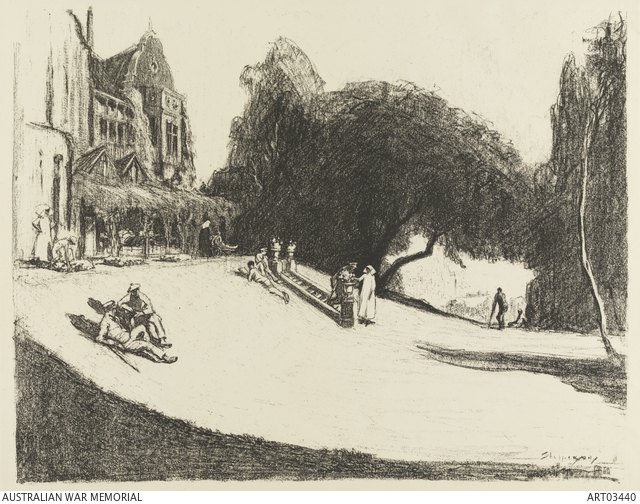
Claude Shepperson, Tending the wounded: Convalescence in England, 1917. Two-colour lithograph from The Great War: Britain’s efforts and ideals. An image of earthly care during the period in which Ward’s book appeared.
Australian War Memorial, ART03440. Published by the British Ministry of Information, 1917. Copyright expired; public domain. · Image source ↗ · Public Domain
A Subaltern in Spirit Land by J. S. M. Ward
In A Subaltern in Spirit Land, J. S. M. Ward’s brother Rex describes their mother remaining unconscious after her death. Four former doctors and two former nurses take her into their care. H. J. L. knows hospitals on the spirit plane and is surprised to learn of one on the astral plane. [11][12][13][14]
The hospital stands in extensive gardens and resembles an eighteenth-century French château adapted internally for modern care. Small treatment rooms, individual attention and peaceful surroundings replace the crowded clinical setting Rex remembers from earth. Ward’s mother wakes gradually, initially misunderstanding where she is. Recognition of Rex and concern for her living granddaughter return within ordinary family conversation. Her recovery takes time, and visitors are asked to leave when she becomes tired. [13][14][15][16][17]
Recreation belongs to the care described here. Patients attend a farce in a theatre fitted largely with bath-chairs, and a nurse mentions quieter concerts within the hospital. These scenes make recovery social and pleasurable as well as restful. Elsewhere the book’s doctors explain illness through moral and spiritual character. Those explanations belong to Ward’s historical spiritual medicine; they do not establish that illness or disability reveals a person’s moral worth. [18][19]
See references (9)
- A Subaltern in Spirit Land, printed p. 123, Reader page 138
- A Subaltern in Spirit Land, printed p. 124, Reader page 139
- A Subaltern in Spirit Land, printed p. 125, Reader page 140
- A Subaltern in Spirit Land, printed p. 126, Reader page 141
- A Subaltern in Spirit Land, printed p. 130, Reader page 145
- A Subaltern in Spirit Land, printed p. 131, Reader page 146
- A Subaltern in Spirit Land, printed p. 132, Reader page 147
- A Subaltern in Spirit Land, printed p. 135, Reader page 150
- A Subaltern in Spirit Land, printed p. 136, Reader page 151
The Encyclopaedia of Death and Life in Spirit-World, Volume I
J. R. Francis’s The Encyclopaedia of Death and Life in Spirit-World, Volume I, gives spiritual hospitals a role in the dialogue ‘Death Considered by Spirit Lucretus’. Its named speaker says that some newcomers are initially weak and need guardians to take them to a hospital. Arrival is compared with a birth requiring care. The passage’s explanation belongs to its Spiritualist account of continuing embodiment. [20][21]
Another unsigned narrative, ‘Dedicated to Those Who Are Intemperate’, describes a newcomer waking in a modest room with a deceased brother, sister and spirit physician beside him. The physician assesses the consequences of his earthly habits, and the sister continues to encourage him through a lengthy recovery. This episode offers a scene of personal convalescence rather than a detailed account of hospital administration. [22][23][24]
The narrator insists that his sister’s kindness matters more than condemnation. Care is extended through rest, companionship and support for a changed way of living. The story also contains obsolete explanations of addiction and prenatal influence. Those explanations are part of the historical text, not a clinical account of dependence or a basis for blaming mothers. Its value here lies in the particular model of spiritual care it imagines. [23][24][25]
See references (6)
- The Encyclopaedia of Death and Life in Spirit-World, Volume I, printed p. 60, Reader page 59
- The Encyclopaedia of Death and Life in Spirit-World, Volume I, printed p. 64, Reader page 63
- The Encyclopaedia of Death and Life in Spirit-World, Volume I, printed p. 140, Reader page 139
- The Encyclopaedia of Death and Life in Spirit-World, Volume I, printed p. 141, Reader page 140
- The Encyclopaedia of Death and Life in Spirit-World, Volume I, printed p. 142, Reader page 141
- The Encyclopaedia of Death and Life in Spirit-World, Volume I, printed p. 143, Reader page 142
Life and Labor in the Spirit World: Shelhamer’s spirit-band
Life and Labor in the Spirit World, credited to the spirit-band of the medium M. T. Shelhamer, describes a refuge in Pleasant Valley under the heading A Home for the Weary. Spirit Violet says that Mary and her companion establish it for people who have died in despair. Comfortable surroundings and sympathetic care are meant to ease their sorrow and strengthen them. [26][27]
The house allows privacy and seclusion as well as cheerful companionship. Its founders continue devising ways to help others, connecting the refuge with their wider mission. Music also appears in the book’s descriptions of restoring harmony. These are narrated forms of spiritual care within the source’s worldview. [27][28][29][30]
Spirit May’s account of Rocky Nook extends the principle to children whose earthly experiences have made a return towards earth distressing. Their community offers beauty, play and recovery before later service becomes possible. The need for rest and reassurance is treated as particular to their experience, rather than a failure shared by every child. [31][32][33]
See references (8)
- Life and Labor in the Spirit World, printed p. 90, Reader page 91
- Life and Labor in the Spirit World, printed p. 91, Reader page 92
- Life and Labor in the Spirit World, printed p. 175, Reader page 176
- Life and Labor in the Spirit World, printed p. 176, Reader page 177
- Life and Labor in the Spirit World, printed p. 177, Reader page 178
- Life and Labor in the Spirit World, printed p. 317, Reader page 318
- Life and Labor in the Spirit World, printed p. 318, Reader page 319
- Life and Labor in the Spirit World, printed p. 319, Reader page 320
An institution of care at different stages
Ward moves from houses of refuge to a hospital his own guide did not know existed. Francis imagines some newcomers needing help to gain strength, as a child might after birth. Each gives recovery a different place in the passage from death. [1][2][5][3][4][8][9][11][12][13][14][20][21]
Rest, company, music and attention recur. The writers also use explanations of illness and character from their own periods. The historical distance matters most where a story turns a condition into a moral explanation. [18][19][23][24][25]
Ward separates regaining strength from beginning lessons. Violet’s home at Pleasant Valley offers rest to people in despair, while May’s account puts care in the lives of children. The type of help follows the history of the people who arrive. [1][2][5][6][26][27][31][32][33]
See references (24)
- Gone West, printed p. 44, Reader page 57
- Gone West, printed p. 50, Reader page 63
- Gone West, printed p. 65, Reader page 78
- Gone West, printed p. 66, Reader page 79
- Gone West, printed p. 51, Reader page 64
- Gone West, printed p. 52, Reader page 65
- Gone West, printed p. 67, Reader page 80
- Gone West, printed p. 162, Reader page 175
- A Subaltern in Spirit Land, printed p. 123, Reader page 138
- A Subaltern in Spirit Land, printed p. 124, Reader page 139
- A Subaltern in Spirit Land, printed p. 125, Reader page 140
- A Subaltern in Spirit Land, printed p. 126, Reader page 141
- A Subaltern in Spirit Land, printed p. 135, Reader page 150
- A Subaltern in Spirit Land, printed p. 136, Reader page 151
- The Encyclopaedia of Death and Life in Spirit-World, Volume I, printed p. 60, Reader page 59
- The Encyclopaedia of Death and Life in Spirit-World, Volume I, printed p. 64, Reader page 63
- The Encyclopaedia of Death and Life in Spirit-World, Volume I, printed p. 141, Reader page 140
- The Encyclopaedia of Death and Life in Spirit-World, Volume I, printed p. 142, Reader page 141
- The Encyclopaedia of Death and Life in Spirit-World, Volume I, printed p. 143, Reader page 142
- Life and Labor in the Spirit World, printed p. 90, Reader page 91
- Life and Labor in the Spirit World, printed p. 91, Reader page 92
- Life and Labor in the Spirit World, printed p. 317, Reader page 318
- Life and Labor in the Spirit World, printed p. 318, Reader page 319
- Life and Labor in the Spirit World, printed p. 319, Reader page 320
Read further in the library
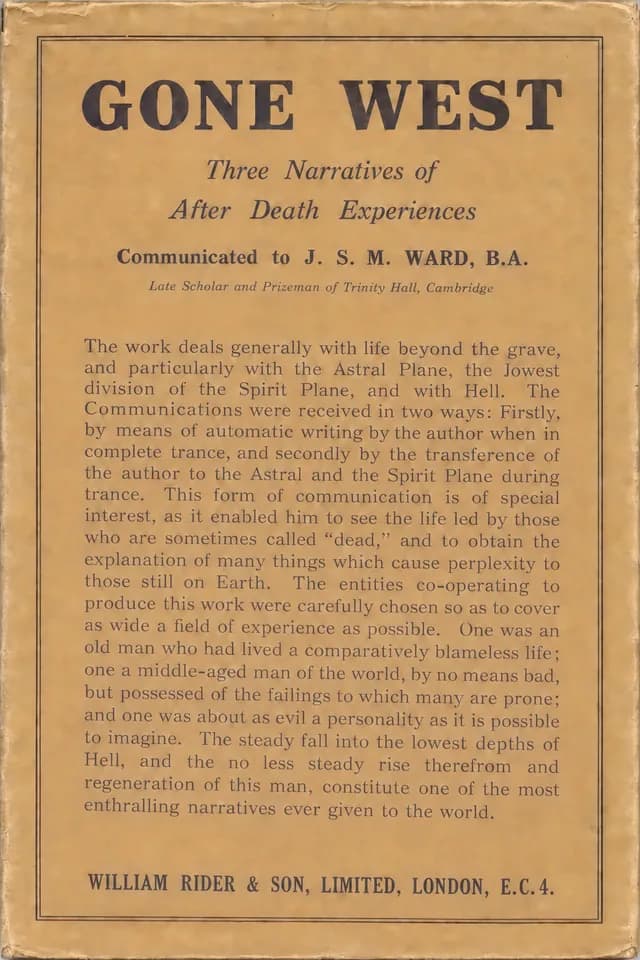
Gone West
Reading note
Ward’s account supplies the exact examples discussed below.

A Subaltern in Spirit Land: A Sequel to Gone West
Reading note
Ward’s sequel supplies a distinct account of this subject, cited to the 1920 edition.

The Encyclopaedia of Death and Life in the Spirit-World, Volume I
Reading note
Distinct attributed accounts in the 1903 fourth edition, cited to exact printed pages and retained Reader leaves.
Life and Labour in the Spirit World
Reading note
The separately titled account draws on exact passages in the consulted Library edition.
Sources
See references (33)
- Gone West, printed p. 44, Reader page 57J. S. M. Ward, Gone West, 1920 third impression in the 2009 Geoff Cutler digital transcription.Read this page in Gone West ↗Return to text ↑
- Gone West, printed p. 50, Reader page 63J. S. M. Ward, Gone West, 1920 third impression in the 2009 Geoff Cutler digital transcription.Read this page in Gone West ↗Return to text ↑
- Gone West, printed p. 65, Reader page 78J. S. M. Ward, Gone West, 1920 third impression in the 2009 Geoff Cutler digital transcription.Read this page in Gone West ↗Return to text ↑
- Gone West, printed p. 66, Reader page 79J. S. M. Ward, Gone West, 1920 third impression in the 2009 Geoff Cutler digital transcription.Read this page in Gone West ↗Return to text ↑
- Gone West, printed p. 51, Reader page 64J. S. M. Ward, Gone West, 1920 third impression in the 2009 Geoff Cutler digital transcription.Read this page in Gone West ↗Return to text ↑
- Gone West, printed p. 52, Reader page 65J. S. M. Ward, Gone West, 1920 third impression in the 2009 Geoff Cutler digital transcription.Read this page in Gone West ↗Return to text ↑
- Gone West, printed p. 64, Reader page 77J. S. M. Ward, Gone West, 1920 third impression in the 2009 Geoff Cutler digital transcription.Read this page in Gone West ↗Return to text ↑
- Gone West, printed p. 67, Reader page 80J. S. M. Ward, Gone West, 1920 third impression in the 2009 Geoff Cutler digital transcription.Read this page in Gone West ↗Return to text ↑
- Gone West, printed p. 162, Reader page 175J. S. M. Ward, Gone West, 1920 third impression in the 2009 Geoff Cutler digital transcription.Read this page in Gone West ↗Return to text ↑
- Tending the wounded: Convalescence in England ↗Australian War Memorial, ART03440. Published by the British Ministry of Information, 1917. Copyright expired; public domain.Return to text ↑
- A Subaltern in Spirit Land, printed p. 123, Reader page 138J. S. M. Ward, A Subaltern in Spirit Land: A Sequel to Gone West, William Rider & Son, 1920.Read this page in A Subaltern in Spirit Land: A Sequel to Gone West ↗Return to text ↑
- A Subaltern in Spirit Land, printed p. 124, Reader page 139J. S. M. Ward, A Subaltern in Spirit Land: A Sequel to Gone West, William Rider & Son, 1920.Read this page in A Subaltern in Spirit Land: A Sequel to Gone West ↗Return to text ↑
- A Subaltern in Spirit Land, printed p. 125, Reader page 140J. S. M. Ward, A Subaltern in Spirit Land: A Sequel to Gone West, William Rider & Son, 1920.Read this page in A Subaltern in Spirit Land: A Sequel to Gone West ↗Return to text ↑
- A Subaltern in Spirit Land, printed p. 126, Reader page 141J. S. M. Ward, A Subaltern in Spirit Land: A Sequel to Gone West, William Rider & Son, 1920.Read this page in A Subaltern in Spirit Land: A Sequel to Gone West ↗Return to text ↑
- A Subaltern in Spirit Land, printed p. 130, Reader page 145J. S. M. Ward, A Subaltern in Spirit Land: A Sequel to Gone West, William Rider & Son, 1920.Read this page in A Subaltern in Spirit Land: A Sequel to Gone West ↗Return to text ↑
- A Subaltern in Spirit Land, printed p. 131, Reader page 146J. S. M. Ward, A Subaltern in Spirit Land: A Sequel to Gone West, William Rider & Son, 1920.Read this page in A Subaltern in Spirit Land: A Sequel to Gone West ↗Return to text ↑
- A Subaltern in Spirit Land, printed p. 132, Reader page 147J. S. M. Ward, A Subaltern in Spirit Land: A Sequel to Gone West, William Rider & Son, 1920.Read this page in A Subaltern in Spirit Land: A Sequel to Gone West ↗Return to text ↑
- A Subaltern in Spirit Land, printed p. 135, Reader page 150J. S. M. Ward, A Subaltern in Spirit Land: A Sequel to Gone West, William Rider & Son, 1920.Read this page in A Subaltern in Spirit Land: A Sequel to Gone West ↗Return to text ↑
- A Subaltern in Spirit Land, printed p. 136, Reader page 151J. S. M. Ward, A Subaltern in Spirit Land: A Sequel to Gone West, William Rider & Son, 1920.Read this page in A Subaltern in Spirit Land: A Sequel to Gone West ↗Return to text ↑
- The Encyclopaedia of Death and Life in Spirit-World, Volume I, printed p. 60, Reader page 59J. R. Francis (compiler), The Encyclopaedia of Death and Life in Spirit-World, Volume I, fourth edition, Progressive Thinker Publishing House, Chicago, 1903. Individual contributors identified in the text.Read this page in The Encyclopaedia of Death and Life in the Spirit-World, Volume I ↗Return to text ↑
- The Encyclopaedia of Death and Life in Spirit-World, Volume I, printed p. 64, Reader page 63J. R. Francis (compiler), The Encyclopaedia of Death and Life in Spirit-World, Volume I, fourth edition, Progressive Thinker Publishing House, Chicago, 1903. Individual contributors identified in the text.Read this page in The Encyclopaedia of Death and Life in the Spirit-World, Volume I ↗Return to text ↑
- The Encyclopaedia of Death and Life in Spirit-World, Volume I, printed p. 140, Reader page 139J. R. Francis (compiler), The Encyclopaedia of Death and Life in Spirit-World, Volume I, fourth edition, Progressive Thinker Publishing House, Chicago, 1903. Individual contributors identified in the text.Read this page in The Encyclopaedia of Death and Life in the Spirit-World, Volume I ↗Return to text ↑
- The Encyclopaedia of Death and Life in Spirit-World, Volume I, printed p. 141, Reader page 140J. R. Francis (compiler), The Encyclopaedia of Death and Life in Spirit-World, Volume I, fourth edition, Progressive Thinker Publishing House, Chicago, 1903. Individual contributors identified in the text.Read this page in The Encyclopaedia of Death and Life in the Spirit-World, Volume I ↗Return to text ↑
- The Encyclopaedia of Death and Life in Spirit-World, Volume I, printed p. 142, Reader page 141J. R. Francis (compiler), The Encyclopaedia of Death and Life in Spirit-World, Volume I, fourth edition, Progressive Thinker Publishing House, Chicago, 1903. Individual contributors identified in the text.Read this page in The Encyclopaedia of Death and Life in the Spirit-World, Volume I ↗Return to text ↑
- The Encyclopaedia of Death and Life in Spirit-World, Volume I, printed p. 143, Reader page 142J. R. Francis (compiler), The Encyclopaedia of Death and Life in Spirit-World, Volume I, fourth edition, Progressive Thinker Publishing House, Chicago, 1903. Individual contributors identified in the text.Read this page in The Encyclopaedia of Death and Life in the Spirit-World, Volume I ↗Return to text ↑
- Life and Labor in the Spirit World, printed p. 90, Reader page 91Members of the Spirit-Band of Miss M. T. Shelhamer, Life and Labor in the Spirit World, Second Thousand, Boston: Colby & Rich, 1885. Exact Library edition IMJ-0202-E001. Parts I, II and III are respectively attributed to Spirit Violet, Spirit May and John Critchley Prince. Original metadata and retained Library PageRefs verified; consequential passages checked against actual Library facsimiles. Original Library PDF bytes remain unavailable.Read this page in Life and Labour in the Spirit World ↗Return to text ↑
- Life and Labor in the Spirit World, printed p. 91, Reader page 92Members of the Spirit-Band of Miss M. T. Shelhamer, Life and Labor in the Spirit World, Second Thousand, Boston: Colby & Rich, 1885. Exact Library edition IMJ-0202-E001. Parts I, II and III are respectively attributed to Spirit Violet, Spirit May and John Critchley Prince. Original metadata and retained Library PageRefs verified; consequential passages checked against actual Library facsimiles. Original Library PDF bytes remain unavailable.Read this page in Life and Labour in the Spirit World ↗Return to text ↑
- Life and Labor in the Spirit World, printed p. 175, Reader page 176Members of the Spirit-Band of Miss M. T. Shelhamer, Life and Labor in the Spirit World, Second Thousand, Boston: Colby & Rich, 1885. Exact Library edition IMJ-0202-E001. Parts I, II and III are respectively attributed to Spirit Violet, Spirit May and John Critchley Prince. Original metadata and retained Library PageRefs verified; consequential passages checked against actual Library facsimiles. Original Library PDF bytes remain unavailable.Read this page in Life and Labour in the Spirit World ↗Return to text ↑
- Life and Labor in the Spirit World, printed p. 176, Reader page 177Members of the Spirit-Band of Miss M. T. Shelhamer, Life and Labor in the Spirit World, Second Thousand, Boston: Colby & Rich, 1885. Exact Library edition IMJ-0202-E001. Parts I, II and III are respectively attributed to Spirit Violet, Spirit May and John Critchley Prince. Original metadata and retained Library PageRefs verified; consequential passages checked against actual Library facsimiles. Original Library PDF bytes remain unavailable.Read this page in Life and Labour in the Spirit World ↗Return to text ↑
- Life and Labor in the Spirit World, printed p. 177, Reader page 178Members of the Spirit-Band of Miss M. T. Shelhamer, Life and Labor in the Spirit World, Second Thousand, Boston: Colby & Rich, 1885. Exact Library edition IMJ-0202-E001. Parts I, II and III are respectively attributed to Spirit Violet, Spirit May and John Critchley Prince. Original metadata and retained Library PageRefs verified; consequential passages checked against actual Library facsimiles. Original Library PDF bytes remain unavailable.Read this page in Life and Labour in the Spirit World ↗Return to text ↑
- Life and Labor in the Spirit World, printed p. 317, Reader page 318Members of the Spirit-Band of Miss M. T. Shelhamer, Life and Labor in the Spirit World, Second Thousand, Boston: Colby & Rich, 1885. Exact Library edition IMJ-0202-E001. Parts I, II and III are respectively attributed to Spirit Violet, Spirit May and John Critchley Prince. Original metadata and retained Library PageRefs verified; consequential passages checked against actual Library facsimiles. Original Library PDF bytes remain unavailable.Read this page in Life and Labour in the Spirit World ↗Return to text ↑
- Life and Labor in the Spirit World, printed p. 318, Reader page 319Members of the Spirit-Band of Miss M. T. Shelhamer, Life and Labor in the Spirit World, Second Thousand, Boston: Colby & Rich, 1885. Exact Library edition IMJ-0202-E001. Parts I, II and III are respectively attributed to Spirit Violet, Spirit May and John Critchley Prince. Original metadata and retained Library PageRefs verified; consequential passages checked against actual Library facsimiles. Original Library PDF bytes remain unavailable.Read this page in Life and Labour in the Spirit World ↗Return to text ↑
- Life and Labor in the Spirit World, printed p. 319, Reader page 320Members of the Spirit-Band of Miss M. T. Shelhamer, Life and Labor in the Spirit World, Second Thousand, Boston: Colby & Rich, 1885. Exact Library edition IMJ-0202-E001. Parts I, II and III are respectively attributed to Spirit Violet, Spirit May and John Critchley Prince. Original metadata and retained Library PageRefs verified; consequential passages checked against actual Library facsimiles. Original Library PDF bytes remain unavailable.Read this page in Life and Labour in the Spirit World ↗Return to text ↑