The Four Paths of Yoga
The four paths of yoga in Vivekananda’s teaching are Karma, Bhakti, Jnana and Raja Yoga. Compare their emphasis on work, devotion, knowledge and meditation.
In this article
Understanding the concept
The four paths of yoga in Swami Vivekananda’s framework approach spiritual freedom through work, devotion, knowledge and mental discipline. He calls them Karma Yoga, Bhakti Yoga, Jnana Yoga and Raja Yoga. [4]
The name of a path describes where the emphasis falls. One person may give most attention to work and also practise devotion or concentration. Vivekananda expects the paths to overlap. [4]
The interests of the practitioner give this framework a practical use. Someone drawn to Karma Yoga can begin by examining the motives behind action. Someone drawn to meditation may begin with the way they direct attention. [3]
- Karma: work
- Selfless action and freedom from appropriation of its results.
- Bhakti: love
- Devotion and surrender of personal will.
- Jnana: knowledge
- Inquiry into the self and the relinquishment of a limited self-conception.
- Raja: mental discipline
- The cultivation of attention and meditation, identified with the psychological emphasis in the fourfold framework.
Karma, Bhakti, Jnana and Raja Yoga
- Karma Yoga. Selfless work. Act without making the reward the purpose of the action. [5][6][7][4][8][3]
- Bhakti Yoga. Love and devotion. Give worship and surrender a central place. [5][6][7][4][8][3]
- Jnana Yoga. Knowledge. Examine what the self is and what has been mistaken for it. [5][6][7][4][8][3]
- Raja Yoga. Mental discipline. Develop attention through practices such as concentration and meditation. [5][6][7][4][8][3]
Karma-Yoga by Swami Vivekananda
Vivekananda groups the paths at the close of Karma-Yoga. He gives each an emphasis and argues that all can bring a person to freedom. His examples then show what the approaches can share. [5][6][7][4][8]
His account of work and devotion shows the overlap in practice. A worker can offer the fruits of action to God, combining devotional language with the discipline of acting without attachment. The distinction between paths does not require excluding the motive and language of another path from one’s work. [9][10][11]
The convergence he stresses is self-abnegation. He describes a worshipper surrendering personal will, a philosopher seeing through the seeming self, and a worker giving up self-centred motive. These are his parallel explanations of how different approaches reach a shared point. [12][13][5][6]
He also gives work an independent capacity to reach the goal. A Karma Yogin need not first accept a doctrine about God or the soul. That passage prevents the framework from becoming a compulsory sequence in which everyone must complete one named yoga before attempting another. [7][8]
The claim that all paths and religions converge belongs to Vivekananda’s interpretation. It is central to his presentation, but does not settle how other traditions understand their own goals. A useful comparison preserves both his proposed unity and the actual differences between the sources being compared. [4]
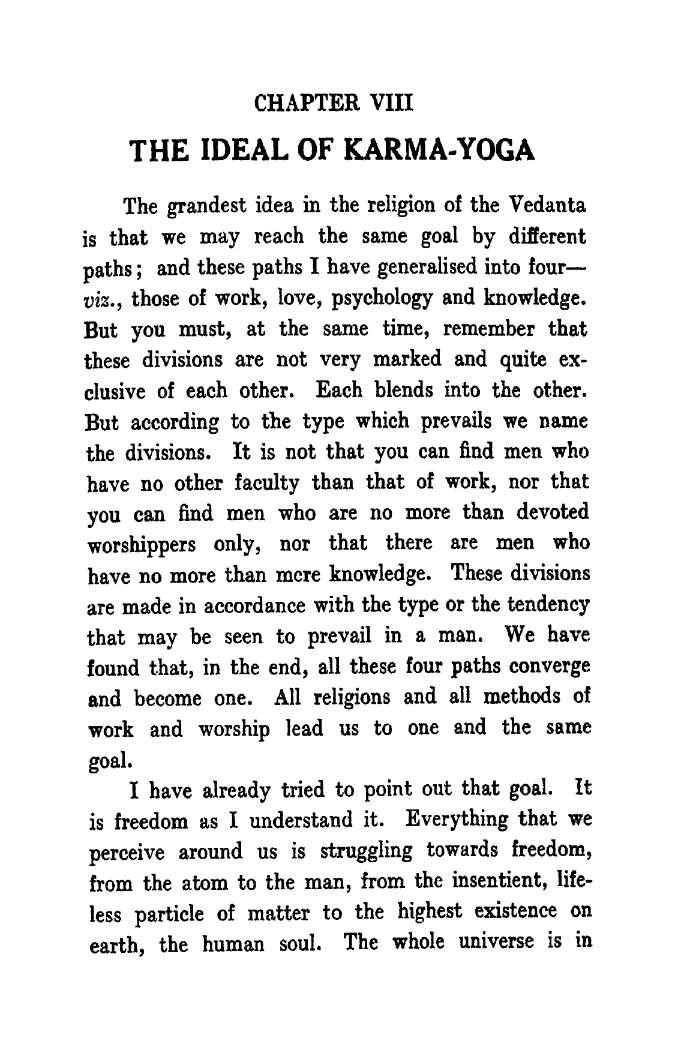
Karma-Yoga (1939), Library Reader page 111. Vivekananda introduces his four emphases and describes how they blend into one another.
Swami Vivekananda, Karma-Yoga, English second printing in the 1939 combined volume. Historical public-domain text, exact checksum-verified Library scan. · Image source ↗ · Public Domain
See references (10)
The Bhagavad Gita: knowledge, work and renunciation
In Bhagavad Gita 3.3, Krishna names disciplines of knowledge and action. At 5.2, renunciation and Karma Yoga are both commended, with Karma Yoga preferred in that comparison. The cited English readings are Swami Mukundananda’s translations. These are specific distinctions within the dialogue, rather than an enumeration of Vivekananda’s four paths. [1][2]
The Vedanta Society of Southern California: a living account
The Vedanta Society of Southern California presents the four paths through concrete practices: devotion and prayer, meditation, discrimination concerning the self, and dedicated service. Its introduction quotes Vivekananda’s Raja-Yoga preface on combining work, worship, psychic control and philosophy. This documents one institution’s continuing use of the framework. It does not establish that every tradition classifies yoga in the same way. [3]
Why the paths can overlap
In Gita 3.3, Krishna distinguishes the disciplines of knowledge and action. At 5.2, he compares Karma Yoga with renunciation. Vivekananda’s list addresses another question, how work, devotion, inquiry and mental discipline can each organise a spiritual life. [1][2][4]
The paths can meet in a single action. A person can care for someone out of love, examine what they expect in return and give the task close attention. Vivekananda names different starting points within a life that can include all of those capacities. [9][5][6][10][4][8]
Read further in the library
Karma Yoga
Reading note
The separately titled account draws on exact passages in the consulted Library edition.
Sources
See references (13)
- Bhagavad Gita 3.3, translated by Swami Mukundananda ↗Bhagavad Gita, dialogue of Krishna and Arjuna, verse 3.3. Swami Mukundananda’s published translation and separately labelled commentary.Return to text ↑
- Bhagavad Gita 5.2, translated by Swami Mukundananda ↗Bhagavad Gita 5.2, in Swami Mukundananda’s devotional translation. The verse commends both renunciation and Karma Yoga, while preferring Karma Yoga in the comparison.Return to text ↑
- Yoga: Spiritual Practice, Vedanta Society of Southern California ↗The Vedanta Society of Southern California’s own introduction to its practice, with separately attributed extracts from Vivekananda. Used as a specific living-tradition account, not a survey of all yoga traditions.Return to text ↑
- Karma-Yoga, Reader page 111Swami Vivekananda, Karma-Yoga, in Karma-Yoga & Bhakti-Yoga, English second printing, Ramakrishna-Vivekananda Center of New York, Inc., 1939. Exact Library edition IMJ-0097-E002. Only the Karma-Yoga part is used in this crawl; the old Work slug mentioning Hindi does not identify this edition’s language.Read this page in Karma Yoga ↗Return to text ↑
- Karma-Yoga, Reader page 82Swami Vivekananda, Karma-Yoga, in Karma-Yoga & Bhakti-Yoga, English second printing, Ramakrishna-Vivekananda Center of New York, Inc., 1939. Exact Library edition IMJ-0097-E002. Only the Karma-Yoga part is used in this crawl; the old Work slug mentioning Hindi does not identify this edition’s language.Read this page in Karma Yoga ↗Return to text ↑
- Karma-Yoga, Reader page 83Swami Vivekananda, Karma-Yoga, in Karma-Yoga & Bhakti-Yoga, English second printing, Ramakrishna-Vivekananda Center of New York, Inc., 1939. Exact Library edition IMJ-0097-E002. Only the Karma-Yoga part is used in this crawl; the old Work slug mentioning Hindi does not identify this edition’s language.Read this page in Karma Yoga ↗Return to text ↑
- Karma-Yoga, Reader page 91Swami Vivekananda, Karma-Yoga, in Karma-Yoga & Bhakti-Yoga, English second printing, Ramakrishna-Vivekananda Center of New York, Inc., 1939. Exact Library edition IMJ-0097-E002. Only the Karma-Yoga part is used in this crawl; the old Work slug mentioning Hindi does not identify this edition’s language.Read this page in Karma Yoga ↗Return to text ↑
- Karma-Yoga, Reader page 115Swami Vivekananda, Karma-Yoga, in Karma-Yoga & Bhakti-Yoga, English second printing, Ramakrishna-Vivekananda Center of New York, Inc., 1939. Exact Library edition IMJ-0097-E002. Only the Karma-Yoga part is used in this crawl; the old Work slug mentioning Hindi does not identify this edition’s language.Read this page in Karma Yoga ↗Return to text ↑
- Karma-Yoga, Reader page 47Swami Vivekananda, Karma-Yoga, in Karma-Yoga & Bhakti-Yoga, English second printing, Ramakrishna-Vivekananda Center of New York, Inc., 1939. Exact Library edition IMJ-0097-E002. Only the Karma-Yoga part is used in this crawl; the old Work slug mentioning Hindi does not identify this edition’s language.Read this page in Karma Yoga ↗Return to text ↑
- Karma-Yoga, printed p. 101, Reader page 103Swami Vivekananda, Karma-Yoga, in Karma-Yoga & Bhakti-Yoga, English second printing, Ramakrishna-Vivekananda Center of New York, Inc., 1939. Exact Library edition IMJ-0097-E002. Only the Karma-Yoga part is used in this crawl; the old Work slug mentioning Hindi does not identify this edition’s language.Read this page in Karma Yoga ↗Return to text ↑
- Karma-Yoga, Reader page 104Swami Vivekananda, Karma-Yoga, in Karma-Yoga & Bhakti-Yoga, English second printing, Ramakrishna-Vivekananda Center of New York, Inc., 1939. Exact Library edition IMJ-0097-E002. Only the Karma-Yoga part is used in this crawl; the old Work slug mentioning Hindi does not identify this edition’s language.Read this page in Karma Yoga ↗Return to text ↑
- Karma-Yoga, Reader page 80Swami Vivekananda, Karma-Yoga, in Karma-Yoga & Bhakti-Yoga, English second printing, Ramakrishna-Vivekananda Center of New York, Inc., 1939. Exact Library edition IMJ-0097-E002. Only the Karma-Yoga part is used in this crawl; the old Work slug mentioning Hindi does not identify this edition’s language.Read this page in Karma Yoga ↗Return to text ↑
- Karma-Yoga, printed p. 79, Reader page 81Swami Vivekananda, Karma-Yoga, in Karma-Yoga & Bhakti-Yoga, English second printing, Ramakrishna-Vivekananda Center of New York, Inc., 1939. Exact Library edition IMJ-0097-E002. Only the Karma-Yoga part is used in this crawl; the old Work slug mentioning Hindi does not identify this edition’s language.Read this page in Karma Yoga ↗Return to text ↑