Devachan
Devachan is a Theosophical afterlife state of spiritual fulfilment. Compare Leadbeater on aspiration with Steiner’s transition and Magica Sexualis on love.
In this article
Understanding the concept
Devachan is a postmortem state in modern Theosophy in which a person is said to experience the fulfilment of spiritual aspirations. Some writers compare it with heaven. It belongs to a sequence in which the concerns of physical life give way to a different form of experience. [2][1]
The Astral Plane by Charles Webster Leadbeater
In The Astral Plane, Charles Webster Leadbeater gives earthly aspirations a life beyond death. He describes Devachan as the working out of spiritual forces set in motion by what the person most deeply hoped for. A strong spiritual life can, in this account, lead to a long interval of fulfilment. [1]
The same passage allows an exceptional alternative. With a teacher’s help and a higher permission, a pupil may choose what Leadbeater calls the Path of Renunciation: directing the accumulated capacity towards work for humanity instead of taking the interval of bliss. The pupil then waits in Kamaloka for a suitable reincarnation. This is presented as a departure from the usual course, not the fate of every person after death. [1]
The cited passage comes from the 1895 edition transcribed by Project Gutenberg. The page numbers refer to that edition. [1]
Initiation and Its Results by Rudolf Steiner
Rudolf Steiner’s Initiation and Its Results mentions Devachan at the end of its account of Kamaloka. When desires directed towards physical satisfactions have been cleansed away, the soul is said to ascend to a loftier region bearing that name. [2]
Steiner concentrates on the change that makes the next stage possible. His example of a desire outlasting the capacity to satisfy it explains where the person has come from. Devachan names the destination he gives in the passage. [3][2]
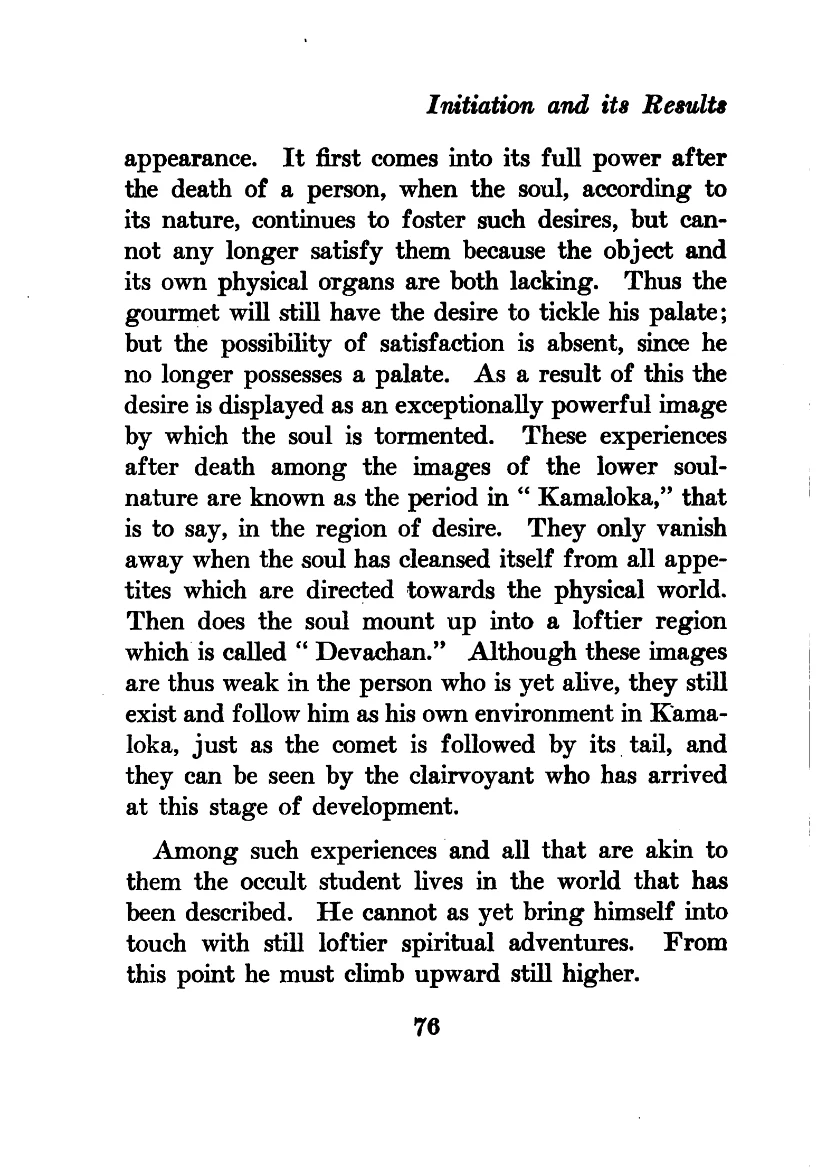
Source facsimile: Initiation and Its Results (1909), printed p. 76, Reader page 74.
Rudolf Steiner, Initiation and Its Results, Clifford Bax translation, First American Edition, 1909. Public-domain historical page from the checksum-verified Library PDF. · Image source ↗ · Public Domain
Magica Sexualis by Émile Laurent and Paul Nagour
Émile Laurent and Paul Nagour’s Magica Sexualis discusses Devachan through passages attributed to Jules Lermina’s Magie pratique and the Revue théosophique. Lermina’s account makes it a temporary state of rest. After a long interval, the individual can return to embodied life and continue a process of purification. The term therefore belongs to a sequence of spiritual conditions, rather than an unchanging final destination. [7][8]
Companionship gives the state its emotional character. A passage assigned to the Revue describes the fulfilment of sublime aspirations and the continued presence of those who were loved. The quotation then attributed to Lermina calls Devachan a creative power that places the beloved image beside the lover. The emphasis falls on a fulfilled experience of attachment, without establishing how two independent persons would share one surrounding world. [8]
The same account explicitly withholds what would correspond to physical sexual union. Its intimate language should therefore be read together with that limit. The presence of a beloved image is not an assertion that bodily relations continue with their earthly organs and conditions unchanged. [8]
The book gives an especially revealing example when only one of two lovers has reached Devachan. The person still on Earth experiences the beloved in dreams, while the Devachanic personality is said to enjoy that presence continuously. The two sides of the relationship are thus described through different conditions of awareness, not through an ordinary reunion in one physical place. [8][9]
The compilation prints a passage ascribed to the Revue théosophique that seems to deny the persistence of metaphysical aspirations just before describing their development. The surrounding examples are clearer about rest, love and the presence of the beloved image. The difficulty belongs to the words printed in this edition. [7][8][9]
The Divine Comedy by Dante Alighieri
Dante Alighieri’s Divine Comedy depicts the blessed through an ascent among planetary spheres. Beatrice explains that they share one heaven; their different appearances make degrees of blessedness intelligible to the traveller. The poem’s visible order is therefore also a way of teaching. [4][5]
What is fulfilled and what is relinquished
Steiner places Devachan after desires that depend on the body have been cleared away. Leadbeater describes aspirations being fulfilled there. Magica Sexualis adds an image of the beloved enjoyed continually by one person and encountered in dreams by another. Each gives fulfilment a particular relation to what the body once allowed. [2][3][1][7][8][9][6]
Dante’s heavenly spheres teach a living traveller how blessedness is received. Devachan belongs to Theosophical accounts of a particular interval or stage. Their resemblance gives the reader a way to compare spiritual fulfilment across two different kinds of afterlife account. [2][4][5]
Leadbeater’s Path of Renunciation is an exception for a pupil in the circumstances he describes. That detail makes his account more specific than Steiner’s brief movement from Kamaloka to Devachan. [1][2]
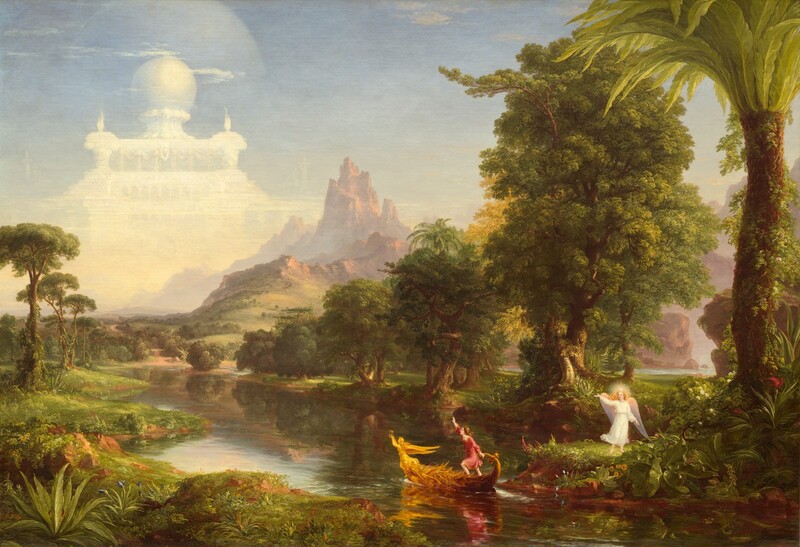
Thomas Cole, The Voyage of Life: Youth, 1842. The palace in the clouds pictures the voyager’s hopes.
National Gallery of Art, Washington. Ailsa Mellon Bruce Fund, 1971.16.2. Public Domain. · Image source ↗ · Public Domain
- Steiner’s transition
- Devachan is named as the loftier region reached after cleansing desires directed towards physical satisfaction.
- Leadbeater’s account
- The state fulfils spiritual forces formed through earthly aspirations; an advanced pupil may exceptionally renounce it for further work.
See references (9)
- C. W. Leadbeater, The Astral Plane (1895), Human Inhabitants: The Chela awaiting reincarnation, printed pp. 24–25
- Initiation and Its Results, printed p. 76, Reader page 74
- Initiation and Its Results, printed p. 75, Reader page 73
- Purgatory and Paradise, Paradise III, printed p. 169, Reader page 219
- Purgatory and Paradise, Paradise IV, printed p. 172, Reader page 222
- Thomas Cole, The Voyage of Life: Youth, 1842
- Magica Sexualis, printed p. 20, Reader page 28
- Magica Sexualis, printed p. 21, Reader page 29
- Magica Sexualis, printed p. 22, Reader page 30
Read further in the library

Initiation and Its Results
Reading note
The separately titled account draws on exact passages in the consulted Library edition.

Purgatory and Paradise: The Vision of Dante
Reading note
Separately attributed comparison with exact previously researched Library passages.
The Astral Plane
Reading note
Separately attributed account from the 1895 Project Gutenberg transcription, with exact printed pagination; not an asserted Library Reader leaf.

Magica Sexualis
Reading note
The separately titled account draws on exact passages in the consulted Library edition.
Sources
See references (9)
- C. W. Leadbeater, The Astral Plane (1895), Human Inhabitants: The Chela awaiting reincarnation, printed pp. 24–25 ↗Charles Webster Leadbeater, The Astral Plane: Its Scenery, Inhabitants and Phenomena. Theosophical Publishing Society, London, 1895. Exact printed markers in Project Gutenberg’s transcription. This external pagination is not asserted to be a Library Reader sequence.Return to text ↑
- Initiation and Its Results, printed p. 76, Reader page 74Rudolf Steiner, Initiation and Its Results: A Sequel to The Way of Initiation, translated by Clifford Bax. First American Edition, 1909. Macoy Publishing and Masonic Supply Co., New York; Max Gysi, London. Claims of clairvoyant perception and subtle organs remain attributed. References identify the exact consulted Library edition.Read this page in Initiation and Its Results ↗Return to text ↑
- Initiation and Its Results, printed p. 75, Reader page 73Rudolf Steiner, Initiation and Its Results: A Sequel to The Way of Initiation, translated by Clifford Bax. First American Edition, 1909. Macoy Publishing and Masonic Supply Co., New York; Max Gysi, London. Claims of clairvoyant perception and subtle organs remain attributed. References identify the exact consulted Library edition.Read this page in Initiation and Its Results ↗Return to text ↑
- Purgatory and Paradise, Paradise III, printed p. 169, Reader page 219Dante Alighieri, The Divine Comedy, translated by Henry Francis Cary, designs by Gustave Doré. Inferno: Thompson & Thomas, Chicago, undated New Edition; Purgatory and Paradise: Thompson & Thomas, Chicago, 1901.Read this page in Purgatory and Paradise: The Vision of Dante ↗Return to text ↑
- Purgatory and Paradise, Paradise IV, printed p. 172, Reader page 222Dante Alighieri, The Divine Comedy, translated by Henry Francis Cary, designs by Gustave Doré. Inferno: Thompson & Thomas, Chicago, undated New Edition; Purgatory and Paradise: Thompson & Thomas, Chicago, 1901.Read this page in Purgatory and Paradise: The Vision of Dante ↗Return to text ↑
- Thomas Cole, The Voyage of Life: Youth, 1842 ↗National Gallery of Art, 1971.16.2. Primary object page identifies the image as free and public domain.Return to text ↑
- Magica Sexualis, printed p. 20, Reader page 28Émile Laurent and Paul Nagour, Magica Sexualis, privately printed by Falstaff Press Inc., New York, undated inspected edition. Exact original Library edition IMJ-0105-E001. The work is a historical compilation; its quoted fiction, trial allegations and medical interpretations are not treated as independently verified facts. Current Reader positions are mapped separately from printed pagination.Read this page in Magica Sexualis ↗Return to text ↑
- Magica Sexualis, printed p. 21, Reader page 29Émile Laurent and Paul Nagour, Magica Sexualis, privately printed by Falstaff Press Inc., New York, undated inspected edition. Exact original Library edition IMJ-0105-E001. The work is a historical compilation; its quoted fiction, trial allegations and medical interpretations are not treated as independently verified facts. Current Reader positions are mapped separately from printed pagination.Read this page in Magica Sexualis ↗Return to text ↑
- Magica Sexualis, printed p. 22, Reader page 30Émile Laurent and Paul Nagour, Magica Sexualis, privately printed by Falstaff Press Inc., New York, undated inspected edition. Exact original Library edition IMJ-0105-E001. The work is a historical compilation; its quoted fiction, trial allegations and medical interpretations are not treated as independently verified facts. Current Reader positions are mapped separately from printed pagination.Read this page in Magica Sexualis ↗Return to text ↑