Kamaloka
Kamaloka is a Theosophical state in which bodily desires continue after death. Compare Steiner’s account of unsatisfied desire with Ward’s place of learning.
In this article
Understanding the concept
Kamaloka is a postmortem state or region of desire in Theosophical writing. Rudolf Steiner describes a person still wanting physical pleasures after losing the bodily means to enjoy them. The condition lasts while those desires hold their force. [1][2]
Initiation and Its Results by Rudolf Steiner
Rudolf Steiner’s Initiation and Its Results approaches Kamaloka through the appearances supposedly produced by feeling and desire. During physical life, a desire can be directed towards an object that may still be obtained. The book says its astral image is then comparatively faint. [1]
Steiner asks the reader to imagine wanting the pleasure of a taste without having a palate. In his account, death leaves the desire with nothing through which it can be satisfied. The example explains why he makes this interval a purification. [2]
The soul is said to remain among the images of its own desires until they lose their hold. Steiner then names Devachan as the further region it can enter. [2]
The same passage connects the postmortem condition with the clairvoyance discussed in the chapter. These desire-images are said to exist during bodily life, though weakened by physical existence and possible satisfaction. Steiner claims the trained observer can perceive them. This joins his account of after-death experience with his account of spiritual sight. [1][2]
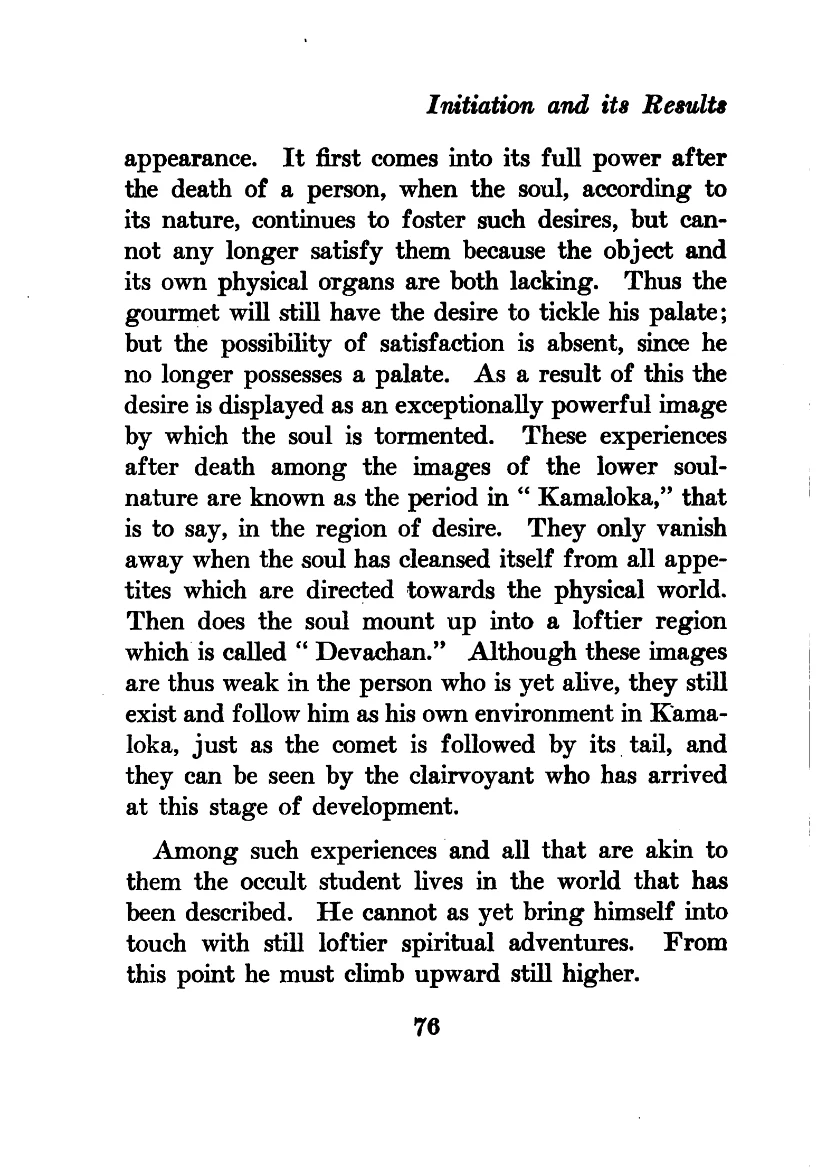
Initiation and Its Results (1909), printed p. 76, Library Reader page 74. Steiner treats the loss of the palate as an example of a desire that outlasts the body.
Rudolf Steiner, Initiation and Its Results, Clifford Bax translation, First American Edition, 1909. Public-domain historical page from the checksum-verified Library PDF. · Image source ↗ · Public Domain
- During embodied life
- The desired object and bodily means of satisfaction may still be available; the corresponding astral image is said to be comparatively faint.
- In the postmortem condition
- The desire remains, but its physical means of fulfilment are absent; Steiner describes the resulting image as powerful and tormenting.
Gone West by J. S. M. Ward
In J. S. M. Ward’s Gone West, the reported spirit contributor H. J. L. says that purgatory roughly corresponds to his present condition. He calls it a place of learning and regrets time wasted on earth, when capacities could have been developed. [3]
Desire and regret after death
Ward’s description of purgatory makes regret a reason to learn. Steiner begins with a desire that survives the means of satisfying it. The two accounts put change after death at the centre and give the person a different difficulty to work through. [1][2][3]
Read further in the library
Initiation and Its Results
Reading note
The separately titled account draws on exact passages in the consulted Library edition.
Gone West
Reading note
Separately attributed comparison with exact previously researched Library passages.
Sources
See references (3)
- Initiation and Its Results, printed p. 75, Reader page 73Rudolf Steiner, Initiation and Its Results: A Sequel to The Way of Initiation, translated by Clifford Bax. First American Edition, 1909. Macoy Publishing and Masonic Supply Co., New York; Max Gysi, London. Claims of clairvoyant perception and subtle organs remain attributed. References identify the exact consulted Library edition.Read this page in Initiation and Its Results ↗Return to text ↑
- Initiation and Its Results, printed p. 76, Reader page 74Rudolf Steiner, Initiation and Its Results: A Sequel to The Way of Initiation, translated by Clifford Bax. First American Edition, 1909. Macoy Publishing and Masonic Supply Co., New York; Max Gysi, London. Claims of clairvoyant perception and subtle organs remain attributed. References identify the exact consulted Library edition.Read this page in Initiation and Its Results ↗Return to text ↑
- Gone West, printed p. 2, Reader page 15J. S. M. Ward, Gone West, 1920 third impression as reproduced in the 2009 Geoff Cutler digital transcription.Read this page in Gone West ↗Return to text ↑