Avalokiteshvara
Explore Avalokiteshvara through compassion, the six-syllable mantra, Guanyin’s changing forms, Chenrezig’s symbolism and historical Water Moon sculpture.
In this article
Who is Avalokiteshvara?
Avalokiteshvara is a Buddhist bodhisattva associated with compassion and the relief of suffering. In China the figure is known as Guanyin and has long been a focus of devotion. Worshippers seek aid and blessings from a presence understood as attentive to the world’s distress. [1]
Compassion, narrative and mantra
Compassion in a sutra narrative
The Basket’s Display gives compassionate action a dramatic scale. In passages 1.12–1.15, Avalokiteshvara enters Avici hell. The heat subsides, lotus flowers appear and the inferno becomes a pool. Yama’s guards report that their place of punishment has been transformed. [2]
The reversal makes the bodhisattva’s purpose visible within the story: he goes where suffering is most intense and brings relief. This is the sutra’s religious narrative, whose scale and imagery express its vision of compassionate power. [2]
The six-syllable mantra
The translation’s introduction identifies the text as an important source for the mantra commonly written Om mani padme hum. Its narrative leads towards the difficulty and rarity of obtaining that mantra. The editors also explain its later importance in Tibetan Avalokiteshvara practice. [2]
The same introduction places Avalokiteshvara in Sukhavati in relation to Amitabha. A figure known through widespread devotion thus also belongs within particular texts and accounts of sacred worlds. [2]
Chenrezig and Guanyin
Reading the four-armed Chenrezig form
In Robert Beer’s explanation of a four-armed Chenrezig image, the two central hands hold a wish-fulfilling jewel before the heart. The other hands carry a rosary and a lotus. The four arms express love, compassion, sympathetic joy and equanimity, often called the four immeasurables. [3]
Amitabha appears above the head. The attributes connect a recognizable divine form with qualities to be cultivated, while the folded central hands keep attention near the heart. This interpretation belongs to a particular iconographic form; it does not describe every representation of Avalokiteshvara. [3]
Guanyin’s changing forms
Chinese representations developed increasingly ambiguous and feminine features over time. The Asian Art Museum describes the popularity of a female form by the Yuan period, alongside devotion to Guanyin as a protector of women, children and sailors. [1]
These developments connect compassion with different human hopes and needs. The history is richer than a choice between one permanently male figure and one permanently female goddess. Names, appearances and devotional roles change as the figure is encountered within different communities. [1]
The Water Moon image
An eleventh-century Chinese wood sculpture at the Met presents Avalokiteshvara with the right knee raised and the other leg crossed before the body. Traces of pigment remain on a figure assembled from several pieces of willow. The relaxed posture belongs to the Water Moon form. [4]
The museum connects this manifestation with Mount Potalaka, the bodhisattva’s sacred abode. It also follows the identification of that place with Mount Putuo off China’s Zhejiang coast, which became an important pilgrimage destination. Image, sacred landscape and pilgrimage give compassion a setting that devotees could contemplate and approach. [4]
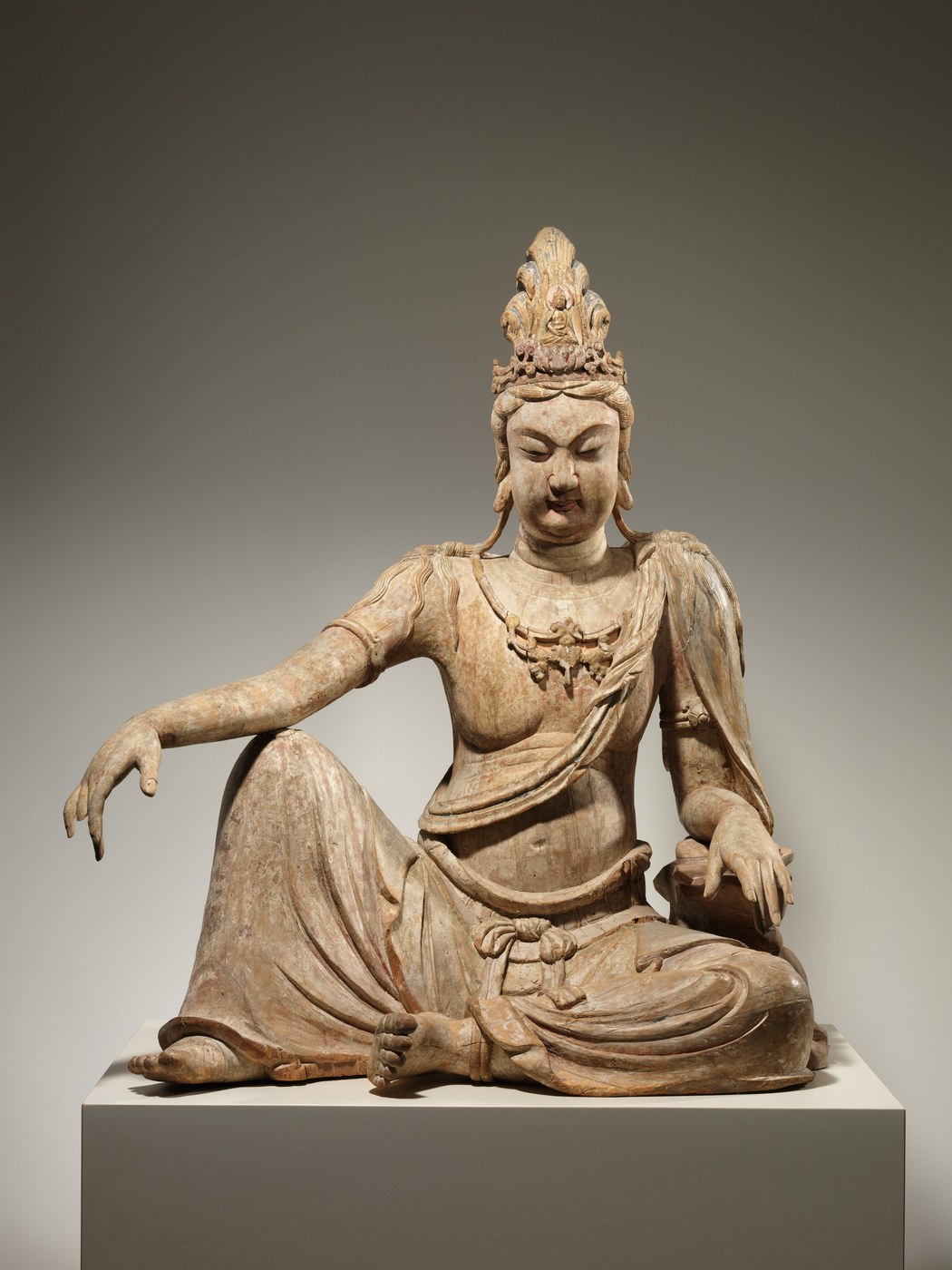
Avalokiteshvara in Water Moon Form, China, eleventh century. Willow wood with traces of pigment.
The Metropolitan Museum of Art. Fletcher Fund, 1928. Accession 28.56. Public Domain (CC0). · Museum record ↗ · CC0
Sources
- The bodhisattva Avalokiteshvara (Guanyin) ↗Asian Art Museum, San Francisco; devotion, Water Moon imagery and genderReturn to text ↑
- The Basket’s Display ↗Peter Alan Roberts, 84000; introduction, summary and translated passages 1.12–1.15Return to text ↑
- Four-armed Chenrezig ↗Robert Beer; interpretation of Pemba Lama’s four-armed formReturn to text ↑
- Bodhisattva Avalokiteshvara in Water Moon Form ↗The Metropolitan Museum of Art; Chinese eleventh-century wood sculpture, accession 28.56Return to text ↑
About this article & its sources
Selected Mahayana narratives, Tibetan iconographic interpretation and Chinese devotional art. Regional forms and historical source companions remain distinct; this is not a manual of initiated practice.
Passage attributions
Who is Avalokiteshvara?
Passage 1: Asian Art Museum, San Francisco; devotion, Water Moon imagery and gender.
Compassion in a sutra narrative
Passage 1: Peter Alan Roberts, 84000; introduction, summary and translated passages 1.12–1.15.
Passage 2: Peter Alan Roberts, 84000; introduction, summary and translated passages 1.12–1.15.
The six-syllable mantra
Passage 1: Peter Alan Roberts, 84000; introduction, summary and translated passages 1.12–1.15.
Passage 2: Peter Alan Roberts, 84000; introduction, summary and translated passages 1.12–1.15.
Reading the four-armed Chenrezig form
Passage 1: Robert Beer; interpretation of Pemba Lama’s four-armed form.
Passage 2: Robert Beer; interpretation of Pemba Lama’s four-armed form.