Sukhavati
Explore Sukhavati, Amitabha’s Western Pure Land, through Buddhist sutras, Japanese traditions, devotional practice and historical art.
In this article
What is Sukhavati?
Sukhavati is the Pure Land of Amitabha Buddha, also known as Amitayus and, in Japanese, Amida. The Smaller Pure Land Sutra describes it as a western land of extraordinary beauty where the Buddha teaches. Its jeweled ponds, radiant lotuses and music accompany a promise of progress towards awakening. [1]
The Larger Sutra presents this land through the vows of Dharmakara, the bodhisattva who becomes the Buddha of that realm. Its promises connect birth there with assurance of nirvana. In the Smaller Sutra, residents reach a stage from which they do not fall back on the path. These descriptions distinguish the land’s purpose from a pleasant rebirth whose benefits eventually run out. The aspiration concerns the ending of suffering, as well as a beautiful destination. [1]
Sutras and living practice
Vows and the Buddha’s Name
The Larger Sutra’s eighteenth vow concerns sincere entrusting, aspiration for birth and recollection of the Buddha, while also stating exclusions involving grave wrongdoing and rejection of the Dharma. Later teachers interpret its wording within their own accounts of compassion and practice. The text should therefore be read alongside, rather than detached from, the traditions that explain it. [1]
Honen’s tradition: the nembutsu
Jodo Shu North America describes Honen’s teaching as a path centred on reciting Amida’s Name, the nembutsu. Aspiration for birth in the Pure Land is open across distinctions of age, social position and education. In that land, the practitioner continues towards awakening through bodhisattva practice. [3]
Recitation makes the aspiration part of ordinary life. The Name can be spoken by someone who cannot pursue an elaborate course of textual study or demanding contemplative exercises. Within this institutional account, accessibility is a central religious concern: the path is presented as available to people in differing circumstances. That emphasis belongs to Jodo Shu’s explanation of its tradition, rather than a claim that every Pure Land school describes practice in exactly the same terms. [3]
Shinran’s tradition: entrusting and gratitude
Jodo Shinshu Hongwanji-ha places the entrusting heart and Amida’s Primal Vow at the centre of its account. Nembutsu expresses a life of gratitude. At death, birth in the Pure Land brings Buddhahood, followed by compassionate activity for beings who remain in delusion. [2]
The direction of the story matters: reaching the land does not end concern for others. Return and compassionate guidance belong to the institution’s explanation of awakening. Its teaching also places daily conduct within gratitude and reverence. This gives the reader a concrete view of Pure Land religion as lived commitment, rather than treating the subject only as a distant location. Honen and Shinran share important language, but their traditions’ formulations deserve their own explanations. [2]
Interpretation and art
How should the land be understood?
The Stanford Encyclopedia’s account of Japanese Pure Land thought describes a tension between finite human life and wisdom that exceeds ordinary conceptual grasp. Religious forms can make that wisdom available through compassionate activity. Images, names and narratives therefore need not be discarded as meaningless simply because a teacher also discusses ultimate reality beyond form. [4]
This helps avoid a misleading choice between a supposedly simple literal belief and a supposedly superior symbolic interpretation. Pure Land thinkers have worked through the relation between form, reality and compassionate means in different ways. A reader can ask how a particular teacher understands Amida and the land, and what that understanding asks of the practitioner. The answer should come from that teacher’s texts and tradition, rather than from an imposed ranking of believers. [4]
The welcoming descent in art
A late-fourteenth-century Japanese hanging scroll in the Met depicts Amida and accompanying bodhisattvas descending to welcome a believer. This type of image is called raigo. The museum explains its historical use near a dying person’s bed, sometimes with a cord connecting the believer to the Buddha’s painted hand. [5]
The scroll makes welcome visible through movement: a luminous retinue approaches across clouds. It belongs to a particular history of Japanese devotional art and care at death, rather than prescribing a practice for every Pure Land community today. [5]
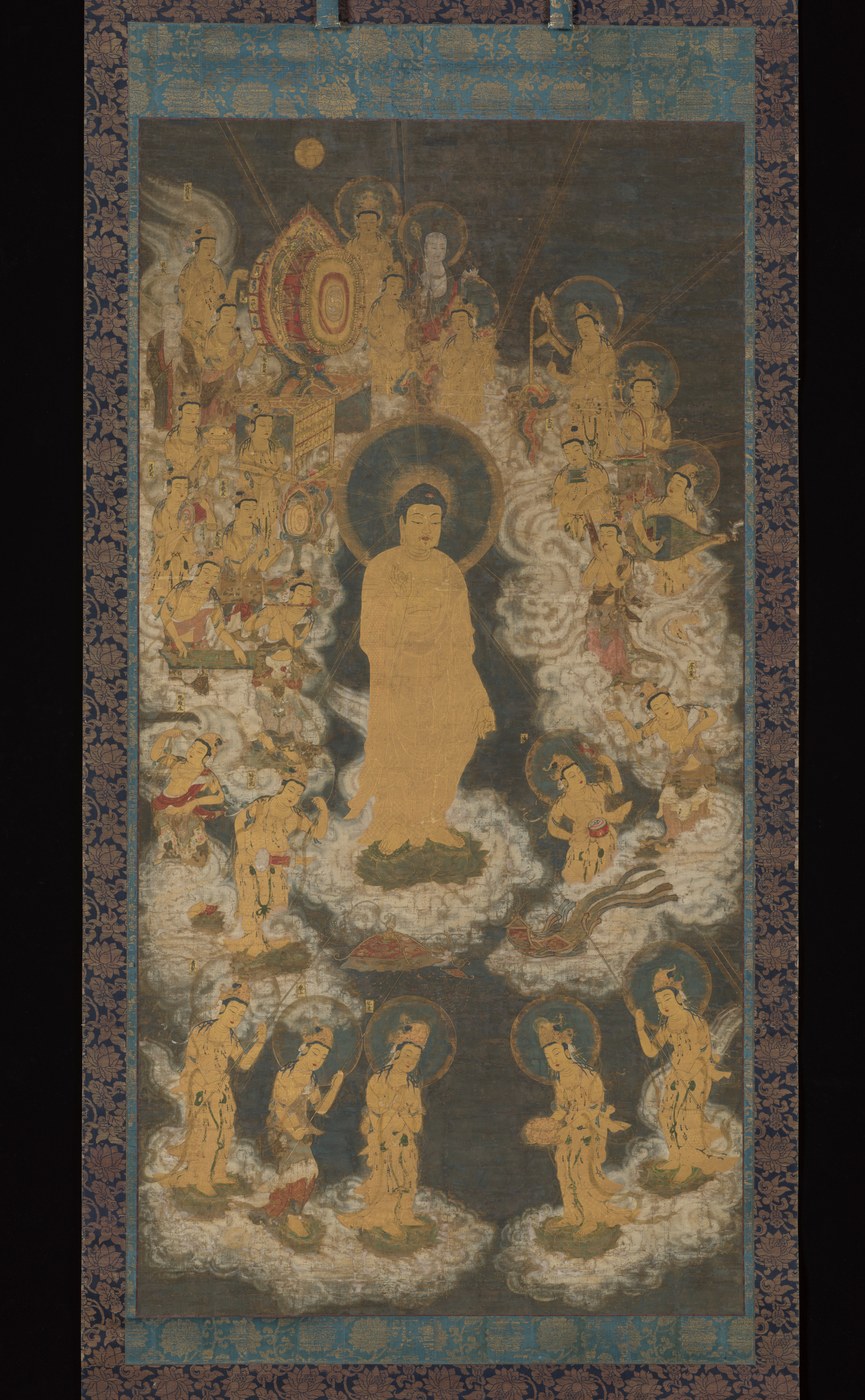
Welcoming Descent of Amida and Bodhisattvas, Japan, late fourteenth century. Unidentified artist; ink, colour and gold on silk.
The Metropolitan Museum of Art. Gift of Abby Aldrich Rockefeller, 1942. Accession 42.25.37. Public Domain (CC0). · Museum record ↗ · CC0
Sources
- The Three Pure Land Sutras ↗Translated by Hisao Inagaki with Harold Stewart; BDK, revised second edition. Larger Sutra, printed pp. 13–15; Smaller Sutra, pp. 91–93, read in the official PDF.Return to text ↑
- Jodo Shinshu Hongwanji-ha: Teaching ↗Official account of Jodo Shinshu Hongwanji-ha teaching and practiceReturn to text ↑
- About Jodo Shu ↗Jodo Shu North America; institutional account of Honen’s traditionReturn to text ↑
- Japanese Pure Land Philosophy ↗Stanford Encyclopedia of Philosophy; scholarly account of Japanese Pure Land thoughtReturn to text ↑
- Welcoming Descent of Amida and Bodhisattvas, 42.25.37 ↗The Metropolitan Museum of Art; Japan, late fourteenth centuryReturn to text ↑
About this article & its sources
Sukhavati in selected Pure Land sutras and living Japanese traditions, with scholarly interpretation and historical art. A Pure Land is not equated with every Buddhist heavenly realm or reduced to one universal literal or symbolic reading.
Passage attributions
What is Sukhavati?
Passage 1: Translated by Hisao Inagaki with Harold Stewart; BDK, revised second edition. Larger Sutra, printed pp. 13–15; Smaller Sutra, pp. 91–93, read in the official PDF..
Passage 2: Translated by Hisao Inagaki with Harold Stewart; BDK, revised second edition. Larger Sutra, printed pp. 13–15; Smaller Sutra, pp. 91–93, read in the official PDF..
Vows and the Buddha’s Name
Passage 1: Translated by Hisao Inagaki with Harold Stewart; BDK, revised second edition. Larger Sutra, printed pp. 13–15; Smaller Sutra, pp. 91–93, read in the official PDF..
Honen’s tradition: the nembutsu
Passage 1: Jodo Shu North America; institutional account of Honen’s tradition.
Passage 2: Jodo Shu North America; institutional account of Honen’s tradition.
Shinran’s tradition: entrusting and gratitude
Passage 1: Official account of Jodo Shinshu Hongwanji-ha teaching and practice.
Passage 2: Official account of Jodo Shinshu Hongwanji-ha teaching and practice.