Angelic Hierarchy
An angelic hierarchy arranges heavenly beings into orders. Learn the nine Christian choirs and compare Dante, Swedenborg and Theosophical accounts.
In this article
The nine choirs
What is an angelic hierarchy?
An angelic hierarchy arranges angels into orders. In the account attributed to Pseudo-Dionysius, nine choirs form three groups of three. Their ranks describe how they receive divine illumination and communicate it to others. [1]
The three groups of the Dionysian account
In The Celestial Hierarchy, chapter VI, Pseudo-Dionysius places seraphim, cherubim and thrones nearest to God. Dominions, virtues and powers form the second group. Principalities, archangels and angels form the third. The grouping gives a place to each order while leaving full knowledge of their nature to God. [1]
Angels can name the whole heavenly company in ordinary usage. In the list it also names the final order. That double use explains why a seraph can be called an angel even though the two names occupy different places in the scheme. [1][5]
Hierarchy, reception and service
The Divine Comedy by Dante Alighieri
In Dante Alighieri’s Paradise XXVIII, nine fiery circles turn around an unbearable point of light. The innermost is the fastest. Dante expects the reverse because the widest sphere of the bodily heavens turns fastest. The discrepancy gives Beatrice a question to answer. [2][3]
Beatrice answers that correspondence should be judged by power and blessedness rather than apparent size. The widest bodily heaven, diffusing the greatest power, corresponds to the highest spiritual order. Once that distinction is made, the two arrangements can express a single order without matching circle for circle in their visible dimensions. [3][4]
She then names the nine choirs in their groups and explains their upward attention and downward influence. The poem endorses the ordering it assigns to Dionysius and imagines Gregory smiling at his own correction after reaching Heaven. That episode belongs to Dante’s account of reception. It does not prove that the surviving Dionysian writings were composed by an apostolic eyewitness. [4][5]
Paradise XXIX adds that the company exceeds human counting and that each receives the one light in a distinct manner. The ranks do not exhaust the individuality of their members. The vision moves between ordered choirs and innumerable mirrors, holding structure and differentiated participation together. [6]
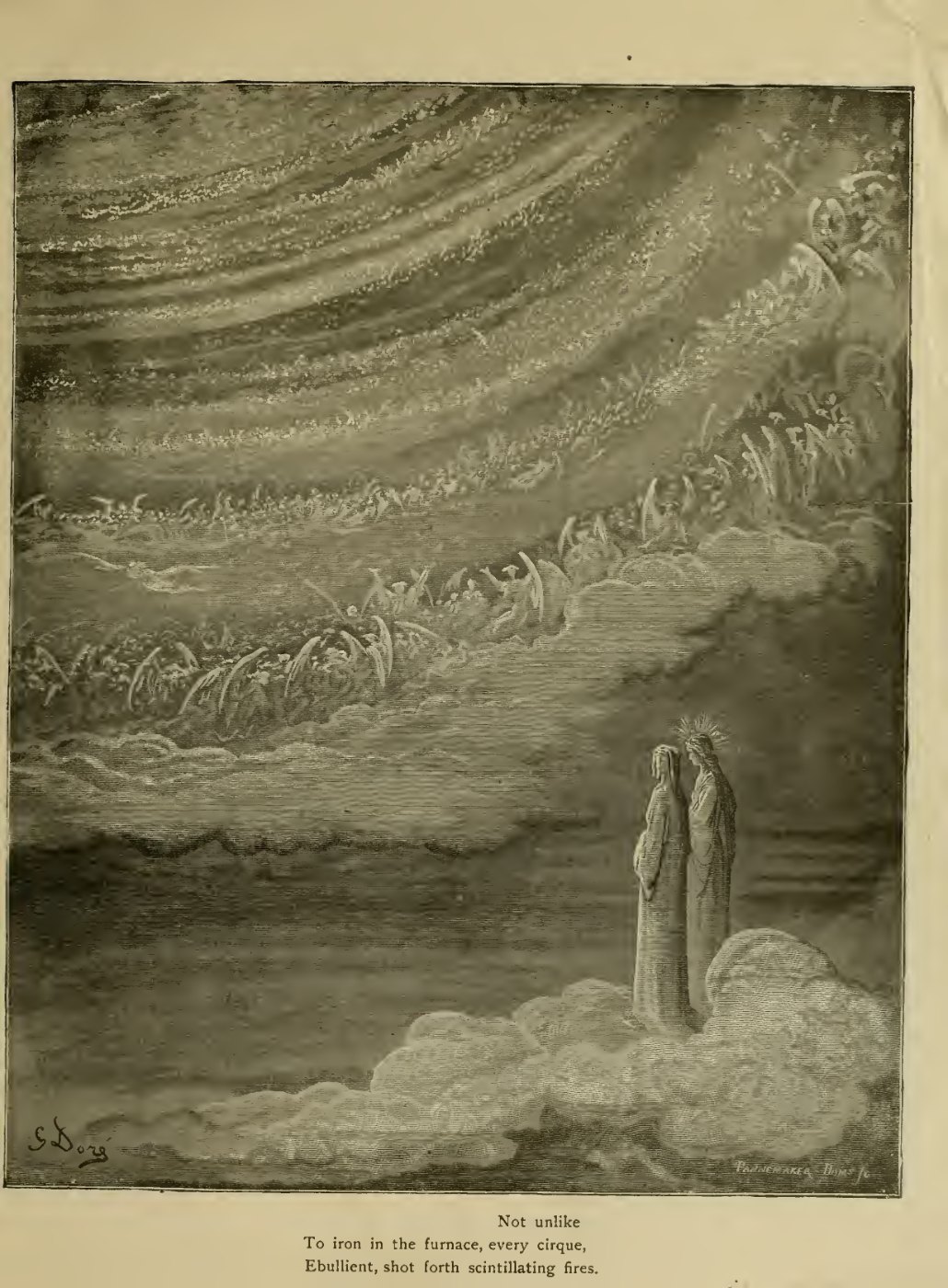
Doré’s design corresponding to the fiery circles of Paradise XXVIII. The original caption compares their sparks with iron in a furnace. It is a poetic representation of angelic order, not a scale diagram of the physical universe.
Design by Gustave Doré. Purgatory and Paradise, Henry Francis Cary translation, Thompson & Thomas, Chicago, 1901. Public Domain. · Image source ↗ · Public Domain
Heaven and Its Wonders and Hell
Emanuel Swedenborg’s Heaven and Its Wonders and Hell organises heaven through two kingdoms and three heavens. The celestial kingdom receives good more immediately in the will and life; the spiritual kingdom receives it through understanding. These kingdoms are not two additional levels placed above the three heavens. The heavens describe degrees in the opening of the angels’ interiors, with the inmost or third heaven distinguished from the middle and outermost. [8][9][10][11][12]
Swedenborg calls the differences between degrees discrete. He compares their relationship with successive causes and effects, distinguishing it from a continuous increase such as greater brightness within the same degree. In his account, moving into a higher heaven therefore requires more than travelling upward or accumulating information. An angel’s capacity to receive its life determines where that angel can live. [13][14][15]
Communication also follows this order. Within a heaven, thought and affection extend through its societies; between heavens, correspondence and downward influx give another kind of connection. Swedenborg allows specially prepared encounters while denying that an angel can ordinarily move into any heaven at will. The hierarchy concerns different forms of reception and mutual service, rather than a ladder of offices identical to the nine angelic orders described elsewhere in this entry. [16][17][18][19][20]
See references (13)
- Heaven and Its Wonders and Hell, printed p. 19, Reader page 26
- Heaven and Its Wonders and Hell, printed p. 20, Reader page 27
- Heaven and Its Wonders and Hell, printed p. 23, Reader page 30
- Heaven and Its Wonders and Hell, printed p. 24, Reader page 31
- Heaven and Its Wonders and Hell, printed p. 26, Reader page 33
- Heaven and Its Wonders and Hell, printed p. 28, Reader page 35
- Heaven and Its Wonders and Hell, printed p. 29, Reader page 36
- Heaven and Its Wonders and Hell, printed p. 30, Reader page 37
- Heaven and Its Wonders and Hell, printed p. 149, Reader page 156
- Heaven and Its Wonders and Hell, printed p. 150, Reader page 157
- Heaven and Its Wonders and Hell, printed p. 151, Reader page 158
- Heaven and Its Wonders and Hell, printed p. 154, Reader page 161
- Heaven and Its Wonders and Hell, printed p. 156, Reader page 163
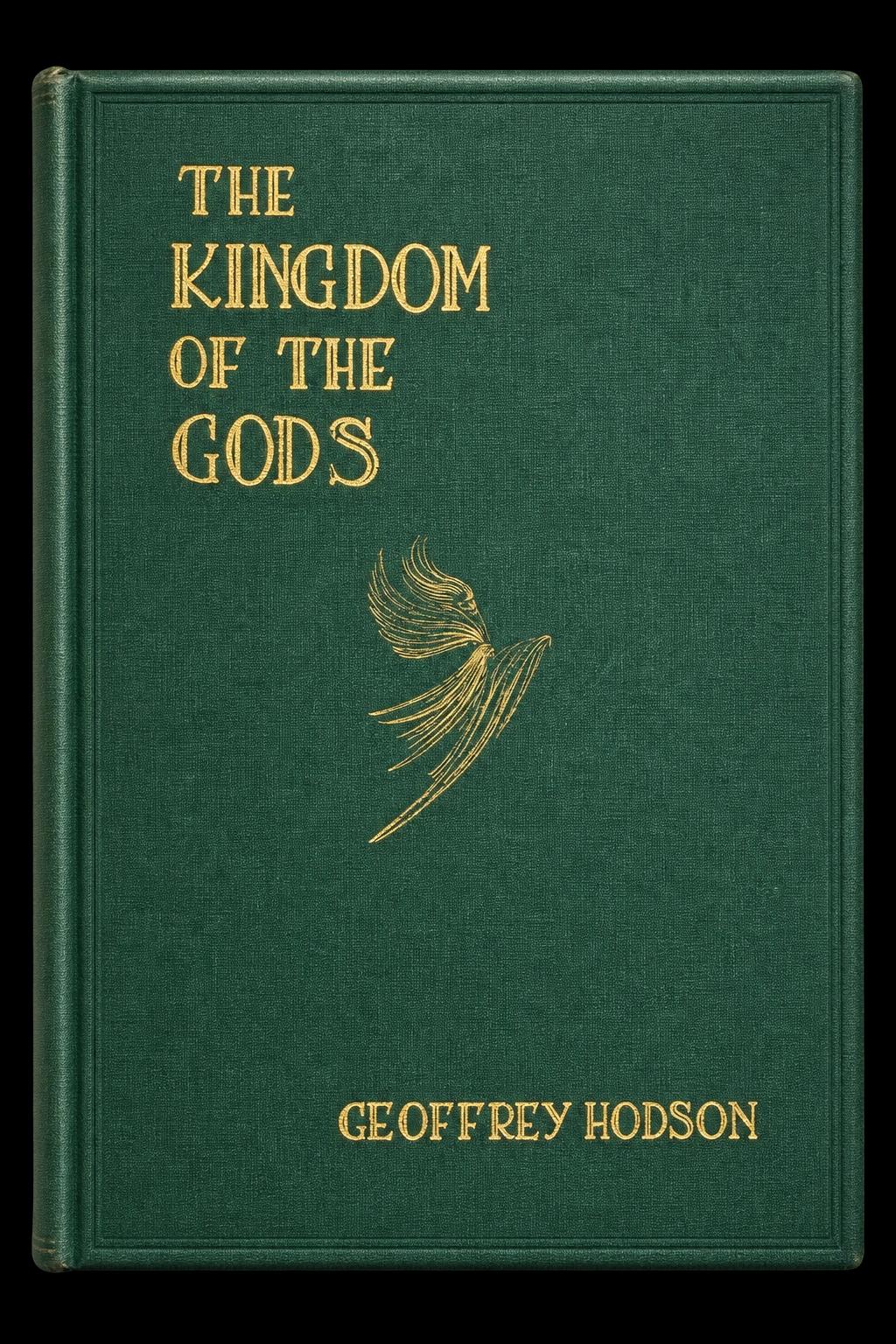
The Kingdom of the Gods by Geoffrey Hodson
Geoffrey Hodson describes the angelic hierarchy as part of a single living order. One individual can belong to a larger being in something like the way a cell belongs to a body. Through successive levels, the many kinds of life are connected to one divine source. Hodson gives the angels, archangels and nature spirits different degrees of development and different work within that order. [31][32][33][34]
His chapter on the Sephirothal Tree applies a second way of organising the hosts. In Hodson’s presentation, the ten sefirot carry divine names at one level, archangels at another, and angelic choirs at another. He adds planetary and elemental correspondences at the level that includes physical nature. This is his Theosophical reading of the Tree. [35][36]
Hodson places the Christian names alongside the ten sefirot, which he uses to explain different worlds and inhabitants. The two schemes count and arrange different things. His use of them together belongs to his reading of the Tree. [35][36][1]
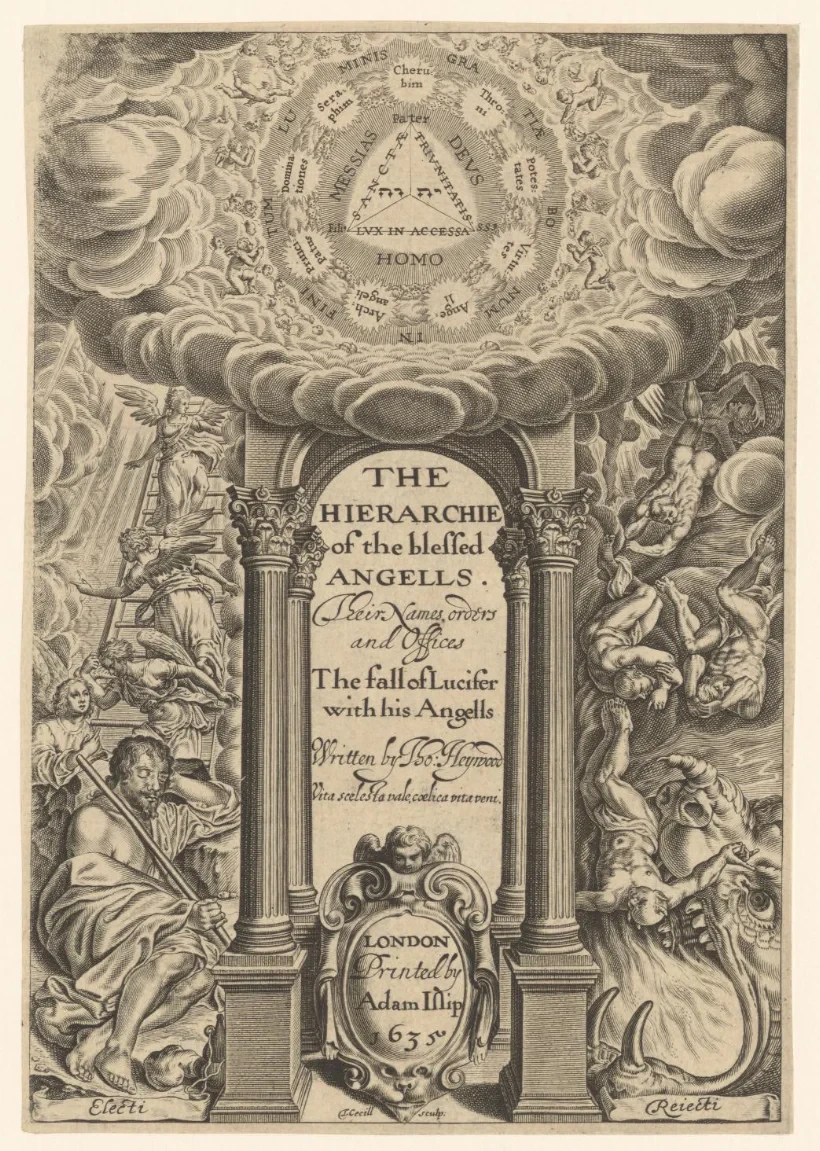
Thomas Cecill’s engraving for The Hierarchie of the Blessed Angells depicts ranks in a Christian setting, a distinct context for the comparisons made here.
Thomas Cecill, Angels on Jacob’s Ladder and the Fall of the Damned. Rijksmuseum. · Image source ↗ · Public Domain
See references (7)
- The Celestial Hierarchy, chapter VI: first, middle and last orders
- The Kingdom of the Gods, Reader page 52
- The Kingdom of the Gods, Reader page 55
- The Kingdom of the Gods, Reader page 61
- The Kingdom of the Gods, Reader page 62
- The Kingdom of the Gods, Reader page 129
- The Kingdom of the Gods, Reader page 130
The Science of the Sacraments by Charles W. Leadbeater
In The Science of the Sacraments, Charles W. Leadbeater gives the nine orders roles in the Eucharist. He says their representatives answer the Preface and a Directing Angel assigns some to carry help to the people named by the priest. [21][22][23][24][25][26][27]
Leadbeater also distinguishes those assigned to carry help from angels who watch and adore. The Angel of the Presence belongs to another part of his explanation. He calls that figure a thought-form of Christ, giving it a different origin and function from the orders that participate. [25][26][28][29]
See references (9)
- The Science of the Sacraments, Reader page 160
- The Science of the Sacraments, Reader page 161
- The Science of the Sacraments, Reader page 162
- The Science of the Sacraments, Reader page 163
- The Science of the Sacraments, Reader page 173
- The Science of the Sacraments, Reader page 174
- The Science of the Sacraments, Reader page 176
- The Science of the Sacraments, Reader page 201
- The Science of the Sacraments, Reader page 202
Orders of beings and degrees of heavenly life
Dante makes the nine choirs visible as circles moving around a single light. Swedenborg’s two kingdoms and three heavens describe how different communities receive divine good. The count serves a different purpose in each system. [2][3][6][8][9][10][11][12][16][17][18][19][20]
Hodson relates angelic work to the larger order to which a being belongs. Leadbeater asks who responds, directs or carries help during a rite. Both give the orders something to do, with the emphasis falling on nature in one book and a liturgy in the other. [2][3][8][9][23][24][25][26]
See references (17)
- Purgatory and Paradise, Paradise XXVIII, Reader page 341
- Purgatory and Paradise, Paradise XXVIII, Reader page 342
- Purgatory and Paradise, Paradise XXIX, Reader page 349
- Heaven and Its Wonders and Hell, printed p. 19, Reader page 26
- Heaven and Its Wonders and Hell, printed p. 20, Reader page 27
- Heaven and Its Wonders and Hell, printed p. 23, Reader page 30
- Heaven and Its Wonders and Hell, printed p. 24, Reader page 31
- Heaven and Its Wonders and Hell, printed p. 26, Reader page 33
- Heaven and Its Wonders and Hell, printed p. 149, Reader page 156
- Heaven and Its Wonders and Hell, printed p. 150, Reader page 157
- Heaven and Its Wonders and Hell, printed p. 151, Reader page 158
- Heaven and Its Wonders and Hell, printed p. 154, Reader page 161
- Heaven and Its Wonders and Hell, printed p. 156, Reader page 163
- The Science of the Sacraments, Reader page 162
- The Science of the Sacraments, Reader page 163
- The Science of the Sacraments, Reader page 173
- The Science of the Sacraments, Reader page 174
Read further in the library
Purgatory and Paradise: The Vision of Dante
Reading note
A separately attributed account in the consulted Cary translation, with exact current Library Reader leaves.

Heaven and Its Wonders and Hell
Reading note
Two kingdoms and three heavens provide a different arrangement from the nine Dionysian orders.
The Science of the Sacraments
Reading note
The separately titled account draws on exact passages in the consulted Library edition.
The Kingdom of the Gods
Reading note
The separately titled account draws on exact passages in the consulted Library edition.
Sources
See references (36)
- The Celestial Hierarchy, chapter VI: first, middle and last orders ↗Pseudo-Dionysius, The Celestial Hierarchy, English translation hosted by Christian Classics Ethereal Library. Chapter number read from the text heading; URL suffix vii is not the chapter number.Return to text ↑
- Purgatory and Paradise, Paradise XXVIII, Reader page 341Dante Alighieri, The Divine Comedy, translated by Henry Francis Cary. Inferno: undated New Edition, Thompson & Thomas, Chicago. Purgatory and Paradise: New Edition, Thompson & Thomas, Chicago, 1901. Designs by Gustave Doré.Read this page in Purgatory and Paradise: The Vision of Dante ↗Return to text ↑
- Purgatory and Paradise, Paradise XXVIII, Reader page 342Dante Alighieri, The Divine Comedy, translated by Henry Francis Cary. Inferno: undated New Edition, Thompson & Thomas, Chicago. Purgatory and Paradise: New Edition, Thompson & Thomas, Chicago, 1901. Designs by Gustave Doré.Read this page in Purgatory and Paradise: The Vision of Dante ↗Return to text ↑
- Purgatory and Paradise, Paradise XXVIII, Reader page 343Dante Alighieri, The Divine Comedy, translated by Henry Francis Cary. Inferno: undated New Edition, Thompson & Thomas, Chicago. Purgatory and Paradise: New Edition, Thompson & Thomas, Chicago, 1901. Designs by Gustave Doré.Read this page in Purgatory and Paradise: The Vision of Dante ↗Return to text ↑
- Purgatory and Paradise, Paradise XXVIII, Reader page 344Dante Alighieri, The Divine Comedy, translated by Henry Francis Cary. Inferno: undated New Edition, Thompson & Thomas, Chicago. Purgatory and Paradise: New Edition, Thompson & Thomas, Chicago, 1901. Designs by Gustave Doré.Read this page in Purgatory and Paradise: The Vision of Dante ↗Return to text ↑
- Purgatory and Paradise, Paradise XXIX, Reader page 349Dante Alighieri, The Divine Comedy, translated by Henry Francis Cary. Inferno: undated New Edition, Thompson & Thomas, Chicago. Purgatory and Paradise: New Edition, Thompson & Thomas, Chicago, 1901. Designs by Gustave Doré.Read this page in Purgatory and Paradise: The Vision of Dante ↗Return to text ↑
- Purgatory and Paradise, Paradise XXVIII, Reader page 143Dante Alighieri, The Divine Comedy, translated by Henry Francis Cary. Inferno: undated New Edition, Thompson & Thomas, Chicago. Purgatory and Paradise: New Edition, Thompson & Thomas, Chicago, 1901. Designs by Gustave Doré.Read this page in Purgatory and Paradise: The Vision of Dante ↗
- Heaven and Its Wonders and Hell, printed p. 19, Reader page 26Emanuel Swedenborg, Heaven and Its Wonders and Hell, translated by J. C. Ager. The American Swedenborg Printing and Publishing Society, New York, 1916. Original Latin work first published in 1758.Read this page in Heaven and Its Wonders and Hell ↗Return to text ↑
- Heaven and Its Wonders and Hell, printed p. 20, Reader page 27Emanuel Swedenborg, Heaven and Its Wonders and Hell, translated by J. C. Ager. The American Swedenborg Printing and Publishing Society, New York, 1916. Original Latin work first published in 1758.Read this page in Heaven and Its Wonders and Hell ↗Return to text ↑
- Heaven and Its Wonders and Hell, printed p. 23, Reader page 30Emanuel Swedenborg, Heaven and Its Wonders and Hell, translated by J. C. Ager. The American Swedenborg Printing and Publishing Society, New York, 1916. Original Latin work first published in 1758.Read this page in Heaven and Its Wonders and Hell ↗Return to text ↑
- Heaven and Its Wonders and Hell, printed p. 24, Reader page 31Emanuel Swedenborg, Heaven and Its Wonders and Hell, translated by J. C. Ager. The American Swedenborg Printing and Publishing Society, New York, 1916. Original Latin work first published in 1758.Read this page in Heaven and Its Wonders and Hell ↗Return to text ↑
- Heaven and Its Wonders and Hell, printed p. 26, Reader page 33Emanuel Swedenborg, Heaven and Its Wonders and Hell, translated by J. C. Ager. The American Swedenborg Printing and Publishing Society, New York, 1916. Original Latin work first published in 1758.Read this page in Heaven and Its Wonders and Hell ↗Return to text ↑
- Heaven and Its Wonders and Hell, printed p. 28, Reader page 35Emanuel Swedenborg, Heaven and Its Wonders and Hell, translated by J. C. Ager. The American Swedenborg Printing and Publishing Society, New York, 1916. Original Latin work first published in 1758.Read this page in Heaven and Its Wonders and Hell ↗Return to text ↑
- Heaven and Its Wonders and Hell, printed p. 29, Reader page 36Emanuel Swedenborg, Heaven and Its Wonders and Hell, translated by J. C. Ager. The American Swedenborg Printing and Publishing Society, New York, 1916. Original Latin work first published in 1758.Read this page in Heaven and Its Wonders and Hell ↗Return to text ↑
- Heaven and Its Wonders and Hell, printed p. 30, Reader page 37Emanuel Swedenborg, Heaven and Its Wonders and Hell, translated by J. C. Ager. The American Swedenborg Printing and Publishing Society, New York, 1916. Original Latin work first published in 1758.Read this page in Heaven and Its Wonders and Hell ↗Return to text ↑
- Heaven and Its Wonders and Hell, printed p. 149, Reader page 156Emanuel Swedenborg, Heaven and Its Wonders and Hell, translated by J. C. Ager. The American Swedenborg Printing and Publishing Society, New York, 1916. Original Latin work first published in 1758.Read this page in Heaven and Its Wonders and Hell ↗Return to text ↑
- Heaven and Its Wonders and Hell, printed p. 150, Reader page 157Emanuel Swedenborg, Heaven and Its Wonders and Hell, translated by J. C. Ager. The American Swedenborg Printing and Publishing Society, New York, 1916. Original Latin work first published in 1758.Read this page in Heaven and Its Wonders and Hell ↗Return to text ↑
- Heaven and Its Wonders and Hell, printed p. 151, Reader page 158Emanuel Swedenborg, Heaven and Its Wonders and Hell, translated by J. C. Ager. The American Swedenborg Printing and Publishing Society, New York, 1916. Original Latin work first published in 1758.Read this page in Heaven and Its Wonders and Hell ↗Return to text ↑
- Heaven and Its Wonders and Hell, printed p. 154, Reader page 161Emanuel Swedenborg, Heaven and Its Wonders and Hell, translated by J. C. Ager. The American Swedenborg Printing and Publishing Society, New York, 1916. Original Latin work first published in 1758.Read this page in Heaven and Its Wonders and Hell ↗Return to text ↑
- Heaven and Its Wonders and Hell, printed p. 156, Reader page 163Emanuel Swedenborg, Heaven and Its Wonders and Hell, translated by J. C. Ager. The American Swedenborg Printing and Publishing Society, New York, 1916. Original Latin work first published in 1758.Read this page in Heaven and Its Wonders and Hell ↗Return to text ↑
- The Science of the Sacraments, Reader page 160Charles W. Leadbeater, The Science of the Sacraments, The St. Alban Press, 1920. Exact Library edition IMJ-0615-E001.Read this page in The Science of the Sacraments ↗Return to text ↑
- The Science of the Sacraments, Reader page 161Charles W. Leadbeater, The Science of the Sacraments, The St. Alban Press, 1920. Exact Library edition IMJ-0615-E001.Read this page in The Science of the Sacraments ↗Return to text ↑
- The Science of the Sacraments, Reader page 162Charles W. Leadbeater, The Science of the Sacraments, The St. Alban Press, 1920. Exact Library edition IMJ-0615-E001.Read this page in The Science of the Sacraments ↗Return to text ↑
- The Science of the Sacraments, Reader page 163Charles W. Leadbeater, The Science of the Sacraments, The St. Alban Press, 1920. Exact Library edition IMJ-0615-E001.Read this page in The Science of the Sacraments ↗Return to text ↑
- The Science of the Sacraments, Reader page 173Charles W. Leadbeater, The Science of the Sacraments, The St. Alban Press, 1920. Exact Library edition IMJ-0615-E001.Read this page in The Science of the Sacraments ↗Return to text ↑
- The Science of the Sacraments, Reader page 174Charles W. Leadbeater, The Science of the Sacraments, The St. Alban Press, 1920. Exact Library edition IMJ-0615-E001.Read this page in The Science of the Sacraments ↗Return to text ↑
- The Science of the Sacraments, Reader page 176Charles W. Leadbeater, The Science of the Sacraments, The St. Alban Press, 1920. Exact Library edition IMJ-0615-E001.Read this page in The Science of the Sacraments ↗Return to text ↑
- The Science of the Sacraments, Reader page 201Charles W. Leadbeater, The Science of the Sacraments, The St. Alban Press, 1920. Exact Library edition IMJ-0615-E001.Read this page in The Science of the Sacraments ↗Return to text ↑
- The Science of the Sacraments, Reader page 202Charles W. Leadbeater, The Science of the Sacraments, The St. Alban Press, 1920. Exact Library edition IMJ-0615-E001.Read this page in The Science of the Sacraments ↗Return to text ↑
- Thomas Cecill, Angels on Jacob’s Ladder and the Fall of the Damned ↗Thomas Cecill, Angels on Jacob’s Ladder and the Fall of the Damned. Rijksmuseum.
- The Kingdom of the Gods, Reader page 52Geoffrey Hodson, The Kingdom of the Gods, Theosophical Publishing House, first published 1952, thirteenth reprint 2007. Lumitheca Library edition IMJ-0606-E001.Read this page in The Kingdom of the Gods ↗Return to text ↑
- The Kingdom of the Gods, Reader page 55Geoffrey Hodson, The Kingdom of the Gods, Theosophical Publishing House, first published 1952, thirteenth reprint 2007. Lumitheca Library edition IMJ-0606-E001.Read this page in The Kingdom of the Gods ↗Return to text ↑
- The Kingdom of the Gods, Reader page 61Geoffrey Hodson, The Kingdom of the Gods, Theosophical Publishing House, first published 1952, thirteenth reprint 2007. Lumitheca Library edition IMJ-0606-E001.Read this page in The Kingdom of the Gods ↗Return to text ↑
- The Kingdom of the Gods, Reader page 62Geoffrey Hodson, The Kingdom of the Gods, Theosophical Publishing House, first published 1952, thirteenth reprint 2007. Lumitheca Library edition IMJ-0606-E001.Read this page in The Kingdom of the Gods ↗Return to text ↑
- The Kingdom of the Gods, Reader page 129Geoffrey Hodson, The Kingdom of the Gods, Theosophical Publishing House, first published 1952, thirteenth reprint 2007. Lumitheca Library edition IMJ-0606-E001.Read this page in The Kingdom of the Gods ↗Return to text ↑
- The Kingdom of the Gods, Reader page 130Geoffrey Hodson, The Kingdom of the Gods, Theosophical Publishing House, first published 1952, thirteenth reprint 2007. Lumitheca Library edition IMJ-0606-E001.Read this page in The Kingdom of the Gods ↗Return to text ↑