Eucharist
What is the Eucharist? Explore bread and wine in Christian worship, how traditions understand Christ’s presence, and C. W. Leadbeater’s Liberal Catholic account.
In this article
What is the Eucharist?
The Eucharist is a Christian rite of thanksgiving and communion rooted in Jesus’s Last Supper. Bread and wine are offered, blessed or consecrated, and receiving the elements is called Communion. Depending on the church, the service may be called the Lord’s Supper, the Mass or the Divine Liturgy. [1][2][3]
Christian churches explain Christ’s presence in different ways. The Roman Catholic Catechism calls the change of substance transubstantiation. The Orthodox Church in America teaches that bread and wine become Christ’s body and blood in a mystery. The Church of England’s Article XXVIII rejects transubstantiation and speaks of receiving Christ spiritually through faith. [1][2][3]
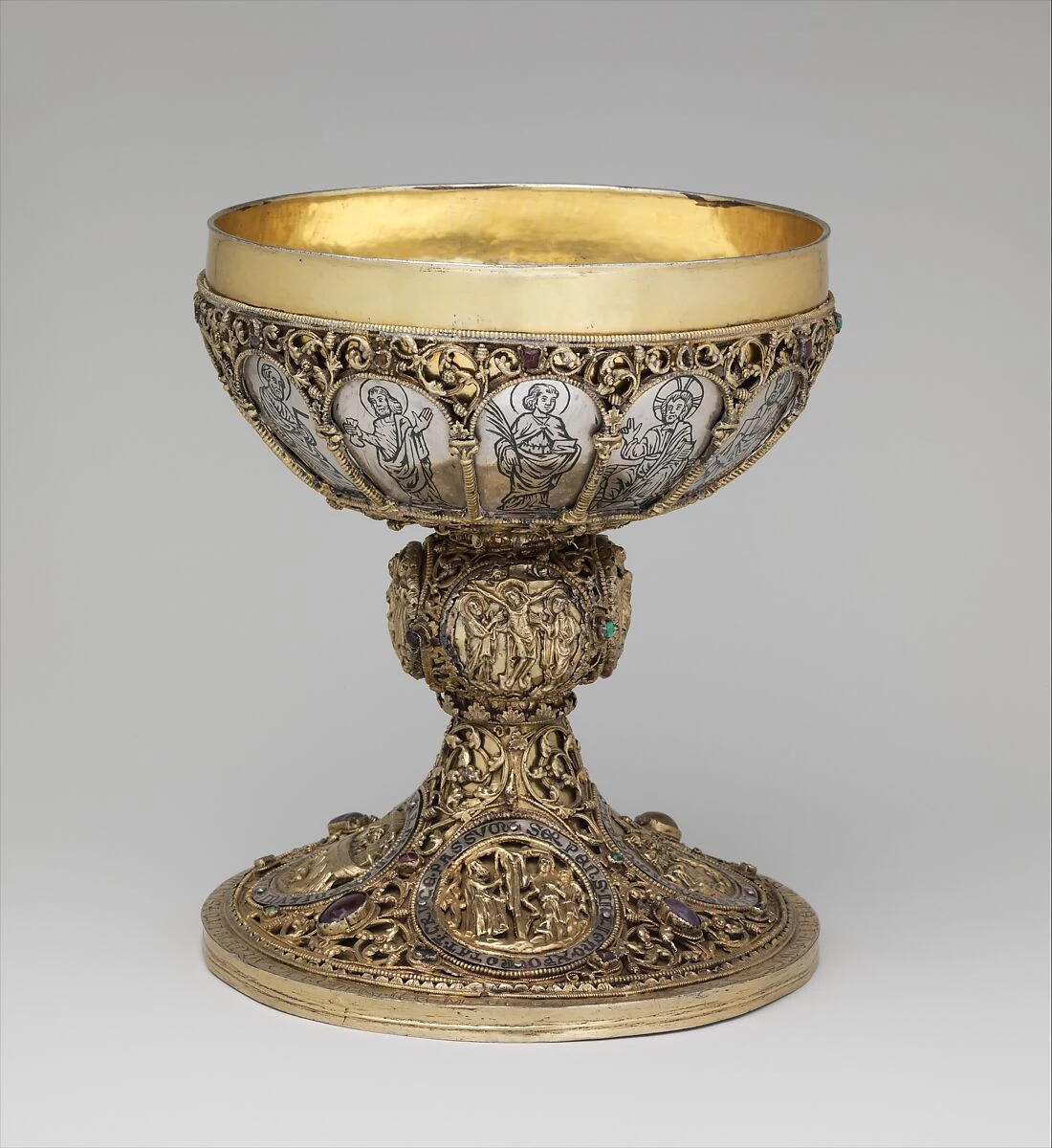
A chalice from the Saint Trudpert ensemble, made around 1230–50. The chalice holds the wine at the Eucharist.
The Metropolitan Museum of Art, The Cloisters Collection, 47.101.26. Public domain image. · Image source ↗ · Public Domain
The Science of the Sacraments by Charles W. Leadbeater
Charles W. Leadbeater says Communion gives the recipient a share in Christ’s life. In his Liberal Catholic account, the service also gathers and distributes a spiritual influence to the neighbourhood. He asks the congregation to help carry out the work of the service. [5][6][7][8][9]
The celebrant’s actions, the congregation’s devotion and the music help form what Leadbeater calls a Eucharistic thought-edifice. He describes it as a structure in subtle planes. After Communion, he says, the person receiving it briefly becomes another centre from which the influence spreads. [10][8][9][11]
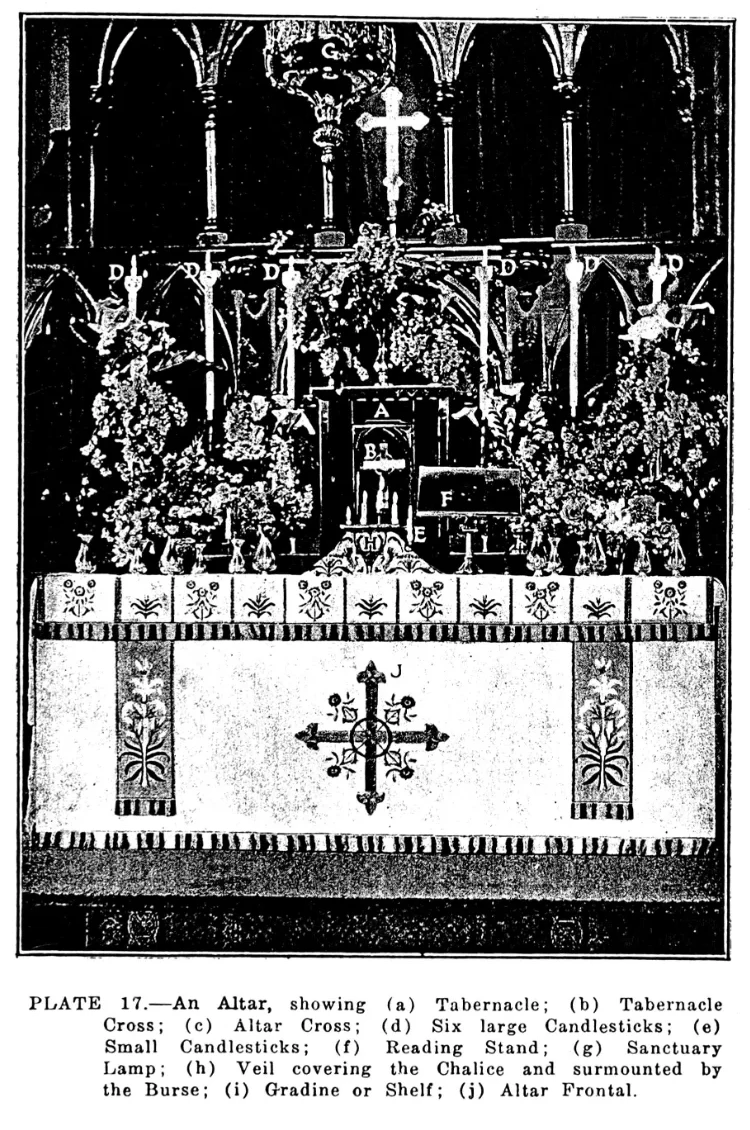
Plate 17, facing printed page 408. Labels identify the tabernacle, candles, reading stand, vessels and altar frontal.
The Science of the Sacraments by Charles W. Leadbeater, The St. Alban Press, 1920. Library facsimile. · Image source ↗ · Public Domain
See references (7)
- The Science of the Sacraments, Reader page 11
- The Science of the Sacraments, printed p. 16, Reader page 14
- The Science of the Sacraments, printed p. 17, Reader page 15
- The Science of the Sacraments, printed p. 235, Reader page 247
- The Science of the Sacraments, printed p. 236, Reader page 248
- The Science of the Sacraments, printed p. 22, Reader page 20
- The Science of the Sacraments, printed p. 237, Reader page 249
Man the Grand Symbol of the Mysteries by Manly P. Hall
Manly P. Hall looks at the Eucharist in a chapter on blood symbolism. He draws on Godfrey Higgins, who puts wine, the blood of Bacchus and accounts of sacramental bread side by side. Hall treats the resemblance as a clue to a shared origin. This is his proposed historical connection. [12][13][14]
Hall also returns to the distribution of Christ’s body and blood to the faithful. Sharing the contents of the vessel gives him an image of a community participating in one life. [15][16]
See references (5)
- Man the Grand Symbol of the Mysteries, Reader page 252
- Man the Grand Symbol of the Mysteries, printed p. 258, Reader page 253
- Man the Grand Symbol of the Mysteries, printed p. 259, Reader page 254
- Man the Grand Symbol of the Mysteries, printed p. 271, Reader page 266
- Man the Grand Symbol of the Mysteries, printed p. 272, Reader page 267
What the rite does and where its symbols come from
The Catholic Catechism links the Eucharist to the memorial of Christ’s sacrifice and to his sacramental presence. Leadbeater traces the influence he believes worship sends out from the church. Hall uses the rite to ask a historical question about bread and wine as symbols. [1][5][8][9][13][16]
See references (6)
- Catechism of the Catholic Church, §§1356–1381
- The Science of the Sacraments, Reader page 11
- The Science of the Sacraments, printed p. 235, Reader page 247
- The Science of the Sacraments, printed p. 236, Reader page 248
- Man the Grand Symbol of the Mysteries, printed p. 258, Reader page 253
- Man the Grand Symbol of the Mysteries, printed p. 272, Reader page 267
In the library
The Science of the Sacraments
Reading note
The separately titled account draws on exact passages in the consulted Library edition.
Man the Grand Symbol of the Mysteries
Reading note
The separately titled account draws on exact passages in the consulted Library edition.
Sources
See references (17)
- Catechism of the Catholic Church, §§1356–1381 ↗Holy See, Catechism of the Catholic Church, English edition.
- Articles of Religion, Articles XXV and XXVIII ↗Church of England, Book of Common Prayer.
- The Orthodox Faith, Holy Eucharist ↗Orthodox Church in America, The Orthodox Faith, vol. II.
- Chalice from the Saint Trudpert ensemble, ca. 1230–50 ↗The Metropolitan Museum of Art, The Cloisters Collection, 47.101.26. Public domain image.
- The Science of the Sacraments, Reader page 11Charles W. Leadbeater, The Science of the Sacraments, The St. Alban Press, 1920. Exact Library edition IMJ-0615-E001.Read this page in The Science of the Sacraments ↗
- The Science of the Sacraments, printed p. 16, Reader page 14Charles W. Leadbeater, The Science of the Sacraments, The St. Alban Press, 1920. Exact Library edition IMJ-0615-E001.Read this page in The Science of the Sacraments ↗
- The Science of the Sacraments, printed p. 17, Reader page 15Charles W. Leadbeater, The Science of the Sacraments, The St. Alban Press, 1920. Exact Library edition IMJ-0615-E001.Read this page in The Science of the Sacraments ↗
- The Science of the Sacraments, printed p. 235, Reader page 247Charles W. Leadbeater, The Science of the Sacraments, The St. Alban Press, 1920. Exact Library edition IMJ-0615-E001.Read this page in The Science of the Sacraments ↗
- The Science of the Sacraments, printed p. 236, Reader page 248Charles W. Leadbeater, The Science of the Sacraments, The St. Alban Press, 1920. Exact Library edition IMJ-0615-E001.Read this page in The Science of the Sacraments ↗
- The Science of the Sacraments, printed p. 22, Reader page 20Charles W. Leadbeater, The Science of the Sacraments, The St. Alban Press, 1920. Exact Library edition IMJ-0615-E001.Read this page in The Science of the Sacraments ↗
- The Science of the Sacraments, printed p. 237, Reader page 249Charles W. Leadbeater, The Science of the Sacraments, The St. Alban Press, 1920. Exact Library edition IMJ-0615-E001.Read this page in The Science of the Sacraments ↗
- Man the Grand Symbol of the Mysteries, Reader page 252Manly P. Hall, Man the Grand Symbol of the Mysteries, Fourth Edition, The Philosophers Press, Los Angeles, 1937. Lumitheca Library edition IMJ-0603-E001.Read this page in Man the Grand Symbol of the Mysteries ↗
- Man the Grand Symbol of the Mysteries, printed p. 258, Reader page 253Manly P. Hall, Man the Grand Symbol of the Mysteries, Fourth Edition, The Philosophers Press, Los Angeles, 1937. Lumitheca Library edition IMJ-0603-E001.Read this page in Man the Grand Symbol of the Mysteries ↗
- Man the Grand Symbol of the Mysteries, printed p. 259, Reader page 254Manly P. Hall, Man the Grand Symbol of the Mysteries, Fourth Edition, The Philosophers Press, Los Angeles, 1937. Lumitheca Library edition IMJ-0603-E001.Read this page in Man the Grand Symbol of the Mysteries ↗
- Man the Grand Symbol of the Mysteries, printed p. 271, Reader page 266Manly P. Hall, Man the Grand Symbol of the Mysteries, Fourth Edition, The Philosophers Press, Los Angeles, 1937. Lumitheca Library edition IMJ-0603-E001.Read this page in Man the Grand Symbol of the Mysteries ↗
- Man the Grand Symbol of the Mysteries, printed p. 272, Reader page 267Manly P. Hall, Man the Grand Symbol of the Mysteries, Fourth Edition, The Philosophers Press, Los Angeles, 1937. Lumitheca Library edition IMJ-0603-E001.Read this page in Man the Grand Symbol of the Mysteries ↗
- The Science of the Sacraments, Reader page 422Charles W. Leadbeater, The Science of the Sacraments, The St. Alban Press, 1920. Exact Library edition IMJ-0615-E001.Read this page in The Science of the Sacraments ↗